
GLUTARAL
Glutaraldehyde (Pentane-1,5-dial)
GLUTARAL appears in Annex V as a positive-list preservative entry for EU cosmetics. Maximum concentration in this record: 0.1%.
Chemical identity and properties
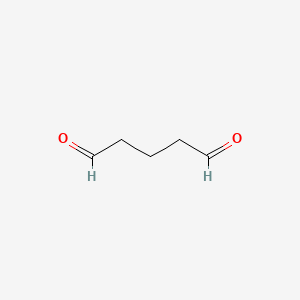
Glutaraldehyde
Glutaraldehyde is a dialdehyde comprised of pentane with aldehyde functions at C-1 and C-5. It has a role as a disinfectant, a cross-linking reagent and a fixative. — ChEBI
- IUPAC name
- pentanedial
- Molecular formula
- C5H8O2
- Molecular weight
- 100.12 g/mol
- Exact mass
- 100.052429494 Da
- XLogP3
- -0.5
- Topological polar surface area
- 34.1 Ų
- Hydrogen-bond donors
- 0
- Hydrogen-bond acceptors
- 2
- Covalent units
- 1
- Defined stereocentres
- 0
Also known as
16 more reported names
External database identifiers
- ChEBI:CHEBI:64276
- ChEMBL:CHEMBL1235482
- EPA DTXSID:DTXSID6025355
- PubMed:38360295
- PubMed:28236482
- PubMed:26795242
- PubMed:23124339
- PubMed:23110191
- PubMed:23109864
- PubMed:23109856
- PubMed:23109832
- PubMed:23108619
- PubMed:23108618
- PubMed:23084681
- PubMed:23066289
Evidence from additional scientific databases
NIH PubChem PUG-View
Attributed physical-property, hazard, environmental and use annotations.
- Autoignition Temperature: 225 °C Source: Hazardous Substances Data Bank (HSDB)
- Boiling Point: 369 to 372 °F at 760 mmHg (decomposes) (NTP, 1992) Source: CAMEO Chemicals
- Boiling Point: 187-189 °C (decomposes) Source: Hazardous Substances Data Bank (HSDB)
- Boiling Point: Boiling point: 106-108 °C at 50 mm Hg, 71-72 °C at 10 mm Hg Source: Hazardous Substances Data Bank (HSDB)
- Boiling Point: 188.00 °C. @ 760.00 mm Hg Source: Human Metabolome Database (HMDB)
- Boiling Point: 101 °C Source: ILO-WHO International Chemical Safety Cards (ICSCs)
- Boiling Point: 369-372 ° Source: Occupational Safety and Health Administration (OSHA)
- Boiling Point: 212 °F Source: The National Institute for Occupational Safety and Health (NIOSH)
- Color/Form: Colorless liquid Source: Hazardous Substances Data Bank (HSDB)
- Color/Form: Oil Source: Hazardous Substances Data Bank (HSDB)
- Density: 1.062 to 1.124 at 68 °F (USCG, 1999) Source: CAMEO Chemicals
- Density: 0.72 Source: Hazardous Substances Data Bank (HSDB)
- Density: Relative density (water = 1): 0.7 Source: ILO-WHO International Chemical Safety Cards (ICSCs)
- Density: 1.33 g/cm³ Source: ILO-WHO International Chemical Safety Cards (ICSCs)
- Density: 1.10 Source: Occupational Safety and Health Administration (OSHA)
- Density: 0.72 @25 °C Source: PAC Chemical Database, U.S. Department of Energy
- Density: 1.10 Source: The National Institute for Occupational Safety and Health (NIOSH)
- Flash Point: >95 °C c.c. Source: ILO-WHO International Chemical Safety Cards (ICSCs)
- LogP: log Kow = -0.33 Source: Hazardous Substances Data Bank (HSDB)
- LogP: -0.22 Source: ILO-WHO International Chemical Safety Cards (ICSCs)
- Melting Point: less than 20 °F (USCG, 1999) Source: CAMEO Chemicals
- Melting Point: Freezing point: -14 °C Source: Hazardous Substances Data Bank (HSDB)
- Melting Point: -14 °C Source: Human Metabolome Database (HMDB)
- Melting Point: -14 °C Source: ILO-WHO International Chemical Safety Cards (ICSCs)
- Melting Point: -33 °C Source: ILO-WHO International Chemical Safety Cards (ICSCs)
- Melting Point: 7 °F Source: Occupational Safety and Health Administration (OSHA)
- Melting Point: -14 °C Source: PAC Chemical Database, U.S. Department of Energy
- Melting Point: 7 °F Source: The National Institute for Occupational Safety and Health (NIOSH)
- Odor: Pungent odor Source: Hazardous Substances Data Bank (HSDB)
- Odor: Sweetish Source: Hazardous Substances Data Bank (HSDB)
- Physical Description: Glutaraldehyde solution is a light yellow liquid. Mixes with water. (USCG, 1999) Source: CAMEO Chemicals
- Physical Description: Dry Powder; Liquid Source: EPA Chemical Data Reporting (CDR)
- Physical Description: Colorless liquid with a pungent odor; [NIOSH] Clear, viscous colorless liquid; [ICSC] Light yellow liquid; [CAMEO] Colorless or light yellow liquid with a sharp pungent odor; Commercially available in aqueous solutions ranging from 2-50%; [Reference #1] Source: Haz-Map, Information on Hazardous Chemicals and Occupational Diseases
- Physical Description: Liquid Source: Human Metabolome Database (HMDB)
- Physical Description: CLEAR VISCOUS COLOURLESS LIQUID WITH PUNGENT ODOUR. Source: ILO-WHO International Chemical Safety Cards (ICSCs)
- Physical Description: CLEAR COLOURLESS LIQUID WITH PUNGENT ODOUR. Source: ILO-WHO International Chemical Safety Cards (ICSCs)
- Physical Description: Colorless liquid with a pungent odor. Source: Occupational Safety and Health Administration (OSHA)
- Physical Description: Colorless liquid with a pungent odor. Source: The National Institute for Occupational Safety and Health (NIOSH)
- Refractive Index: Index of refraction: 1.433 at 25 °C Source: Hazardous Substances Data Bank (HSDB)
- Solubility: greater than or equal to 100 mg/mL at 72 °F (NTP, 1992) Source: CAMEO Chemicals
- Solubility: Miscible with water Source: Hazardous Substances Data Bank (HSDB)
- Solubility: Soluble in ethanol, benzene, ether Source: Hazardous Substances Data Bank (HSDB)
- Solubility: Miscible with ethanol Source: Hazardous Substances Data Bank (HSDB)
- Solubility: Solubility in water: miscible Source: ILO-WHO International Chemical Safety Cards (ICSCs)
- Solubility: Miscible Source: The National Institute for Occupational Safety and Health (NIOSH)
- Vapor Pressure: 17 mmHg at 68 °F (NTP, 1992) Source: CAMEO Chemicals
- Vapor Pressure: 0.6 [mmHg] Source: Haz-Map, Information on Hazardous Chemicals and Occupational Diseases
- Vapor Pressure: Vapor pressure (20 °C): 0.0152 torr (50% aqueous solution); 0.0012 torr (2% aqueous solution) Source: Hazardous Substances Data Bank (HSDB)
- Vapor Pressure: 0.6 mm Hg at 30 °C Source: Hazardous Substances Data Bank (HSDB)
- Vapor Pressure: Vapor pressure, kPa at 20 °C: 2.3 Source: ILO-WHO International Chemical Safety Cards (ICSCs)
- Vapor Pressure: 17 mmHg Source: Occupational Safety and Health Administration (OSHA)
- Vapor Pressure: 0.6 [mm Hg] @30 °C Source: PAC Chemical Database, U.S. Department of Energy
- Vapor Pressure: 17 mmHg Source: The National Institute for Occupational Safety and Health (NIOSH)
- Viscosity: 12.75 mm²/s at 25 °C Source: ILO-WHO International Chemical Safety Cards (ICSCs)
- pH: Mildly acidic (50% solution) Source: Hazardous Substances Data Bank (HSDB)
- Substance: Glutaraldehyde Source: NTP Technical Reports
- NTP Technical Report: TR-490: Toxicology and Carcinogenesis Studies of Glutaraldehyde (CASRN 111-30-8) in F344/N Rats and B6C3F1 Mice (Inhalation Studies) (1999 ) Source: NTP Technical Reports
- Peer Review Date: 10/30/98 Source: NTP Technical Reports
- Conclusion for Male Rat: No Evidence Source: NTP Technical Reports
- Conclusion for Female Rat: No Evidence Source: NTP Technical Reports
- Conclusion for Male Mice: No Evidence Source: NTP Technical Reports
- Conclusion for Female Mice: No Evidence Source: NTP Technical Reports
- Summary: Under the conditions of these 2-year inhalation studies, there was no evidence of carcinogenic activity of glutaraldehyde in male or female F344/N rats exposed to 250, 500, or 750 ppb. There was no evidence of carcinogenic activity in male or female B6C3F1 mice exposed to 62.5, 125, or 250 ppb.; Incidences of nonneoplastic lesions of the nose were significantly increased in male and female rats and mice. Source: NTP Technical Reports
- Carcinogen Classification: No indication of carcinogenicity to humans (not listed by IARC). Source: Toxin and Toxin Target Database (T3DB)
- Exposure Routes: The substance can be absorbed into the body by inhalation of its vapour, through the skin and by ingestion. Source: ILO-WHO International Chemical Safety Cards (ICSCs)
- Exposure Routes: inhalation, skin absorption, ingestion, skin and/or eye contact Source: The National Institute for Occupational Safety and Health (NIOSH)
- First Aid: EYES: First check the victim for contact lenses and remove if present. Flush victim's eyes with water or normal saline solution for 20 to 30 minutes while simultaneously calling a hospital or poison control center. Do not put any ointments, oils, or medication in the victim's eyes without specific instructions from a physician. IMMEDIATELY transport the victim after flushing eyes to a hospital even if no symptoms (such as redness or irritation) develop.; SKIN: IMMEDIATELY flood affected skin with water while removing and isolating all contaminated clothing. Gently wash all affected skin areas thoroughly with soap and water. If symptoms such as redness or irritation develop, IMMEDIATELY call a physician and be prepared to transport the victim to a hospital for treatment.; INHALATION: IMMEDIATELY leave the contaminated area; take deep breaths of fresh air. If symptoms (such as wheezing, coughing, shortness of breath, or burning in the mouth, throat, or chest) develop, call a physician and be prepared to transport the victim to a hospital. Provide proper respiratory protection to rescuers entering an unknown atmosphere. Whenever possible, Self-Contained Breathing Apparatus (SCBA) shou Source: CAMEO Chemicals
- First Aid: (General first aid procedures); Eye: Irrigate immediately - If this chemical contacts the eyes, immediately wash (irrigate) the eyes with large amounts of water, occasionally lifting the lower and upper lids. Get medical attention immediately.; Skin: Water flush immediately - If this chemical contacts the skin, immediately flush the contaminated skin with water. If this chemical penetrates the clothing, immediately remove the clothing and flush the skin with water. Get medical attention promptly.; Breathing: Respiratory support; Swallow: Medical attention immediately - If this chemical has been swallowed, get medical attention immediately. Source: The National Institute for Occupational Safety and Health (NIOSH)
- Signal: Danger Source: Regulation (EC) No 1272/2008 of the European Parliament and of the Council
- GHS Hazard Statements: H301: Toxic if swallowed [Danger Acute toxicity, oral]; H314: Causes severe skin burns and eye damage [Danger Skin corrosion/irritation]; H317: May cause an allergic skin reaction [Warning Sensitization, Skin]; H330: Fatal if inhaled [Danger Acute toxicity, inhalation]; H334: May cause allergy or asthma symptoms or breathing difficulties if inhaled [Danger Sensitization, respiratory]; H335: May cause respiratory irritation [Warning Specific target organ toxicity, single exposure; Respiratory tract irritation]; H400: Very toxic to aquatic life [Warning Hazardous to the aquatic environment, acute hazard]; H411: Toxic to aquatic life with long lasting effects [Hazardous to the aquatic environment, long-term hazard] Source: Regulation (EC) No 1272/2008 of the European Parliament and of the Council
- Precautionary Statement Codes: P233, P260, P261, P264, P270, P271, P272, P273, P280, P284, P301+P316, P301+P330+P331, P302+P352, P302+P361+P354, P304+P340, P305+P354+P338, P316, P319, P320, P321, P330, P333+P317, P342+P316, P362+P364, P363, P391, P403, P403+P233, P405, and P501 (click each P-code to see the statement) Source: Regulation (EC) No 1272/2008 of the European Parliament and of the Council
- Note: This chemical does not meet GHS hazard criteria for < 0.1% (1 of 2123) of reports. Source: European Chemicals Agency (ECHA)
- Signal: Danger Source: European Chemicals Agency (ECHA)
- GHS Hazard Statements: H301 (> 99.9%): Toxic if swallowed [Danger Acute toxicity, oral]; H314 (> 99.9%): Causes severe skin burns and eye damage [Danger Skin corrosion/irritation]; H317 (> 99.9%): May cause an allergic skin reaction [Warning Sensitization, Skin]; H318 (18.7%): Causes serious eye damage [Danger Serious eye damage/eye irritation]; H330 (20.1%): Fatal if inhaled [Danger Acute toxicity, inhalation]; H331 (82.6%): Toxic if inhaled [Danger Acute toxicity, inhalation]; H334 (> 99.9%): May cause allergy or asthma symptoms or breathing difficulties if inhaled [Danger Sensitization, respiratory]; H335 (19%): May cause respiratory irritation [Warning Specific target organ toxicity, single exposure; Respiratory tract irritation]; H400 (99.9%): Very toxic to aquatic life [Warning Hazardous to the aquatic environment, acute hazard]; H411 (16.1%): Toxic to aquatic life with long lasting effects [Hazardous to the aquatic environment, long-term hazard] Source: European Chemicals Agency (ECHA)
- Precautionary Statement Codes: P233, P260, P261, P264, P264+P265, P270, P271, P272, P273, P280, P284, P301+P316, P301+P330+P331, P302+P352, P302+P361+P354, P304+P340, P305+P354+P338, P316, P317, P319, P320, P321, P330, P333+P317, P342+P316, P362+P364, P363, P391, P403, P403+P233, P405, and P501 (click each P-code to see the statement) Source: European Chemicals Agency (ECHA)
- ECHA C&L Notifications Summary: Aggregated GHS information provided per 2123 reports by companies from 44 notifications to the ECHA C&L Inventory. Each notification may be associated with multiple companies.; Reported as not meeting GHS hazard criteria per 1 of 2123 reports by companies.; There are 43 notifications provided by 2122 of 2123 reports by companies with hazard statement code(s).; Information may vary between notifications depending on impurities, additives, and other factors. The percentage value in parenthesis indicates the notified classification ratio from companies that provide hazard codes. Only hazard codes with percentage values above 10% are shown. For more detailed information, please visit ECHA C&L website. Source: European Chemicals Agency (ECHA)
- Signal: Danger Source: NITE-CMC
- GHS Hazard Statements: H227: Combustible liquid [Warning Flammable liquids]; H301: Toxic if swallowed [Danger Acute toxicity, oral]; H311: Toxic in contact with skin [Danger Acute toxicity, dermal]; H314: Causes severe skin burns and eye damage [Danger Skin corrosion/irritation]; H317: May cause an allergic skin reaction [Warning Sensitization, Skin]; H318: Causes serious eye damage [Danger Serious eye damage/eye irritation]; H330: Fatal if inhaled [Danger Acute toxicity, inhalation]; H334: May cause allergy or asthma symptoms or breathing difficulties if inhaled [Danger Sensitization, respiratory]; H370: Causes damage to organs [Danger Specific target organ toxicity, single exposure]; H372: Causes damage to organs through prolonged or repeated exposure [Danger Specific target organ toxicity, repeated exposure]; H400: Very toxic to aquatic life [Warning Hazardous to the aquatic environment, acute hazard]; H411: Toxic to aquatic life with long lasting effects [Hazardous to the aquatic environment, long-term hazard] Source: NITE-CMC
- Precautionary Statement Codes: P210, P233, P260, P261, P262, P264, P264+P265, P270, P271, P272, P273, P280, P284, P301+P316, P301+P330+P331, P302+P352, P302+P361+P354, P304+P340, P305+P354+P338, P308+P316, P316, P317, P319, P320, P321, P330, P333+P317, P342+P316, P361+P364, P362+P364, P363, P370+P378, P391, P403, P403+P233, P405, and P501 (click each P-code to see the statement) Source: NITE-CMC
- GHS Hazard Statements: H227: Combustible liquid [Warning Flammable liquids]; H301: Toxic if swallowed [Danger Acute toxicity, oral]; H312: Harmful in contact with skin [Warning Acute toxicity, dermal]; H314: Causes severe skin burns and eye damage [Danger Skin corrosion/irritation]; H317: May cause an allergic skin reaction [Warning Sensitization, Skin]; H318: Causes serious eye damage [Danger Serious eye damage/eye irritation]; H330: Fatal if inhaled [Danger Acute toxicity, inhalation]; H334: May cause allergy or asthma symptoms or breathing difficulties if inhaled [Danger Sensitization, respiratory]; H335: May cause respiratory irritation [Warning Specific target organ toxicity, single exposure; Respiratory tract irritation]; H370: Causes damage to organs [Danger Specific target organ toxicity, single exposure]; H372: Causes damage to organs through prolonged or repeated exposure [Danger Specific target organ toxicity, repeated exposure] Source: NITE-CMC
- NFPA Health Rating: 3 - Materials that, under emergency conditions, can cause serious or permanent injury. Source: Hazardous Substances Data Bank (HSDB)
- NFPA Fire Rating: 0 - Materials that will not burn under typical fire conditions, including intrinsically noncombustible materials such as concrete, stone, and sand. Source: Hazardous Substances Data Bank (HSDB)
- NFPA Instability Rating: 0 - Materials that in themselves are normally stable, even under fire conditions. Source: Hazardous Substances Data Bank (HSDB)
- Target Organs: Dermal (Skin), Gastrointestinal (Stomach and Intestines, part of the digestive system), Ocular (Eyes), Renal (Urinary System or Kidneys), Respiratory (From the Nose to the Lungs) Source: Agency for Toxic Substances and Disease Registry (ATSDR)
- Target Organs: Eyes, skin, respiratory system Source: The National Institute for Occupational Safety and Health (NIOSH)
- Cosmetic Ingredient Review Conclusion: Based upon the animal and clinical data presented in this report, the CIR Expert Panel concludes that Glutaral is safe for use at concentrations up to 0.5% in rinse-off products. There is insufficient data to determine the safety of Glutaral in leave-on products. Glutaral should not be used in aerosolized products. Source: Cosmetic Ingredient Review (CIR)
- Cosmetic Ingredient Review Finding(s): Safe for use in cosmetics, with qualifications Source: Cosmetic Ingredient Review (CIR)
- Toxicity Summary: IDENTIFICATION AND USE: Glutaraldehyde is a colorless liquid. It is registered for pesticide use in the U.S. but approved pesticide uses may change periodically and so federal, state and local authorities must be consulted for currently approved uses. It is used as algaecide, bacteriocide and fungicide. Glutaraldehyde is used as a tissue fixative in histology and electron and light microscopy, generally as a 1.5-6% aqueous solution. Glutaraldehyde is used, generally in conjunction with wetting agents, to control viruses and other micro-organisms in fish farming. Glutaraldehyde is allowed as a preservative in cosmetics in Europe at concentrations up to 0.1%. It is not allowed in aerosols and sprays. Glutaraldehyde is a biocide commonly used in a 2% concentration for cold sterilization of surgical and dental equipment. Biocides, such as glutaraldehyde, are added to eliminate bacterial growth in fracturing fluids. HUMAN EXPOSURE AND TOXICITY: Exposure to concentrations < 1 ppm by inhalation or skin contact may cause irritation of the skin and/or mucous membranes. The critical effects of glutaraldehyde exposure are eye, skin, and respiratory irritation, skin sensitization and occupatio Source: Hazardous Substances Data Bank (HSDB)
- Environmental Bioconcentration: An estimated BCF of 3 was calculated for glutaraldehyde(SRC), using a log Kow of -0.33(1) and a regression-derived equation(2). According to a classification scheme(3), this BCF suggests the potential for bioconcentration in aquatic organisms is low(SRC). Source: Hazardous Substances Data Bank (HSDB)
- Environmental Fate: TERRESTRIAL FATE: Based on a classification scheme(1), measured Koc values ranging from 5.1 to 500(2,3) indicate that glutaraldehyde is expected to have very high to moderate mobility in soil(SRC). Volatilization of glutaraldehyde from moist soil surfaces is not expected to be an important fate process(SRC) given a Henry's Law constant of 3.3X10⁻⁸ atm-cu m/mole(2). Glutaraldehyde is expected to volatilize from dry soil surfaces(SRC) based upon a vapor pressure of 0.6 mm Hg at 30 °C(4), and it has been reported that small amounts of glutaraldehyde will volatilize to the atmosphere(4). Results of biodegradation screening tests indicate that glutaraldehyde is readily biodegradable(2,3,5). A soil degradation study using a loamy sand soil and and initial glutaraldehyde concentration of 10 ppm observed a pseudo-first order dissipation half-life of 1.7 days due primarily to soil microorganisms(3). Source: Hazardous Substances Data Bank (HSDB)
- Environmental Fate: AQUATIC FATE: Based on a classification scheme(1), measured Koc values ranging from 5.1 to 500(2,3) indicate that glutaraldehyde is not expected to adsorb to suspended solids and sediment(SRC). Volatilization from water surfaces is not expected(4) based upon a Henry's Law constant of 3.3X10⁻⁸ atm-cu m/mole(2). According to a classification scheme(5), an estimated BCF of 3(SRC), from its log Kow of -0.33(2) and a regression-derived equation(6), suggests the potential for bioconcentration in aquatic organisms is low(SRC). Results of biodegradation screening tests indicate that glutaraldehyde is readily biodegradable(2,3,7). In a closed bottle test using seawater as inoculum, glutaraldehyde showed 73% degradation in 28 days(2). At 25 °C, glutaraldehyde has measured hydrolysis half-lives of 508-628, 102-394 and 46-63.8 days at pH 5, pH 7 and pH 9 respectively(2,3). The measured half-life for the photolysis of sterile aqueous solutions of glutaraldehyde exposed to natural sunlight was 196 days(2). Source: Hazardous Substances Data Bank (HSDB)
- Environmental Fate: ATMOSPHERIC FATE: According to a model of gas/particle partitioning of semivolatile organic compounds in the atmosphere(1), glutaraldehyde, which has a vapor pressure of 0.6 mm Hg at 30 °C(2), is expected to exist solely as a vapor in the ambient atmosphere. Vapor-phase glutaraldehyde is degraded in the atmosphere by reaction with photochemically-produced hydroxyl radicals(SRC); the half-life for this reaction in air is estimated to be 15 hours(SRC), calculated from its rate constant of 2.52X10⁻¹¹ cu cm/molecule-sec at 25 °C(3). Aqueous solutions of glutaraldehyde have an observed photolysis half-life of 196 days when exposed to sunlight(4) suggesting that direct photolysis may occur in the ambient atmosphere(SRC). Source: Hazardous Substances Data Bank (HSDB)
- Consumer Uses: Preservative; Other Source: EPA Chemical Data Reporting (CDR)
- Industry Uses: Other; Tanning agents not otherwise specified; Corrosion inhibitor; Not Known or Reasonably Ascertainable; Embalming agent; Preservative; Intermediate; Processing aids, specific to petroleum production Source: EPA Chemical Data Reporting (CDR)
- Cosmetic Ingredient Review Link: CIR ingredient: Glutaral Source: Cosmetic Ingredient Review (CIR)
- Sources/Uses: Glutaraldehyde is used in hospitals and medical and dental offices in solutions for cold sterilization and automatic processing of x-rays. [Marks, p. 146-7] Used as a tissue fixative in histology and microscopy, chemical intermediate, embalming fluid, biocide (cosmetics, water treatment, oilfield, and fish farming applications), disinfectant, cross-linking agent, leather tanning agent, gelatine hardening agent, and keratolytic; [HSDB] Used as an antimicrobial agent in agricultural, food handling, commercial, industrial, residential, public, and medical environments; Also used as materials preservative (cleansers, adhesives, paper, water based coatings, latex paints, inks, dyes, concrete admixtures, and reverse osmosis membranes) and in industrial processes and water systems treatment (recirculating and waste-water water systems, drilling muds, oil and gas storage systems, paper mills, and metalworking fluids); [Reference #1] Source: Haz-Map, Information on Hazardous Chemicals and Occupational Diseases
- Industrial Processes with risk of exposure: Metal Machining [Category: Heat or Machine]; Petroleum Production and Refining [Category: Industry]; Pulp and Paper Processing [Category: Industry]; Painting (Pigments, Binders, and Biocides) [Category: Paint]; Using Disinfectants or Biocides [Category: Clean]; Sterilizing Equipment [Category: Clean]; Sewer and Wastewater Treatment [Category: Industry]; Leather Tanning and Processing [Category: Industry]; Photographic Processing [Category: Other]; Farming (Respiratory Hazards) [Category: Industry] Source: Haz-Map, Information on Hazardous Chemicals and Occupational Diseases
- Uses: For glutaraldehyde (USEPA/OPP Pesticide Code: 043901) ACTIVE products with label matches. /SRP: Registered for use in the U.S. but approved pesticide uses may change periodically and so federal, state and local authorities must be consulted for currently approved uses./ Source: Hazardous Substances Data Bank (HSDB)
- Uses: Microscopy/histology. Glutaraldehyde is used as a tissue fixative in histology and electron and light microscopy, generally as a 1.5-6% aqueous solution. Aquaculture. Glutaraldehyde is used, generally in conjunction with wetting agents, to control viruses and other micro-organisms in fish farming. Cosmetics. Glutaraldehyde is allowed as a preservative in cosmetics in Europe at concentrations up to 0.1%. It is not allowed in aerosols and sprays. Source: Hazardous Substances Data Bank (HSDB)
- Uses: Embalming fluid Source: Hazardous Substances Data Bank (HSDB)
- Uses: Intermediate; fixative for tissues; cross-linking protein and polyhydroxy materials, tanning of soft leathers. Source: Hazardous Substances Data Bank (HSDB)
- Uses: For more Uses (Complete) data for Glutaraldehyde (16 total), please visit the HSDB record page. Source: Hazardous Substances Data Bank (HSDB)
- Uses: Use (kg; approx.) in Germany (2009): >25000; Use (kg; exact) in Germany (2009): 47964; Consumption (g per capita; approx.) in Germany (2009): 0.305; Consumption (g per capita; exact) in Germany (2009): 0.586; Calculated removal (%): 92.1 Source: NORMAN Suspect List Exchange
- Uses: Glutaral is used as an antimicrobial agent in sugar mills and as a fixing agent in the immobilisation of glucose isomerase enzyme preparations for use in the manufacture of high fructose corn syrup A polymerized isomer of glutaraldehyde known as polycycloglutaracetal is a fertilizer for aquatic plants. Glutaraldehyde is a colorless liquid with a pungent odor used to disinfect medical and dental equipment. It is also used for industrial water treatment and as a chemical preservative. It is used as a tissue fixative in electron microscopy. Glutaraldehyde is frequently used in biochemistry applications as an amine-reactive homobifunctional crosslinker. Source: Toxin and Toxin Target Database (T3DB)
Mapped by: Existing checksum-valid CAS to unique PubChem CID match. Retrieved: 2026-08-31. Open source record
Scientific classifications and hazard annotations provide context and do not replace the market-specific regulatory decision shown above.
Additional source coverage and match status
| Source | Result | Checked |
|---|---|---|
| NIH PubChem PUG-View | Exact match | 2026-08-31 |
A recorded no-match is useful evidence that the source was checked; it is not a claim that the substance does not exist elsewhere.
Retrieved from NIH PubChem on 2026-09-02 by checksum-valid CAS matching. Chemical properties do not replace the regulatory decision on this page.
Record details
Maximum concentration
0.1%
Other restrictions
Not to be used in aerosols (sprays)
Warnings
Contains glutaral (9)
INCI glossary name
GLUTARAL
Chemical name
Glutaraldehyde (Pentane-1,5-dial)
Regulatory information
Identified ingredients
Key data
Inventory links for GLUTARAL
Related records for GLUTARAL
Direct matches are limited for this record, so nearby entries from Annex V are shown as well.
HEXAMIDINE / HEXAMIDINE DIISETHIONATE / HEXAMIDINE DIPARABEN / HEXAMIDINE PARABEN
SODIUM HYDROXYMETHYLGLYCINATE
BEHENTRIMONIUM CHLORIDE (1) / CETRIMONIUM BROMIDE / CETRIMONIUM CHLORIDE (2)/ LAURTRIMONIUM BROMIDE…
CHLORHEXIDINE / CHLORHEXIDINE DIACETATE / CHLORHEXIDINE DIGLUCONATE / CHLORHEXIDINE DIHYDROCHLORIDE
BENZALKONIUM CHLORIDE / BENZALKONIUM BROMIDE / BENZALKONIUM SACCHARINATE
What Annex V means for GLUTARAL
GLUTARAL is an approved preservative listed in Annex V of EU Cosmetics Regulation 1223/2009. Only substances on this positive list may be used as cosmetic preservatives in the EU.
Each preservative entry specifies maximum permitted concentrations and applicable product scope. Concentrations must not exceed the listed maximum. Some preservatives require warning statements on the product label.
This record is linked to 1 CosIng inventory ingredient for name and identifier cross-reference. The page also surfaces 12 related annex records with overlapping identifiers, annex logic or naming patterns.
Compliance checklist
- Use concentration must not exceed: 0.1%
- Verify the preservative is effective at the permitted concentration for your matrix.
- Apply required label warning statement.
Frequently asked questions
Source note for Annex V record GLUTARAL
This page summarizes one Annex V record for GLUTARAL from public European Commission cosmetic materials and adds linked inventory or identifier matches when available.
Use this record page to review Annex V conditions for GLUTARAL, but confirm any final regulatory decision against the current official annex wording and source files.
Tools & next steps
Check your formula
Paste a full INCI list to detect GLUTARAL and other flagged EU annex records in one pass.
INCI CheckerCompare entries
Compare GLUTARAL side by side with another annex record to review differences in restrictions, concentrations and annex placement.
CompareBrowse the annex
See all records in Annex V and compare regulatory conditions across substances in this annex.
Open Annex V