
Alpha-Arbutin
4-Hydroxyphenyl-alpha-D-glucopyranoside
Alpha-Arbutin is listed in Annex III and may only be used under the conditions shown in this record. Maximum concentration in this record: (a) 2 % (b) 0,5 %.
Reading this entry
Alpha-arbutin was restricted in 2024 to 2% in face cream and 0.5% in body lotion, and carries a condition about a different substance: hydroquinone must stay at unavoidable trace level.
- Face cream: 2%. Body lotion: 0.5%.
- Hydroquinone in the formulation must be no higher than the unavoidable trace level.
- 1 February 2025 stops non-compliant products being placed on the market; 1 November 2025 stops them being made available.
- Beta-arbutin is a separate entry with its own limit — the two are not interchangeable.
The hydroquinone condition is the substantive part of this entry. Arbutin is a glycoside of hydroquinone and can release it, and hydroquinone is prohibited for skin use in the EU. The SCCS assessment that led to Regulation (EU) 2024/996 set the arbutin limits at concentrations where that release stays within what Article 17 tolerates, and the entry states the requirement directly: hydroquinone levels shall remain as low as possible and no higher than the unavoidable trace level.
For a formulator this is a specification and stability question rather than a dosing one. Free hydroquinone content depends on the raw material's purity and on what happens to the product over its life — pH, temperature and time all matter — so meeting the arbutin percentage is necessary and not sufficient.
The product types are named narrowly: face cream at 2%, body lotion at 0.5%. A serum or an essence is not a face cream, and a product outside both named types has no entry to rely on. The two 2025 dates close the transition from either end of the supply chain in the usual way.
Checked against
Chemical identity and properties
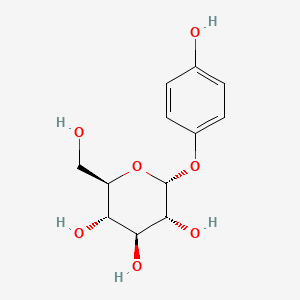
- IUPAC name
- (2R,3S,4S,5R,6R)-2-(hydroxymethyl)-6-(4-hydroxyphenoxy)oxane-3,4,5-triol
- Molecular formula
- C12H16O7
- Molecular weight
- 272.25 g/mol
- Exact mass
- 272.08960285 Da
- XLogP3
- -0.7
- Topological polar surface area
- 120.0 Ų
- Hydrogen-bond donors
- 5
- Hydrogen-bond acceptors
- 7
- Covalent units
- 1
- Defined stereocentres
- 5
Also known as
16 more reported names
External database identifiers
- ChEBI:CHEBI:29710
- ChEMBL:CHEMBL226495
- EPA DTXSID:DTXSID20233358
- PubMed:21529910
- PubMed:18473917
- PubMed:17442288
- PubMed:15973488
- PubMed:12843585
- PubMed:11438283
Retrieved from NIH PubChem on 2026-09-02 by checksum-valid CAS matching. Chemical properties do not replace the regulatory decision on this page.
Record details
Maximum concentration
(a) 2 % (b) 0,5 %
Product type
Other restrictions
Hydroquinone levels shall remain as low as possible in formulations containing alpha-Arbutin and shall not be higher than the unavoidable trace level.
From 1 February 2025 cosmetic products containing that substance and not complying with the conditions shall not be placed on the Union market. From 1 November 2025 cosmetic products containing that substance and not complying with the conditions shall not be made available on the Union market.
INCI glossary name
Alpha-Arbutin
Chemical name
4-Hydroxyphenyl-alpha-D-glucopyranoside
Regulatory information
SCCS opinions
Identified ingredients
Key data
Inventory links for Alpha-Arbutin
Related records for Alpha-Arbutin
Direct matches are limited for this record, so nearby entries from Annex III are shown as well.
Retinol; Retinyl Acetate; Retinyl Palmitate
Pinene
What Annex III means for Alpha-Arbutin
Alpha-Arbutin is a restricted substance under Annex III of EU Cosmetics Regulation 1223/2009. Its use in cosmetics is only permitted under the specific conditions set out in the entry above, including applicable concentration limits, product type restrictions and required warning statements.
When including this substance in a formulation, all conditions — maximum concentration, product scope and warning labels — must be met simultaneously. Compliance with one condition does not override the others.
This record is linked to 1 CosIng inventory ingredient for name and identifier cross-reference. The page also surfaces 10 related annex records with overlapping identifiers, annex logic or naming patterns.
Compliance checklist
- Ensure formulation concentration does not exceed: (a) 2 % (b) 0,5 %
- Confirm product type compatibility: (a) Face cream (b) Body lotion
- Document conditions of use in the Product Information File (PIF).
Frequently asked questions
Source note for Annex III record Alpha-Arbutin
This page summarizes one Annex III record for Alpha-Arbutin from public European Commission cosmetic materials and adds linked inventory or identifier matches when available.
Use this record page to review Annex III conditions for Alpha-Arbutin, but confirm any final regulatory decision against the current official annex wording and source files.
Tools & next steps
Check your formula
Paste a full INCI list to detect Alpha-Arbutin and other flagged EU annex records in one pass.
INCI CheckerCompare entries
Compare Alpha-Arbutin side by side with another annex record to review differences in restrictions, concentrations and annex placement.
CompareBrowse the annex
See all records in Annex III and compare regulatory conditions across substances in this annex.
Open Annex III