
Retinol; Retinyl Acetate; Retinyl Palmitate
(2E,4E,6E,8E)-3,7-dimethyl-9-(2,6,6-trimethylcyclohexen-1-yl)nona-2,4,6,8-tetraen-1-ol; [(2E,4E,6E,8E)-3,7-dimethyl-9-(2,6,6-trimethylcyclohexen-1-yl)nona-2,4,6,8-tetraenyl] acetate; [(2E,4E,6E,8E)-3,7-dimethyl-9-(2,6,6-trimethylcyclohexen-1-yl)nona-2,4,6,8-tetraenyl] hexadecanoate
Retinol; Retinyl Acetate; Retinyl Palmitate is listed in Annex III and may only be used under the conditions shown in this record. Maximum concentration in this record: (a) 0,05 % Retinol Equivalent (RE) (b) 0,3 % RE.
Reading this entry
Vitamin A in cosmetics became a restricted substance in 2024, with limits expressed as Retinol Equivalent, a mandatory label warning, and two different deadlines that mean different things.
- Body lotion: 0.05% Retinol Equivalent. Other leave-on and rinse-off products: 0.3% RE.
- The limit is a Retinol Equivalent, so retinol, retinyl acetate and retinyl palmitate are counted together, not separately.
- The label must read: 'Contains Vitamin A. Consider your daily intake before use'.
- 1 November 2025 stops non-compliant products being placed on the market; 1 May 2027 stops them being made available.
Regulation (EU) 2024/996 added this entry after the SCCS revisited its opinion on vitamin A. The reasoning is about total intake rather than about the product: vitamin A reaches the body from food and supplements as well as from what is applied to skin, and the limits are set with that whole picture in mind. That is also what the mandatory warning is for — it asks the reader to think about their daily intake, not about the cosmetic alone.
Two details in the wording do real work. The limits are Retinol Equivalent, which means retinol, retinyl acetate and retinyl palmitate are converted to a common basis and counted together; a formula using two of them is not entitled to the limit twice. And the two dates are not a grace period followed by a reminder. From 1 November 2025 a non-compliant product may not be placed on the Union market — that is the manufacturer or importer's first supply. From 1 May 2027 it may not be made available, which reaches stock already in a distributor's or retailer's hands.
Between those dates, a product made before the first deadline can lawfully still be sold. After the second, it cannot, wherever it sits in the chain.
Checked against
Chemical identity and properties
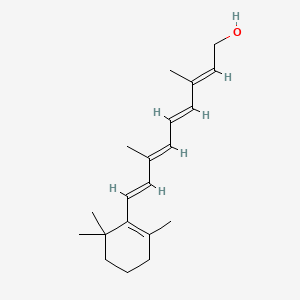
Retinol
All-trans-retinol is a retinol in which all four exocyclic double bonds have E- (trans-) geometry. It has a role as a mouse metabolite, a plant metabolite and a human metabolite. It is a vitamin A and a retinol. — ChEBI
- IUPAC name
- (2E,4E,6E,8E)-3,7-dimethyl-9-(2,6,6-trimethylcyclohexen-1-yl)nona-2,4,6,8-tetraen-1-ol
- Molecular formula
- C20H30O
- Molecular weight
- 286.5 g/mol
- Exact mass
- 286.229665576 Da
- XLogP3
- 5.7
- Topological polar surface area
- 20.2 Ų
- Hydrogen-bond donors
- 1
- Hydrogen-bond acceptors
- 1
- Covalent units
- 1
- Defined stereocentres
- 0
Also known as
16 more reported names
External database identifiers
Evidence from additional scientific databases
NIH PubChem PUG-View
Attributed physical-property, hazard, environmental and use annotations.
- Boiling Point: 279 to 280 °F at 1e-06 mmHg (NTP, 1992) Source: CAMEO Chemicals
- Boiling Point: 137-138 °C at 1X10⁻⁶ mm Hg Source: Hazardous Substances Data Bank (HSDB)
- Color/Form: Solvated crystals from polar solvents, such as methanol or ethyl formate Source: Hazardous Substances Data Bank (HSDB)
- LogP: 5.68 Source: DrugBank
- LogP: log Kow = 5.68 Source: Hazardous Substances Data Bank (HSDB)
- LogP: 5.68 Source: Human Metabolome Database (HMDB)
- Melting Point: 144 to 147 °F (NTP, 1992) Source: CAMEO Chemicals
- Melting Point: 63.5 °C Source: DrugBank
- Melting Point: 62-64 °C Source: Hazardous Substances Data Bank (HSDB)
- Melting Point: Pale yellow prismatic crystals from methanol; mp: 57-58 °C; UV max (ethanol): 326 nm (E=1,550, 1%, 1 cm) /Retinol acetate/ Source: Hazardous Substances Data Bank (HSDB)
- Melting Point: Amorphous or crystalline; mp: 28-29 °C; UV max (ethanol); 325-328 nm (E=975, 1%, 1 cm) /Retinol palmitate/ Source: Hazardous Substances Data Bank (HSDB)
- Melting Point: 61 - 63 °C Source: Human Metabolome Database (HMDB)
- Physical Description: Vitamin a appears as yellow crystals or orange solid. Practically water insoluble. (NTP, 1992) Source: CAMEO Chemicals
- Physical Description: Solid; [Merck Index] Yellow or orange solid; [NTP] Source: Haz-Map, Information on Hazardous Chemicals and Occupational Diseases
- Physical Description: Solid Source: Human Metabolome Database (HMDB)
- Refractive Index: Index of refraction: 1.6410 at 20 °C/D (calculated form refractive indexes of 20-70% solutions in mineral oil); max absorption: 324-325 nm (E=1,835, 1%, 1 cm) Source: Hazardous Substances Data Bank (HSDB)
- Solubility: Practically insoluble (NTP, 1992) Source: CAMEO Chemicals
- Solubility: 0.671 mg/L Source: DrugBank
- Solubility: Practically insoluble in water or glycerol; soluble in absolute alcohol, methanol, chloroform, ether, fats and oils Source: Hazardous Substances Data Bank (HSDB)
- Solubility: Sol in ethanol and acetone and benzene Source: Hazardous Substances Data Bank (HSDB)
- Vapor Pressure: 0.00000008 [mmHg] Source: Haz-Map, Information on Hazardous Chemicals and Occupational Diseases
- Vapor Pressure: 7.5X10⁻⁸ mm Hg at 25 °C /Estimated/ Source: Hazardous Substances Data Bank (HSDB)
- Carcinogen Classification: No indication of carcinogenicity to humans (not listed by IARC). Source: Toxin and Toxin Target Database (T3DB)
- Exposure Routes: Oral, readily absorbed from the normal gastrointestinal tract Source: Toxin and Toxin Target Database (T3DB)
- First Aid: EYES: First check the victim for contact lenses and remove if present. Flush victim's eyes with water or normal saline solution for 20 to 30 minutes while simultaneously calling a hospital or poison control center. Do not put any ointments, oils, or medication in the victim's eyes without specific instructions from a physician. If symptoms (such as redness or irritation) develop, immediately transport the victim to a hospital.; SKIN: IMMEDIATELY flood affected skin with water while removing and isolating all contaminated clothing. Gently wash all affected skin areas thoroughly with soap and water. If symptoms such as redness or irritation develop, IMMEDIATELY call a physician and be prepared to transport the victim to a hospital for treatment.; INHALATION: IMMEDIATELY leave the contaminated area; take deep breaths of fresh air. If symptoms (such as wheezing, coughing, shortness of breath, or burning in the mouth, throat, or chest) develop, call a physician and be prepared to transport the victim to a hospital. Provide proper respiratory protection to rescuers entering an unknown atmosphere. Whenever possible, Self-Contained Breathing Apparatus (SCBA) should be used; if not availabl Source: CAMEO Chemicals
- Note: This chemical does not meet GHS hazard criteria for 0.3% (1 of 311) of reports. Source: European Chemicals Agency (ECHA)
- Signal: Danger Source: European Chemicals Agency (ECHA)
- GHS Hazard Statements: H302 (15.8%): Harmful if swallowed [Warning Acute toxicity, oral]; H317 (74.9%): May cause an allergic skin reaction [Warning Sensitization, Skin]; H319 (75.6%): Causes serious eye irritation [Warning Serious eye damage/eye irritation]; H360 (88.1%): May damage fertility or the unborn child [Danger Reproductive toxicity]; H413 (74.9%): May cause long lasting harmful effects to aquatic life [Hazardous to the aquatic environment, long-term hazard] Source: European Chemicals Agency (ECHA)
- Precautionary Statement Codes: P203, P261, P264, P264+P265, P270, P272, P273, P280, P301+P317, P302+P352, P305+P351+P338, P318, P321, P330, P333+P317, P337+P317, P362+P364, P405, and P501 (click each P-code to see the statement) Source: European Chemicals Agency (ECHA)
- ECHA C&L Notifications Summary: Aggregated GHS information provided per 311 reports by companies from 14 notifications to the ECHA C&L Inventory. Each notification may be associated with multiple companies.; Reported as not meeting GHS hazard criteria per 1 of 311 reports by companies.; There are 13 notifications provided by 310 of 311 reports by companies with hazard statement code(s).; Information may vary between notifications depending on impurities, additives, and other factors. The percentage value in parenthesis indicates the notified classification ratio from companies that provide hazard codes. Only hazard codes with percentage values above 10% are shown. For more detailed information, please visit ECHA C&L website. Source: European Chemicals Agency (ECHA)
- Note: This chemical does not meet GHS hazard criteria for 1% (1 of 105) of reports. Source: European Chemicals Agency (ECHA)
- GHS Hazard Statements: H317 (99%): May cause an allergic skin reaction [Warning Sensitization, Skin]; H319 (99%): Causes serious eye irritation [Warning Serious eye damage/eye irritation]; H360D (99%): May damage the unborn child [Danger Reproductive toxicity] Source: European Chemicals Agency (ECHA)
- Precautionary Statement Codes: P203, P261, P264+P265, P272, P280, P302+P352, P305+P351+P338, P318, P321, P333+P317, P337+P317, P362+P364, P405, and P501 (click each P-code to see the statement) Source: European Chemicals Agency (ECHA)
- ECHA C&L Notifications Summary: Aggregated GHS information provided per 105 reports by companies from 2 notifications to the ECHA C&L Inventory. Each notification may be associated with multiple companies.; Reported as not meeting GHS hazard criteria per 1 of 105 reports by companies.; There is 1 notification provided by 104 of 105 reports by companies with hazard statement code(s).; Information may vary between notifications depending on impurities, additives, and other factors. The percentage value in parenthesis indicates the notified classification ratio from companies that provide hazard codes. Only hazard codes with percentage values above 10% are shown. For more detailed information, please visit ECHA C&L website. Source: European Chemicals Agency (ECHA)
- Cosmetic Ingredient Review Finding(s): Safe in the present practices of use and concentration. Ingredient, concentration, and use information are available in documents discoverable at https://cir-reports.cir-safety.org Source: Cosmetic Ingredient Review (CIR)
- Toxicity Summary: Signs and Symptoms of Overdose; Vitamin A toxicity may present with various clinical symptoms, including abdominal pain, headache, nausea, and facial flushing. Laboratory findings often include mild anemia, thrombocytopenia, elevated liver function tests, and a significant increase in serum retinol levels. Although the diagnosis is primarily clinical, laboratory tests such as serum retinol or retinyl ester levels can assist in confirming the diagnosis. A thorough dietary history is essential to identify excessive vitamin A intake.; Management of Overdose; Symptoms of toxicity may resolve within several weeks after discontinuing vitamin A and initiating supportive therapy. Patients with increased intracranial pressure may require lumbar punctures or medications such as mannitol and diuretics for management. Patients with hypercalcemia may need intravenous fluids and additional treatments, such as calcitonin and corticosteroids. Vitamin A toxicity can present with a range of clinical features, including abdominal pain, headache, nausea, and facial flushing. Laboratory findings often show mild anemia, thrombocytopenia, elevated liver function tests, and a significant increase in serum Source: StatPearls
- Toxicity Summary: Vision:Vitamin A (all-trans retinol) is converted in the retina to the 11-cis-isomer of retinaldehyde or 11-cis-retinal. 11-cis-retinal functions in the retina in the transduction of light into the neural signals necessary for vision. 11-cis-retinal, while attached to opsin in rhodopsin is isomerized to all-trans-retinal by light. This is the event that triggers the nerve impulse to the brain which allows for the perception of light. All-trans-retinal is then released from opsin and reduced to all-trans-retinol. All-trans-retinol is isomerized to 11-cis-retinol in the dark, and then oxidized to 11-cis-retinal. 11-cis-retinal recombines with opsin to re-form rhodopsin. Night blindness or defective vision at low illumination results from a failure to re-synthesize 11-cis retinal rapidly. Epithelial differentiation: The role of Vitamin A in epithelial differentiation, as well as in other physiological processes, involves the binding of Vitamin A to two families of nuclear retinoid receptors (retinoic acid receptors, RARs; and retinoid-X receptors, RXRs). These receptors function as ligand-activated transcription factors that modulate gene transcription. When there is not enough Vitami Source: Toxin and Toxin Target Database (T3DB)
- Cosmetic Ingredient Review Link: CIR ingredient: Retinol Source: Cosmetic Ingredient Review (CIR)
- Sources/Uses: Essential micronutrient found in animals; [Merck Index] Used as a nutritional supplement for foods; [FDA] Permitted for use as an inert ingredient in non-food pesticide products; [EPA] Source: Haz-Map, Information on Hazardous Chemicals and Occupational Diseases
- Uses: Vitamin (antixerophthalmic) Source: Hazardous Substances Data Bank (HSDB)
- Uses: MEDICATION Source: Hazardous Substances Data Bank (HSDB)
- Uses: MEDICATION (VET) Source: Hazardous Substances Data Bank (HSDB)
- Uses: For the treatment of vitamin A deficiency. Vitamin A helps regulate the immune system, which helps prevent or fight off infections by making white blood cells that destroy harmful bacteria and viruses. Source: Toxin and Toxin Target Database (T3DB)
Mapped by: Existing checksum-valid CAS to unique PubChem CID match. Retrieved: 2026-08-31. Open source record
Scientific classifications and hazard annotations provide context and do not replace the market-specific regulatory decision shown above.
Additional source coverage and match status
| Source | Result | Checked |
|---|---|---|
| NIH PubChem PUG-View | Exact match | 2026-08-31 |
A recorded no-match is useful evidence that the source was checked; it is not a claim that the substance does not exist elsewhere.
Retrieved from NIH PubChem on 2026-08-31 by checksum-valid CAS matching. Chemical properties do not replace the regulatory decision on this page.
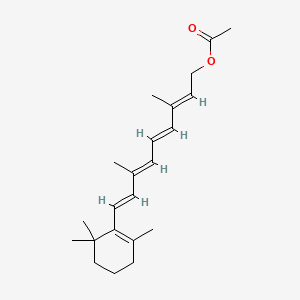
Retinol, acetate
Retinyl acetate is an acetate ester. It is functionally related to an all-trans-retinol. — ChEBI
- IUPAC name
- [(2E,4E,6E,8E)-3,7-dimethyl-9-(2,6,6-trimethylcyclohexen-1-yl)nona-2,4,6,8-tetraenyl] acetate
- Molecular formula
- C22H32O2
- Molecular weight
- 328.5 g/mol
- Exact mass
- 328.240230259 Da
- XLogP3
- 6.3
- Topological polar surface area
- 26.3 Ų
- Hydrogen-bond donors
- 0
- Hydrogen-bond acceptors
- 2
- Covalent units
- 1
- Defined stereocentres
- 0
Also known as
16 more reported names
External database identifiers
- ChEBI:CHEBI:32095
- ChEBI:CHEBI:94695
- ChEMBL:CHEMBL486193
- EPA DTXSID:DTXSID6021240
- PubMed:228596
Evidence from additional scientific databases
NIH PubChem PUG-View
Attributed physical-property, hazard, environmental and use annotations.
- Carcinogen Classification: No indication of carcinogenicity to humans (not listed by IARC). Source: Toxin and Toxin Target Database (T3DB)
- Note: This chemical does not meet GHS hazard criteria for 0.3% (1 of 374) of reports. Source: European Chemicals Agency (ECHA)
- Signal: Danger Source: European Chemicals Agency (ECHA)
- GHS Hazard Statements: H315 (83.4%): Causes skin irritation [Warning Skin corrosion/irritation]; H360 (59.4%): May damage fertility or the unborn child [Danger Reproductive toxicity]; H361 (39.6%): Suspected of damaging fertility or the unborn child [Warning Reproductive toxicity]; H413 (64.4%): May cause long lasting harmful effects to aquatic life [Hazardous to the aquatic environment, long-term hazard] Source: European Chemicals Agency (ECHA)
- Precautionary Statement Codes: P203, P264, P273, P280, P302+P352, P318, P321, P332+P317, P362+P364, P405, and P501 (click each P-code to see the statement) Source: European Chemicals Agency (ECHA)
- ECHA C&L Notifications Summary: Aggregated GHS information provided per 374 reports by companies from 22 notifications to the ECHA C&L Inventory. Each notification may be associated with multiple companies.; Reported as not meeting GHS hazard criteria per 1 of 374 reports by companies.; There are 21 notifications provided by 373 of 374 reports by companies with hazard statement code(s).; Information may vary between notifications depending on impurities, additives, and other factors. The percentage value in parenthesis indicates the notified classification ratio from companies that provide hazard codes. Only hazard codes with percentage values above 10% are shown. For more detailed information, please visit ECHA C&L website. Source: European Chemicals Agency (ECHA)
Mapped by: Existing checksum-valid CAS to unique PubChem CID match. Retrieved: 2026-08-31. Open source record
Scientific classifications and hazard annotations provide context and do not replace the market-specific regulatory decision shown above.
Additional source coverage and match status
| Source | Result | Checked |
|---|---|---|
| NIH PubChem PUG-View | Exact match | 2026-08-31 |
A recorded no-match is useful evidence that the source was checked; it is not a claim that the substance does not exist elsewhere.
Retrieved from NIH PubChem on 2026-08-31 by checksum-valid CAS matching. Chemical properties do not replace the regulatory decision on this page.
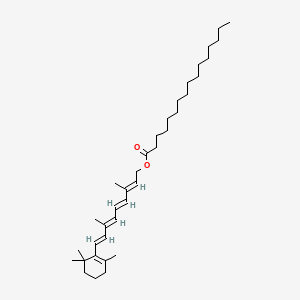
Retinol Palmitate
All-trans-retinyl palmitate is an all-trans-retinyl ester obtained by formal condensation of the carboxy group of palmitic (hexadecanoic acid) with the hydroxy group of all-trans-retinol. It is used in cosmetic products to treat various skin disorders such as acne, skin aging, wrinkles, dark spots, and also protect against psoriasis. It has a role as an antioxidant, a human xenobiotic metabolite and an Escherichia coli metabolite. It is a retinyl palmitate and an all-trans-retinyl ester. It is functionally related to an all-trans-retinol. — ChEBI
- IUPAC name
- [(2E,4E,6E,8E)-3,7-dimethyl-9-(2,6,6-trimethylcyclohexen-1-yl)nona-2,4,6,8-tetraenyl] hexadecanoate
- Molecular formula
- C36H60O2
- Molecular weight
- 524.9 g/mol
- Exact mass
- 524.45933115 Da
- XLogP3
- 13.6
- Topological polar surface area
- 26.3 Ų
- Hydrogen-bond donors
- 0
- Hydrogen-bond acceptors
- 2
- Covalent units
- 1
- Defined stereocentres
- 0
Also known as
16 more reported names
External database identifiers
- ChEBI:CHEBI:17616
- ChEMBL:CHEMBL1675
- EPA DTXSID:DTXSID1021241
- PubMed:38191030
- PubMed:32846153
- PubMed:20679000
- PubMed:19686701
- PubMed:17377406
- PubMed:17303254
- PubMed:17299104
- PubMed:17164434
- PubMed:16798117
- PubMed:16741517
- PubMed:16497549
- PubMed:16299098
Retrieved from NIH PubChem on 2026-08-31 by checksum-valid CAS matching. Chemical properties do not replace the regulatory decision on this page.
Record details
Maximum concentration
(a) 0,05 % Retinol Equivalent (RE) (b) 0,3 % RE
Product type
Other restrictions
From 1 November 2025 cosmetic products containing that substance and not complying with the conditions shall not be placed on the Union market. From 1 May 2027 cosmetic products containing that substance and not complying with the conditions shall not be made available on the Union market.
Warnings
For any cosmetic product containing Retinol, Retinyl Acetate or Retinyl Palmitate the following, labelling is obligatory: ‘Contains Vitamin A. Consider your daily intake before use’.
INCI glossary name
Retinol; Retinyl Acetate; Retinyl Palmitate
Chemical name
(2E,4E,6E,8E)-3,7-dimethyl-9-(2,6,6-trimethylcyclohexen-1-yl)nona-2,4,6,8-tetraen-1-ol; [(2E,4E,6E,8E)-3,7-dimethyl-9-(2,6,6-trimethylcyclohexen-1-yl)nona-2,4,6,8-tetraenyl] acetate; [(2E,4E,6E,8E)-3,7-dimethyl-9-(2,6,6-trimethylcyclohexen-1-yl)nona-2,4,6,8-tetraenyl] hexadecanoate
Regulatory information
Identified ingredients
Key data
Inventory links for Retinol; Retinyl Acetate; Retinyl Palmitate
RETINOL
Related records for Retinol; Retinyl Acetate; Retinyl Palmitate
Direct matches are limited for this record, so nearby entries from Annex III are shown as well.
Pinene
What Annex III means for Retinol; Retinyl Acetate; Retinyl Palmitate
Retinol; Retinyl Acetate; Retinyl Palmitate is a restricted substance under Annex III of EU Cosmetics Regulation 1223/2009. Its use in cosmetics is only permitted under the specific conditions set out in the entry above, including applicable concentration limits, product type restrictions and required warning statements.
When including this substance in a formulation, all conditions — maximum concentration, product scope and warning labels — must be met simultaneously. Compliance with one condition does not override the others.
This record is linked to 3 CosIng inventory ingredients for name and identifier cross-reference. The page also surfaces 11 related annex records with overlapping identifiers, annex logic or naming patterns.
Compliance checklist
- Ensure formulation concentration does not exceed: (a) 0,05 % Retinol Equivalent (RE) (b) 0,3 % RE
- Confirm product type compatibility: (a) Body lotion (b) other leave-on and rinse-off products
- Include required warning statement on product label.
- Document conditions of use in the Product Information File (PIF).
Frequently asked questions
Source note for Annex III record Retinol; Retinyl Acetate; Retinyl Palmitate
This page summarizes one Annex III record for Retinol; Retinyl Acetate; Retinyl Palmitate from public European Commission cosmetic materials and adds linked inventory or identifier matches when available.
Use this record page to review Annex III conditions for Retinol; Retinyl Acetate; Retinyl Palmitate, but confirm any final regulatory decision against the current official annex wording and source files.
Tools & next steps
Check your formula
Paste a full INCI list to detect Retinol; Retinyl Acetate; Retinyl Palmitate and other flagged EU annex records in one pass.
INCI CheckerCompare entries
Compare Retinol; Retinyl Acetate; Retinyl Palmitate side by side with another annex record to review differences in restrictions, concentrations and annex placement.
CompareBrowse the annex
See all records in Annex III and compare regulatory conditions across substances in this annex.
Open Annex III