
THIOGLYCOLIC ACID
Thioglycolic acid and its salts
THIOGLYCOLIC ACID is listed in Annex III and may only be used under the conditions shown in this record. Maximum concentration in this record: (a) (i) 8% (ii) 11% (b) 5% (c) 2% (d) 11% The abovementioned percentages are calculated as thioglycollic acid.
Reading this entry
Thioglycolic acid is limited by concentration and by pH together. A compliant percentage at the wrong pH is not a compliant product.
- Hair products: 8% general use, 11% professional. Depilatories: 5%. Rinse-off hair products: 2%. Eyelash waving: 11%.
- Each group carries a pH range for the ready-to-use product — pH 7 to 9.5 for most, up to 12.7 for depilatories.
- Percentages are calculated as thioglycolic acid, so salts count as the acid they derive from.
- Eyelash waving at 11% is professional use only, with its own labelling.
Most Annex III entries constrain how much of a substance a product may contain. This one constrains that and the chemistry it sits in. Every product group carries a pH range for the ready-to-use product, and the ranges differ: 7 to 9.5 for hair products, rinse-offs and eyelash waving, but 7 to 12.7 for depilatories, which work by breaking keratin and need the alkalinity to do it.
The consequence is that concentration alone does not answer the question. A hair product at 8% and pH 10 is outside this entry as surely as one at 15%, because the entry states both conditions and both bind.
The percentages are calculated as thioglycolic acid. The entry covers the acid "and its salts", so ammonium thioglycolate — the form most perm and depilatory products actually contain — is converted back to acid for the purpose of the limit rather than measured as itself.
Eyelash waving is professional use only. It shares the 11% ceiling with professional hair products, and both carry the glove and eye-contact warnings the entry sets out.
Checked against
Chemical identity and properties
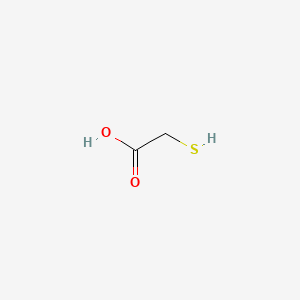
Thioglycolic Acid
Thioglycolic acid is a sulfur-containing carboxylic acid. It is a conjugate acid of a thioglycolate(1-). — ChEBI
- IUPAC name
- 2-sulfanylacetic acid
- Molecular formula
- C2H4O2S
- Molecular weight
- 92.12 g/mol
- Exact mass
- 91.99320054 Da
- XLogP3
- 0.1
- Topological polar surface area
- 38.3 Ų
- Hydrogen-bond donors
- 2
- Hydrogen-bond acceptors
- 3
- Covalent units
- 1
- Defined stereocentres
- 0
Also known as
16 more reported names
External database identifiers
- ChEBI:CHEBI:30065
- ChEMBL:CHEMBL116455
- EPA DTXSID:DTXSID8026141
- PubMed:23121955
- PubMed:23071814
- PubMed:23061285
- PubMed:23037869
- PubMed:23035480
- PubMed:22981329
- PubMed:22967646
- PubMed:22966676
- PubMed:22944414
- PubMed:22938609
- PubMed:22935823
- PubMed:22924153
Retrieved from NIH PubChem on 2026-08-31 by checksum-valid CAS matching. Chemical properties do not replace the regulatory decision on this page.
Record details
Maximum concentration
(a) (i) 8% (ii) 11% (b) 5% (c) 2% (d) 11% The abovementioned percentages are calculated as thioglycollic acid
Product type
Other restrictions
(a) (i) General use ready for use pH 7 to 9.5 (ii) Professional use ready for use pH 7 to 9.5
(b) ready for use pH 7 to 12.7
(c) ready for use pH 7 to 9.5
(d) ready for use pH 7 to 9,5
Warnings
Conditions of use:
(a) (b) (c) (d)
Avoid contact with eyes
Rinse eyes immediately if product comes into contact with them.
(a) (c) (d)
Wear suitable gloves
Warnings to be printed on the label:
(a)(i) (b) (c)
Contains thioglycolate
Follow the instructions
Keep out of reach of children
(a)(ii) (d)
For professional use only
Contains thioglycolate
Follow the instructions’
INCI glossary name
THIOGLYCOLIC ACID
Chemical name
Thioglycolic acid and its salts
Chemical / IUPAC name
Thioglycolic acid and its salts
Regulatory information
SCCS opinions
Key data
Inventory links for THIOGLYCOLIC ACID
CALCIUM THIOGLYCOLATE HYDROXIDE
Related records for THIOGLYCOLIC ACID
Direct matches are limited for this record, so nearby entries from Annex III are shown as well.
AMMONIA
POTASSIUM CHLORATE / SODIUM CHLORATE
p-Phenylenediamine and its salts
What Annex III means for THIOGLYCOLIC ACID
THIOGLYCOLIC ACID is a restricted substance under Annex III of EU Cosmetics Regulation 1223/2009. Its use in cosmetics is only permitted under the specific conditions set out in the entry above, including applicable concentration limits, product type restrictions and required warning statements.
When including this substance in a formulation, all conditions — maximum concentration, product scope and warning labels — must be met simultaneously. Compliance with one condition does not override the others.
This record is linked to 9 CosIng inventory ingredients for name and identifier cross-reference. The page also surfaces 11 related annex records with overlapping identifiers, annex logic or naming patterns.
Compliance checklist
- Ensure formulation concentration does not exceed: (a) (i) 8% (ii) 11% (b) 5% (c) 2% (d) 11% The abovementioned percentages are calculated as thioglycollic acid
- Confirm product type compatibility: (a) Hair products (b) Depilatories (c) Hair rinse-off products (d) Products intended for eyelash waving
- Include required warning statement on product label.
- Document conditions of use in the Product Information File (PIF).
Frequently asked questions
Source note for Annex III record THIOGLYCOLIC ACID
This page summarizes one Annex III record for THIOGLYCOLIC ACID from public European Commission cosmetic materials and adds linked inventory or identifier matches when available.
Use this record page to review Annex III conditions for THIOGLYCOLIC ACID, but confirm any final regulatory decision against the current official annex wording and source files.
Tools & next steps
Check your formula
Paste a full INCI list to detect THIOGLYCOLIC ACID and other flagged EU annex records in one pass.
INCI CheckerCompare entries
Compare THIOGLYCOLIC ACID side by side with another annex record to review differences in restrictions, concentrations and annex placement.
CompareBrowse the annex
See all records in Annex III and compare regulatory conditions across substances in this annex.
Open Annex III