
Boratos, tetraboratos, octaboratos e sais e ésteres do ácido bórico, incluindo octaboratos dissódicos, MEA-borate, MIPA-borate, boratos de potássio, zinco e sódio, bórax e borato fenil mercúrico
ANVISA lists this substance among materials that may not be used in personal-hygiene products, cosmetics or perfumes in Brazil.
Regulatory decision and full conditions
- Status
- Prohibited
- Legal role
- Binding rule
- Regulatory summary
- ANVISA lists this substance among materials that may not be used in personal-hygiene products, cosmetics or perfumes in Brazil.
- Conditions and restrictions
Boratos, tetraboratos, octaboratos e sais e ésteres do ácido bórico, incluindo octaboratos dissódicos, MEA-borate, MIPA-borate, boratos de potássio, zinco e sódio, bórax e borato fenil mercúrico
Substance identity
- Official source name
- Boratos, tetraboratos, octaboratos e sais e ésteres do ácido bórico, incluindo octaboratos dissódicos, MEA-borate, MIPA-borate, boratos de potássio, zinco e sódio, bórax e borato fenil mercúrico
- CAS
- 12008-41-2; 12280-03-4; 10377-81-8; 26038-87-9; 68130-12-1; 68003-13-4; 26038-90-4; 12712-38-8; 1332-07-6; 1330-43-4; 12267-73-1; 13840-56-7; 1303-96-4; 12179-04-3; 102-98-7; 6273-99-0
- EC
- 234-541-0; 233-829-3; 268-109-8; 603-184-6; 215-566-6; 215-540-4; 235-541-3; 237-560-2; 203-068-1; 228-465-7
- Identity mapping
- cas_number
- Linked ingredient
- ZINC BORATE
Linked CosIng identity data
Names and aliases
CosIng description: Boric acid, zinc salt
EU inventory restriction note: II/1396
Recorded cosmetic function: SKIN CONDITIONING - HUMECTANT
Function pages:SKIN CONDITIONING - HUMECTANT
View the complete ingredient profileCross-market snapshot for this identity
Exact linked records currently present in this site. An absent market means no imported exact match, not permission to use the substance.
European Union
2 linked records · 1 with specific conditions
Open supporting recordCanada
3 linked records · 3 with specific conditions
Open supporting recordNew Zealand
11 linked records
Open supporting recordChina
1 linked record · 1 with specific conditions
Open supporting recordSouth Korea
1 linked record · 1 with specific conditions
Open supporting recordBrazil
Current record1 linked record · 1 with specific conditions
Open supporting recordIndia
3 linked records · 3 with specific conditions
Open supporting recordSaudi Arabia
1 linked record
Open supporting record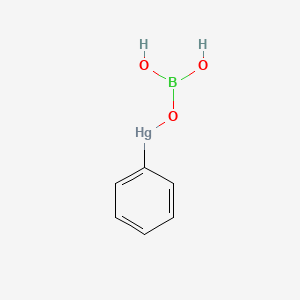
Verified chemistry for CAS 102-98-7
Phenylmercury borate
Phenylmercuric borate is an organomercuric compound. It is used as a topical antiseptic and disinfectant. Mercury is a heavy, silvery d-block metal and one of six elements that are liquid at or near room temperature and pressure. It is a naturally occuring substance, and combines with other elements such as chlorine, sulfur, or oxygen to form inorganic mercury compounds (salts). Mercury also combines with carbon to make organic mercury compounds. (L1, L262) — Toxin and Toxin Target Database (T3DB)
- IUPAC name
- boronooxy(phenyl)mercury
- Molecular formula
- C6H7BHgO3
- Molecular weight
- 338.52 g/mol
- Exact mass
- 340.019468 Da
- Monoisotopic mass
- 340.019468 Da
- Topological polar surface area
- 49.7 Ų
- Molecular complexity
- 106.0
- Formal charge
- 0
- Hydrogen-bond donors
- 2
- Hydrogen-bond acceptors
- 3
- Rotatable bonds
- 3
- Heavy atoms
- 11
- Covalent units
- 1
Names and synonyms reported to PubChem
11 more reported names
Advanced structure statistics
- Defined atom stereocentres
- 0
- Undefined atom stereocentres
- 0
- Defined bond stereocentres
- 0
- Undefined bond stereocentres
- 0
- 3D conformers
- 0
Machine-readable structure identifiers
- SMILES
B(O)(O)O[Hg]C1=CC=CC=C1- InChI
InChI=1S/C6H5.BH2O3.Hg/c1-2-4-6-5-3-1;2-1(3)4;/h1-5H;2-3H;/q;-1;+1- InChIKey
VUXSPDNLYQTOSY-UHFFFAOYSA-N
Evidence from additional scientific databases
NIH PubChem PUG-View
Attributed physical-property, hazard, environmental and use annotations.
- Carcinogen Classification: No indication of carcinogenicity (not listed by IARC). (L135) Source: Toxin and Toxin Target Database (T3DB)
- Exposure Routes: Oral (L7) ; inhalation (L7) ; dermal (L7) Source: Toxin and Toxin Target Database (T3DB)
- Note: This chemical does not meet GHS hazard criteria for 7% (3 of 43) of reports. Source: European Chemicals Agency (ECHA)
- Signal: Danger Source: European Chemicals Agency (ECHA)
- GHS Hazard Statements: H300 (93%): Fatal if swallowed [Danger Acute toxicity, oral]; H310 (93%): Fatal in contact with skin [Danger Acute toxicity, dermal]; H330 (93%): Fatal if inhaled [Danger Acute toxicity, inhalation]; H373 (93%): May causes damage to organs through prolonged or repeated exposure [Warning Specific target organ toxicity, repeated exposure]; H400 (90.7%): Very toxic to aquatic life [Warning Hazardous to the aquatic environment, acute hazard]; H410 (90.7%): Very toxic to aquatic life with long lasting effects [Warning Hazardous to the aquatic environment, long-term hazard] Source: European Chemicals Agency (ECHA)
- Precautionary Statement Codes: P260, P262, P264, P270, P271, P273, P280, P284, P301+P316, P302+P352, P304+P340, P316, P319, P320, P321, P330, P361+P364, P391, P403+P233, P405, and P501 (click each P-code to see the statement) Source: European Chemicals Agency (ECHA)
- ECHA C&L Notifications Summary: Aggregated GHS information provided per 43 reports by companies from 4 notifications to the ECHA C&L Inventory. Each notification may be associated with multiple companies.; Reported as not meeting GHS hazard criteria per 3 of 43 reports by companies.; There are 3 notifications provided by 40 of 43 reports by companies with hazard statement code(s).; Information may vary between notifications depending on impurities, additives, and other factors. The percentage value in parenthesis indicates the notified classification ratio from companies that provide hazard codes. Only hazard codes with percentage values above 10% are shown. For more detailed information, please visit ECHA C&L website. Source: European Chemicals Agency (ECHA)
- Health Effects: Mercury mainly affects the nervous system. Exposure to high levels of metallic, inorganic, or organic mercury can permanently damage the brain, kidneys, and developing fetus. Effects on brain functioning may result in irritability, shyness, tremors, changes in vision or hearing, and memory problems. Acrodynia, a type of mercury poisoning in children, is characterized by pain and pink discoloration of the hands and feet. Mercury poisoning can also cause Hunter-Russell syndrome and Minamata disease. (L7) Source: Toxin and Toxin Target Database (T3DB)
- Toxicity Summary: High-affinity binding of the divalent mercuric ion to thiol or sulfhydryl groups of proteins is believed to be the major mechanism for the activity of mercury. Through alterations in intracellular thiol status, mercury can promote oxidative stress, lipid peroxidation, mitochondrial dysfunction, and changes in heme metabolism. Mercury is known to bind to microsomal and mitochondrial enzymes, resulting in cell injury and death. For example, mercury is known to inhibit aquaporins, halting water flow across the cell membrane. It also inhibits the protein LCK, which causes decreased T-cell signalling and immune system depression. Mercury is also believed to inhibit neuronal excitability by acting on the postsynaptic neuronal membrane. It also affects the nervous system by inhibiting protein kinase C and alkaline phosphatase, which impairs brain microvascular formation and function, as well as alters the blood-brain barrier. Organic mercury exerts developmental effects by binding to tubulin, preventing microtubule assembly and causing mitotic inhibition. Mercury also produces an autoimmune response, likely by modification of major histocompatibility complex (MHC) class II molecules, self Source: Toxin and Toxin Target Database (T3DB)
- Uses: Phenylmercuric borate is used as a topical antiseptic and disinfectant. (L262) Source: Toxin and Toxin Target Database (T3DB)
Mapped by: Existing checksum-valid CAS to unique PubChem CID match. Retrieved: 2026-08-31. Open source record
Scientific classifications and hazard annotations provide context and do not replace the market-specific regulatory decision shown above.
Additional source coverage and match status
| Source | Result | Checked |
|---|---|---|
| EMBL-EBI ChEBI | No exact record | 2026-08-31 |
| NIH PubChem PUG-View | Exact match | 2026-08-31 |
A recorded no-match is useful evidence that the source was checked; it is not a claim that the substance does not exist elsewhere.
Retrieved from NIH PubChem on 2026-09-02 by checksum-valid CAS matching. Chemical properties do not replace the regulatory decision on this page.
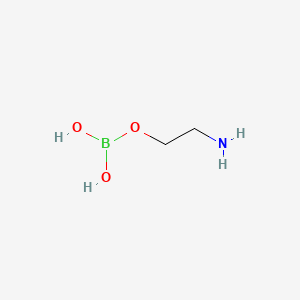
Verified chemistry for CAS 10377-81-8
Monoethanolamine borate
- IUPAC name
- 2-aminoethoxyboronic acid
- Molecular formula
- C2H8BNO3
- Molecular weight
- 104.90 g/mol
- Exact mass
- 105.0597233 Da
- Monoisotopic mass
- 105.0597233 Da
- Topological polar surface area
- 75.7 Ų
- Molecular complexity
- 41.0
- Formal charge
- 0
- Hydrogen-bond donors
- 3
- Hydrogen-bond acceptors
- 4
- Rotatable bonds
- 3
- Heavy atoms
- 7
- Covalent units
- 1
Names and synonyms reported to PubChem
12 more reported names
External database identifiers
- EPA DTXSID:DTXSID3049673
Advanced structure statistics
- Defined atom stereocentres
- 0
- Undefined atom stereocentres
- 0
- Defined bond stereocentres
- 0
- Undefined bond stereocentres
- 0
- 3D conformers
- 0
Machine-readable structure identifiers
- SMILES
B(O)(O)OCCN- InChI
InChI=1S/C2H8BNO3/c4-1-2-7-3(5)6/h5-6H,1-2,4H2- InChIKey
JCAYXDKNUSEQRT-UHFFFAOYSA-N
Evidence from additional scientific databases
NIH PubChem PUG-View
Attributed physical-property, hazard, environmental and use annotations.
- Note: This chemical does not meet GHS hazard criteria for 29.7% (11 of 37) of reports. Source: European Chemicals Agency (ECHA)
- Signal: Warning Source: European Chemicals Agency (ECHA)
- GHS Hazard Statements: H315 (70.3%): Causes skin irritation [Warning Skin corrosion/irritation]; H319 (70.3%): Causes serious eye irritation [Warning Serious eye damage/eye irritation]; H335 (67.6%): May cause respiratory irritation [Warning Specific target organ toxicity, single exposure; Respiratory tract irritation] Source: European Chemicals Agency (ECHA)
- Precautionary Statement Codes: P261, P264, P264+P265, P271, P280, P302+P352, P304+P340, P305+P351+P338, P319, P321, P332+P317, P337+P317, P362+P364, P403+P233, P405, and P501 (click each P-code to see the statement) Source: European Chemicals Agency (ECHA)
- ECHA C&L Notifications Summary: Aggregated GHS information provided per 37 reports by companies from 3 notifications to the ECHA C&L Inventory. Each notification may be associated with multiple companies.; Reported as not meeting GHS hazard criteria per 11 of 37 reports by companies.; There are 2 notifications provided by 26 of 37 reports by companies with hazard statement code(s).; Information may vary between notifications depending on impurities, additives, and other factors. The percentage value in parenthesis indicates the notified classification ratio from companies that provide hazard codes. Only hazard codes with percentage values above 10% are shown. For more detailed information, please visit ECHA C&L website. Source: European Chemicals Agency (ECHA)
Mapped by: Existing checksum-valid CAS to unique PubChem CID match. Retrieved: 2026-08-31. Open source record
Scientific classifications and hazard annotations provide context and do not replace the market-specific regulatory decision shown above.
Additional source coverage and match status
| Source | Result | Checked |
|---|---|---|
| EMBL-EBI ChEBI | No exact record | 2026-08-31 |
| NIH PubChem PUG-View | Exact match | 2026-08-31 |
A recorded no-match is useful evidence that the source was checked; it is not a claim that the substance does not exist elsewhere.
Retrieved from NIH PubChem on 2026-09-02 by checksum-valid CAS matching. Chemical properties do not replace the regulatory decision on this page.
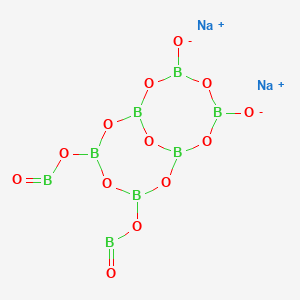
Verified chemistry for CAS 12008-41-2
Boron sodium oxide (B8Na2O13)
- IUPAC name
- disodium;(9,11-dioxido-5-oxoboranyloxy-2,4,6,8,10,12,13-heptaoxa-1,3,5,7,9,11-hexaborabicyclo[5.5.1]tridecan-3-yl)oxy-oxoborane
- Molecular formula
- B8Na2O13
- Molecular weight
- 340.5 g/mol
- Exact mass
- 340.9915016 Da
- Monoisotopic mass
- 341.987870 Da
- Topological polar surface area
- 163.0 Ų
- Molecular complexity
- 319.0
- Formal charge
- 0
- Hydrogen-bond donors
- 0
- Hydrogen-bond acceptors
- 13
- Rotatable bonds
- 2
- Heavy atoms
- 23
- Covalent units
- 3
Names and synonyms reported to PubChem
12 more reported names
External database identifiers
- EPA DTXSID:DTXSID6034390
Advanced structure statistics
- Defined atom stereocentres
- 0
- Undefined atom stereocentres
- 0
- Defined bond stereocentres
- 0
- Undefined bond stereocentres
- 0
- 3D conformers
- 0
Machine-readable structure identifiers
- SMILES
B(=O)OB1OB2OB(OB(OB(O2)OB(O1)OB=O)[O-])[O-].[Na+].[Na+]- InChI
InChI=1S/B8O13.2Na/c9-1-13-5-18-6(14-2-10)20-8-17-4(12)15-3(11)16-7(19-5)21-8;;/q-2;2*+1- InChIKey
CGCGPGRQKOPVHP-UHFFFAOYSA-N
Evidence from additional scientific databases
NIH PubChem PUG-View
Attributed physical-property, hazard, environmental and use annotations.
- Color/Form: Crystalline rod Source: Hazardous Substances Data Bank (HSDB)
- Physical Description: Dry Powder Source: EPA Chemical Data Reporting (CDR)
- Solubility: Dissolves rapidly in water ... easily forms viscous supersaturated solutions at elevated temperatures. Solubility at 30 degC: 21.9wt % /Disodium octaborate tetrahydrate/ Source: Hazardous Substances Data Bank (HSDB)
- Solubility: Solubility: 9.5 g/100 g water /Disodium octaborate tetrahydrate/ Source: Hazardous Substances Data Bank (HSDB)
- Signal: Danger Source: Regulation (EC) No 1272/2008 of the European Parliament and of the Council
- GHS Hazard Statements: H360FD: May damage fertility; May damage the unborn child [Danger Reproductive toxicity] Source: Regulation (EC) No 1272/2008 of the European Parliament and of the Council
- Precautionary Statement Codes: P203, P280, P318, P405, and P501 (click each P-code to see the statement) Source: Regulation (EC) No 1272/2008 of the European Parliament and of the Council
- Note: This chemical does not meet GHS hazard criteria for 0.5% (1 of 222) of reports. Source: European Chemicals Agency (ECHA)
- Signal: Danger Source: European Chemicals Agency (ECHA)
- GHS Hazard Statements: H360 (86.5%): May damage fertility or the unborn child [Danger Reproductive toxicity]; H360FD (18.5%): May damage fertility; May damage the unborn child [Danger Reproductive toxicity] Source: European Chemicals Agency (ECHA)
- Precautionary Statement Codes: P203, P280, P318, P405, and P501 (click each P-code to see the statement) Source: European Chemicals Agency (ECHA)
- ECHA C&L Notifications Summary: Aggregated GHS information provided per 222 reports by companies from 10 notifications to the ECHA C&L Inventory. Each notification may be associated with multiple companies.; Reported as not meeting GHS hazard criteria per 1 of 222 reports by companies.; There are 9 notifications provided by 221 of 222 reports by companies with hazard statement code(s).; Information may vary between notifications depending on impurities, additives, and other factors. The percentage value in parenthesis indicates the notified classification ratio from companies that provide hazard codes. Only hazard codes with percentage values above 10% are shown. For more detailed information, please visit ECHA C&L website. Source: European Chemicals Agency (ECHA)
- Toxicity Summary: The inorganic borates display low acute toxicity. They are either not irritant or mild skin and eye irritants. They are not skin sensitisers, nor are they mutagenic or carcinogenic. The most sensitive endpoints of toxicity are considered to be effects on the reproductive organs, fertility in males, and developmental effects. The doses that cause these effects are far higher than any levels to which the human population could be exposed... /Inorganic borates/ Source: Hazardous Substances Data Bank (HSDB)
- Consumer Uses: Adhesion/cohesion promoter; Corrosion inhibitor; Soil amendments (fertilizers) Source: EPA Chemical Data Reporting (CDR)
- Industry Uses: Soil amendments (fertilizers); Adhesion/cohesion promoter; Swelling agent Source: EPA Chemical Data Reporting (CDR)
- Uses: For disodium octaborate (USEPA/OPP Pesticide Code: 011107) ACTIVE products with label matches. /SRP: Registered for use in the U.S. but approved pesticide uses may change periodically and so federal, state and local authorities must be consulted for currently approved uses./ Source: Hazardous Substances Data Bank (HSDB)
- Uses: For disodium octaborate tetrahydrate (USEPA/OPP Pesticide Code: 011103) ACTIVE products with label matches. /SRP: Registered for use in the U.S. but approved pesticide uses may change periodically and so federal, state and local authorities must be consulted for currently approved uses./ /Disodium octaborate tetrahydrate/ Source: Hazardous Substances Data Bank (HSDB)
- Uses: Used to prevent and control decay fungi in lumber and timber products. Source: Hazardous Substances Data Bank (HSDB)
- Uses: Multimicronutrient fertilizer /Disodium octaborate tetrahydrate/ Source: Hazardous Substances Data Bank (HSDB)
- Uses: For more Uses (Complete) data for DISODIUM OCTABORATE (8 total), please visit the HSDB record page. Source: Hazardous Substances Data Bank (HSDB)
Mapped by: Existing checksum-valid CAS to unique PubChem CID match. Retrieved: 2026-08-31. Open source record
Scientific classifications and hazard annotations provide context and do not replace the market-specific regulatory decision shown above.
Additional source coverage and match status
| Source | Result | Checked |
|---|---|---|
| NIH PubChem PUG-View | Exact match | 2026-08-31 |
A recorded no-match is useful evidence that the source was checked; it is not a claim that the substance does not exist elsewhere.
Retrieved from NIH PubChem on 2026-09-02 by checksum-valid CAS matching. Chemical properties do not replace the regulatory decision on this page.
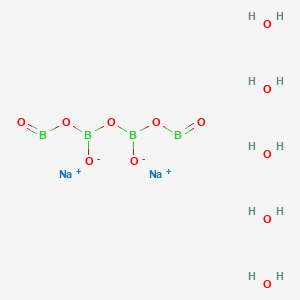
Verified chemistry for CAS 12179-04-3
Sodium tetraborate pentahydrate
- IUPAC name
- disodium;[oxido(oxoboranyloxy)boranyl]oxy-oxoboranyloxyborinate;pentahydrate
- Molecular formula
- B4H10Na2O12
- Molecular weight
- 291.3 g/mol
- Exact mass
- 292.0339850 Da
- Monoisotopic mass
- 292.0339850 Da
- Topological polar surface area
- 113.0 Ų
- Molecular complexity
- 110.0
- Formal charge
- 0
- Hydrogen-bond donors
- 5
- Hydrogen-bond acceptors
- 12
- Rotatable bonds
- 4
- Heavy atoms
- 18
- Covalent units
- 8
Names and synonyms reported to PubChem
6 more reported names
External database identifiers
- EPA DTXSID:DTXSID7034389
Advanced structure statistics
- Defined atom stereocentres
- 0
- Undefined atom stereocentres
- 0
- Defined bond stereocentres
- 0
- Undefined bond stereocentres
- 0
- 3D conformers
- 0
Machine-readable structure identifiers
- SMILES
B(=O)OB([O-])OB([O-])OB=O.O.O.O.O.O.[Na+].[Na+]- InChI
InChI=1S/B4O7.2Na.5H2O/c5-1-9-3(7)11-4(8)10-2-6;;;;;;;/h;;;5*1H2/q-2;2*+1;;;;;- InChIKey
QZSYXKPOZFXCDM-UHFFFAOYSA-N
Evidence from additional scientific databases
NIH PubChem PUG-View
Attributed physical-property, hazard, environmental and use annotations.
- Density: 1.82 Source: Occupational Safety and Health Administration (OSHA)
- Density: 1.82 Source: The National Institute for Occupational Safety and Health (NIOSH)
- Melting Point: 392 °F Source: Occupational Safety and Health Administration (OSHA)
- Melting Point: 392 °F Source: The National Institute for Occupational Safety and Health (NIOSH)
- Physical Description: CBI; Dry Powder; Liquid; Other Solid Source: EPA Chemical Data Reporting (CDR)
- Physical Description: Colorless or white, odorless crystals or free-flowing powder; Begins to lose water of hydration at 252 degrees F; [NIOSH] Source: Haz-Map, Information on Hazardous Chemicals and Occupational Diseases
- Physical Description: Colorless or white, odorless crystals or free-flowing powder. Source: Occupational Safety and Health Administration (OSHA)
- Physical Description: Colorless or white, odorless crystals or free-flowing powder. [herbicide] [Note: Begins to lose water of hydration at 252 °F.] Source: The National Institute for Occupational Safety and Health (NIOSH)
- Solubility: 3% Source: The National Institute for Occupational Safety and Health (NIOSH)
- Vapor Pressure: 0 mmHg (approx) Source: Occupational Safety and Health Administration (OSHA)
- Vapor Pressure: 0 mmHg (approx) Source: The National Institute for Occupational Safety and Health (NIOSH)
- Exposure Routes: inhalation, ingestion, skin and/or eye contact Source: The National Institute for Occupational Safety and Health (NIOSH)
- First Aid: (General first aid procedures); Eye: Irrigate immediately - If this chemical contacts the eyes, immediately wash (irrigate) the eyes with large amounts of water, occasionally lifting the lower and upper lids. Get medical attention immediately.; Skin: Soap wash - If this chemical contacts the skin, wash the contaminated skin with soap and water.; Breathing: Respiratory support; Swallow: Medical attention immediately - If this chemical has been swallowed, get medical attention immediately. Source: The National Institute for Occupational Safety and Health (NIOSH)
- Signal: Danger Source: Regulation (EC) No 1272/2008 of the European Parliament and of the Council
- GHS Hazard Statements: H360FD: May damage fertility; May damage the unborn child [Danger Reproductive toxicity] Source: Regulation (EC) No 1272/2008 of the European Parliament and of the Council
- Precautionary Statement Codes: P203, P280, P318, P405, and P501 (click each P-code to see the statement) Source: Regulation (EC) No 1272/2008 of the European Parliament and of the Council
- Signal: Danger Source: European Chemicals Agency (ECHA)
- GHS Hazard Statements: H319 (57.2%): Causes serious eye irritation [Warning Serious eye damage/eye irritation]; H360 (91.2%): May damage fertility or the unborn child [Danger Reproductive toxicity] Source: European Chemicals Agency (ECHA)
- Precautionary Statement Codes: P203, P264+P265, P280, P305+P351+P338, P318, P337+P317, P405, and P501 (click each P-code to see the statement) Source: European Chemicals Agency (ECHA)
- ECHA C&L Notifications Summary: Aggregated GHS information provided per 339 reports by companies from 12 notifications to the ECHA C&L Inventory. Each notification may be associated with multiple companies.; Information may vary between notifications depending on impurities, additives, and other factors. The percentage value in parenthesis indicates the notified classification ratio from companies that provide hazard codes. Only hazard codes with percentage values above 10% are shown. For more detailed information, please visit ECHA C&L website. Source: European Chemicals Agency (ECHA)
- Signal: Danger Source: NITE-CMC
- GHS Hazard Statements: H335: May cause respiratory irritation [Warning Specific target organ toxicity, single exposure; Respiratory tract irritation]; H360: May damage fertility or the unborn child [Danger Reproductive toxicity]; H370: Causes damage to organs [Danger Specific target organ toxicity, single exposure] Source: NITE-CMC
- Precautionary Statement Codes: P203, P260, P261, P264, P270, P271, P280, P304+P340, P308+P316, P318, P319, P321, P403+P233, P405, and P501 (click each P-code to see the statement) Source: NITE-CMC
- Signal: Danger Source: Hazardous Chemical Information System (HCIS), Safe Work Australia
- GHS Hazard Statements: H360FD: May damage fertility; May damage the unborn child [Danger Reproductive toxicity] Source: Hazardous Chemical Information System (HCIS), Safe Work Australia
- Target Organs: Eyes, skin, respiratory system Source: The National Institute for Occupational Safety and Health (NIOSH)
- Consumer Uses: Flame retardant; Anti-adhesive/cohesive Source: EPA Chemical Data Reporting (CDR)
- Industry Uses: Anti-adhesive/cohesive; Plating agent; Flame retardant; Corrosion inhibitor; Not Known or Reasonably Ascertainable; Etching agent; Chelating agent; Defoamer Source: EPA Chemical Data Reporting (CDR)
- Sources/Uses: Used as a preservative, antiseptic and fungicide; also used to manufacture glazes, enamels, soldering fluxes and cleaning compounds and to fireproof textiles and wood; [ACGIH] Boric acid and borates as tablets or powder are used to kill larvae in barns and other insects in houses. Rarely, they are sprayed as herbicides. [EPA: Recognition of Pesticide Poisonings] Source: Haz-Map, Information on Hazardous Chemicals and Occupational Diseases
- Industrial Processes with risk of exposure: Soldering [Category: Heat or Machine]; Using Disinfectants or Biocides [Category: Clean]; Farming (Pesticides) [Category: Industry]; Textiles (Printing, Dyeing, or Finishing) [Category: Industry] Source: Haz-Map, Information on Hazardous Chemicals and Occupational Diseases
Mapped by: Existing checksum-valid CAS to unique PubChem CID match. Retrieved: 2026-08-31. Open source record
Scientific classifications and hazard annotations provide context and do not replace the market-specific regulatory decision shown above.
Additional source coverage and match status
| Source | Result | Checked |
|---|---|---|
| NIH PubChem PUG-View | Exact match | 2026-08-31 |
A recorded no-match is useful evidence that the source was checked; it is not a claim that the substance does not exist elsewhere.
Retrieved from NIH PubChem on 2026-09-02 by checksum-valid CAS matching. Chemical properties do not replace the regulatory decision on this page.
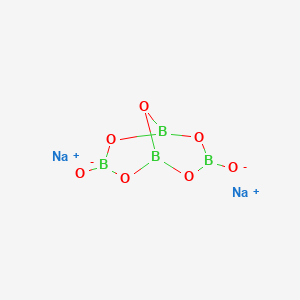
Verified chemistry for CAS 12267-73-1
Sodium Tetraborate
- IUPAC name
- disodium;3,7-dioxido-2,4,6,8,9-pentaoxa-1,3,5,7-tetraborabicyclo[3.3.1]nonane
- Molecular formula
- B4Na2O7
- Molecular weight
- 201.2 g/mol
- Exact mass
- 201.9811616 Da
- Monoisotopic mass
- 201.9811616 Da
- Topological polar surface area
- 92.3 Ų
- Molecular complexity
- 121.0
- Formal charge
- 0
- Hydrogen-bond donors
- 0
- Hydrogen-bond acceptors
- 7
- Rotatable bonds
- 0
- Heavy atoms
- 13
- Covalent units
- 3
Names and synonyms reported to PubChem
16 more reported names
External database identifiers
- EPA DTXSID:DTXSID101014358
- PubMed:21774671
- PubMed:19059942
- PubMed:1432568
Advanced structure statistics
- Defined atom stereocentres
- 0
- Undefined atom stereocentres
- 0
- Defined bond stereocentres
- 0
- Undefined bond stereocentres
- 0
- 3D conformers
- 0
Machine-readable structure identifiers
- SMILES
B1(OB2OB(OB(O1)O2)[O-])[O-].[Na+].[Na+]- InChI
InChI=1S/B4O7.2Na/c5-1-7-3-9-2(6)10-4(8-1)11-3;;/q-2;2*+1- InChIKey
UQGFMSUEHSUPRD-UHFFFAOYSA-N
Evidence from additional scientific databases
NIH PubChem PUG-View
Attributed physical-property, hazard, environmental and use annotations.
- Boiling Point: 1,575 °C (decomposes) Source: Hazardous Substances Data Bank (HSDB)
- Boiling Point: 2867 °F (decomposes) Source: Occupational Safety and Health Administration (OSHA)
- Boiling Point: 2867 °F (Decomposes) Source: The National Institute for Occupational Safety and Health (NIOSH)
- Color/Form: Colorless glassy solid; hygroscopic Source: Hazardous Substances Data Bank (HSDB)
- Color/Form: Light grey, vitreous granules Source: Hazardous Substances Data Bank (HSDB)
- Color/Form: White to gray powder; becomes opaque on exposure to air Source: Hazardous Substances Data Bank (HSDB)
- Density: 2.367 Source: Hazardous Substances Data Bank (HSDB)
- Density: White crystals or powder, odorless; density: 1.73 20 °C/4 °C; loses water of crystallization when heated, with melting between 75 and 320 °C; fuses to a glassy mass at red heat (borax glass); effloresces slightly in warm dry air; soluble in water, glycerol; insoluble in alcohol /Sodium tetraborate decahydrate/ Source: Hazardous Substances Data Bank (HSDB)
- Density: Relative density (water = 1): 2.4 Source: ILO-WHO International Chemical Safety Cards (ICSCs)
- Density: 2.37 Source: Occupational Safety and Health Administration (OSHA)
- Density: 2.37 Source: The National Institute for Occupational Safety and Health (NIOSH)
- Melting Point: Between 171 °C and 175 °C with decomposition Source: EU Food Improvement Agents
- Melting Point: 743 °C Source: Hazardous Substances Data Bank (HSDB)
- Melting Point: 742 °C Source: ILO-WHO International Chemical Safety Cards (ICSCs)
- Melting Point: 1366 °F Source: Occupational Safety and Health Administration (OSHA)
- Melting Point: 1366 °F Source: The National Institute for Occupational Safety and Health (NIOSH)
- Odor: Odorless Source: Hazardous Substances Data Bank (HSDB)
- Physical Description: Liquid; Liquid; Other Solid; Dry Powder; Large Crystals; Large Crystals; Dry Powder; Other Solid Source: EPA Chemical Data Reporting (CDR)
- Physical Description: Powder or glass-like plates becoming opaque on exposure to air; slowly soluble in water Source: EU Food Improvement Agents
- Physical Description: White to gray, odorless powder; Becomes opaque on exposure to air; [NIOSH] Source: Haz-Map, Information on Hazardous Chemicals and Occupational Diseases
- Physical Description: COLOURLESS-TO-WHITE HYGROSCOPIC CRYSTALS OR POWDER. TURNS OPAQUE ON EXPOSURE TO AIR. Source: ILO-WHO International Chemical Safety Cards (ICSCs)
- Physical Description: White to gray, odorless powder. Source: Occupational Safety and Health Administration (OSHA)
- Physical Description: White to gray, odorless powder. [herbicide] [Note: Becomes opaque on exposure to air.] Source: The National Institute for Occupational Safety and Health (NIOSH)
- Refractive Index: INDEX OF REFRACTION: 1.5010 Source: Hazardous Substances Data Bank (HSDB)
- Solubility: Water solubility: 3.1% at 25 °C; 2.5% at 20 °C Source: Hazardous Substances Data Bank (HSDB)
- Solubility: Solubility at 25 °C: 16.7% in methanol; 30% in ethylene glycol; 40.6 g/L in formamide Source: Hazardous Substances Data Bank (HSDB)
- Solubility: Solubility in water, g/100ml at 20 °C: 2.56 Source: ILO-WHO International Chemical Safety Cards (ICSCs)
- Solubility: 4% Source: The National Institute for Occupational Safety and Health (NIOSH)
- Vapor Pressure: Negligible at 20 °C Source: Hazardous Substances Data Bank (HSDB)
- Vapor Pressure: 0 mmHg (approx) Source: Occupational Safety and Health Administration (OSHA)
- Vapor Pressure: 0 mmHg (approx) Source: The National Institute for Occupational Safety and Health (NIOSH)
- pH: pH = 9.3 at 20 °C (3% solution) Source: Hazardous Substances Data Bank (HSDB)
- Exposure Routes: The substance can be absorbed into the body by inhalation of its aerosol and by ingestion. Source: ILO-WHO International Chemical Safety Cards (ICSCs)
- Exposure Routes: inhalation, ingestion, skin and/or eye contact Source: The National Institute for Occupational Safety and Health (NIOSH)
- First Aid: (General first aid procedures); Eye: Irrigate immediately - If this chemical contacts the eyes, immediately wash (irrigate) the eyes with large amounts of water, occasionally lifting the lower and upper lids. Get medical attention immediately.; Skin: Soap wash - If this chemical contacts the skin, wash the contaminated skin with soap and water.; Breathing: Respiratory support; Swallow: Medical attention immediately - If this chemical has been swallowed, get medical attention immediately. Source: The National Institute for Occupational Safety and Health (NIOSH)
- Signal: Danger Source: Regulation (EC) No 1272/2008 of the European Parliament and of the Council
- GHS Hazard Statements: H360FD: May damage fertility; May damage the unborn child [Danger Reproductive toxicity] Source: Regulation (EC) No 1272/2008 of the European Parliament and of the Council
- Precautionary Statement Codes: P203, P280, P318, P405, and P501 (click each P-code to see the statement) Source: Regulation (EC) No 1272/2008 of the European Parliament and of the Council
- Signal: Danger Source: European Chemicals Agency (ECHA)
- GHS Hazard Statements: H319 (53.2%): Causes serious eye irritation [Warning Serious eye damage/eye irritation]; H360 (88.5%): May damage fertility or the unborn child [Danger Reproductive toxicity]; H360FD (22.3%): May damage fertility; May damage the unborn child [Danger Reproductive toxicity] Source: European Chemicals Agency (ECHA)
- Precautionary Statement Codes: P203, P264+P265, P280, P305+P351+P338, P318, P337+P317, P405, and P501 (click each P-code to see the statement) Source: European Chemicals Agency (ECHA)
- ECHA C&L Notifications Summary: Aggregated GHS information provided per 1733 reports by companies from 44 notifications to the ECHA C&L Inventory. Each notification may be associated with multiple companies.; Information may vary between notifications depending on impurities, additives, and other factors. The percentage value in parenthesis indicates the notified classification ratio from companies that provide hazard codes. Only hazard codes with percentage values above 10% are shown. For more detailed information, please visit ECHA C&L website. Source: European Chemicals Agency (ECHA)
- Signal: Danger Source: NITE-CMC
- GHS Hazard Statements: H315: Causes skin irritation [Warning Skin corrosion/irritation]; H319: Causes serious eye irritation [Warning Serious eye damage/eye irritation]; H335: May cause respiratory irritation [Warning Specific target organ toxicity, single exposure; Respiratory tract irritation]; H360: May damage fertility or the unborn child [Danger Reproductive toxicity]; H370: Causes damage to organs [Danger Specific target organ toxicity, single exposure]; H372: Causes damage to organs through prolonged or repeated exposure [Danger Specific target organ toxicity, repeated exposure] Source: NITE-CMC
- Precautionary Statement Codes: P203, P260, P261, P264, P264+P265, P270, P271, P280, P302+P352, P304+P340, P305+P351+P338, P308+P316, P318, P319, P321, P332+P317, P337+P317, P362+P364, P403+P233, P405, and P501 (click each P-code to see the statement) Source: NITE-CMC
- GHS Hazard Statements: H320: Causes eye irritation [Warning Serious eye damage/eye irritation]; H335: May cause respiratory irritation [Warning Specific target organ toxicity, single exposure; Respiratory tract irritation]; H360: May damage fertility or the unborn child [Danger Reproductive toxicity]; H370: Causes damage to organs [Danger Specific target organ toxicity, single exposure]; H372: Causes damage to organs through prolonged or repeated exposure [Danger Specific target organ toxicity, repeated exposure]; H373: May causes damage to organs through prolonged or repeated exposure [Warning Specific target organ toxicity, repeated exposure]; H402: Harmful to aquatic life [Hazardous to the aquatic environment, acute hazard]; H412: Harmful to aquatic life with long lasting effects [Hazardous to the aquatic environment, long-term hazard] Source: NITE-CMC
- Precautionary Statement Codes: P203, P260, P261, P264, P264+P265, P270, P271, P273, P280, P304+P340, P305+P351+P338, P308+P316, P318, P319, P321, P337+P317, P403+P233, P405, and P501 (click each P-code to see the statement) Source: NITE-CMC
- Target Organs: Eyes, skin, respiratory system Source: The National Institute for Occupational Safety and Health (NIOSH)
- Environmental Bioconcentration: Accumulates in the plant Source: Hazardous Substances Data Bank (HSDB)
- Environmental Fate: Terrestrial Fate: Average persistence at recommended rates is one or more years, depending on soil type and rainfall. Less persistent in acid soils and in high rainfall areas. Source: Hazardous Substances Data Bank (HSDB)
- Consumer Uses: Adhesion/cohesion promoter; Flux agent; Soil amendments (fertilizers); Filler; Not Known or Reasonably Ascertainable; Bleaching agent; Anti-freeze agent; Other Source: EPA Chemical Data Reporting (CDR)
- Industry Uses: Processing aids not otherwise specified; Bleaching agent; Anti-freeze agent; Other; Heat stabilizer; Hardener; Adhesion/cohesion promoter; Flame retardant; Flux agent; Filler; Soil amendments (fertilizers) Source: EPA Chemical Data Reporting (CDR)
- Sources/Uses: Used as tablets or powder to kill larvae in livestock confinements and crawling insects in residences; [EPA Pesticides] Used as a fluxing agent, a buffering agent, a biocide (preservative, antiseptic, insecticide, fungicide, herbicide, algicide, nematicide), a fireproofing agent, a corrosion inhibitor, a tanning agent, and a textile bleaching agent; Used to manufacture glazes, enamels, borosilicate glass, fertilizers, detergents, antifreeze, pharmaceuticals, and cosmetics; [HSDB] Source: Haz-Map, Information on Hazardous Chemicals and Occupational Diseases
- Industrial Processes with risk of exposure: Acid and Alkali Cleaning of Metals [Category: Clean]; Using Disinfectants or Biocides [Category: Clean]; Farming (Pesticides) [Category: Industry]; Glass Manufacturing [Category: Industry] Source: Haz-Map, Information on Hazardous Chemicals and Occupational Diseases
- Uses: For sodium tetraborate (USEPA/OPP Pesticide Code: 011112) ACTIVE products with label matches. /SRP: Registered for use in the U.S. but approved pesticide uses may change periodically and so federal, state and local authorities must be consulted for currently approved uses./ Source: Hazardous Substances Data Bank (HSDB)
- Uses: Manufacture of glass, enamels, & other ceramic products Source: Hazardous Substances Data Bank (HSDB)
- Uses: Soldering metals; manufacture of glazes and enamels; tanning; in cleaning compounds; artificially aging wood; ...curing and preserving skins Source: Hazardous Substances Data Bank (HSDB)
- Uses: As preservative either alone or with other antiseptics against wood fungus; fireproofing fabrics & wood Source: Hazardous Substances Data Bank (HSDB)
- Uses: For more Uses (Complete) data for SODIUM TETRABORATE (15 total), please visit the HSDB record page. Source: Hazardous Substances Data Bank (HSDB)
Mapped by: Existing checksum-valid CAS to unique PubChem CID match. Retrieved: 2026-08-31. Open source record
Scientific classifications and hazard annotations provide context and do not replace the market-specific regulatory decision shown above.
Additional source coverage and match status
| Source | Result | Checked |
|---|---|---|
| NIH PubChem PUG-View | Exact match | 2026-08-31 |
A recorded no-match is useful evidence that the source was checked; it is not a claim that the substance does not exist elsewhere.
Retrieved from NIH PubChem on 2026-09-02 by checksum-valid CAS matching. Chemical properties do not replace the regulatory decision on this page.
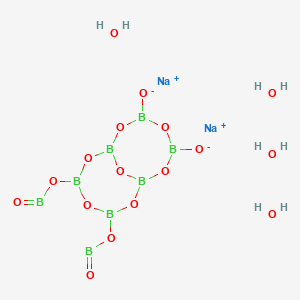
Verified chemistry for CAS 12280-03-4
Disodium octaborate tetrahydrate
- IUPAC name
- disodium;(9,11-dioxido-5-oxoboranyloxy-2,4,6,8,10,12,13-heptaoxa-1,3,5,7,9,11-hexaborabicyclo[5.5.1]tridecan-3-yl)oxy-oxoborane;tetrahydrate
- Molecular formula
- B8H8Na2O17
- Molecular weight
- 412.5 g/mol
- Exact mass
- 413.0337604 Da
- Monoisotopic mass
- 414.030129 Da
- Topological polar surface area
- 167.0 Ų
- Molecular complexity
- 319.0
- Formal charge
- 0
- Hydrogen-bond donors
- 4
- Hydrogen-bond acceptors
- 17
- Rotatable bonds
- 2
- Heavy atoms
- 27
- Covalent units
- 7
Names and synonyms reported to PubChem
16 more reported names
External database identifiers
- EPA DTXSID:DTXSID1034391
Advanced structure statistics
- Defined atom stereocentres
- 0
- Undefined atom stereocentres
- 0
- Defined bond stereocentres
- 0
- Undefined bond stereocentres
- 0
- 3D conformers
- 0
Machine-readable structure identifiers
- SMILES
B(=O)OB1OB2OB(OB(OB(O2)OB(O1)OB=O)[O-])[O-].O.O.O.O.[Na+].[Na+]- InChI
InChI=1S/B8O13.2Na.4H2O/c9-1-13-5-18-6(14-2-10)20-8-17-4(12)15-3(11)16-7(19-5)21-8;;;;;;/h;;;4*1H2/q-2;2*+1;;;;- InChIKey
RDMZIKMKSGCBKK-UHFFFAOYSA-N
Evidence from additional scientific databases
NIH PubChem PUG-View
Attributed physical-property, hazard, environmental and use annotations.
- Physical Description: Large Crystals; CBI Source: EPA Chemical Data Reporting (CDR)
- Physical Description: White odorless solid; [Reference #1] White odorless powder; [U.S. Borax MSDS] Source: Haz-Map, Information on Hazardous Chemicals and Occupational Diseases
- Signal: Danger Source: Regulation (EC) No 1272/2008 of the European Parliament and of the Council
- GHS Hazard Statements: H360FD: May damage fertility; May damage the unborn child [Danger Reproductive toxicity] Source: Regulation (EC) No 1272/2008 of the European Parliament and of the Council
- Precautionary Statement Codes: P203, P280, P318, P405, and P501 (click each P-code to see the statement) Source: Regulation (EC) No 1272/2008 of the European Parliament and of the Council
- Note: This chemical does not meet GHS hazard criteria for 7.1% (2 of 28) of reports. Source: European Chemicals Agency (ECHA)
- Signal: Danger Source: European Chemicals Agency (ECHA)
- GHS Hazard Statements: H315 (14.3%): Causes skin irritation [Warning Skin corrosion/irritation]; H319 (71.4%): Causes serious eye irritation [Warning Serious eye damage/eye irritation]; H360 (78.6%): May damage fertility or the unborn child [Danger Reproductive toxicity] Source: European Chemicals Agency (ECHA)
- Precautionary Statement Codes: P203, P264, P264+P265, P280, P302+P352, P305+P351+P338, P318, P321, P332+P317, P337+P317, P362+P364, P405, and P501 (click each P-code to see the statement) Source: European Chemicals Agency (ECHA)
- ECHA C&L Notifications Summary: Aggregated GHS information provided per 28 reports by companies from 4 notifications to the ECHA C&L Inventory. Each notification may be associated with multiple companies.; Reported as not meeting GHS hazard criteria per 2 of 28 reports by companies.; There are 3 notifications provided by 26 of 28 reports by companies with hazard statement code(s).; Information may vary between notifications depending on impurities, additives, and other factors. The percentage value in parenthesis indicates the notified classification ratio from companies that provide hazard codes. Only hazard codes with percentage values above 10% are shown. For more detailed information, please visit ECHA C&L website. Source: European Chemicals Agency (ECHA)
- Signal: Danger Source: NITE-CMC
- GHS Hazard Statements: H335: May cause respiratory irritation [Warning Specific target organ toxicity, single exposure; Respiratory tract irritation]; H360: May damage fertility or the unborn child [Danger Reproductive toxicity]; H370: Causes damage to organs [Danger Specific target organ toxicity, single exposure]; H372: Causes damage to organs through prolonged or repeated exposure [Danger Specific target organ toxicity, repeated exposure]; H373: May causes damage to organs through prolonged or repeated exposure [Warning Specific target organ toxicity, repeated exposure] Source: NITE-CMC
- Precautionary Statement Codes: P203, P260, P261, P264, P270, P271, P280, P304+P340, P308+P316, P318, P319, P321, P403+P233, P405, and P501 (click each P-code to see the statement) Source: NITE-CMC
- Signal: Danger Source: Hazardous Chemical Information System (HCIS), Safe Work Australia
- Consumer Uses: Other; Not Known or Reasonably Ascertainable Source: EPA Chemical Data Reporting (CDR)
- Industry Uses: Soil amendments (fertilizers); Other Source: EPA Chemical Data Reporting (CDR)
- Sources/Uses: Used as an insecticide (ants, cockroaches, flies, silverfish, termites, and wood boring insects) and fungicidal wood preservative; Not used on crops but used on compost, manure, and animal quarters; [Reference #1] Source: Haz-Map, Information on Hazardous Chemicals and Occupational Diseases
- Industrial Processes with risk of exposure: Applying Wood Preservatives [Category: Other]; Farming (Pesticides) [Category: Industry] Source: Haz-Map, Information on Hazardous Chemicals and Occupational Diseases
Mapped by: Existing checksum-valid CAS to unique PubChem CID match. Retrieved: 2026-08-31. Open source record
Scientific classifications and hazard annotations provide context and do not replace the market-specific regulatory decision shown above.
Additional source coverage and match status
| Source | Result | Checked |
|---|---|---|
| NIH PubChem PUG-View | Exact match | 2026-08-31 |
A recorded no-match is useful evidence that the source was checked; it is not a claim that the substance does not exist elsewhere.
Retrieved from NIH PubChem on 2026-09-02 by checksum-valid CAS matching. Chemical properties do not replace the regulatory decision on this page.
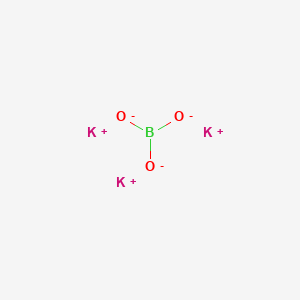
Verified chemistry for CAS 12712-38-8
boric acid, potassium salt
Tripotassium borate is a member of borate salts. — ChEBI
- IUPAC name
- tripotassium;borate
- Molecular formula
- BK3O3
- Molecular weight
- 176.11 g/mol
- Exact mass
- 175.8851685 Da
- Monoisotopic mass
- 175.8851685 Da
- Topological polar surface area
- 69.2 Ų
- Molecular complexity
- 8.0
- Formal charge
- 0
- Hydrogen-bond donors
- 0
- Hydrogen-bond acceptors
- 3
- Rotatable bonds
- 0
- Heavy atoms
- 7
- Covalent units
- 4
Names and synonyms reported to PubChem
4 more reported names
External database identifiers
- ChEBI:CHEBI:38911
- EPA DTXSID:DTXSID3049750
Advanced structure statistics
- Defined atom stereocentres
- 0
- Undefined atom stereocentres
- 0
- Defined bond stereocentres
- 0
- Undefined bond stereocentres
- 0
- 3D conformers
- 0
Machine-readable structure identifiers
- SMILES
B([O-])([O-])[O-].[K+].[K+].[K+]- InChI
InChI=1S/BO3.3K/c2-1(3)4;;;/q-3;3*+1- InChIKey
WUUHFRRPHJEEKV-UHFFFAOYSA-N
Evidence from additional scientific databases
NIH PubChem PUG-View
Attributed physical-property, hazard, environmental and use annotations.
- Signal: Danger Source: European Chemicals Agency (ECHA)
- GHS Hazard Statements: H315 (71%): Causes skin irritation [Warning Skin corrosion/irritation]; H319 (71%): Causes serious eye irritation [Warning Serious eye damage/eye irritation]; H335 (35.5%): May cause respiratory irritation [Warning Specific target organ toxicity, single exposure; Respiratory tract irritation]; H360 (29%): May damage fertility or the unborn child [Danger Reproductive toxicity] Source: European Chemicals Agency (ECHA)
- Precautionary Statement Codes: P203, P261, P264, P264+P265, P271, P280, P302+P352, P304+P340, P305+P351+P338, P318, P319, P321, P332+P317, P337+P317, P362+P364, P403+P233, P405, and P501 (click each P-code to see the statement) Source: European Chemicals Agency (ECHA)
- ECHA C&L Notifications Summary: Aggregated GHS information provided per 62 reports by companies from 3 notifications to the ECHA C&L Inventory. Each notification may be associated with multiple companies.; Information may vary between notifications depending on impurities, additives, and other factors. The percentage value in parenthesis indicates the notified classification ratio from companies that provide hazard codes. Only hazard codes with percentage values above 10% are shown. For more detailed information, please visit ECHA C&L website. Source: European Chemicals Agency (ECHA)
- Signal: Danger Source: Hazardous Chemical Information System (HCIS), Safe Work Australia
- GHS Hazard Statements: H360FD: May damage fertility; May damage the unborn child [Danger Reproductive toxicity] Source: Hazardous Chemical Information System (HCIS), Safe Work Australia
- Precautionary Statement Codes: P203, P280, P318, P405, and P501 (click each P-code to see the statement) Source: Hazardous Chemical Information System (HCIS), Safe Work Australia
Mapped by: Existing checksum-valid CAS to unique PubChem CID match. Retrieved: 2026-08-31. Open source record
Scientific classifications and hazard annotations provide context and do not replace the market-specific regulatory decision shown above.
Additional source coverage and match status
| Source | Result | Checked |
|---|---|---|
| NIH PubChem PUG-View | Exact match | 2026-08-31 |
A recorded no-match is useful evidence that the source was checked; it is not a claim that the substance does not exist elsewhere.
Retrieved from NIH PubChem on 2026-09-02 by checksum-valid CAS matching. Chemical properties do not replace the regulatory decision on this page.
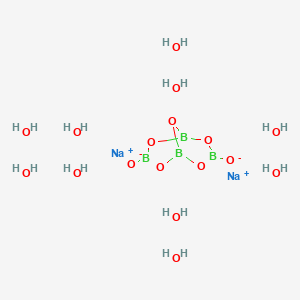
Verified chemistry for CAS 1303-96-4
Borax (B4Na2O7.10H2O)
Borax is a mineral with formula of Na2B4O5(OH)4·8H2O. The IMA symbol is Brx. — RRUFF Project
- IUPAC name
- disodium;3,7-dioxido-2,4,6,8,9-pentaoxa-1,3,5,7-tetraborabicyclo[3.3.1]nonane;decahydrate
- Molecular formula
- B4H20Na2O17
- Molecular weight
- 381.4 g/mol
- Exact mass
- 382.0868084 Da
- Monoisotopic mass
- 382.0868084 Da
- Topological polar surface area
- 102.0 Ų
- Molecular complexity
- 121.0
- Formal charge
- 0
- Hydrogen-bond donors
- 10
- Hydrogen-bond acceptors
- 17
- Rotatable bonds
- 0
- Heavy atoms
- 23
- Covalent units
- 13
Names and synonyms reported to PubChem
16 more reported names
External database identifiers
- ChEMBL:CHEMBL3833375
- EPA DTXSID:DTXSID701014356
- PubMed:10010
Advanced structure statistics
- Defined atom stereocentres
- 0
- Undefined atom stereocentres
- 0
- Defined bond stereocentres
- 0
- Undefined bond stereocentres
- 0
- 3D conformers
- 0
Machine-readable structure identifiers
- SMILES
B1(OB2OB(OB(O1)O2)[O-])[O-].O.O.O.O.O.O.O.O.O.O.[Na+].[Na+]- InChI
InChI=1S/B4O7.2Na.10H2O/c5-1-7-3-9-2(6)10-4(8-1)11-3;;;;;;;;;;;;/h;;;10*1H2/q-2;2*+1;;;;;;;;;;- InChIKey
CDMADVZSLOHIFP-UHFFFAOYSA-N
Evidence from additional scientific databases
NIH PubChem PUG-View
Attributed physical-property, hazard, environmental and use annotations.
- Boiling Point: 608 °F Source: Occupational Safety and Health Administration (OSHA)
- Boiling Point: 608 °F Source: The National Institute for Occupational Safety and Health (NIOSH)
- Color/Form: White, monoclinic crystals Source: Hazardous Substances Data Bank (HSDB)
- Color/Form: Hard crystals, granules or crystalline powder; efflorescent in dry air, the crystals often being coated with white powder Source: Hazardous Substances Data Bank (HSDB)
- Color/Form: Crystalline granules or crystalline powder Source: Hazardous Substances Data Bank (HSDB)
- Color/Form: White, crystalline solid [Note: Becomes anhydrous at 608 degrees F] Source: Hazardous Substances Data Bank (HSDB)
- Density: 1.73 g/cu cm Source: Hazardous Substances Data Bank (HSDB)
- Density: Relative density (water = 1): 1.7 Source: ILO-WHO International Chemical Safety Cards (ICSCs)
- Density: 1.73 Source: Occupational Safety and Health Administration (OSHA)
- Density: 1.73 @25 °C Source: PAC Chemical Database, U.S. Department of Energy
- Density: 1.73 Source: The National Institute for Occupational Safety and Health (NIOSH)
- Melting Point: 75 °C (decomposes) Source: Hazardous Substances Data Bank (HSDB)
- Melting Point: 167 °F Source: Occupational Safety and Health Administration (OSHA)
- Melting Point: 167 °F Source: The National Institute for Occupational Safety and Health (NIOSH)
- Odor: Odorless Source: Hazardous Substances Data Bank (HSDB)
- Physical Description: Liquid; Other Solid; Large Crystals; Wet Solid; Dry Powder Source: EPA Chemical Data Reporting (CDR)
- Physical Description: White, odorless, crystalline solid; Becomes anhydrous at 608 degrees F; [NIOSH] Source: Haz-Map, Information on Hazardous Chemicals and Occupational Diseases
- Physical Description: WHITE CRYSTALS OR CRYSTALLINE POWDER. Source: ILO-WHO International Chemical Safety Cards (ICSCs)
- Physical Description: White, odorless, crystalline solid. Source: Occupational Safety and Health Administration (OSHA)
- Physical Description: White, odorless, crystalline solid. [herbicide] [Note: Becomes anhydrous at 608 °F.] Source: The National Institute for Occupational Safety and Health (NIOSH)
- Refractive Index: Index of refraction: 1.447 (alpha); 1.469 (beta); 1.472 (gamma) Source: Hazardous Substances Data Bank (HSDB)
- Solubility: Aqueous solution is alkaline to litmus and phenolphthalein; pH about pH = 9.5 Source: Hazardous Substances Data Bank (HSDB)
- Solubility: At 100 °C loses 5H2O; at 150 °C loses 9H2O; becomes anhydrous at 320 °C; borax dissolves many metallic oxides when fused with them Source: Hazardous Substances Data Bank (HSDB)
- Solubility: In water, 5.93X10+4 mg/L at 25 °C Source: Hazardous Substances Data Bank (HSDB)
- Solubility: 3.17 g/100 g water at 25 °C Source: Hazardous Substances Data Bank (HSDB)
- Solubility: 1 g/16 mL in water; 1 g/0.6 mL boiling water; 1 g/1 mL glycerol; insoluble in alcohol Source: Hazardous Substances Data Bank (HSDB)
- Solubility: Insoluble in ethanol Source: Hazardous Substances Data Bank (HSDB)
- Solubility: 0.60 g/100 g acetone Source: Hazardous Substances Data Bank (HSDB)
- Solubility: Solubility in water, g/100ml at 20 °C: 5.1 Source: ILO-WHO International Chemical Safety Cards (ICSCs)
- Solubility: 6% Source: The National Institute for Occupational Safety and Health (NIOSH)
- Vapor Pressure: Approximately 0 mm Hg Source: Hazardous Substances Data Bank (HSDB)
- Vapor Pressure: 0 mmHg (approx) Source: Occupational Safety and Health Administration (OSHA)
- Vapor Pressure: 0 mmHg (approx) Source: The National Institute for Occupational Safety and Health (NIOSH)
- pH: pH at 20 °C: 9.3 (0.1% solution); 9.2 (1.0% solution) Source: Hazardous Substances Data Bank (HSDB)
- Exposure Routes: The substance can be absorbed into the body by inhalation and by ingestion. Source: ILO-WHO International Chemical Safety Cards (ICSCs)
- Exposure Routes: inhalation, ingestion, skin and/or eye contact Source: The National Institute for Occupational Safety and Health (NIOSH)
- First Aid: (General first aid procedures); Eye: Irrigate immediately - If this chemical contacts the eyes, immediately wash (irrigate) the eyes with large amounts of water, occasionally lifting the lower and upper lids. Get medical attention immediately.; Skin: Soap wash - If this chemical contacts the skin, wash the contaminated skin with soap and water.; Breathing: Respiratory support; Swallow: Medical attention immediately - If this chemical has been swallowed, get medical attention immediately. Source: The National Institute for Occupational Safety and Health (NIOSH)
- Signal: Danger Source: Regulation (EC) No 1272/2008 of the European Parliament and of the Council
- GHS Hazard Statements: H360FD: May damage fertility; May damage the unborn child [Danger Reproductive toxicity] Source: Regulation (EC) No 1272/2008 of the European Parliament and of the Council
- Precautionary Statement Codes: P203, P280, P318, P405, and P501 (click each P-code to see the statement) Source: Regulation (EC) No 1272/2008 of the European Parliament and of the Council
- Note: This chemical does not meet GHS hazard criteria for < 0.1% (1 of 2865) of reports. Source: European Chemicals Agency (ECHA)
- Signal: Danger Source: European Chemicals Agency (ECHA)
- GHS Hazard Statements: H319 (12.6%): Causes serious eye irritation [Warning Serious eye damage/eye irritation]; H360 (93.2%): May damage fertility or the unborn child [Danger Reproductive toxicity] Source: European Chemicals Agency (ECHA)
- Precautionary Statement Codes: P203, P264+P265, P280, P305+P351+P338, P318, P337+P317, P405, and P501 (click each P-code to see the statement) Source: European Chemicals Agency (ECHA)
- ECHA C&L Notifications Summary: Aggregated GHS information provided per 2865 reports by companies from 31 notifications to the ECHA C&L Inventory. Each notification may be associated with multiple companies.; Reported as not meeting GHS hazard criteria per 1 of 2865 reports by companies.; There are 30 notifications provided by 2864 of 2865 reports by companies with hazard statement code(s).; Information may vary between notifications depending on impurities, additives, and other factors. The percentage value in parenthesis indicates the notified classification ratio from companies that provide hazard codes. Only hazard codes with percentage values above 10% are shown. For more detailed information, please visit ECHA C&L website. Source: European Chemicals Agency (ECHA)
- Signal: Danger Source: NITE-CMC
- GHS Hazard Statements: H315: Causes skin irritation [Warning Skin corrosion/irritation]; H319: Causes serious eye irritation [Warning Serious eye damage/eye irritation]; H335: May cause respiratory irritation [Warning Specific target organ toxicity, single exposure; Respiratory tract irritation]; H360: May damage fertility or the unborn child [Danger Reproductive toxicity]; H370: Causes damage to organs [Danger Specific target organ toxicity, single exposure]; H372: Causes damage to organs through prolonged or repeated exposure [Danger Specific target organ toxicity, repeated exposure]; H413: May cause long lasting harmful effects to aquatic life [Hazardous to the aquatic environment, long-term hazard] Source: NITE-CMC
- Precautionary Statement Codes: P203, P260, P261, P264, P264+P265, P270, P271, P273, P280, P302+P352, P304+P340, P305+P351+P338, P308+P316, P318, P319, P321, P332+P317, P337+P317, P362+P364, P403+P233, P405, and P501 (click each P-code to see the statement) Source: NITE-CMC
- GHS Hazard Statements: H303: May be harmful if swallowed [Warning Acute toxicity, oral]; H315: Causes skin irritation [Warning Skin corrosion/irritation]; H319: Causes serious eye irritation [Warning Serious eye damage/eye irritation]; H361: Suspected of damaging fertility or the unborn child [Warning Reproductive toxicity]; H370: Causes damage to organs [Danger Specific target organ toxicity, single exposure]; H372: Causes damage to organs through prolonged or repeated exposure [Danger Specific target organ toxicity, repeated exposure]; H373: May causes damage to organs through prolonged or repeated exposure [Warning Specific target organ toxicity, repeated exposure] Source: NITE-CMC
- Target Organs: Eyes, skin, respiratory system Source: The National Institute for Occupational Safety and Health (NIOSH)
- Cosmetic Ingredient Review Conclusion: The Expert Panel concludes that Sodium Borate and Boric Acid, in concentrations less than or equal to 5 percent, are safe as cosmetic ingredients when used as currently recommended; however, cosmetic formulations containing free Sodium Borate or Boric Acid at this concentration should not be used on infant skin or injured skin. Note: In 2003, the CIR Expert Panel considered available new data on these ingredients and reaffirmed the above conclusion. Source: Cosmetic Ingredient Review (CIR)
- Cosmetic Ingredient Review Finding(s): Safe for use in cosmetics, with qualifications Source: Cosmetic Ingredient Review (CIR)
- Environmental Bioconcentration: In a greenhouse experiment with sandy loam soil treated with 0-8.0 ppm boron as borax, boron toxicity symptoms appeared earliest in lentil plants and barley seedlings exposed to 8.0 ppm boron. In barley the severity of boron toxicity decreased with the decrease in boron levels, whereas in lentil the severity of the symptoms eventually reached the same level in 2 and 4 ppm boron treatments as with the highest concentration. Dry matter yield decreased 38.6% in lentil and 23.4% in barley exposed to 8.0 ppm boron in comparison with controls. Boron contents of lentil and barley plants on soil treated with 8 ppm boron were approximately 7- and approximately 8-fold those of control plants, respectively. Source: Hazardous Substances Data Bank (HSDB)
- Environmental Fate: TERRESTRIAL FATE: Boron is naturally occurring and ubiquitous in the environment. No microbial degradation. Disappearance from soil is by washing out. Persistence in soil is about 2 years, depending on rainfall and soil structure. Source: Hazardous Substances Data Bank (HSDB)
- Consumer Uses: Other; Adhesion/cohesion promoter; Soil amendments (fertilizers); Not Known or Reasonably Ascertainable; Flame retardant Source: EPA Chemical Data Reporting (CDR)
- Industry Uses: Abrasives; Plating agent; Etching agent; Chelating agent; Flame retardant; Soil amendments (fertilizers) Source: EPA Chemical Data Reporting (CDR)
- Cosmetic Ingredient Review Link: CIR ingredient: Sodium Borate Source: Cosmetic Ingredient Review (CIR)
- Sources/Uses: Used as a preservative, antiseptic and fungicide; also used to manufacture glazes, enamels, soldering fluxes and cleaning compounds and to fireproof textiles and wood; [ACGIH] Boric acid and borates as tablets or powder are used to kill larvae in barns and other insects in houses. Rarely, they are sprayed as herbicides. [EPA: Recognition of Pesticide Poisonings] Used in photo developing bath; [www.ci.tucson.az.us/arthazards/medium.html] Borax (borax decahydrate) is found naturally in some salt lakes and alkaline soils. Boric acid is formed by crystallizing a solution of hydrochloric acid or sulfuric acid and borax. [Hawley] Source: Haz-Map, Information on Hazardous Chemicals and Occupational Diseases
- Industrial Processes with risk of exposure: Soldering [Category: Heat or Machine]; Using Disinfectants or Biocides [Category: Clean]; Farming (Pesticides) [Category: Industry]; Photographic Processing [Category: Other]; Textiles (Printing, Dyeing, or Finishing) [Category: Industry] Source: Haz-Map, Information on Hazardous Chemicals and Occupational Diseases
- Uses: For borax (USEPA/OPP Pesticide Code: 011102) ACTIVE products with label matches. /SRP: Registered for use in the U.S. but approved pesticide uses may change periodically and so federal, state and local authorities must be consulted for currently approved uses./ Source: Hazardous Substances Data Bank (HSDB)
- Uses: Long been used as a mild antiseptic fungicide and as a herbicide ... Total control of vegetation on non-crop land, such as paths, giving long-term control. Also used in insect baits for food stores to control Formicidae. Source: Hazardous Substances Data Bank (HSDB)
- Uses: Soldering metals; manufacture of glazes and enamels; tanning; in cleaning compounds; artificially aging wood; as preservative, either alone or with other antiseptics against wood fungus; fireproofing fabrics and wood; curing and preserving skins; in cockroach control. In buffers; as a complexing or masking agent in analytical chemistry. Pharmaceutic aid (alkalizer). Source: Hazardous Substances Data Bank (HSDB)
- Uses: Used in ant poisons, for fly control around refuse and manure piles, as a larvicide, in manufacture of glazes, enamels, cleaning compounds, and in soldering metals Source: Hazardous Substances Data Bank (HSDB)
- Uses: For more Uses (Complete) data for BORAX (17 total), please visit the HSDB record page. Source: Hazardous Substances Data Bank (HSDB)
Mapped by: Existing checksum-valid CAS to unique PubChem CID match. Retrieved: 2026-08-31. Open source record
Scientific classifications and hazard annotations provide context and do not replace the market-specific regulatory decision shown above.
Additional source coverage and match status
| Source | Result | Checked |
|---|---|---|
| NIH PubChem PUG-View | Exact match | 2026-08-31 |
A recorded no-match is useful evidence that the source was checked; it is not a claim that the substance does not exist elsewhere.
Retrieved from NIH PubChem on 2026-09-02 by checksum-valid CAS matching. Chemical properties do not replace the regulatory decision on this page.
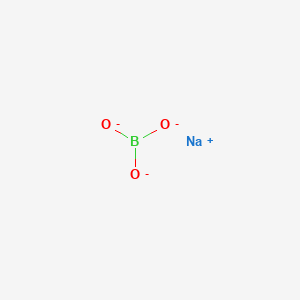
Verified chemistry for CAS 13840-56-7
Boric acid (H3BO3), sodium salt (1:?)
- IUPAC name
- sodium borate
- Molecular formula
- BNaO3-2
- Formula without charge
- BNaO3
- Molecular weight
- 81.80 g/mol
- Exact mass
- 81.9838183 Da
- Monoisotopic mass
- 81.9838183 Da
- Topological polar surface area
- 69.2 Ų
- Molecular complexity
- 8.0
- Formal charge
- -2
- Hydrogen-bond donors
- 0
- Hydrogen-bond acceptors
- 3
- Rotatable bonds
- 0
- Heavy atoms
- 5
- Covalent units
- 2
Names and synonyms reported to PubChem
2 more reported names
Advanced structure statistics
- Defined atom stereocentres
- 0
- Undefined atom stereocentres
- 0
- Defined bond stereocentres
- 0
- Undefined bond stereocentres
- 0
- 3D conformers
- 0
Machine-readable structure identifiers
- SMILES
B([O-])([O-])[O-].[Na+]- InChI
InChI=1S/BO3.Na/c2-1(3)4;/q-3;+1- InChIKey
WJZOJDGNGVXSIK-UHFFFAOYSA-N
Retrieved from NIH PubChem on 2026-09-02 by checksum-valid CAS matching. Chemical properties do not replace the regulatory decision on this page.
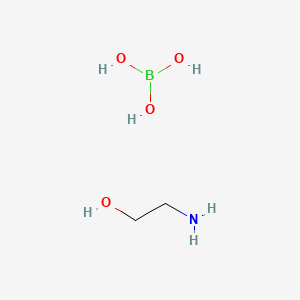
Verified chemistry for CAS 26038-87-9
(2-Hydroxyethyl)ammonium dihydrogen orthoborate
- IUPAC name
- 2-aminoethanol;boric acid
- Molecular formula
- C2H10BNO4
- Molecular weight
- 122.92 g/mol
- Exact mass
- 123.0702880 Da
- Monoisotopic mass
- 123.0702880 Da
- Topological polar surface area
- 107.0 Ų
- Molecular complexity
- 18.0
- Formal charge
- 0
- Hydrogen-bond donors
- 5
- Hydrogen-bond acceptors
- 5
- Rotatable bonds
- 1
- Heavy atoms
- 8
- Covalent units
- 2
Names and synonyms reported to PubChem
10 more reported names
External database identifiers
- EPA DTXSID:DTXSID6029464
Advanced structure statistics
- Defined atom stereocentres
- 0
- Undefined atom stereocentres
- 0
- Defined bond stereocentres
- 0
- Undefined bond stereocentres
- 0
- 3D conformers
- 0
Machine-readable structure identifiers
- SMILES
B(O)(O)O.C(CO)N- InChI
InChI=1S/C2H7NO.BH3O3/c3-1-2-4;2-1(3)4/h4H,1-3H2;2-4H- InChIKey
QIDCRGDFWRMBJC-UHFFFAOYSA-N
Retrieved from NIH PubChem on 2026-09-02 by checksum-valid CAS matching. Chemical properties do not replace the regulatory decision on this page.
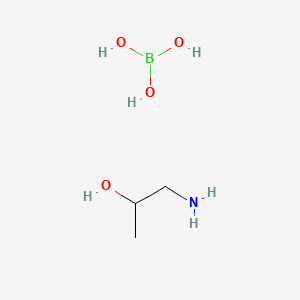
Verified chemistry for CAS 26038-90-4
(2-Hydroxypropyl)ammonium dihydrogen orthoborate
- IUPAC name
- 1-aminopropan-2-ol;boric acid
- Molecular formula
- C3H12BNO4
- Molecular weight
- 136.95 g/mol
- Exact mass
- 137.0859380 Da
- Monoisotopic mass
- 137.0859380 Da
- Topological polar surface area
- 107.0 Ų
- Molecular complexity
- 30.0
- Formal charge
- 0
- Hydrogen-bond donors
- 5
- Hydrogen-bond acceptors
- 5
- Rotatable bonds
- 1
- Heavy atoms
- 9
- Covalent units
- 2
Names and synonyms reported to PubChem
5 more reported names
External database identifiers
- EPA DTXSID:DTXSID10892195
Advanced structure statistics
- Defined atom stereocentres
- 0
- Undefined atom stereocentres
- 1
- Defined bond stereocentres
- 0
- Undefined bond stereocentres
- 0
- 3D conformers
- 0
Machine-readable structure identifiers
- SMILES
B(O)(O)O.CC(CN)O- InChI
InChI=1S/C3H9NO.BH3O3/c1-3(5)2-4;2-1(3)4/h3,5H,2,4H2,1H3;2-4H- InChIKey
FWGLAJMZAXEFTA-UHFFFAOYSA-N
Retrieved from NIH PubChem on 2026-09-02 by checksum-valid CAS matching. Chemical properties do not replace the regulatory decision on this page.
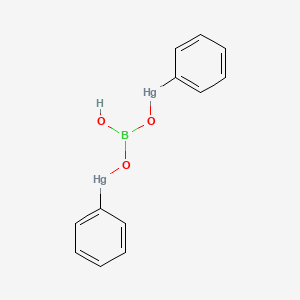
Verified chemistry for CAS 6273-99-0
Mercury, [mu-[orthoborato(2-)-O:O']]diphenyldi-
- IUPAC name
- [hydroxy(phenylmercuriooxy)boranyl]oxy-phenylmercury
- Molecular formula
- C12H11BHg2O3
- Molecular weight
- 615.21 g/mol
- Exact mass
- 616.019095 Da
- Monoisotopic mass
- 618.02141 Da
- Topological polar surface area
- 38.7 Ų
- Molecular complexity
- 199.0
- Formal charge
- 0
- Hydrogen-bond donors
- 1
- Hydrogen-bond acceptors
- 3
- Rotatable bonds
- 6
- Heavy atoms
- 18
- Covalent units
- 1
Names and synonyms reported to PubChem
4 more reported names
External database identifiers
- EPA DTXSID:DTXSID80897334
Advanced structure statistics
- Defined atom stereocentres
- 0
- Undefined atom stereocentres
- 0
- Defined bond stereocentres
- 0
- Undefined bond stereocentres
- 0
- 3D conformers
- 0
Machine-readable structure identifiers
- SMILES
B(O)(O[Hg]C1=CC=CC=C1)O[Hg]C2=CC=CC=C2- InChI
InChI=1S/2C6H5.BHO3.2Hg/c2*1-2-4-6-5-3-1;2-1(3)4;;/h2*1-5H;2H;;/q;;-2;2*+1- InChIKey
HCIUVGKUNYOVBM-UHFFFAOYSA-N
Retrieved from NIH PubChem on 2026-09-02 by checksum-valid CAS matching. Chemical properties do not replace the regulatory decision on this page.
Official source and provenance
- Registered source
- Brazil ANVISA consolidated prohibited substances — RDC 529/2021 through RDC 1.030/2026
- Source reference
- RDC 529/2021 consolidated annex, entry 1407 (through RDC 1.030/2026)
- Source record ID
annex:1407- Source version
- RDC 529/2021 consolidated through RDC 1.030/2026
- Source language
- Portuguese with official English identity where published
- Translation status
- Official English translation · English translation
- Effective date
- 2026-06-15
- Source updated
- 2026-06-15
- Snapshot checked
- 2026-08-31 15:26 UTC
- Validation method
- pdfplumber government baseline + 4 RDC 1.030 exclusions + 15 additions; 1,387 substantive rows
- SHA-256
a212e85540a186a842664fbdd4f351af0b1b4baeeb0c4765b9b52c6ce91c1e84
Registered dataset notes
- Dataset coverage
- All 1,387 substantive current prohibited rows after applying RDC 1.030/2026 additions, amendments and exclusions to RDC 529/2021
- Authority note
- Binding consolidated prohibited list for personal-hygiene products, cosmetics and perfumes
How this record fits the market dataset
Status distribution
Condition text is present on 1387 of 1387 current records. An empty condition field is interpreted according to the record type above; it is never converted into an unrestricted-use claim.
Brazil market context
Complete prohibited dataset plus current restricted-list workflow
Coverage version: ANVISA RDC 1.029/2026 and RDC 1.030/2026, published 15 June 2026
All 1,387 substantive current prohibited rows in RDC 529/2021 consolidated through RDC 1.030/2026, plus the current RDC 1.029 restricted-list and identity workflow.
Verification checklist
- Resolve Portuguese, INCI and CAS identity with the ANVISA crosswalk.
- Check the consolidated prohibited list including RDC 1.030/2026 changes.
- Apply RDC 1.029/2026 restrictions and the still-effective complementary rules.
- Verify Mercosur incorporation, regularisation, labelling and transition periods.
Official market sources
- Brazil ANVISA INCI translation panelIdentity and labelling crosswalk only; regulatory lists must be sourced separately
- Brazil ANVISA restricted substances — RDC 1.029/2026Binding ANVISA resolution effective on publication; replaced RDC 530/2021 for this list part
- Brazil ANVISA consolidated prohibited substances — RDC 529/2021 through RDC 1.030/2026Binding consolidated prohibited list for personal-hygiene products, cosmetics and perfumes
Verification workflow and record completeness
Before using this result in a compliance decision
- Confirm that “Boratos, tetraboratos, octaboratos e sais e ésteres do ácido bórico, incluindo octaboratos dissódicos, MEA-borate, MIPA-borate, boratos de potássio, zinco e sódio, bórax e borato fenil mercúrico” and every CAS/EC identifier refer to the material in your supplier specification.
- Resolve Portuguese, INCI and CAS identity with the ANVISA crosswalk.
- Check the consolidated prohibited list including RDC 1.030/2026 changes.
- Apply RDC 1.029/2026 restrictions and the still-effective complementary rules.
- Verify Mercosur incorporation, regularisation, labelling and transition periods.
- Document the source version and recheck the regulator before manufacture, notification or market placement.
Fields available in this record
- Official substance nameAvailable
- CASAvailable
- ECAvailable
- Separate condition textAvailable
- Effective dateAvailable
- Snapshot hash and methodAvailable
Questions this page answers
Stable citation
Boratos, tetraboratos, octaboratos e sais e ésteres do ácido bórico, incluindo octaboratos dissódicos, MEA-borate, MIPA-borate, boratos de potássio, zinco e sódio, bórax e borato fenil mercúrico. RDC 529/2021 consolidated annex, entry 1407 (through RDC 1.030/2026). Brazil. Source version RDC 529/2021 consolidated through RDC 1.030/2026. CosIng Checker regulatory record: https://cosingchecker.com/regulations/br/records/14582/
Cite the regulator as the legal authority. This page is a structured evidence index and verification aid, not a substitute for the official text or professional legal assessment.
Interpretation and limits for Brazil
This official record identifies the substance as prohibited for cosmetic use in the stated market scope.
Do not rely on a formulation containing this identity until the cited source, effective date and exact substance match have been verified.
How to interpret the legal role
The cited row forms part of a binding rule or legally incorporated list for this market.
Evidence on this page
- Recorded outcome: Prohibited
- Legal role: Binding rule
- Source version: RDC 529/2021 consolidated through RDC 1.030/2026
- Effective date: 2026-06-15
What it does not prove
RDC 1.030/2026 amends rather than replaces the prohibited baseline, and the second restricted-list revision was still under consultation in July 2026.
Further authoritative substance research
None of these sources overrides the market decision above.
Cosmetic Ingredient Review safety assessments
Expert Panel conclusions, assessed ingredient groups, use conditions, dates and report documents
Independent expert review considered by FDA; not a government approval or binding market rule
Research this identity at the sourceFDA Global Substance Registration System
UNII identifiers, preferred names, substance types, codes and public substance relationships
Identity registry only; UNII availability does not imply FDA review or approval
Research this identity at the sourceILO/WHO International Chemical Safety Cards
Hazards, symptoms, first aid, storage, incompatibilities and physical properties for covered chemicals
International occupational chemical-safety reference; not cosmetic-use approval
Research this identity at the sourceJapan NITE-CHRIP
Chemical identity, Japanese and foreign legal lists, GHS hazards and exposure-related information
Chemical-management evidence; cosmetic status remains governed by the applicable MHLW standard and market rules
Research this identity at the sourceNIOSH Pocket Guide to Chemical Hazards
REL, PEL, IDLH, properties, exposure routes, symptoms, target organs, first aid and measurement methods for covered workplace chemicals
US occupational-health guidance and limits; not a cosmetic ingredient decision
Research this identity at the sourceOECD eChemPortal
Gateway to authority-owned physical-property, fate, ecotoxicity, toxicity, exposure and GHS records
Discovery gateway; each linked authority remains responsible for its data
Research this identity at the sourceUS EPA CompTox CTX APIs
API key required for importDTXSID identity, experimental and predicted properties, toxicity, bioactivity, exposure and environmental data
Scientific and computational evidence; predictions must remain labelled and do not determine cosmetic legality
Research this identity at the source