
Mercury and its compounds
Canada Hotlist: Mercury and its compounds
Health Canada lists this ingredient as prohibited for use in cosmetic products.
Regulatory decision and full conditions
- Status
- Prohibited
- Legal role
- Official guidance
- Regulatory summary
- Health Canada lists this ingredient as prohibited for use in cosmetic products.
- Conditions and restrictions
Synonyms or related compounds: Mercuric oxide; Phenyl mercuric acetate; Phenyl mercuric benzoate; Phenyl mercuric borate; Thimerosal
Substance identity
- Official source name
- Mercury and its compounds
- CAS
- 7439-97-6; 21908-53-2; 62-38-4; 94-43-9; 102-98-7; 6273-99-0; 54-64-8
- EC
- Not supplied in this source row
- Identity mapping
- Exact CAS: 21908-53-2
- Linked ingredient
- MERCURIC OXIDE
Linked CosIng identity data
Names and aliases
EU inventory restriction note: II/221
Recorded cosmetic function: ANTIMICROBIAL
Function pages:ANTIMICROBIAL
View the complete ingredient profileCross-market snapshot for this identity
Exact linked records currently present in this site. An absent market means no imported exact match, not permission to use the substance.
European Union
3 linked records · 2 with specific conditions
Open supporting recordGreat Britain
3 linked records · 2 with specific conditions
Open supporting recordCanada
Current record2 linked records · 2 with specific conditions
Open supporting recordNew Zealand
4 linked records · 3 with specific conditions
Open supporting recordASEAN
1 linked record
Open supporting recordChina
1 linked record · 1 with specific conditions
Open supporting recordSouth Korea
1 linked record · 1 with specific conditions
Open supporting recordBrazil
2 linked records · 2 with specific conditions
Open supporting recordIndia
1 linked record · 1 with specific conditions
Open supporting recordSaudi Arabia
1 linked record
Open supporting record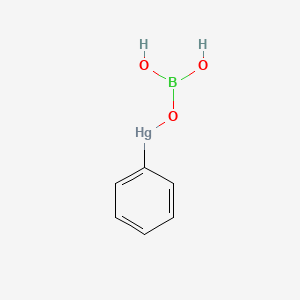
Verified chemistry for CAS 102-98-7
Phenylmercury borate
Phenylmercuric borate is an organomercuric compound. It is used as a topical antiseptic and disinfectant. Mercury is a heavy, silvery d-block metal and one of six elements that are liquid at or near room temperature and pressure. It is a naturally occuring substance, and combines with other elements such as chlorine, sulfur, or oxygen to form inorganic mercury compounds (salts). Mercury also combines with carbon to make organic mercury compounds. (L1, L262) — Toxin and Toxin Target Database (T3DB)
- IUPAC name
- boronooxy(phenyl)mercury
- Molecular formula
- C6H7BHgO3
- Molecular weight
- 338.52 g/mol
- Exact mass
- 340.019468 Da
- Monoisotopic mass
- 340.019468 Da
- Topological polar surface area
- 49.7 Ų
- Molecular complexity
- 106.0
- Formal charge
- 0
- Hydrogen-bond donors
- 2
- Hydrogen-bond acceptors
- 3
- Rotatable bonds
- 3
- Heavy atoms
- 11
- Covalent units
- 1
Names and synonyms reported to PubChem
11 more reported names
Advanced structure statistics
- Defined atom stereocentres
- 0
- Undefined atom stereocentres
- 0
- Defined bond stereocentres
- 0
- Undefined bond stereocentres
- 0
- 3D conformers
- 0
Machine-readable structure identifiers
- SMILES
B(O)(O)O[Hg]C1=CC=CC=C1- InChI
InChI=1S/C6H5.BH2O3.Hg/c1-2-4-6-5-3-1;2-1(3)4;/h1-5H;2-3H;/q;-1;+1- InChIKey
VUXSPDNLYQTOSY-UHFFFAOYSA-N
Evidence from additional scientific databases
NIH PubChem PUG-View
Attributed physical-property, hazard, environmental and use annotations.
- Carcinogen Classification: No indication of carcinogenicity (not listed by IARC). (L135) Source: Toxin and Toxin Target Database (T3DB)
- Exposure Routes: Oral (L7) ; inhalation (L7) ; dermal (L7) Source: Toxin and Toxin Target Database (T3DB)
- Note: This chemical does not meet GHS hazard criteria for 7% (3 of 43) of reports. Source: European Chemicals Agency (ECHA)
- Signal: Danger Source: European Chemicals Agency (ECHA)
- GHS Hazard Statements: H300 (93%): Fatal if swallowed [Danger Acute toxicity, oral]; H310 (93%): Fatal in contact with skin [Danger Acute toxicity, dermal]; H330 (93%): Fatal if inhaled [Danger Acute toxicity, inhalation]; H373 (93%): May causes damage to organs through prolonged or repeated exposure [Warning Specific target organ toxicity, repeated exposure]; H400 (90.7%): Very toxic to aquatic life [Warning Hazardous to the aquatic environment, acute hazard]; H410 (90.7%): Very toxic to aquatic life with long lasting effects [Warning Hazardous to the aquatic environment, long-term hazard] Source: European Chemicals Agency (ECHA)
- Precautionary Statement Codes: P260, P262, P264, P270, P271, P273, P280, P284, P301+P316, P302+P352, P304+P340, P316, P319, P320, P321, P330, P361+P364, P391, P403+P233, P405, and P501 (click each P-code to see the statement) Source: European Chemicals Agency (ECHA)
- ECHA C&L Notifications Summary: Aggregated GHS information provided per 43 reports by companies from 4 notifications to the ECHA C&L Inventory. Each notification may be associated with multiple companies.; Reported as not meeting GHS hazard criteria per 3 of 43 reports by companies.; There are 3 notifications provided by 40 of 43 reports by companies with hazard statement code(s).; Information may vary between notifications depending on impurities, additives, and other factors. The percentage value in parenthesis indicates the notified classification ratio from companies that provide hazard codes. Only hazard codes with percentage values above 10% are shown. For more detailed information, please visit ECHA C&L website. Source: European Chemicals Agency (ECHA)
- Health Effects: Mercury mainly affects the nervous system. Exposure to high levels of metallic, inorganic, or organic mercury can permanently damage the brain, kidneys, and developing fetus. Effects on brain functioning may result in irritability, shyness, tremors, changes in vision or hearing, and memory problems. Acrodynia, a type of mercury poisoning in children, is characterized by pain and pink discoloration of the hands and feet. Mercury poisoning can also cause Hunter-Russell syndrome and Minamata disease. (L7) Source: Toxin and Toxin Target Database (T3DB)
- Toxicity Summary: High-affinity binding of the divalent mercuric ion to thiol or sulfhydryl groups of proteins is believed to be the major mechanism for the activity of mercury. Through alterations in intracellular thiol status, mercury can promote oxidative stress, lipid peroxidation, mitochondrial dysfunction, and changes in heme metabolism. Mercury is known to bind to microsomal and mitochondrial enzymes, resulting in cell injury and death. For example, mercury is known to inhibit aquaporins, halting water flow across the cell membrane. It also inhibits the protein LCK, which causes decreased T-cell signalling and immune system depression. Mercury is also believed to inhibit neuronal excitability by acting on the postsynaptic neuronal membrane. It also affects the nervous system by inhibiting protein kinase C and alkaline phosphatase, which impairs brain microvascular formation and function, as well as alters the blood-brain barrier. Organic mercury exerts developmental effects by binding to tubulin, preventing microtubule assembly and causing mitotic inhibition. Mercury also produces an autoimmune response, likely by modification of major histocompatibility complex (MHC) class II molecules, self Source: Toxin and Toxin Target Database (T3DB)
- Uses: Phenylmercuric borate is used as a topical antiseptic and disinfectant. (L262) Source: Toxin and Toxin Target Database (T3DB)
Mapped by: Existing checksum-valid CAS to unique PubChem CID match. Retrieved: 2026-08-31. Open source record
Scientific classifications and hazard annotations provide context and do not replace the market-specific regulatory decision shown above.
Additional source coverage and match status
| Source | Result | Checked |
|---|---|---|
| EMBL-EBI ChEBI | No exact record | 2026-08-31 |
| NIH PubChem PUG-View | Exact match | 2026-08-31 |
A recorded no-match is useful evidence that the source was checked; it is not a claim that the substance does not exist elsewhere.
Retrieved from NIH PubChem on 2026-09-02 by checksum-valid CAS matching. Chemical properties do not replace the regulatory decision on this page.
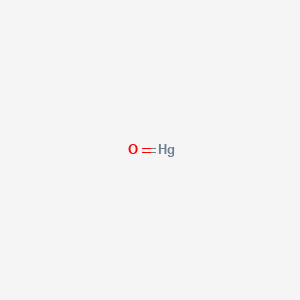
Verified chemistry for CAS 21908-53-2
Mercuric oxide
Mercuric oxide, [solid] appears as red or orange-red odorless, dense crystalline powder or scales, yellow when finely powdered. Used as a chemical intermediate for mercury salts, organic mercury compounds, and chlorine monoxide; antiseptic in pharmaceuticals; component of dry cell batteries; pigment and glass modifier; fungicide; preservative in cosmetics; analytical reagent; formerly used in antifouling paints. (EPA, 1998) — CAMEO Chemicals
- IUPAC name
- oxomercury
- Molecular formula
- HgO
- Molecular weight
- 216.59 g/mol
- Exact mass
- 217.965558 Da
- Monoisotopic mass
- 217.965558 Da
- Topological polar surface area
- 17.1 Ų
- Molecular complexity
- 2.0
- Formal charge
- 0
- Hydrogen-bond donors
- 0
- Hydrogen-bond acceptors
- 1
- Rotatable bonds
- 0
- Heavy atoms
- 2
- Covalent units
- 1
Names and synonyms reported to PubChem
16 more reported names
External database identifiers
Advanced structure statistics
- Defined atom stereocentres
- 0
- Undefined atom stereocentres
- 0
- Defined bond stereocentres
- 0
- Undefined bond stereocentres
- 0
- 3D conformers
- 0
Machine-readable structure identifiers
- SMILES
O=[Hg]- InChI
InChI=1S/Hg.O- InChIKey
UKWHYYKOEPRTIC-UHFFFAOYSA-N
Retrieved from NIH PubChem on 2026-09-02 by checksum-valid CAS matching. Chemical properties do not replace the regulatory decision on this page.
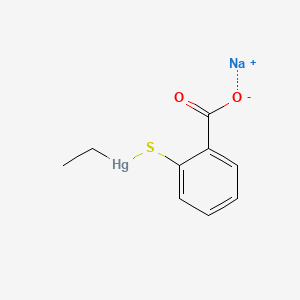
Verified chemistry for CAS 54-64-8
Thimerosal
Thimerosal is an alkylmercury compound (approximately 49% mercury by weight) used as an antiseptic and antifungal agent. It has a role as an antiseptic drug, a disinfectant, an antifungal drug and a drug allergen. It contains an ethylmercurithiosalicylate. — ChEBI
- IUPAC name
- sodium (2-carboxylatophenyl)sulfanyl-ethylmercury
- Molecular formula
- C9H9HgNaO2S
- Molecular weight
- 404.82 g/mol
- Exact mass
- 405.992739 Da
- Monoisotopic mass
- 405.992739 Da
- Topological polar surface area
- 65.4 Ų
- Molecular complexity
- 180.0
- Formal charge
- 0
- Hydrogen-bond donors
- 0
- Hydrogen-bond acceptors
- 3
- Rotatable bonds
- 3
- Heavy atoms
- 14
- Covalent units
- 2
Names and synonyms reported to PubChem
16 more reported names
External database identifiers
Advanced structure statistics
- Defined atom stereocentres
- 0
- Undefined atom stereocentres
- 0
- Defined bond stereocentres
- 0
- Undefined bond stereocentres
- 0
- 3D conformers
- 0
Machine-readable structure identifiers
- SMILES
CC[Hg]SC1=CC=CC=C1C(=O)[O-].[Na+]- InChI
InChI=1S/C7H6O2S.C2H5.Hg.Na/c8-7(9)5-3-1-2-4-6(5)10;1-2;;/h1-4,10H,(H,8,9);1H2,2H3;;/q;;2*+1/p-2- InChIKey
RTKIYNMVFMVABJ-UHFFFAOYSA-L
Retrieved from NIH PubChem on 2026-08-31 by checksum-valid CAS matching. Chemical properties do not replace the regulatory decision on this page.
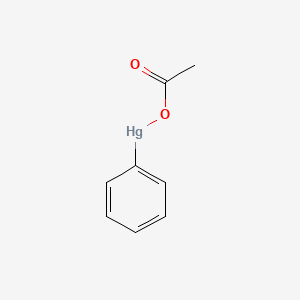
Verified chemistry for CAS 62-38-4
Phenylmercuric Acetate
Small lustrous prisms. Toxic by ingestion, inhalation and skin absorption. May severely irritate skin and eyes. Used as an herbicide and fungicide. as such, is mixed with organic solvent for the purpose of application. — CAMEO Chemicals
- IUPAC name
- acetyloxy(phenyl)mercury
- Molecular formula
- C8H8HgO2
- Molecular weight
- 336.74 g/mol
- Exact mass
- 338.023073 Da
- Monoisotopic mass
- 338.023073 Da
- Topological polar surface area
- 26.3 Ų
- Molecular complexity
- 130.0
- Formal charge
- 0
- Hydrogen-bond donors
- 0
- Hydrogen-bond acceptors
- 2
- Rotatable bonds
- 3
- Heavy atoms
- 11
- Covalent units
- 1
Names and synonyms reported to PubChem
16 more reported names
External database identifiers
Advanced structure statistics
- Defined atom stereocentres
- 0
- Undefined atom stereocentres
- 0
- Defined bond stereocentres
- 0
- Undefined bond stereocentres
- 0
- 3D conformers
- 0
Machine-readable structure identifiers
- SMILES
CC(=O)O[Hg]C1=CC=CC=C1- InChI
InChI=1S/C6H5.C2H4O2.Hg/c1-2-4-6-5-3-1;1-2(3)4;/h1-5H;1H3,(H,3,4);/q;;+1/p-1- InChIKey
XEBWQGVWTUSTLN-UHFFFAOYSA-M
Retrieved from NIH PubChem on 2026-09-02 by checksum-valid CAS matching. Chemical properties do not replace the regulatory decision on this page.
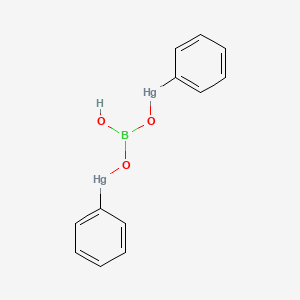
Verified chemistry for CAS 6273-99-0
Mercury, [mu-[orthoborato(2-)-O:O']]diphenyldi-
- IUPAC name
- [hydroxy(phenylmercuriooxy)boranyl]oxy-phenylmercury
- Molecular formula
- C12H11BHg2O3
- Molecular weight
- 615.21 g/mol
- Exact mass
- 616.019095 Da
- Monoisotopic mass
- 618.02141 Da
- Topological polar surface area
- 38.7 Ų
- Molecular complexity
- 199.0
- Formal charge
- 0
- Hydrogen-bond donors
- 1
- Hydrogen-bond acceptors
- 3
- Rotatable bonds
- 6
- Heavy atoms
- 18
- Covalent units
- 1
Names and synonyms reported to PubChem
4 more reported names
External database identifiers
- EPA DTXSID:DTXSID80897334
Advanced structure statistics
- Defined atom stereocentres
- 0
- Undefined atom stereocentres
- 0
- Defined bond stereocentres
- 0
- Undefined bond stereocentres
- 0
- 3D conformers
- 0
Machine-readable structure identifiers
- SMILES
B(O)(O[Hg]C1=CC=CC=C1)O[Hg]C2=CC=CC=C2- InChI
InChI=1S/2C6H5.BHO3.2Hg/c2*1-2-4-6-5-3-1;2-1(3)4;;/h2*1-5H;2H;;/q;;-2;2*+1- InChIKey
HCIUVGKUNYOVBM-UHFFFAOYSA-N
Retrieved from NIH PubChem on 2026-09-02 by checksum-valid CAS matching. Chemical properties do not replace the regulatory decision on this page.

Verified chemistry for CAS 7439-97-6
Mercury
Mercurycombines with other elements, such as chlorine, sulfur, or oxygen, to form inorganic mercury compounds or "salts", which are usually white powders or crystals. Mercury also combines with carbon to make organic mercury compounds. The most common one, methylmercury, is produced mainly by microscopic organisms in the water and soil. More mercury in the environment can increase the amounts of methylmercury that these small organisms make.Metallic Mercuryis a dense liquid that vaporizes easily at room temperature. Metallic mercury is not easily absorbed into unbroken skin. However, it vaporizes, even at room temperature. The higher the temperature, the more vapors are released. Mercury vapors are colorless and odorless, though they can be seen with the aid of an ultraviolet light.Metallic mercury is used to produce chlorine gas and caustic soda, and is also used in thermometers, dental fillings, and batteries. Mercury salts are sometimes used in skin lightening creams and as antiseptic creams and ointments. — Agency for Toxic Substances and Disease Registry (ATSDR)
- IUPAC name
- mercury
- Molecular formula
- Hg
- Molecular weight
- 200.59 g/mol
- Exact mass
- 201.970644 Da
- Monoisotopic mass
- 201.970644 Da
- Topological polar surface area
- 0.0 Ų
- Molecular complexity
- 0.0
- Formal charge
- 0
- Hydrogen-bond donors
- 0
- Hydrogen-bond acceptors
- 0
- Rotatable bonds
- 0
- Heavy atoms
- 1
- Covalent units
- 1
Names and synonyms reported to PubChem
16 more reported names
External database identifiers
- ChEBI:CHEBI:16170
- ChEBI:CHEBI:25195
- EPA DTXSID:DTXSID001029625
- EPA DTXSID:DTXSID1024172
- PubMed:40393628
- PubMed:39947444
- PubMed:39357351
- PubMed:39294077
- PubMed:39164771
- PubMed:38945390
- PubMed:38797200
- PubMed:38653421
- PubMed:37914285
- PubMed:37676925
- PubMed:37415728
- PubMed:37137463
Advanced structure statistics
- Defined atom stereocentres
- 0
- Undefined atom stereocentres
- 0
- Defined bond stereocentres
- 0
- Undefined bond stereocentres
- 0
- 3D conformers
- 0
Machine-readable structure identifiers
- SMILES
[Hg]- InChI
InChI=1S/Hg- InChIKey
QSHDDOUJBYECFT-UHFFFAOYSA-N
Retrieved from NIH PubChem on 2026-09-02 by checksum-valid CAS matching. Chemical properties do not replace the regulatory decision on this page.
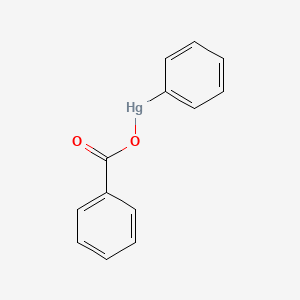
Verified chemistry for CAS 94-43-9
Phenylmercury benzoate
- IUPAC name
- benzoyloxy(phenyl)mercury
- Molecular formula
- C13H10HgO2
- Molecular weight
- 398.81 g/mol
- Exact mass
- 400.038723 Da
- Monoisotopic mass
- 400.038723 Da
- Topological polar surface area
- 26.3 Ų
- Molecular complexity
- 218.0
- Formal charge
- 0
- Hydrogen-bond donors
- 0
- Hydrogen-bond acceptors
- 2
- Rotatable bonds
- 4
- Heavy atoms
- 16
- Covalent units
- 1
Names and synonyms reported to PubChem
6 more reported names
External database identifiers
- EPA DTXSID:DTXSID70896891
Advanced structure statistics
- Defined atom stereocentres
- 0
- Undefined atom stereocentres
- 0
- Defined bond stereocentres
- 0
- Undefined bond stereocentres
- 0
- 3D conformers
- 0
Machine-readable structure identifiers
- SMILES
C1=CC=C(C=C1)C(=O)O[Hg]C2=CC=CC=C2- InChI
InChI=1S/C7H6O2.C6H5.Hg/c8-7(9)6-4-2-1-3-5-6;1-2-4-6-5-3-1;/h1-5H,(H,8,9);1-5H;/q;;+1/p-1- InChIKey
ZXFQZMVPEYERPI-UHFFFAOYSA-M
Retrieved from NIH PubChem on 2026-09-02 by checksum-valid CAS matching. Chemical properties do not replace the regulatory decision on this page.
Official source and provenance
- Registered source
- Health Canada Cosmetic Ingredient Hotlist
- Source reference
- Hotlist prohibited entry 303
- Source record ID
prohibited:303- Source version
- Health Canada Hotlist 2025-08-13
- Source language
- English
- Translation status
- Original is English
- Source updated
- 2025-08-13
- Snapshot checked
- 2026-08-30 04:07 UTC
- Validation method
- strict HTML tables t1=490 and t2=90
- SHA-256
8b52ff573d08373ee90121f6a701b3607e4a3d6fc748a7d56171eb53510af91a
Registered dataset notes
- Dataset coverage
- Administrative prohibitions, restrictions, conditions and warning requirements
- Authority note
- Official Health Canada compliance indicator; not a complete safety clearance
How this record fits the market dataset
Status distribution
Condition text is present on 172 of 580 current records. An empty condition field is interpreted according to the record type above; it is never converted into an unrestricted-use claim.
Canada market context
Complete Hotlist snapshot
Coverage version: Health Canada Cosmetic Ingredient Hotlist, 13 August 2025
All prohibited and restricted Hotlist entries, including conditions and warning requirements published in the official list.
Verification checklist
- Search English/French names and CAS identifiers.
- Apply every restriction, concentration and label warning.
- Check Food and Drugs Act/Cosmetic Regulations requirements.
- Recheck the current Hotlist before notification or sale.
Official market sources
- Health Canada Cosmetic Ingredient HotlistOfficial Health Canada compliance indicator; not a complete safety clearance
Verification workflow and record completeness
Before using this result in a compliance decision
- Confirm that “Mercury and its compounds” and every CAS/EC identifier refer to the material in your supplier specification.
- Search English/French names and CAS identifiers.
- Apply every restriction, concentration and label warning.
- Check Food and Drugs Act/Cosmetic Regulations requirements.
- Recheck the current Hotlist before notification or sale.
- Document the source version and recheck the regulator before manufacture, notification or market placement.
Fields available in this record
- Official substance nameAvailable
- CASAvailable
- ECNot supplied
- Separate condition textAvailable
- Effective dateNot supplied
- Snapshot hash and methodAvailable
Questions this page answers
Stable citation
Mercury and its compounds. Hotlist prohibited entry 303. Canada. Source version Health Canada Hotlist 2025-08-13. CosIng Checker regulatory record: https://cosingchecker.com/regulations/ca/records/303/
Cite the regulator as the legal authority. This page is a structured evidence index and verification aid, not a substitute for the official text or professional legal assessment.
Interpretation and limits for Canada
This official record identifies the substance as prohibited for cosmetic use in the stated market scope.
Do not rely on a formulation containing this identity until the cited source, effective date and exact substance match have been verified.
How to interpret the legal role
The authority uses this source as compliance guidance; the underlying legislation remains controlling.
Evidence on this page
- Recorded outcome: Prohibited
- Legal role: Official guidance
- Source version: Health Canada Hotlist 2025-08-13
What it does not prove
The Hotlist is an administrative compliance tool, not an exhaustive safety approval list.
Further authoritative substance research
None of these sources overrides the market decision above.
Cosmetic Ingredient Review safety assessments
Expert Panel conclusions, assessed ingredient groups, use conditions, dates and report documents
Independent expert review considered by FDA; not a government approval or binding market rule
Research this identity at the sourceFDA Global Substance Registration System
UNII identifiers, preferred names, substance types, codes and public substance relationships
Identity registry only; UNII availability does not imply FDA review or approval
Research this identity at the sourceILO/WHO International Chemical Safety Cards
Hazards, symptoms, first aid, storage, incompatibilities and physical properties for covered chemicals
International occupational chemical-safety reference; not cosmetic-use approval
Research this identity at the sourceJapan NITE-CHRIP
Chemical identity, Japanese and foreign legal lists, GHS hazards and exposure-related information
Chemical-management evidence; cosmetic status remains governed by the applicable MHLW standard and market rules
Research this identity at the sourceNIOSH Pocket Guide to Chemical Hazards
REL, PEL, IDLH, properties, exposure routes, symptoms, target organs, first aid and measurement methods for covered workplace chemicals
US occupational-health guidance and limits; not a cosmetic ingredient decision
Research this identity at the sourceOECD eChemPortal
Gateway to authority-owned physical-property, fate, ecotoxicity, toxicity, exposure and GHS records
Discovery gateway; each linked authority remains responsible for its data
Research this identity at the sourceUS EPA CompTox CTX APIs
API key required for importDTXSID identity, experimental and predicted properties, toxicity, bioactivity, exposure and environmental data
Scientific and computational evidence; predictions must remain labelled and do not determine cosmetic legality
Research this identity at the source