
CAS 12008-41-2PubChem CID 90479350
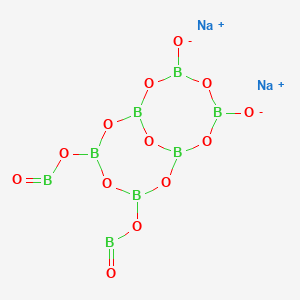
Boron sodium oxide (B8Na2O13)
- IUPAC name
- disodium;(9,11-dioxido-5-oxoboranyloxy-2,4,6,8,10,12,13-heptaoxa-1,3,5,7,9,11-hexaborabicyclo[5.5.1]tridecan-3-yl)oxy-oxoborane
- Molecular formula
- B8Na2O13
- Molecular weight
- 340.5 g/mol
- Exact mass
- 340.9915016 Da
- Topological polar surface area
- 163.0 Ų
- Hydrogen-bond donors
- 0
- Hydrogen-bond acceptors
- 13
- Covalent units
- 3
- Defined stereocentres
- 0
Also known as
Disodium octaborateImpelBORA-CAREJT9XWY98MFSodium borate (Na2B8O13)Boron sodium oxide (Na2B8O13)Boric acid (H2B8O13), disodium saltRefChem:1080103
12 more reported names
234-541-0602-894-3BORACOL-40Boracol 40UNII-JT9XWY98MFSodium borate(B8Na2O13)Sodium octaborate (Na2B8O13)HSDB 7707EINECS 234-541-0EC 234-541-0CGCGPGRQKOPVHP-UHFFFAOYSA-NDisodium 9,11-bis[(oxoboranyl)oxy]bicyclo[5.5.1]hexaboroxane-3,5-bis(olate)
External database identifiers
- EPA DTXSID:DTXSID6034390
Evidence from additional scientific databases
NIH PubChem PUG-View
Exact identifier match90479350
Attributed physical-property, hazard, environmental and use annotations.
- Color/Form: Crystalline rod Source: Hazardous Substances Data Bank (HSDB)
- Physical Description: Dry Powder Source: EPA Chemical Data Reporting (CDR)
- Solubility: Dissolves rapidly in water ... easily forms viscous supersaturated solutions at elevated temperatures. Solubility at 30 degC: 21.9wt % /Disodium octaborate tetrahydrate/ Source: Hazardous Substances Data Bank (HSDB)
- Solubility: Solubility: 9.5 g/100 g water /Disodium octaborate tetrahydrate/ Source: Hazardous Substances Data Bank (HSDB)
- Signal: Danger Source: Regulation (EC) No 1272/2008 of the European Parliament and of the Council
- GHS Hazard Statements: H360FD: May damage fertility; May damage the unborn child [Danger Reproductive toxicity] Source: Regulation (EC) No 1272/2008 of the European Parliament and of the Council
- Precautionary Statement Codes: P203, P280, P318, P405, and P501 (click each P-code to see the statement) Source: Regulation (EC) No 1272/2008 of the European Parliament and of the Council
- Note: This chemical does not meet GHS hazard criteria for 0.5% (1 of 222) of reports. Source: European Chemicals Agency (ECHA)
- Signal: Danger Source: European Chemicals Agency (ECHA)
- GHS Hazard Statements: H360 (86.5%): May damage fertility or the unborn child [Danger Reproductive toxicity]; H360FD (18.5%): May damage fertility; May damage the unborn child [Danger Reproductive toxicity] Source: European Chemicals Agency (ECHA)
- Precautionary Statement Codes: P203, P280, P318, P405, and P501 (click each P-code to see the statement) Source: European Chemicals Agency (ECHA)
- ECHA C&L Notifications Summary: Aggregated GHS information provided per 222 reports by companies from 10 notifications to the ECHA C&L Inventory. Each notification may be associated with multiple companies.; Reported as not meeting GHS hazard criteria per 1 of 222 reports by companies.; There are 9 notifications provided by 221 of 222 reports by companies with hazard statement code(s).; Information may vary between notifications depending on impurities, additives, and other factors. The percentage value in parenthesis indicates the notified classification ratio from companies that provide hazard codes. Only hazard codes with percentage values above 10% are shown. For more detailed information, please visit ECHA C&L website. Source: European Chemicals Agency (ECHA)
- Toxicity Summary: The inorganic borates display low acute toxicity. They are either not irritant or mild skin and eye irritants. They are not skin sensitisers, nor are they mutagenic or carcinogenic. The most sensitive endpoints of toxicity are considered to be effects on the reproductive organs, fertility in males, and developmental effects. The doses that cause these effects are far higher than any levels to which the human population could be exposed... /Inorganic borates/ Source: Hazardous Substances Data Bank (HSDB)
- Consumer Uses: Adhesion/cohesion promoter; Corrosion inhibitor; Soil amendments (fertilizers) Source: EPA Chemical Data Reporting (CDR)
- Industry Uses: Soil amendments (fertilizers); Adhesion/cohesion promoter; Swelling agent Source: EPA Chemical Data Reporting (CDR)
- Uses: For disodium octaborate (USEPA/OPP Pesticide Code: 011107) ACTIVE products with label matches. /SRP: Registered for use in the U.S. but approved pesticide uses may change periodically and so federal, state and local authorities must be consulted for currently approved uses./ Source: Hazardous Substances Data Bank (HSDB)
- Uses: For disodium octaborate tetrahydrate (USEPA/OPP Pesticide Code: 011103) ACTIVE products with label matches. /SRP: Registered for use in the U.S. but approved pesticide uses may change periodically and so federal, state and local authorities must be consulted for currently approved uses./ /Disodium octaborate tetrahydrate/ Source: Hazardous Substances Data Bank (HSDB)
- Uses: Used to prevent and control decay fungi in lumber and timber products. Source: Hazardous Substances Data Bank (HSDB)
- Uses: Multimicronutrient fertilizer /Disodium octaborate tetrahydrate/ Source: Hazardous Substances Data Bank (HSDB)
- Uses: For more Uses (Complete) data for DISODIUM OCTABORATE (8 total), please visit the HSDB record page. Source: Hazardous Substances Data Bank (HSDB)
Mapped by: Existing checksum-valid CAS to unique PubChem CID match. Retrieved: 2026-08-31. Open source record
Scientific classifications and hazard annotations provide context and do not replace the market-specific regulatory decision shown above.
Additional source coverage and match status
| Source | Result | Checked |
|---|---|---|
| NIH PubChem PUG-View | Exact match | 2026-08-31 |
A recorded no-match is useful evidence that the source was checked; it is not a claim that the substance does not exist elsewhere.
Retrieved from NIH PubChem on 2026-09-02 by checksum-valid CAS matching. Chemical properties do not replace the regulatory decision on this page.