
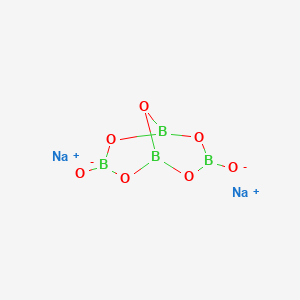
CAS 12267-73-1PubChem CID 10219853
Sodium Tetraborate
- IUPAC name
- disodium;3,7-dioxido-2,4,6,8,9-pentaoxa-1,3,5,7-tetraborabicyclo[3.3.1]nonane
- Molecular formula
- B4Na2O7
- Molecular weight
- 201.2 g/mol
- Exact mass
- 201.9811616 Da
- Topological polar surface area
- 92.3 Ų
- Hydrogen-bond donors
- 0
- Hydrogen-bond acceptors
- 7
- Covalent units
- 3
- Defined stereocentres
- 0
Also known as
1330-43-4Sodium Tetraborate, AnhydrousBorax glassBoron sodium oxide (B4Na2O7)Anhydrous boraxSodium biborateBorax AnhydrousFused borax
16 more reported names
Sodium borate anhydrousBorax, fusedSodium pyroborateDehyborGranuborSprayborSodium borate, anhydrousBorax, dehydratedSodium boron oxideRasorite 658191EN8ZMDBoric acid, disodium saltBoric acid (H2B4O7), disodium saltSodium tetraborate anhydrousINS NO.285Sodium boron oxide (na2b4o7)
External database identifiers
- EPA DTXSID:DTXSID101014358
- PubMed:21774671
- PubMed:19059942
- PubMed:1432568
Evidence from additional scientific databases
NIH PubChem PUG-View
Exact identifier match10219853
Attributed physical-property, hazard, environmental and use annotations.
- Boiling Point: 1,575 °C (decomposes) Source: Hazardous Substances Data Bank (HSDB)
- Boiling Point: 2867 °F (decomposes) Source: Occupational Safety and Health Administration (OSHA)
- Boiling Point: 2867 °F (Decomposes) Source: The National Institute for Occupational Safety and Health (NIOSH)
- Color/Form: Colorless glassy solid; hygroscopic Source: Hazardous Substances Data Bank (HSDB)
- Color/Form: Light grey, vitreous granules Source: Hazardous Substances Data Bank (HSDB)
- Color/Form: White to gray powder; becomes opaque on exposure to air Source: Hazardous Substances Data Bank (HSDB)
- Density: 2.367 Source: Hazardous Substances Data Bank (HSDB)
- Density: White crystals or powder, odorless; density: 1.73 20 °C/4 °C; loses water of crystallization when heated, with melting between 75 and 320 °C; fuses to a glassy mass at red heat (borax glass); effloresces slightly in warm dry air; soluble in water, glycerol; insoluble in alcohol /Sodium tetraborate decahydrate/ Source: Hazardous Substances Data Bank (HSDB)
- Density: Relative density (water = 1): 2.4 Source: ILO-WHO International Chemical Safety Cards (ICSCs)
- Density: 2.37 Source: Occupational Safety and Health Administration (OSHA)
- Density: 2.37 Source: The National Institute for Occupational Safety and Health (NIOSH)
- Melting Point: Between 171 °C and 175 °C with decomposition Source: EU Food Improvement Agents
- Melting Point: 743 °C Source: Hazardous Substances Data Bank (HSDB)
- Melting Point: 742 °C Source: ILO-WHO International Chemical Safety Cards (ICSCs)
- Melting Point: 1366 °F Source: Occupational Safety and Health Administration (OSHA)
- Melting Point: 1366 °F Source: The National Institute for Occupational Safety and Health (NIOSH)
- Odor: Odorless Source: Hazardous Substances Data Bank (HSDB)
- Physical Description: Liquid; Liquid; Other Solid; Dry Powder; Large Crystals; Large Crystals; Dry Powder; Other Solid Source: EPA Chemical Data Reporting (CDR)
- Physical Description: Powder or glass-like plates becoming opaque on exposure to air; slowly soluble in water Source: EU Food Improvement Agents
- Physical Description: White to gray, odorless powder; Becomes opaque on exposure to air; [NIOSH] Source: Haz-Map, Information on Hazardous Chemicals and Occupational Diseases
- Physical Description: COLOURLESS-TO-WHITE HYGROSCOPIC CRYSTALS OR POWDER. TURNS OPAQUE ON EXPOSURE TO AIR. Source: ILO-WHO International Chemical Safety Cards (ICSCs)
- Physical Description: White to gray, odorless powder. Source: Occupational Safety and Health Administration (OSHA)
- Physical Description: White to gray, odorless powder. [herbicide] [Note: Becomes opaque on exposure to air.] Source: The National Institute for Occupational Safety and Health (NIOSH)
- Refractive Index: INDEX OF REFRACTION: 1.5010 Source: Hazardous Substances Data Bank (HSDB)
- Solubility: Water solubility: 3.1% at 25 °C; 2.5% at 20 °C Source: Hazardous Substances Data Bank (HSDB)
- Solubility: Solubility at 25 °C: 16.7% in methanol; 30% in ethylene glycol; 40.6 g/L in formamide Source: Hazardous Substances Data Bank (HSDB)
- Solubility: Solubility in water, g/100ml at 20 °C: 2.56 Source: ILO-WHO International Chemical Safety Cards (ICSCs)
- Solubility: 4% Source: The National Institute for Occupational Safety and Health (NIOSH)
- Vapor Pressure: Negligible at 20 °C Source: Hazardous Substances Data Bank (HSDB)
- Vapor Pressure: 0 mmHg (approx) Source: Occupational Safety and Health Administration (OSHA)
- Vapor Pressure: 0 mmHg (approx) Source: The National Institute for Occupational Safety and Health (NIOSH)
- pH: pH = 9.3 at 20 °C (3% solution) Source: Hazardous Substances Data Bank (HSDB)
- Exposure Routes: The substance can be absorbed into the body by inhalation of its aerosol and by ingestion. Source: ILO-WHO International Chemical Safety Cards (ICSCs)
- Exposure Routes: inhalation, ingestion, skin and/or eye contact Source: The National Institute for Occupational Safety and Health (NIOSH)
- First Aid: (General first aid procedures); Eye: Irrigate immediately - If this chemical contacts the eyes, immediately wash (irrigate) the eyes with large amounts of water, occasionally lifting the lower and upper lids. Get medical attention immediately.; Skin: Soap wash - If this chemical contacts the skin, wash the contaminated skin with soap and water.; Breathing: Respiratory support; Swallow: Medical attention immediately - If this chemical has been swallowed, get medical attention immediately. Source: The National Institute for Occupational Safety and Health (NIOSH)
- Signal: Danger Source: Regulation (EC) No 1272/2008 of the European Parliament and of the Council
- GHS Hazard Statements: H360FD: May damage fertility; May damage the unborn child [Danger Reproductive toxicity] Source: Regulation (EC) No 1272/2008 of the European Parliament and of the Council
- Precautionary Statement Codes: P203, P280, P318, P405, and P501 (click each P-code to see the statement) Source: Regulation (EC) No 1272/2008 of the European Parliament and of the Council
- Signal: Danger Source: European Chemicals Agency (ECHA)
- GHS Hazard Statements: H319 (53.2%): Causes serious eye irritation [Warning Serious eye damage/eye irritation]; H360 (88.5%): May damage fertility or the unborn child [Danger Reproductive toxicity]; H360FD (22.3%): May damage fertility; May damage the unborn child [Danger Reproductive toxicity] Source: European Chemicals Agency (ECHA)
- Precautionary Statement Codes: P203, P264+P265, P280, P305+P351+P338, P318, P337+P317, P405, and P501 (click each P-code to see the statement) Source: European Chemicals Agency (ECHA)
- ECHA C&L Notifications Summary: Aggregated GHS information provided per 1733 reports by companies from 44 notifications to the ECHA C&L Inventory. Each notification may be associated with multiple companies.; Information may vary between notifications depending on impurities, additives, and other factors. The percentage value in parenthesis indicates the notified classification ratio from companies that provide hazard codes. Only hazard codes with percentage values above 10% are shown. For more detailed information, please visit ECHA C&L website. Source: European Chemicals Agency (ECHA)
- Signal: Danger Source: NITE-CMC
- GHS Hazard Statements: H315: Causes skin irritation [Warning Skin corrosion/irritation]; H319: Causes serious eye irritation [Warning Serious eye damage/eye irritation]; H335: May cause respiratory irritation [Warning Specific target organ toxicity, single exposure; Respiratory tract irritation]; H360: May damage fertility or the unborn child [Danger Reproductive toxicity]; H370: Causes damage to organs [Danger Specific target organ toxicity, single exposure]; H372: Causes damage to organs through prolonged or repeated exposure [Danger Specific target organ toxicity, repeated exposure] Source: NITE-CMC
- Precautionary Statement Codes: P203, P260, P261, P264, P264+P265, P270, P271, P280, P302+P352, P304+P340, P305+P351+P338, P308+P316, P318, P319, P321, P332+P317, P337+P317, P362+P364, P403+P233, P405, and P501 (click each P-code to see the statement) Source: NITE-CMC
- GHS Hazard Statements: H320: Causes eye irritation [Warning Serious eye damage/eye irritation]; H335: May cause respiratory irritation [Warning Specific target organ toxicity, single exposure; Respiratory tract irritation]; H360: May damage fertility or the unborn child [Danger Reproductive toxicity]; H370: Causes damage to organs [Danger Specific target organ toxicity, single exposure]; H372: Causes damage to organs through prolonged or repeated exposure [Danger Specific target organ toxicity, repeated exposure]; H373: May causes damage to organs through prolonged or repeated exposure [Warning Specific target organ toxicity, repeated exposure]; H402: Harmful to aquatic life [Hazardous to the aquatic environment, acute hazard]; H412: Harmful to aquatic life with long lasting effects [Hazardous to the aquatic environment, long-term hazard] Source: NITE-CMC
- Precautionary Statement Codes: P203, P260, P261, P264, P264+P265, P270, P271, P273, P280, P304+P340, P305+P351+P338, P308+P316, P318, P319, P321, P337+P317, P403+P233, P405, and P501 (click each P-code to see the statement) Source: NITE-CMC
- Target Organs: Eyes, skin, respiratory system Source: The National Institute for Occupational Safety and Health (NIOSH)
- Environmental Bioconcentration: Accumulates in the plant Source: Hazardous Substances Data Bank (HSDB)
- Environmental Fate: Terrestrial Fate: Average persistence at recommended rates is one or more years, depending on soil type and rainfall. Less persistent in acid soils and in high rainfall areas. Source: Hazardous Substances Data Bank (HSDB)
- Consumer Uses: Adhesion/cohesion promoter; Flux agent; Soil amendments (fertilizers); Filler; Not Known or Reasonably Ascertainable; Bleaching agent; Anti-freeze agent; Other Source: EPA Chemical Data Reporting (CDR)
- Industry Uses: Processing aids not otherwise specified; Bleaching agent; Anti-freeze agent; Other; Heat stabilizer; Hardener; Adhesion/cohesion promoter; Flame retardant; Flux agent; Filler; Soil amendments (fertilizers) Source: EPA Chemical Data Reporting (CDR)
- Sources/Uses: Used as tablets or powder to kill larvae in livestock confinements and crawling insects in residences; [EPA Pesticides] Used as a fluxing agent, a buffering agent, a biocide (preservative, antiseptic, insecticide, fungicide, herbicide, algicide, nematicide), a fireproofing agent, a corrosion inhibitor, a tanning agent, and a textile bleaching agent; Used to manufacture glazes, enamels, borosilicate glass, fertilizers, detergents, antifreeze, pharmaceuticals, and cosmetics; [HSDB] Source: Haz-Map, Information on Hazardous Chemicals and Occupational Diseases
- Industrial Processes with risk of exposure: Acid and Alkali Cleaning of Metals [Category: Clean]; Using Disinfectants or Biocides [Category: Clean]; Farming (Pesticides) [Category: Industry]; Glass Manufacturing [Category: Industry] Source: Haz-Map, Information on Hazardous Chemicals and Occupational Diseases
- Uses: For sodium tetraborate (USEPA/OPP Pesticide Code: 011112) ACTIVE products with label matches. /SRP: Registered for use in the U.S. but approved pesticide uses may change periodically and so federal, state and local authorities must be consulted for currently approved uses./ Source: Hazardous Substances Data Bank (HSDB)
- Uses: Manufacture of glass, enamels, & other ceramic products Source: Hazardous Substances Data Bank (HSDB)
- Uses: Soldering metals; manufacture of glazes and enamels; tanning; in cleaning compounds; artificially aging wood; ...curing and preserving skins Source: Hazardous Substances Data Bank (HSDB)
- Uses: As preservative either alone or with other antiseptics against wood fungus; fireproofing fabrics & wood Source: Hazardous Substances Data Bank (HSDB)
- Uses: For more Uses (Complete) data for SODIUM TETRABORATE (15 total), please visit the HSDB record page. Source: Hazardous Substances Data Bank (HSDB)
Mapped by: Existing checksum-valid CAS to unique PubChem CID match. Retrieved: 2026-08-31. Open source record
Scientific classifications and hazard annotations provide context and do not replace the market-specific regulatory decision shown above.
Additional source coverage and match status
| Source | Result | Checked |
|---|---|---|
| NIH PubChem PUG-View | Exact match | 2026-08-31 |
A recorded no-match is useful evidence that the source was checked; it is not a claim that the substance does not exist elsewhere.
Retrieved from NIH PubChem on 2026-09-02 by checksum-valid CAS matching. Chemical properties do not replace the regulatory decision on this page.