
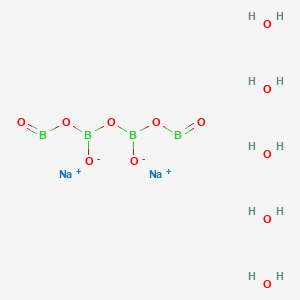
CAS 12179-04-3PubChem CID 86341921
Sodium tetraborate pentahydrate
- IUPAC name
- disodium;[oxido(oxoboranyloxy)boranyl]oxy-oxoboranyloxyborinate;pentahydrate
- Molecular formula
- B4H10Na2O12
- Molecular weight
- 291.3 g/mol
- Exact mass
- 292.0339850 Da
- Topological polar surface area
- 113.0 Ų
- Hydrogen-bond donors
- 5
- Hydrogen-bond acceptors
- 12
- Covalent units
- 8
- Defined stereocentres
- 0
Also known as
Sodium borate, pentahydrateSG2N20S03UBoron sodium oxide(B4Na2O7), pentahydrateBoric acid(H2B4O7), disodium salt, pentahydrateRefChem:887925601-808-1Boron sodium oxide (B4Na2O7), hydrate (1:5)Disodium tetraborate pentahydrate
6 more reported names
UNII-SG2N20S03UBoron sodium oxide (B4Na2O7), pentahydrateEC 215-540-4Boric acid (H2B4O7), disodium salt, pentaborateBoron sodium oxide pentahydrateQZSYXKPOZFXCDM-UHFFFAOYSA-N
External database identifiers
- EPA DTXSID:DTXSID7034389
Evidence from additional scientific databases
NIH PubChem PUG-View
Exact identifier match86341921
Attributed physical-property, hazard, environmental and use annotations.
- Density: 1.82 Source: Occupational Safety and Health Administration (OSHA)
- Density: 1.82 Source: The National Institute for Occupational Safety and Health (NIOSH)
- Melting Point: 392 °F Source: Occupational Safety and Health Administration (OSHA)
- Melting Point: 392 °F Source: The National Institute for Occupational Safety and Health (NIOSH)
- Physical Description: CBI; Dry Powder; Liquid; Other Solid Source: EPA Chemical Data Reporting (CDR)
- Physical Description: Colorless or white, odorless crystals or free-flowing powder; Begins to lose water of hydration at 252 degrees F; [NIOSH] Source: Haz-Map, Information on Hazardous Chemicals and Occupational Diseases
- Physical Description: Colorless or white, odorless crystals or free-flowing powder. Source: Occupational Safety and Health Administration (OSHA)
- Physical Description: Colorless or white, odorless crystals or free-flowing powder. [herbicide] [Note: Begins to lose water of hydration at 252 °F.] Source: The National Institute for Occupational Safety and Health (NIOSH)
- Solubility: 3% Source: The National Institute for Occupational Safety and Health (NIOSH)
- Vapor Pressure: 0 mmHg (approx) Source: Occupational Safety and Health Administration (OSHA)
- Vapor Pressure: 0 mmHg (approx) Source: The National Institute for Occupational Safety and Health (NIOSH)
- Exposure Routes: inhalation, ingestion, skin and/or eye contact Source: The National Institute for Occupational Safety and Health (NIOSH)
- First Aid: (General first aid procedures); Eye: Irrigate immediately - If this chemical contacts the eyes, immediately wash (irrigate) the eyes with large amounts of water, occasionally lifting the lower and upper lids. Get medical attention immediately.; Skin: Soap wash - If this chemical contacts the skin, wash the contaminated skin with soap and water.; Breathing: Respiratory support; Swallow: Medical attention immediately - If this chemical has been swallowed, get medical attention immediately. Source: The National Institute for Occupational Safety and Health (NIOSH)
- Signal: Danger Source: Regulation (EC) No 1272/2008 of the European Parliament and of the Council
- GHS Hazard Statements: H360FD: May damage fertility; May damage the unborn child [Danger Reproductive toxicity] Source: Regulation (EC) No 1272/2008 of the European Parliament and of the Council
- Precautionary Statement Codes: P203, P280, P318, P405, and P501 (click each P-code to see the statement) Source: Regulation (EC) No 1272/2008 of the European Parliament and of the Council
- Signal: Danger Source: European Chemicals Agency (ECHA)
- GHS Hazard Statements: H319 (57.2%): Causes serious eye irritation [Warning Serious eye damage/eye irritation]; H360 (91.2%): May damage fertility or the unborn child [Danger Reproductive toxicity] Source: European Chemicals Agency (ECHA)
- Precautionary Statement Codes: P203, P264+P265, P280, P305+P351+P338, P318, P337+P317, P405, and P501 (click each P-code to see the statement) Source: European Chemicals Agency (ECHA)
- ECHA C&L Notifications Summary: Aggregated GHS information provided per 339 reports by companies from 12 notifications to the ECHA C&L Inventory. Each notification may be associated with multiple companies.; Information may vary between notifications depending on impurities, additives, and other factors. The percentage value in parenthesis indicates the notified classification ratio from companies that provide hazard codes. Only hazard codes with percentage values above 10% are shown. For more detailed information, please visit ECHA C&L website. Source: European Chemicals Agency (ECHA)
- Signal: Danger Source: NITE-CMC
- GHS Hazard Statements: H335: May cause respiratory irritation [Warning Specific target organ toxicity, single exposure; Respiratory tract irritation]; H360: May damage fertility or the unborn child [Danger Reproductive toxicity]; H370: Causes damage to organs [Danger Specific target organ toxicity, single exposure] Source: NITE-CMC
- Precautionary Statement Codes: P203, P260, P261, P264, P270, P271, P280, P304+P340, P308+P316, P318, P319, P321, P403+P233, P405, and P501 (click each P-code to see the statement) Source: NITE-CMC
- Signal: Danger Source: Hazardous Chemical Information System (HCIS), Safe Work Australia
- GHS Hazard Statements: H360FD: May damage fertility; May damage the unborn child [Danger Reproductive toxicity] Source: Hazardous Chemical Information System (HCIS), Safe Work Australia
- Target Organs: Eyes, skin, respiratory system Source: The National Institute for Occupational Safety and Health (NIOSH)
- Consumer Uses: Flame retardant; Anti-adhesive/cohesive Source: EPA Chemical Data Reporting (CDR)
- Industry Uses: Anti-adhesive/cohesive; Plating agent; Flame retardant; Corrosion inhibitor; Not Known or Reasonably Ascertainable; Etching agent; Chelating agent; Defoamer Source: EPA Chemical Data Reporting (CDR)
- Sources/Uses: Used as a preservative, antiseptic and fungicide; also used to manufacture glazes, enamels, soldering fluxes and cleaning compounds and to fireproof textiles and wood; [ACGIH] Boric acid and borates as tablets or powder are used to kill larvae in barns and other insects in houses. Rarely, they are sprayed as herbicides. [EPA: Recognition of Pesticide Poisonings] Source: Haz-Map, Information on Hazardous Chemicals and Occupational Diseases
- Industrial Processes with risk of exposure: Soldering [Category: Heat or Machine]; Using Disinfectants or Biocides [Category: Clean]; Farming (Pesticides) [Category: Industry]; Textiles (Printing, Dyeing, or Finishing) [Category: Industry] Source: Haz-Map, Information on Hazardous Chemicals and Occupational Diseases
Mapped by: Existing checksum-valid CAS to unique PubChem CID match. Retrieved: 2026-08-31. Open source record
Scientific classifications and hazard annotations provide context and do not replace the market-specific regulatory decision shown above.
Additional source coverage and match status
| Source | Result | Checked |
|---|---|---|
| NIH PubChem PUG-View | Exact match | 2026-08-31 |
A recorded no-match is useful evidence that the source was checked; it is not a claim that the substance does not exist elsewhere.
Retrieved from NIH PubChem on 2026-09-02 by checksum-valid CAS matching. Chemical properties do not replace the regulatory decision on this page.