
METHENAMINE
Methenamine
METHENAMINE appears in Annex V as a positive-list preservative entry for EU cosmetics. Maximum concentration in this record: 0.15%.
Chemical identity and properties
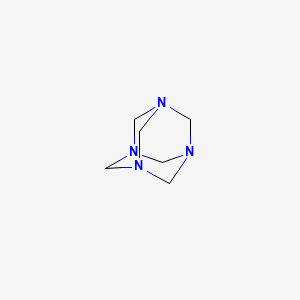
Hexamethylenetetramine
Hexamethylenetetramine is a polycyclic cage that is adamantane in which the carbon atoms at positions 1, 3, 5 and 7 are replaced by nitrogen atoms. It has a role as an antibacterial drug. It is a polycyclic cage, a tetramine and a polyazaalkane. — ChEBI
- IUPAC name
- 1,3,5,7-tetrazatricyclo[3.3.1.13,7]decane
- Molecular formula
- C6H12N4
- Molecular weight
- 140.19 g/mol
- Exact mass
- 140.106196400 Da
- XLogP3
- 0.3
- Topological polar surface area
- 13.0 Ų
- Hydrogen-bond donors
- 0
- Hydrogen-bond acceptors
- 4
- Covalent units
- 1
- Defined stereocentres
- 0
Also known as
16 more reported names
External database identifiers
- ChEBI:CHEBI:6824
- ChEMBL:CHEMBL1201270
- EPA DTXSID:DTXSID6020692
- PubMed:32876438
- PubMed:24689705
- PubMed:23571415
- PubMed:23110170
- PubMed:23076896
- PubMed:23060961
- PubMed:23060957
- PubMed:23012900
- PubMed:22966704
- PubMed:22959825
- PubMed:22947203
- PubMed:22917514
Evidence from additional scientific databases
EMBL-EBI ChEBI
hexamethylenetetramine
A polycyclic cage that is adamantane in which the carbon atoms at positions 1, 3, 5 and 7 are replaced by nitrogen atoms.
- Formula
- C6H12N4
- Average mass
- 140.190 g/mol
- Monoisotopic mass
- 140.10620 Da
- Formal charge
- 0
- polycyclic cage — is a (CHEBI:33640)
- polyazaalkane — is a (CHEBI:39474)
- tetramine — is a (CHEBI:39166)
- antibacterial drug — has role (CHEBI:36047)
- antibacterial agent — has role (CHEBI:33282)
- antibacterial drug — has role (CHEBI:36047)
- antibacterial agent — has role (CHEBI:33282)
- polycyclic cage — is a (CHEBI:33640)
- polyazaalkane — is a (CHEBI:39474)
- tetramine — is a (CHEBI:39166)
Additional curated names
Cross-references from this source
- CAS: 100-97-0 — ChemIDplus
- CAS: 100-97-0 — NIST Chemistry WebBook
- REGISTRY_NUMBER: 2018 — Reaxys
- REGISTRY_NUMBER: 26964 — Gmelin
- MANUAL_X_REF: 3344 — DrugCentral
- MANUAL_X_REF: D00393 — KEGG DRUG
- MANUAL_X_REF: HMDB0029598 — HMDB
- MANUAL_X_REF: LSM-5440 — LINCS
- MANUAL_X_REF: Methenamine — Wikipedia
- MANUAL_X_REF: US2762799 — Patent
- MANUAL_X_REF: US2762800 — Patent
Mapped by: Exact CAS cross-reference in the ChEBI compound record. Source updated: 2017-02-22. Retrieved: 2026-08-31. Open source record
NIH PubChem PUG-View
Attributed physical-property, hazard, environmental and use annotations.
- Autoignition Temperature: greater than 700 °F (NTP, 1992) Source: CAMEO Chemicals
- Autoignition Temperature: 390 °C Source: ILO-WHO International Chemical Safety Cards (ICSCs)
- Boiling Point: Sublimes (NTP, 1992) Source: CAMEO Chemicals
- Color/Form: Crystallizes from ethanol as colorless, hygroscopic rhombododecahedra. Source: Hazardous Substances Data Bank (HSDB)
- Color/Form: Colorless crystalline solid Source: Hazardous Substances Data Bank (HSDB)
- Color/Form: Colorless, lustrous crystals or white crystalline powder Source: Hazardous Substances Data Bank (HSDB)
- Color/Form: White, crystalline powder or colorless, lustrous crystals Source: Hazardous Substances Data Bank (HSDB)
- Density: 1.35 at 68 °F (USCG, 1999) - Denser than water; will sink Source: CAMEO Chemicals
- Density: 1.3394 g/cu cm at 22 °C Source: Hazardous Substances Data Bank (HSDB)
- Density: Density: 1.27 at 25 °C Source: Hazardous Substances Data Bank (HSDB)
- Density: 1.33 g/cm³ Source: ILO-WHO International Chemical Safety Cards (ICSCs)
- Density: 1.331 @ -5°C Source: PAC Chemical Database, U.S. Department of Energy
- Dissociation Constants: 1.4X10⁻⁹ (pK = 8.854), temperature not reported Source: Hazardous Substances Data Bank (HSDB)
- Dissociation Constants: pKa = 4.89 at 25 °C Source: Hazardous Substances Data Bank (HSDB)
- Flash Point: 482 °F (NTP, 1992) Source: CAMEO Chemicals
- Flash Point: 482 °F Source: Haz-Map, Information on Hazardous Chemicals and Occupational Diseases
- Flash Point: 250 °C (482 °F) - closed cup Source: Hazardous Substances Data Bank (HSDB)
- Flash Point: 250 °C c.c. Source: ILO-WHO International Chemical Safety Cards (ICSCs)
- LogP: log Kow = -2.18 at pH 7-9, 20 °C Source: Hazardous Substances Data Bank (HSDB)
- LogP: -2.84 Source: ILO-WHO International Chemical Safety Cards (ICSCs)
- Melting Point: 536 °F (sublimes) (NTP, 1992) Source: CAMEO Chemicals
- Melting Point: Sublimes at about 260 °C without melting and with partial decomposition Source: Hazardous Substances Data Bank (HSDB)
- Melting Point: Sour taste; mp: 127-130 °C; ph of soln 4 /Methenamine mandelate/ Source: Hazardous Substances Data Bank (HSDB)
- Melting Point: Odorless, crystalline powder; melting point: ~190 °C with decomposition; soluble in 8 parts water; slight soluble in alcohol /Methenamine sulfosalicylate/ Source: Hazardous Substances Data Bank (HSDB)
- Melting Point: > 250 °C Source: Human Metabolome Database (HMDB)
- Odor: Odorless Source: Hazardous Substances Data Bank (HSDB)
- Odor: Practically odorless Source: Hazardous Substances Data Bank (HSDB)
- Physical Description: Hexamethylenetetramine appears as odorless white crystalline powder or colorless lustrous crystals. Sublimes in a vacuum at about 505 °F with some decomposition. Solutions are strong bases (pH of 0.2 molar aqueous solution is 8.4). (NTP, 1992) Source: CAMEO Chemicals
- Physical Description: Liquid; Dry Powder; Liquid; Dry Powder; Large Crystals Source: EPA Chemical Data Reporting (CDR)
- Physical Description: Colourless or white crystalline powder Source: EU Food Improvement Agents
- Physical Description: White, crystalline powder or colorless, lustrous crystals; [HSDB] Source: Haz-Map, Information on Hazardous Chemicals and Occupational Diseases
- Physical Description: Solid Source: Human Metabolome Database (HMDB)
- Physical Description: HYGROSCOPIC COLOURLESS CRYSTALS OR WHITE CRYSTALLINE POWDER. Source: ILO-WHO International Chemical Safety Cards (ICSCs)
- Refractive Index: Index of refraction: 1.590 /monoclinic, isometric/ Source: Hazardous Substances Data Bank (HSDB)
- Refractive Index: Index of refraction: 1.5911 at 25 °C Source: Hazardous Substances Data Bank (HSDB)
- Solubility: greater than or equal to 100 mg/mL at 68 °F (NTP, 1992) Source: CAMEO Chemicals
- Solubility: In water, 302,300 mg/L at 25 °C Source: Hazardous Substances Data Bank (HSDB)
- Solubility: Solubility of methenamine in 100 g of various solvents at 20 °C is: 13.4 g chloroform, 7.25 g in methanol, 2.89 g in absolute ethanol, 0.65 g in acetone, 0.23 g in benzene, 0.14 g in xylene, 0.06 g in ether, and near zero in petroleum ether. Source: Hazardous Substances Data Bank (HSDB)
- Solubility: At 12 °C, 81.3 g dissolves in 100 g of water; the solubility decreases slightly with increasing temperature. Source: Hazardous Substances Data Bank (HSDB)
- Solubility: Freely soluble in water; practically insoluble in petroleum ether Source: Hazardous Substances Data Bank (HSDB)
- Solubility: For more Solubility (Complete) data for METHENAMINE (6 total), please visit the HSDB record page. Source: Hazardous Substances Data Bank (HSDB)
- Solubility: 449 mg/mL at 12 °C Source: Human Metabolome Database (HMDB)
- Solubility: Solubility in water: good Source: ILO-WHO International Chemical Safety Cards (ICSCs)
- Solubility: >21 [ug/mL] (The mean of the results at pH 7.4) Source: Sanford-Burnham Center for Chemical Genomics
- Vapor Pressure: 0.004 [mmHg] Source: Haz-Map, Information on Hazardous Chemicals and Occupational Diseases
- Vapor Pressure: 6.1X10⁻⁴ mm Hg at 25 °C Source: Hazardous Substances Data Bank (HSDB)
- pH: pH of 0.2 molar aqueous solution: 8.4 Source: Hazardous Substances Data Bank (HSDB)
- Carcinogen Classification: No indication of carcinogenicity to humans (not listed by IARC). Source: Toxin and Toxin Target Database (T3DB)
- Exposure Routes: The substance can be absorbed into the body by inhalation of its aerosol and by ingestion. Source: ILO-WHO International Chemical Safety Cards (ICSCs)
- First Aid: EYES: First check the victim for contact lenses and remove if present. Flush victim's eyes with water or normal saline solution for 20 to 30 minutes while simultaneously calling a hospital or poison control center. Do not put any ointments, oils, or medication in the victim's eyes without specific instructions from a physician. IMMEDIATELY transport the victim after flushing eyes to a hospital even if no symptoms (such as redness or irritation) develop.; SKIN: IMMEDIATELY flood affected skin with water while removing and isolating all contaminated clothing. Gently wash all affected skin areas thoroughly with soap and water. If symptoms such as redness or irritation develop, IMMEDIATELY call a physician and be prepared to transport the victim to a hospital for treatment.; INHALATION: IMMEDIATELY leave the contaminated area; take deep breaths of fresh air. If symptoms (such as wheezing, coughing, shortness of breath, or burning in the mouth, throat, or chest) develop, call a physician and be prepared to transport the victim to a hospital. Provide proper respiratory protection to rescuers entering an unknown atmosphere. Whenever possible, Self-Contained Breathing Apparatus (SCBA) shou Source: CAMEO Chemicals
- ERG2024, Guide 133 (Hexamethylenetetramine): General First Aid:; · Call 911 or emergency medical service.; · Ensure that medical personnel are aware of the material(s) involved, take precautions to protect themselves and avoid contamination.; · Move victim to fresh air if it can be done safely.; · Administer oxygen if breathing is difficult.; · If victim is not breathing:; -- DO NOT perform mouth-to-mouth resuscitation; the victim may have ingested or inhaled the substance.; -- If equipped and pulse detected, wash face and mouth, then give artificial respiration using a proper respiratory medical device (bag-valve mask, pocket mask equipped with a one-way valve or other device).; -- If no pulse detected or no respiratory medical device available, provide continuous compressions. Conduct a pulse check every two minutes or monitor for any signs of spontaneous respirations.; · Remove and isolate contaminated clothing and shoes.; · For minor skin contact, avoid spreading material on unaffected skin.; · In case of contact with substance, remove immediately by flushing skin or eyes with running water for at least 20 minutes.; · For severe burns, immediate medical attention is required.; · Effects of exposure (inhalation, ingestion, Source: Emergency Response Guidebook (ERG)
- Signal: Warning Source: Regulation (EC) No 1272/2008 of the European Parliament and of the Council
- GHS Hazard Statements: H228: Flammable solid [Danger Flammable solids]; H317: May cause an allergic skin reaction [Warning Sensitization, Skin] Source: Regulation (EC) No 1272/2008 of the European Parliament and of the Council
- Precautionary Statement Codes: P210, P240, P241, P261, P272, P280, P302+P352, P321, P333+P317, P362+P364, P370+P378, and P501 (click each P-code to see the statement) Source: Regulation (EC) No 1272/2008 of the European Parliament and of the Council
- Signal: Danger Source: European Chemicals Agency (ECHA)
- GHS Hazard Statements: H228 (100%): Flammable solid [Danger Flammable solids]; H317 (100%): May cause an allergic skin reaction [Warning Sensitization, Skin] Source: European Chemicals Agency (ECHA)
- Precautionary Statement Codes: P210, P240, P241, P261, P272, P280, P302+P352, P321, P333+P317, P362+P364, P370+P378, and P501 (click each P-code to see the statement) Source: European Chemicals Agency (ECHA)
- ECHA C&L Notifications Summary: Aggregated GHS information provided per 1051 reports by companies from 19 notifications to the ECHA C&L Inventory. Each notification may be associated with multiple companies.; Information may vary between notifications depending on impurities, additives, and other factors. The percentage value in parenthesis indicates the notified classification ratio from companies that provide hazard codes. Only hazard codes with percentage values above 10% are shown. For more detailed information, please visit ECHA C&L website. Source: European Chemicals Agency (ECHA)
- GHS Hazard Statements: H302 (100%): Harmful if swallowed [Warning Acute toxicity, oral]; H314 (100%): Causes severe skin burns and eye damage [Danger Skin corrosion/irritation]; H317 (100%): May cause an allergic skin reaction [Warning Sensitization, Skin]; H334 (100%): May cause allergy or asthma symptoms or breathing difficulties if inhaled [Danger Sensitization, respiratory]; H351 (100%): Suspected of causing cancer [Warning Carcinogenicity] Source: European Chemicals Agency (ECHA)
- Precautionary Statement Codes: P203, P233, P260, P261, P264, P270, P271, P272, P280, P284, P301+P317, P301+P330+P331, P302+P352, P302+P361+P354, P304+P340, P305+P354+P338, P316, P318, P321, P330, P333+P317, P342+P316, P362+P364, P363, P403, P405, and P501 (click each P-code to see the statement) Source: European Chemicals Agency (ECHA)
- ECHA C&L Notifications Summary: Aggregated GHS information provided per 39 reports by companies from 2 notifications to the ECHA C&L Inventory. Each notification may be associated with multiple companies.; Information may vary between notifications depending on impurities, additives, and other factors. The percentage value in parenthesis indicates the notified classification ratio from companies that provide hazard codes. Only hazard codes with percentage values above 10% are shown. For more detailed information, please visit ECHA C&L website. Source: European Chemicals Agency (ECHA)
- Signal: Danger Source: NITE-CMC
- GHS Hazard Statements: H228: Flammable solid [Danger Flammable solids]; H317: May cause an allergic skin reaction [Warning Sensitization, Skin]; H361: Suspected of damaging fertility or the unborn child [Warning Reproductive toxicity]; H372: Causes damage to organs through prolonged or repeated exposure [Danger Specific target organ toxicity, repeated exposure] Source: NITE-CMC
- Cosmetic Ingredient Review Conclusion: On the basis of the animal and clinical data presented in this report, the CIR Expert Panel concludes that Methenamine is safe for cosmetic use at concentrations not to exceed 0.16% in formulation. It cannot be concluded that Methenamine is safe for use in cosmetic products intended to be aerosolized. Source: Cosmetic Ingredient Review (CIR)
- Cosmetic Ingredient Review Finding(s): Safe for use in cosmetics, with qualifications Source: Cosmetic Ingredient Review (CIR)
- Toxicity Summary: IDENTIFICATION AND USE: Methenamine is a white or colorless crystalline solid. It is an anti-infective agent. Methenamine hippurate tablets, USP are indicated for prophylactic or suppressive treatment of frequently recurring urinary tract infections when long-term therapy is considered necessary. Non-medical uses include the following: in adhesives, coatings, and sealing compounds; as cross-linking agent for hardening phenol-formaldehyde resin and vulcanizing rubber; as corrosion inhibitor for steel; as fuel tablets for camping stoves; as stabilizer for lubricating and insulating oils; in the chemical detection of metals; in the preservation of hides; as dye fixative; for the manufacture of explosive compounds; antimicrobial food additive. HUMAN EXPOSURE AND TOXICITY: GI distress frequently is caused by doses >500 mg four times a day, even with enteric coated tablets. Painful and frequent micturition, albuminuria, hematuria, and rashes may result from doses of 4 to 8 g/day given for longer than 3-4 weeks. Inhalation may cause asthma-like reactions in previously sensitized individuals. Vapors or solutions have produced skin irritation. Methenamine does not appear to be linked to con Source: Hazardous Substances Data Bank (HSDB)
- Environmental Bioconcentration: An estimated BCF of 3 was calculated in fish for methenamine(SRC), using a log Kow of -2.18(1) and a regression-derived equation(2). According to a classification scheme(2), this BCF suggests the potential for bioconcentration in aquatic organisms is low(SRC). Source: Hazardous Substances Data Bank (HSDB)
- Environmental Fate: TERRESTRIAL FATE: Based on a classification scheme(1), an estimated Koc value of 10(SRC), determined from a structure estimation method(2), indicates that methenamine is expected to have very high mobility in soil(SRC). The pKa of methenamine is 4.89(3), indicating that this compound will exist partially in cation form in the environment and cations generally adsorb more strongly to soils containing organic carbon and clay than their neutral counterparts(4). Volatilization of methenamine from moist soil surfaces is not expected to be an important fate process(SRC) given an estimated Henry's Law constant of 3.7X10⁻¹⁰ atm-cu m/mole(SRC), derived from its vapor pressure, 6.1X10⁻⁴ mm Hg(5), and water solubility, 3.02X10+5 mg/L(6). Methenamine is not expected to volatilize from dry soil surfaces based on its vapor pressure(SRC). Various biolodegradation screening studies have observed between 28-100% degradation of methenamine(7) suggesting that biodegradation is an important environmental fate process in soil(SRC). However, part (or most) of the degradation may be explained by hydrolysis to form formaldehyde and ammonia followed by biodegradation with the degradation rate increasing wi Source: Hazardous Substances Data Bank (HSDB)
- Environmental Fate: AQUATIC FATE: Based on a classification scheme(1), an estimated Koc value of 10(SRC), determined from a structure estimation method(2), indicates that methenamine is not expected to adsorb to suspended solids and sediment(SRC). Volatilization from water surfaces is not expected(3) based upon an estimated Henry's Law constant of 3.7X10⁻¹⁰ atm-cu m/mole(SRC), derived from its vapor pressure, 6.1X10⁻⁴ mm Hg(4), and water solubility, 3.02X10+5 mg/L(5). According to a classification scheme(6), an estimated BCF of 3(SRC), from its log Kow of -2.18(7) and a regression-derived equation(2), suggests the potential for bioconcentration in aquatic organisms is low(SRC). Various biolodegradation screening studies have observed between 28-100% degradation of methenamine(8) suggesting that biodegradation is an important environmental fate process in soil(SRC). However, part (or most) of the degradation may be explained by hydrolysis to form formaldehyde and ammonia followed by biodegradation with the degradation rate increasing with acidity(8). Aqueous hydrolysis half-lives of 13.8 hours and 1.6 hours have been measured at 37.5 °C and pH 5.8 and pH 2 respectively(9). Source: Hazardous Substances Data Bank (HSDB)
- Environmental Fate: ATMOSPHERIC FATE: According to a model of gas/particle partitioning of semivolatile organic compounds in the atmosphere(1), methenamine, which has a vapor pressure of 6.1X10⁻⁴ mm Hg at 25 °C(2), will exist in both the vapor and particulate phases in the ambient atmosphere. Vapor-phase methenamine is degraded in the atmosphere by reaction with photochemically-produced hydroxyl radicals(SRC); the half-life for this reaction in air is estimated to be 45 minutes(SRC), calculated from its rate constant of 5.1X10⁻¹⁰ cu cm/molecule-sec at 25 °C(SRC) that was derived using a structure estimation method(3). Particulate-phase methenamine may be removed from the air by wet and dry deposition(SRC). Source: Hazardous Substances Data Bank (HSDB)
- Consumer Uses: Polymerization promoter; Chemical reaction regulator; Not Known or Reasonably Ascertainable; Hardener Source: EPA Chemical Data Reporting (CDR)
- Industry Uses: Chemical reaction regulator; Monomers; Processing aids not otherwise specified; Binder; Other; Energy Releasers (explosives, motive propellant); Polymerization promoter; Terminator/Blocker; Processing aids, specific to petroleum production; Intermediate; Hardener; Adhesion/cohesion promoter; Not Known or Reasonably Ascertainable; Catalyst Source: EPA Chemical Data Reporting (CDR)
- Cosmetic Ingredient Review Link: CIR ingredient: Methenamine Source: Cosmetic Ingredient Review (CIR)
- Sources/Uses: Used in adhesives, coatings, sealants, and leather preservatives; also used as an anticorrosion agent, antibiotic, dye fixative, chemical stabilizer, and curing agent for formaldehyde resins and rubber; [HSDB] Used as a drug (methenamine) taken by mouth to prevent recurrent urinary tract infections; [Medscape DrugInfo] Used as a hardener for epoxy resins of the bisphenol A type; Used in the tire, rubber, foundry, and phenol-formaldehyde resin industries; Sometimes used in topical drugs and cosmetics; [Kanerva, p. 1811] Used as a formaldehyde releaser for photographic film development. [Kanerva, p. 1054-5] Source: Haz-Map, Information on Hazardous Chemicals and Occupational Diseases
- Industrial Processes with risk of exposure: Molding and Core Making [Category: Foundry]; Painting (Pigments, Binders, and Biocides) [Category: Paint]; Working with Glues and Adhesives [Category: Other]; Plastic Composites Manufacturing [Category: Industry]; Leather Tanning and Processing [Category: Industry]; Photographic Processing [Category: Other] Source: Haz-Map, Information on Hazardous Chemicals and Occupational Diseases
- Uses: Anti-Infective Agents, Urinary Source: Hazardous Substances Data Bank (HSDB)
- Uses: For methenamine (USEPA/OPP Pesticide Code: 045501) there are 0 labels match. /SRP: Not registered for current use in the U.S., but approved pesticide uses may change periodically and so federal, state and local authorities must be consulted for currently approved uses./ Source: Hazardous Substances Data Bank (HSDB)
- Uses: HMTA is used in the rubber industry to prevent vulcanized rubber from blocking and as a accelerator, as a curing agent for thermosetting resins (particularly phenyl-formaldehyde and urea-formaldehyde resins; in foundry mold castings as part of binder resins, in the production of nitrilotriacetic acid; in the manufacture of adhesives and coatings; in firelogs and briquettes for camping; and in flame-retardent materials. Because of its unique ability to hydrolyze to formaldehyde and ammonia under acidic conditions, it is also used in pharmaceuticals, for intestinal infection, and as a preservative in the food industry. Source: Hazardous Substances Data Bank (HSDB)
- Uses: In adhesives, coatings, and sealing compounds; as cross-linking agent for hardening phenol-formaldehyde resin and vulcanizing rubber; as corrosion inhibitor for steel; as fuel tablets for camping stoves; as stabilizer for lubricating and insulating oils; in the chemical detection of metals; in the preservation of hides; as dye fixative; for the manufacture of explosive compounds; antimicrobial food additive; detection of metals. Source: Hazardous Substances Data Bank (HSDB)
- Uses: For more Uses (Complete) data for METHENAMINE (9 total), please visit the HSDB record page. Source: Hazardous Substances Data Bank (HSDB)
- Uses: Use (kg; approx.) in Germany (2009): >500; Use (kg; exact) in Germany (2009): 670; Consumption (g per capita; approx.) in Germany (2009): 0.00611; Consumption (g per capita; exact) in Germany (2009): 0.00818; Calculated removal (%): 8.8 Source: NORMAN Suspect List Exchange
Mapped by: Existing checksum-valid CAS to unique PubChem CID match. Retrieved: 2026-08-31. Open source record
Scientific classifications and hazard annotations provide context and do not replace the market-specific regulatory decision shown above.
Additional source coverage and match status
| Source | Result | Checked |
|---|---|---|
| EMBL-EBI ChEBI | Exact match | 2026-08-31 |
| NIH PubChem PUG-View | Exact match | 2026-08-31 |
A recorded no-match is useful evidence that the source was checked; it is not a claim that the substance does not exist elsewhere.
Retrieved from NIH PubChem on 2026-09-02 by checksum-valid CAS matching. Chemical properties do not replace the regulatory decision on this page.
Record details
Maximum concentration
0.15%
INCI glossary name
METHENAMINE
Chemical name
Methenamine
Chemical / IUPAC name
1,3,5,7-Tetraazatricyclo[3.3.1.1(3,7)]decane
Regulatory information
SCCS opinions
- Opinion concerning Restrictions on Materials listed in annex VI of Directive 76/768/EEC on Cosmetic Products
- Opinion on The Determination of certain Formaldehyde Releasers in Cosmetic Products
- SCIENTIFIC ADVICE ON the threshold for the warning ‘contains formaldehyde’ in Annex V, preamble point 2 for formaldehyde-releasing substances
Identified ingredients
Key data
Inventory links for METHENAMINE
Related records for METHENAMINE
Direct matches are limited for this record, so nearby entries from Annex V are shown as well.
POLYAMINOPROPYL BIGUANIDE
CHLOROXYLENOL
1-Hydroxy-4-methyl-6-(2,4,4-trimethylpentyl)-2 pyridon, piroctone olamine
What Annex V means for METHENAMINE
METHENAMINE is an approved preservative listed in Annex V of EU Cosmetics Regulation 1223/2009. Only substances on this positive list may be used as cosmetic preservatives in the EU.
Each preservative entry specifies maximum permitted concentrations and applicable product scope. Concentrations must not exceed the listed maximum. Some preservatives require warning statements on the product label.
This record is linked to 1 CosIng inventory ingredient for name and identifier cross-reference. The page also surfaces 12 related annex records with overlapping identifiers, annex logic or naming patterns.
Compliance checklist
- Use concentration must not exceed: 0.15%
- Verify the preservative is effective at the permitted concentration for your matrix.
Frequently asked questions
Source note for Annex V record METHENAMINE
This page summarizes one Annex V record for METHENAMINE from public European Commission cosmetic materials and adds linked inventory or identifier matches when available.
Use this record page to review Annex V conditions for METHENAMINE, but confirm any final regulatory decision against the current official annex wording and source files.
Tools & next steps
Check your formula
Paste a full INCI list to detect METHENAMINE and other flagged EU annex records in one pass.
INCI CheckerCompare entries
Compare METHENAMINE side by side with another annex record to review differences in restrictions, concentrations and annex placement.
CompareBrowse the annex
See all records in Annex V and compare regulatory conditions across substances in this annex.
Open Annex V