
Triclosan
5-Chloro-2-(2,4-dichlorophenoxy)phenol
Triclosan appears in Annex V as a positive-list preservative entry for EU cosmetics. Maximum concentration in this record: 0.3%.
Reading this entry
Triclosan is permitted as a preservative only in a closed list of product types, at 0.3%, and not in toothpaste for children under three. Outside that list it may not be used as a preservative at all.
- 0.3%, and only in toothpastes, hand soaps, body soaps and shower gels, non-spray deodorants, face powders, blemish concealers, and nail-cleaning products.
- Not permitted in toothpaste intended for children under three years of age.
- Toothpaste containing it must be labelled 'Not to be used for children under 3 years of age'.
- Annex V is a positive list: a product type absent from this entry is a product type where it is not permitted.
Annex V works the opposite way round from Annex II, and this entry is a good illustration of why that matters. The list of product types is not guidance about where triclosan is typically used. It is the complete set of places it may be used as a preservative. A rinse-off cleanser that is not a hand soap, a body soap or a shower gel is not on that list, and the absence is the answer.
The children's exclusion is written twice over, and both halves bind. The substance may not be used in toothpaste intended for children under three, and toothpaste that does contain it must carry the warning. A product cannot satisfy the second requirement instead of the first.
Regulation (EU) 2024/996 set the current conditions. Products meeting the rules as they stood on 23 April 2024 could be placed on the market until 31 December 2024, and that window has closed.
Checked against
Chemical identity and properties
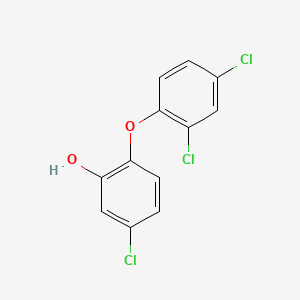
Triclosan
Triclosan is an aromatic ether that is phenol which is substituted at C-5 by a chloro group and at C-2 by a 2,4-dichlorophenoxy group. It is widely used as a preservative and antimicrobial agent in personal care products such as soaps, skin creams, toothpaste and deodorants as well as in household items such as plastic chopping boards, sports equipment and shoes. It has a role as an EC 1.3.1.9 [enoyl-[acyl-carrier-protein] reductase (NADH)] inhibitor, a fungicide, an antibacterial agent, a xenobiotic, an antimalarial, an EC 1.5.1.3 (dihydrofolate reductase) inhibitor, a persistent organic pollutant and a drug allergen. It is a dichlorobenzene, a member of phenols, an aromatic ether and a member of monochlorobenzenes. — ChEBI
- IUPAC name
- 5-chloro-2-(2,4-dichlorophenoxy)phenol
- Molecular formula
- C12H7Cl3O2
- Molecular weight
- 289.5 g/mol
- Exact mass
- 287.951163 Da
- XLogP3
- 5.0
- Topological polar surface area
- 29.5 Ų
- Hydrogen-bond donors
- 1
- Hydrogen-bond acceptors
- 2
- Covalent units
- 1
- Defined stereocentres
- 0
Also known as
16 more reported names
External database identifiers
Retrieved from NIH PubChem on 2026-08-31 by checksum-valid CAS matching. Chemical properties do not replace the regulatory decision on this page.
Record details
Maximum concentration
0.3%
Other restrictions
Not to be used in toothpaste intended for children under 3 years of age.
Cosmetic products containing that substance that do not comply with the conditions may, provided that they comply with the conditions applicable on 23 April 2024, be placed on the Union market until 31 December 2024 and, if they have already been placed on the market before that date, continue to be made available on the Union market until 31 October 2025.
Warnings
For toothpaste containing Triclosan the following labelling is obligatory: ‘Not to be used for children under 3 years of age’.
INCI glossary name
Triclosan
Chemical name
5-Chloro-2-(2,4-dichlorophenoxy)phenol
Chemical / IUPAC name
5-Chloro-2-(2,4-dichlorophenoxy)phenol
Regulatory information
SCCS opinions
- Opinion concerning Triclosan
- Opinion on Triclosan
- Opinion on Triclosan Opinion on Triclosan Anti-microbial Resistance,Oinion on Triclosan Addenum to the SCCP opinion on Triclosan
- Request for a scientific advice on the safety of triclocarban and triclosan as substances with potential endocrine disrupting properties
Identified ingredients
Key data
Inventory links for Triclosan
Related records for Triclosan
Direct matches are limited for this record, so nearby entries from Annex V are shown as well.
CHLOROXYLENOL
POLYAMINOPROPYL BIGUANIDE
2-BROMO-2-NITROPROPANE-1,3-DIOL
What Annex V means for Triclosan
Triclosan is an approved preservative listed in Annex V of EU Cosmetics Regulation 1223/2009. Only substances on this positive list may be used as cosmetic preservatives in the EU.
Each preservative entry specifies maximum permitted concentrations and applicable product scope. Concentrations must not exceed the listed maximum. Some preservatives require warning statements on the product label.
This record is linked to 1 CosIng inventory ingredient for name and identifier cross-reference. The page also surfaces 12 related annex records with overlapping identifiers, annex logic or naming patterns.
Compliance checklist
- Use concentration must not exceed: 0.3%
- Verify the preservative is effective at the permitted concentration for your matrix.
- Apply required label warning statement.
Frequently asked questions
Source note for Annex V record Triclosan
This page summarizes one Annex V record for Triclosan from public European Commission cosmetic materials and adds linked inventory or identifier matches when available.
Use this record page to review Annex V conditions for Triclosan, but confirm any final regulatory decision against the current official annex wording and source files.
Tools & next steps
Check your formula
Paste a full INCI list to detect Triclosan and other flagged EU annex records in one pass.
INCI CheckerCompare entries
Compare Triclosan side by side with another annex record to review differences in restrictions, concentrations and annex placement.
CompareBrowse the annex
See all records in Annex V and compare regulatory conditions across substances in this annex.
Open Annex V