
BENZYL ALCOHOL
Benzyl alcohol (7)
BENZYL ALCOHOL appears in Annex V as a positive-list preservative entry for EU cosmetics. Maximum concentration in this record: 1.0%.
This substance is on the EU list of fragrance allergens that must be named individually in the ingredient list, rather than being covered by the word "parfum", once it exceeds 0.001% in a leave-on product or 0.01% in a rinse-off product.
Declaration is a labelling duty under Article 19, not a restriction on use. See the allergen record
Chemical identity and properties
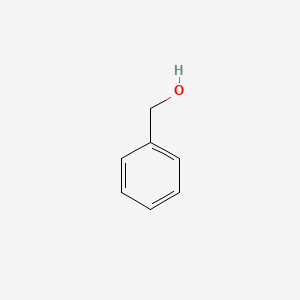
Benzyl Alcohol
Benzyl alcohol is an aromatic alcohol that consists of benzene bearing a single hydroxymethyl substituent. It has a role as an antioxidant, a metabolite, a solvent and a fragrance. — ChEBI
- IUPAC name
- phenylmethanol
- Molecular formula
- C7H8O
- Molecular weight
- 108.14 g/mol
- Exact mass
- 108.057514874 Da
- XLogP3
- 1.1
- Topological polar surface area
- 20.2 Ų
- Hydrogen-bond donors
- 1
- Hydrogen-bond acceptors
- 1
- Covalent units
- 1
- Defined stereocentres
- 0
Also known as
16 more reported names
External database identifiers
Evidence from additional scientific databases
EMBL-EBI ChEBI
benzyl alcohol
An aromatic alcohol that consists of benzene bearing a single hydroxymethyl substituent.
- Formula
- C7H8O
- Average mass
- 108.140 g/mol
- Monoisotopic mass
- 108.05751 Da
- Formal charge
- 0
- benzyl alcohols — is a (CHEBI:22743)
- solvent — has role (CHEBI:46787)
- metabolite — has role (CHEBI:25212)
- antioxidant — has role (CHEBI:22586)
- fragrance — has role (CHEBI:48318)
- antiparasitic agent — has role (CHEBI:35442)
- solvent — has role (CHEBI:46787)
- metabolite — has role (CHEBI:25212)
- antioxidant — has role (CHEBI:22586)
- fragrance — has role (CHEBI:48318)
- antiparasitic agent — has role (CHEBI:35442)
- benzyl alcohols — is a (CHEBI:22743)
- 10836148 Source: PubMed
- 11754587 Source: PubMed
- 11766131 Source: PubMed
- 12459019 Source: PubMed
- 1271397 Source: PubMed
- 12926880 Source: PubMed
- 15857133 Source: PubMed
- 16719518 Source: PubMed
- 17827020 Source: PubMed
- 18605734 Source: PubMed
- 19056282 Source: PubMed
- 19223628 Source: PubMed
- 20020916 Source: PubMed
- 2033592 Source: PubMed
- 21557223 Source: PubMed
- 22036973 Source: PubMed
- 27908763 Source: PubMed
- 2993621 Source: PubMed
- 30878192 Source: PubMed
- 32247113 Source: PubMed
- 37468498 Source: PubMed
- 894678 Source: PubMed
Additional curated names
Cross-references from this source
- CAS: 100-51-6 — ChemIDplus
- CAS: 100-51-6 — KEGG COMPOUND
- CAS: 100-51-6 — NIST Chemistry WebBook
- REGISTRY_NUMBER: 26514 — Gmelin
- REGISTRY_NUMBER: 878307 — Reaxys
- MANUAL_X_REF: 334 — DrugCentral
- MANUAL_X_REF: Benzyl_Alcohol — Wikipedia
- MANUAL_X_REF: BENZYL-ALCOHOL — MetaCyc
- MANUAL_X_REF: C00029811 — KNApSAcK
- MANUAL_X_REF: C00556 — KEGG COMPOUND
- MANUAL_X_REF: c0278 — UM-BBD
- MANUAL_X_REF: C03485 — KEGG COMPOUND
- MANUAL_X_REF: D00077 — KEGG DRUG
- MANUAL_X_REF: HMDB0003119 — HMDB
Mapped by: Exact CAS cross-reference in the ChEBI compound record. Source updated: 2021-09-27. Retrieved: 2026-08-31. Open source record
NIH PubChem PUG-View
Attributed physical-property, hazard, environmental and use annotations.
- Autoignition Temperature: 817 °F (USCG, 1999) Source: CAMEO Chemicals
- Autoignition Temperature: 817 °F (436 °C) Source: Hazardous Substances Data Bank (HSDB)
- Autoignition Temperature: 436 °C Source: ILO-WHO International Chemical Safety Cards (ICSCs)
- Boiling Point: 401 °F at 760 mmHg (NTP, 1992) Source: CAMEO Chemicals
- Boiling Point: 205.3 °C, 478 K, 402 °F Source: DrugBank
- Boiling Point: 205.3 °C Source: Hazardous Substances Data Bank (HSDB)
- Boiling Point: 205.00 to 206.00 °C. @ 760.00 mm Hg Source: Human Metabolome Database (HMDB)
- Boiling Point: 205 °C Source: ILO-WHO International Chemical Safety Cards (ICSCs)
- Boiling Point: 205 °C Source: Joint FAO/WHO Expert Committee on Food Additives (JECFA)
- Boiling Point: 401 °F Source: Occupational Safety and Health Administration (OSHA)
- Boiling Point: 205.31 °C @760 [mm Hg] Source: PAC Chemical Database, U.S. Department of Energy
- Color/Form: Water-white liquid Source: Hazardous Substances Data Bank (HSDB)
- Density: 1.05 at 1515 °F (USCG, 1999) - Denser than water; will sink Source: CAMEO Chemicals
- Density: 1.0419 g/cu cm at 24 °C Source: Hazardous Substances Data Bank (HSDB)
- Density: Percent in saturated air at 20 °C: 0.02; density of saturated air: 1.0005 (air = 1) Source: Hazardous Substances Data Bank (HSDB)
- Density: Liquid heat capacity = 0.520 BTU/lb-F at 68 °F; Liquid thermal conductivity = 1.088 BTU-in/hr-sq ft-F at 70 °F; Saturated vapor density = 0.00161 lb/cu ft at 180 °F; Ideal gas heat capacity = 0.276 BTU/lb-F at 60 °F Source: Hazardous Substances Data Bank (HSDB)
- Density: Relative density (water = 1): 1.04 Source: ILO-WHO International Chemical Safety Cards (ICSCs)
- Density: 1.040-1.050 Source: Joint FAO/WHO Expert Committee on Food Additives (JECFA)
- Density: 1.05 Source: Occupational Safety and Health Administration (OSHA)
- Density: 1.0419 @ 24°C Source: PAC Chemical Database, U.S. Department of Energy
- pKa: 15.4 Source: DrugBank
- Dissociation Constants: pKa = 15.40 Source: Hazardous Substances Data Bank (HSDB)
- Flash Point: 213 °F (NTP, 1992) Source: CAMEO Chemicals
- Flash Point: 93 °C Source: Haz-Map, Information on Hazardous Chemicals and Occupational Diseases
- Flash Point: 213 °F (closed cup); 220 °F (open cup) Source: Hazardous Substances Data Bank (HSDB)
- Flash Point: 220 °F (105 °C) (open cup) Source: Hazardous Substances Data Bank (HSDB)
- Flash Point: 200 °F (93 °C) (closed cup) Source: Hazardous Substances Data Bank (HSDB)
- Flash Point: 96 °C (205 °F) (Closed cup) Source: Hazardous Substances Data Bank (HSDB)
- Flash Point: 93 °C c.c. Source: ILO-WHO International Chemical Safety Cards (ICSCs)
- Flash Point: 213 °F Source: Occupational Safety and Health Administration (OSHA)
- LogP: 1.1 Source: DrugBank
- LogP: log Kow = 1.10 Source: Hazardous Substances Data Bank (HSDB)
- LogP: 1.10 Source: Human Metabolome Database (HMDB)
- LogP: 1.1 Source: ILO-WHO International Chemical Safety Cards (ICSCs)
- Melting Point: 4.5 °F (NTP, 1992) Source: CAMEO Chemicals
- Melting Point: -15..2 °C, 258 K, 5 °F Source: DrugBank
- Melting Point: -15.2 °C Source: Hazardous Substances Data Bank (HSDB)
- Melting Point: -15.2 °C Source: Human Metabolome Database (HMDB)
- Melting Point: -15 °C Source: ILO-WHO International Chemical Safety Cards (ICSCs)
- Melting Point: 4.5 °F Source: Occupational Safety and Health Administration (OSHA)
- Melting Point: -15.4 °C Source: PAC Chemical Database, U.S. Department of Energy
- Odor: Faint aromatic odor Source: Hazardous Substances Data Bank (HSDB)
- Physical Description: Benzyl alcohol appears as a clear colorless liquid with a pleasant odor. Slightly denser than water. Flash point 194 °F. Boiling point 401 °F. Contact may irritate skin, eyes, and mucous membranes. May be slightly toxic by ingestion. Used to make other chemicals. Source: CAMEO Chemicals
- Physical Description: Gas Vapor; Liquid; Liquid; Liquid; Wet Solid; Other Solid; CBI; Other Solid Source: EPA Chemical Data Reporting (CDR)
- Physical Description: Colourless, clear liquid with a faint, aromatic odour Source: EU Food Improvement Agents
- Physical Description: A colorless liquid with a sharp burning taste and slight odor; [ChemIDplus] Source: Haz-Map, Information on Hazardous Chemicals and Occupational Diseases
- Physical Description: Liquid Source: Human Metabolome Database (HMDB)
- Physical Description: COLOURLESS LIQUID WITH CHARACTERISTIC ODOUR. Source: ILO-WHO International Chemical Safety Cards (ICSCs)
- Physical Description: colourless liquid with a slightly pungent, faint aromatic, fruity odour Source: Joint FAO/WHO Expert Committee on Food Additives (JECFA)
- Physical Description: A clear colorless liquid with a pleasant odor. Source: Occupational Safety and Health Administration (OSHA)
- Refractive Index: [n]D/20 1,538-1,541 Source: EU Food Improvement Agents
- Refractive Index: Index of refraction: 1.5396 at 20 °C/D Source: Hazardous Substances Data Bank (HSDB)
- Refractive Index: 1.536-1.541 Source: Joint FAO/WHO Expert Committee on Food Additives (JECFA)
- Solubility: 10 to 50 mg/mL at 70 °F (NTP, 1992) Source: CAMEO Chemicals
- Solubility: 33 mg/mL, clear, colorless Source: DrugBank
- Solubility: Soluble in water, ethanol and ether Source: EU Food Improvement Agents
- Solubility: In water, 42,900 mg/L at 25 °C Source: Hazardous Substances Data Bank (HSDB)
- Solubility: In water, 35,000 mg/L at 20 °C Source: Hazardous Substances Data Bank (HSDB)
- Solubility: Soluble in benzene, methanol, chloroform, ethanol, ether, methanol, chloroform and acetone Source: Hazardous Substances Data Bank (HSDB)
- Solubility: One gram dissolves in 25 mL water; one vol dissolves in 1.5 vols of 50% ethyl alcohol; freely soluble in 50% alcohol; miscible with absolute and 94% alcohol, ether, chloroform. Source: Hazardous Substances Data Bank (HSDB)
- Solubility: 42.9 mg/mL at 25 °C Source: Human Metabolome Database (HMDB)
- Solubility: Solubility in water, g/100ml: 4 Source: ILO-WHO International Chemical Safety Cards (ICSCs)
- Solubility: slightly soluble in water, soluble in organic solvents, oils Source: Joint FAO/WHO Expert Committee on Food Additives (JECFA)
- Solubility: miscible at room temperature (in ethanol) Source: Joint FAO/WHO Expert Committee on Food Additives (JECFA)
- Vapor Pressure: 0.1 mmHg at 68 °F ; 1 mmHg at 136 °F (NTP, 1992) Source: CAMEO Chemicals
- Vapor Pressure: 0.09 [mmHg] Source: Haz-Map, Information on Hazardous Chemicals and Occupational Diseases
- Vapor Pressure: 0.094 mm Hg at 25 °C Source: Hazardous Substances Data Bank (HSDB)
- Vapor Pressure: Vapor pressure, Pa at 20 °C: 13.2 Source: ILO-WHO International Chemical Safety Cards (ICSCs)
- Vapor Pressure: 0.1 mmHg@68 °F Source: Occupational Safety and Health Administration (OSHA)
- Viscosity: 5.474 cP at 25 °C; 2.760 cP at 50 °C; 1.618 cP at 75 °C; 1.055 cP at 100 °C Source: Hazardous Substances Data Bank (HSDB)
- pH: A solution in water is neutral to litmus Source: Hazardous Substances Data Bank (HSDB)
- Substance: Benzyl Alcohol Source: NTP Technical Reports
- NTP Technical Report: TR-343: Toxicology and Carcinogenesis Studies of Benzyl Alcohol (CASRN 100-51-6) in F344/N Rats and B6C3F1 Mice (Gavage Studies) (1989 ) Source: NTP Technical Reports
- Peer Review Date: 11/06/87 Source: NTP Technical Reports
- Conclusion for Male Rat: No Evidence Source: NTP Technical Reports
- Conclusion for Female Rat: No Evidence Source: NTP Technical Reports
- Conclusion for Male Mice: No Evidence Source: NTP Technical Reports
- Conclusion for Female Mice: No Evidence Source: NTP Technical Reports
- Summary: Under the conditions of these 2-year gavage studies, there was no evidence of carcinogenic activity of benzyl alcohol for male or female F344/N rats dosed with 200 or 400 mg/kg. Survival in both dose groups of female rats was 50% that of vehicle controls, primarily due to an increased number of gavage-related deaths. There was no evidence of carcinogenic activity of benzyl alcohol for male or female B6C3F1 mice dosed with 100 or 200 mg/kg for 2 years. Source: NTP Technical Reports
- Exposure Routes: The substance can be absorbed into the body by inhalation of its vapour and by ingestion. Source: ILO-WHO International Chemical Safety Cards (ICSCs)
- First Aid: EYES: First check the victim for contact lenses and remove if present. Flush victim's eyes with water or normal saline solution for 20 to 30 minutes while simultaneously calling a hospital or poison control center. Do not put any ointments, oils, or medication in the victim's eyes without specific instructions from a physician. IMMEDIATELY transport the victim after flushing eyes to a hospital even if no symptoms (such as redness or irritation) develop.; SKIN: IMMEDIATELY flood affected skin with water while removing and isolating all contaminated clothing. Gently wash all affected skin areas thoroughly with soap and water. IMMEDIATELY call a hospital or poison control center even if no symptoms (such as redness or irritation) develop. IMMEDIATELY transport the victim to a hospital for treatment after washing the affected areas.; INHALATION: IMMEDIATELY leave the contaminated area; take deep breaths of fresh air. If symptoms (such as wheezing, coughing, shortness of breath, or burning in the mouth, throat, or chest) develop, call a physician and be prepared to transport the victim to a hospital. Provide proper respiratory protection to rescuers entering an unknown atmosphere. Whene Source: CAMEO Chemicals
- Signal: Warning Source: Regulation (EC) No 1272/2008 of the European Parliament and of the Council
- GHS Hazard Statements: H302: Harmful if swallowed [Warning Acute toxicity, oral]; H317: May cause an allergic skin reaction [Warning Sensitization, Skin]; H319: Causes serious eye irritation [Warning Serious eye damage/eye irritation] Source: Regulation (EC) No 1272/2008 of the European Parliament and of the Council
- Precautionary Statement Codes: P261, P264, P264+P265, P270, P272, P280, P301+P317, P302+P352, P305+P351+P338, P321, P330, P333+P317, P337+P317, P362+P364, and P501 (click each P-code to see the statement) Source: Regulation (EC) No 1272/2008 of the European Parliament and of the Council
- Note: This chemical does not meet GHS hazard criteria for < 0.1% (1 of 4746) of reports. Source: European Chemicals Agency (ECHA)
- Signal: Warning Source: European Chemicals Agency (ECHA)
- GHS Hazard Statements: H302 (> 99.9%): Harmful if swallowed [Warning Acute toxicity, oral]; H319 (18.8%): Causes serious eye irritation [Warning Serious eye damage/eye irritation]; H332 (95.3%): Harmful if inhaled [Warning Acute toxicity, inhalation] Source: European Chemicals Agency (ECHA)
- Precautionary Statement Codes: P261, P264, P264+P265, P270, P271, P280, P301+P317, P304+P340, P305+P351+P338, P317, P330, P337+P317, and P501 (click each P-code to see the statement) Source: European Chemicals Agency (ECHA)
- ECHA C&L Notifications Summary: Aggregated GHS information provided per 4746 reports by companies from 43 notifications to the ECHA C&L Inventory. Each notification may be associated with multiple companies.; Reported as not meeting GHS hazard criteria per 1 of 4746 reports by companies.; There are 42 notifications provided by 4745 of 4746 reports by companies with hazard statement code(s).; Information may vary between notifications depending on impurities, additives, and other factors. The percentage value in parenthesis indicates the notified classification ratio from companies that provide hazard codes. Only hazard codes with percentage values above 10% are shown. For more detailed information, please visit ECHA C&L website. Source: European Chemicals Agency (ECHA)
- GHS Hazard Statements: H302 (100%): Harmful if swallowed [Warning Acute toxicity, oral]; H312 (100%): Harmful in contact with skin [Warning Acute toxicity, dermal]; H315 (100%): Causes skin irritation [Warning Skin corrosion/irritation]; H319 (100%): Causes serious eye irritation [Warning Serious eye damage/eye irritation]; H332 (100%): Harmful if inhaled [Warning Acute toxicity, inhalation]; H335 (100%): May cause respiratory irritation [Warning Specific target organ toxicity, single exposure; Respiratory tract irritation] Source: European Chemicals Agency (ECHA)
- Precautionary Statement Codes: P261, P264, P264+P265, P270, P271, P280, P301+P317, P302+P352, P304+P340, P305+P351+P338, P317, P319, P321, P330, P332+P317, P337+P317, P362+P364, P403+P233, P405, and P501 (click each P-code to see the statement) Source: European Chemicals Agency (ECHA)
- ECHA C&L Notifications Summary: The GHS information provided by 1 company from 1 notification to the ECHA C&L Inventory. Source: European Chemicals Agency (ECHA)
- Signal: Warning Source: NITE-CMC
- NFPA Health Rating: 1 - Materials that, under emergency conditions, can cause significant irritation. Source: Hazardous Substances Data Bank (HSDB)
- NFPA Fire Rating: 1 - Materials that must be preheated before ignition can occur. Materials require considerable preheating, under all ambient temperature conditions, before ignition and combustion can occur. Source: Hazardous Substances Data Bank (HSDB)
- NFPA Instability Rating: 0 - Materials that in themselves are normally stable, even under fire conditions. Source: Hazardous Substances Data Bank (HSDB)
- Cosmetic Ingredient Review Finding(s): Safe in the present practices of use and concentration. Ingredient, concentration, and use information are available in documents discoverable at https://cir-reports.cir-safety.org Source: Cosmetic Ingredient Review (CIR)
- Toxicity Summary: IDENTIFICATION: Benzyl alcohol is an aromatic organic alcohol, water-white in color with a faint aromatic odor and a sharp burning taste; it is a preservative, a solvent, and a local anesthetic. It is used in a wide variety of products including photographic developer for color movie films; dyeing nylon filament, textiles, and sheet plastics; solvent for dyestuffs, cellulose esters, casein, waxes; heat-sealing polyethylene films; intermediate for benzyl esters and ethers; bacteriostatic; cosmetics, ointments, emulsions; ball point pen inks; stencil inks. HUMAN EXPOSURE AND TOXICITY: Benzyl alcohol has been found to be irritating to the skin at levels 3% or greater. Patch test with 0.65% benzyl alcohol did not produce irritation of the skin. Benzyl alcohol poisoning can cause the gasping syndrome in neonates. The infants had a typical course of gradual neurologic deterioration, severe metabolic acidosis, the striking onset of gasping respirations, thrombocytopenia, hepatic and renal failure, hypotension, cardiovascular collapse and death. In every infant, unmetabolized benzyl alcohol was identified in the urine. Hypersensitivity reactions may occur after parenteral or dermal exposur Source: Hazardous Substances Data Bank (HSDB)
- Environmental Bioconcentration: An estimated BCF of 1.4 was calculated in fish for benzyl alcohol(SRC), using a log Kow of 1.10(1) and a regression-derived equation(2). According to a classification scheme(3), this BCF suggests the potential for bioconcentration in aquatic organisms is low(SRC). Source: Hazardous Substances Data Bank (HSDB)
- Environmental Fate: TERRESTRIAL FATE: Based on a classification scheme(1), Koc values of <5(2) and 29(3) indicate that benzyl alcohol is expected to have very high mobility in soil(SRC). Volatilization of benzyl alcohol from moist soil surfaces is not expected to be an important fate process(SRC) given an estimated Henry's Law constant of 3.37X10⁻⁷ atm-cu m/mole(4). Benzyl alcohol is not expected to volatilize from dry soil surfaces(SRC) based upon a vapor pressure of 9.4X10⁻² mm Hg at 25 °C(5). Utilizing the Japanese MITI test, 94% of the Theoretical BOD was reached in 2 weeks(6) indicating that biodegradation is an important environmental fate process in soil(SRC). Source: Hazardous Substances Data Bank (HSDB)
- Environmental Fate: AQUATIC FATE: Based on a classification scheme(1), Koc values of <5(2) and 27(3) indicate that benzyl alcohol is not expected to adsorb to suspended solids and sediment(SRC). Volatilization from water surfaces is not expected to be an important fate process(4) based upon a Henry's Law constant of 3.37X10⁻⁷ atm-cu m/mole(5). According to a classification scheme(6), an estimated BCF of 1.4(SRC), from its log Kow of 1.10(7) and a regression-derived equation(8), suggests the potential for bioconcentration in aquatic organisms is low(SRC). Utilizing the Japanese MITI test, 94% of the Theoretical BOD was reached in 2 weeks(9) indicating that biodegradation is an important environmental fate process in water(SRC). Source: Hazardous Substances Data Bank (HSDB)
- Environmental Fate: ATMOSPHERIC FATE: According to a model of gas/particle partitioning of semivolatile organic compounds in the atmosphere(1), benzyl alcohol, which has a vapor pressure of 9.4X10⁻² mm Hg at 25 °C(2), is expected to exist solely as a vapor in the ambient atmosphere. Vapor phase benzyl alcohol is degraded in the atmosphere by reaction with photochemically produced hydroxyl radicals(SRC); the half-life for this reaction in air is estimated to be 2 days(SRC), calculated from its rate constant of 2.3X10⁻¹¹ cu cm/molecule sec at 25 °C(3). Benzyl alcohol does not contain chromophores that absorb at wavelengths >290 nm(4) and therefore is not expected to be susceptible to direct photolysis by sunlight(SRC). Source: Hazardous Substances Data Bank (HSDB)
- Consumer Uses: Other; Solvent; Solvents (which become part of product formulation or mixture); Insulators; Preservative; Not Known or Reasonably Ascertainable; Fragrance; Cleaning agent Source: EPA Chemical Data Reporting (CDR)
- Industry Uses: Processing aids not otherwise specified; Flavoring and nutrient; Solvents (which become part of product formulation or mixture); Dispersing agent; Solvent; Foamant; Other; Intermediate; Solvents (for cleaning or degreasing); Hardener; Cleaning agent; Fragrance; Not Known or Reasonably Ascertainable; Filler; Preservative Source: EPA Chemical Data Reporting (CDR)
- Cosmetic Ingredient Review Link: CIR ingredient: Benzyl Alcohol Source: Cosmetic Ingredient Review (CIR)
- Sources/Uses: Used as a preservative, epoxy resin catalyst, and in the photographic developer C-22; [Kanerva, p. 1757] Used as a preservative, solvent, and local anesthetic; [Marks, p. 136] Used as a preservative in drugs for injection; [Kanerva, p. 462-3] Used in flavors and perfumes and as a solvent for inks and dyes; [AIHA] Source: Haz-Map, Information on Hazardous Chemicals and Occupational Diseases
- Industrial Processes with risk of exposure: Using Disinfectants or Biocides [Category: Clean]; Plastic Composites Manufacturing [Category: Industry]; Photographic Processing [Category: Other] Source: Haz-Map, Information on Hazardous Chemicals and Occupational Diseases
- Uses: For benzyl alcohol (USEPA/OPP Pesticide Code: 9502) there are 0 labels match. /SRP: Not registered for current use in the U.S., but approved pesticide uses may change periodically and so federal, state and local authorities must be consulted for currently approved uses./ Source: Hazardous Substances Data Bank (HSDB)
- Uses: The active ingredient is no longer contained in any registered /pesticide/ products ... "cancelled." Source: Hazardous Substances Data Bank (HSDB)
- Uses: ... Photographic developer for color movie films; dyeing nylon filament, textiles, and sheet plastics; solvent for dyestuffs, cellulose esters, casein, waxes, etc.; heat-sealing polyethylene films; intermediate for benzyl esters and ethers; bacteriostat; cosmetics, ointments, emulsions; ball point pen inks; stencil inks. Source: Hazardous Substances Data Bank (HSDB)
- Uses: Benzyl alcohol is used in cosmetics as a fragrance component, preservative, solvent, and viscosity-decreasing agent. In January 1998, benzyl alcohol was reported to be used in 322 cosmetic formulations. Source: Hazardous Substances Data Bank (HSDB)
- Uses: For more Uses (Complete) data for BENZYL ALCOHOL (13 total), please visit the HSDB record page. Source: Hazardous Substances Data Bank (HSDB)
Mapped by: Existing checksum-valid CAS to unique PubChem CID match. Retrieved: 2026-08-31. Open source record
Scientific classifications and hazard annotations provide context and do not replace the market-specific regulatory decision shown above.
Additional source coverage and match status
| Source | Result | Checked |
|---|---|---|
| EMBL-EBI ChEBI | Exact match | 2026-08-31 |
| NIH PubChem PUG-View | Exact match | 2026-08-31 |
A recorded no-match is useful evidence that the source was checked; it is not a claim that the substance does not exist elsewhere.
Retrieved from NIH PubChem on 2026-08-31 by checksum-valid CAS matching. Chemical properties do not replace the regulatory decision on this page.
Record details
Maximum concentration
1.0%
INCI glossary name
BENZYL ALCOHOL
Chemical name
Benzyl alcohol (7)
Regulatory information
Identified ingredients
EU Fragrance Allergen
This substance is linked to an EU fragrance-allergen reference. Check the current Annex III entry for the declaration threshold and any additional conditions.
Key data
Inventory links for BENZYL ALCOHOL
Related records for BENZYL ALCOHOL
Direct matches are limited for this record, so nearby entries from Annex V are shown as well.
1-Hydroxy-4-methyl-6-(2,4,4-trimethylpentyl)-2 pyridon, piroctone olamine
POLYAMINOPROPYL BIGUANIDE
METHYLCHLOROISOTHIAZOLINONE AND METHYLISOTHIAZOLINONE
CHLORHEXIDINE / CHLORHEXIDINE DIACETATE / CHLORHEXIDINE DIGLUCONATE / CHLORHEXIDINE DIHYDROCHLORIDE
What Annex V means for BENZYL ALCOHOL
BENZYL ALCOHOL is an approved preservative listed in Annex V of EU Cosmetics Regulation 1223/2009. Only substances on this positive list may be used as cosmetic preservatives in the EU.
Each preservative entry specifies maximum permitted concentrations and applicable product scope. Concentrations must not exceed the listed maximum. Some preservatives require warning statements on the product label.
This record is linked to 1 CosIng inventory ingredient for name and identifier cross-reference. The page also surfaces 12 related annex records with overlapping identifiers, annex logic or naming patterns.
Compliance checklist
- Use concentration must not exceed: 1.0%
- Verify the preservative is effective at the permitted concentration for your matrix.
- This substance is a regulated fragrance allergen. Declare it on the label by INCI name above 0.001% in leave-on or 0.01% in rinse-off products.
Frequently asked questions
Source note for Annex V record BENZYL ALCOHOL
This page summarizes one Annex V record for BENZYL ALCOHOL from public European Commission cosmetic materials and adds linked inventory or identifier matches when available.
Use this record page to review Annex V conditions for BENZYL ALCOHOL, but confirm any final regulatory decision against the current official annex wording and source files.
Tools & next steps
Check your formula
Paste a full INCI list to detect BENZYL ALCOHOL and other flagged EU annex records in one pass.
INCI CheckerCompare entries
Compare BENZYL ALCOHOL side by side with another annex record to review differences in restrictions, concentrations and annex placement.
CompareBrowse the annex
See all records in Annex V and compare regulatory conditions across substances in this annex.
Open Annex V