
UNDECYLENIC ACID / POTASSIUM UNDECYLENATE / SODIUM UNDECYLENATE / CALCIUM UNDECYLENATE / MEA-UNDECYLENATE / TEA-UNDECYLENATE
Undec-10-enoic acid and its salts
UNDECYLENIC ACID / POTASSIUM UNDECYLENATE / SODIUM UNDECYLENATE / CALCIUM UNDECYLENATE / MEA-UNDECYLENATE / TEA-UNDECYLENATE appears in Annex V as a positive-list preservative entry for EU cosmetics. Maximum concentration in this record: 0.2% (as acid).
Chemical identity and properties
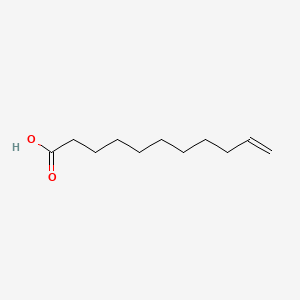
Undecylenic Acid
10-undecenoic acid is an undecenoic acid having its double bond in the 10-position. It is derived from castor oil and is used for the treatment of skin problems. It has a role as a plant metabolite and an antifungal drug. It is a conjugate acid of a 10-undecenoate. — ChEBI
- IUPAC name
- undec-10-enoic acid
- Molecular formula
- C11H20O2
- Molecular weight
- 184.27 g/mol
- Exact mass
- 184.146329876 Da
- XLogP3
- 3.9
- Topological polar surface area
- 37.3 Ų
- Hydrogen-bond donors
- 1
- Hydrogen-bond acceptors
- 2
- Covalent units
- 1
- Defined stereocentres
- 0
Also known as
16 more reported names
External database identifiers
- ChEBI:CHEBI:35045
- ChEMBL:CHEMBL1276010
- EPA DTXSID:DTXSID8035001
- PubMed:26902505
- PubMed:26776224
- PubMed:22947450
- PubMed:22907042
- PubMed:22904206
- PubMed:22717557
- PubMed:22713167
- PubMed:22704888
- PubMed:22652355
- PubMed:22447430
- PubMed:22433058
- PubMed:22396902
Evidence from additional scientific databases
NIH PubChem PUG-View
Attributed physical-property, hazard, environmental and use annotations.
- Boiling Point: Decomposes at 275°C Source: DrugBank
- Boiling Point: 137.00 °C. @ 2.00 mm Hg Source: Human Metabolome Database (HMDB)
- Boiling Point: 275 °C Source: Joint FAO/WHO Expert Committee on Food Additives (JECFA)
- Density: 0.910 - 0.917 Source: Joint FAO/WHO Expert Committee on Food Additives (JECFA)
- LogP: 3.86 Source: Human Metabolome Database (HMDB)
- Melting Point: 24.5 Source: DrugBank
- Melting Point: 24.5 °C Source: Human Metabolome Database (HMDB)
- Physical Description: Liquid Source: EPA Chemical Data Reporting (CDR)
- Physical Description: Liquid or solid; mp = 24.5 deg C; [Merck Index] Colorless or white liquid or low-melting solid; mp = 25-27 deg C; [Alfa Aesar MSDS] Source: Haz-Map, Information on Hazardous Chemicals and Occupational Diseases
- Physical Description: Solid Source: Human Metabolome Database (HMDB)
- Physical Description: colourless to pale yellow liquid Source: Joint FAO/WHO Expert Committee on Food Additives (JECFA)
- Refractive Index: 1.446-1.453 Source: Joint FAO/WHO Expert Committee on Food Additives (JECFA)
- Solubility: Insoluble Source: DrugBank
- Solubility: 0.0737 mg/mL at 30 °C Source: Human Metabolome Database (HMDB)
- Solubility: insoluble in water; soluble in alcohol and ether Source: Joint FAO/WHO Expert Committee on Food Additives (JECFA)
- Solubility: (in ethanol) Source: Joint FAO/WHO Expert Committee on Food Additives (JECFA)
- Carcinogen Classification: No indication of carcinogenicity to humans (not listed by IARC). Source: Toxin and Toxin Target Database (T3DB)
- Signal: Warning Source: European Chemicals Agency (ECHA)
- GHS Hazard Statements: H315 (100%): Causes skin irritation [Warning Skin corrosion/irritation]; H319 (100%): Causes serious eye irritation [Warning Serious eye damage/eye irritation]; H400 (10.5%): Very toxic to aquatic life [Warning Hazardous to the aquatic environment, acute hazard]; H412 (96.2%): Harmful to aquatic life with long lasting effects [Hazardous to the aquatic environment, long-term hazard] Source: European Chemicals Agency (ECHA)
- Precautionary Statement Codes: P264, P264+P265, P273, P280, P302+P352, P305+P351+P338, P321, P332+P317, P337+P317, P362+P364, P391, and P501 (click each P-code to see the statement) Source: European Chemicals Agency (ECHA)
- ECHA C&L Notifications Summary: Aggregated GHS information provided per 1915 reports by companies from 16 notifications to the ECHA C&L Inventory. Each notification may be associated with multiple companies.; Information may vary between notifications depending on impurities, additives, and other factors. The percentage value in parenthesis indicates the notified classification ratio from companies that provide hazard codes. Only hazard codes with percentage values above 10% are shown. For more detailed information, please visit ECHA C&L website. Source: European Chemicals Agency (ECHA)
- Cosmetic Ingredient Review Conclusion: The CIR Expert Panel concluded that the following ingredients are safe in the present practices of use andconcentration described in the safety assessment when formulated to be non-irritating and non-sensitizing, which may be basedon a QRA...Undecylenic Acid... Source: Cosmetic Ingredient Review (CIR)
- Cosmetic Ingredient Review Finding(s): Safe for use in cosmetics, with qualifications Source: Cosmetic Ingredient Review (CIR)
- Industry Uses: Intermediate Source: EPA Chemical Data Reporting (CDR)
- Cosmetic Ingredient Review Link: CIR ingredient: Undecylenic Acid Source: Cosmetic Ingredient Review (CIR)
- Sources/Uses: Used as a topical antifungal agent; [Merck Index] Used as a flavoring agent for foods; [JECFA] Source: Haz-Map, Information on Hazardous Chemicals and Occupational Diseases
Mapped by: Existing checksum-valid CAS to unique PubChem CID match. Retrieved: 2026-08-31. Open source record
Scientific classifications and hazard annotations provide context and do not replace the market-specific regulatory decision shown above.
Additional source coverage and match status
| Source | Result | Checked |
|---|---|---|
| NIH PubChem PUG-View | Exact match | 2026-08-31 |
A recorded no-match is useful evidence that the source was checked; it is not a claim that the substance does not exist elsewhere.
Retrieved from NIH PubChem on 2026-08-31 by checksum-valid CAS matching. Chemical properties do not replace the regulatory decision on this page.
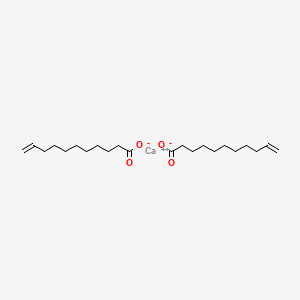
Calcium Undecylenate
Calcium Undecylenate is the calcium salt of undecylenic acid, an 11 carbon mono-unsaturated fatty acid with broad-spectrum antifungal activity. Undecylenic acid inhibits the morphogenesis of Candida albicans to its invasive fungal form and inhibits the conversion of unicellular yeast to their hyphal form. — NCI Thesaurus (NCIt)
- IUPAC name
- calcium bis(undec-10-enoate)
- Molecular formula
- C22H38CaO4
- Molecular weight
- 406.6 g/mol
- Exact mass
- 406.2396005 Da
- Topological polar surface area
- 80.3 Ų
- Hydrogen-bond donors
- 0
- Hydrogen-bond acceptors
- 4
- Covalent units
- 3
- Defined stereocentres
- 0
Also known as
16 more reported names
External database identifiers
- ChEMBL:CHEMBL2104130
Retrieved from NIH PubChem on 2026-09-02 by checksum-valid CAS matching. Chemical properties do not replace the regulatory decision on this page.
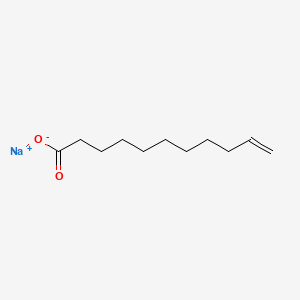
Sodium Undecylenate
The CIR Expert Panel concluded that the following ingredients are safe in the present practices of use andconcentration described in the safety assessment when formulated to be non-irritating and non-sensitizing, which may be basedon a QRA...Sodium Undecylenate... — Cosmetic Ingredient Review (CIR)
- IUPAC name
- sodium undec-10-enoate
- Molecular formula
- C11H19NaO2
- Molecular weight
- 206.26 g/mol
- Exact mass
- 206.12827413 Da
- Topological polar surface area
- 40.1 Ų
- Hydrogen-bond donors
- 0
- Hydrogen-bond acceptors
- 2
- Covalent units
- 2
- Defined stereocentres
- 0
Also known as
16 more reported names
External database identifiers
- EPA DTXSID:DTXSID4037039
Retrieved from NIH PubChem on 2026-09-02 by checksum-valid CAS matching. Chemical properties do not replace the regulatory decision on this page.
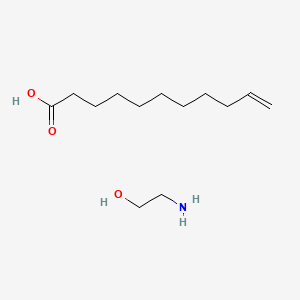
Undecylenic acid monoethanolamine
The CIR Expert Panel concluded that ethanolamine and the 12 related ethanolamine salts, listed below, are safe in the present practices of use and concentration described in this safety assessment (rinse-off products only) when formulated to be non-irritating. The Panel cautioned that ingredients should not be used in cosmetic products in which N-nitroso compounds may be formed...MEA-Undecylenate... — Cosmetic Ingredient Review (CIR)
- IUPAC name
- 2-aminoethanol;undec-10-enoic acid
- Molecular formula
- C13H27NO3
- Molecular weight
- 245.36 g/mol
- Exact mass
- 245.19909372 Da
- Topological polar surface area
- 83.6 Ų
- Hydrogen-bond donors
- 3
- Hydrogen-bond acceptors
- 4
- Covalent units
- 2
- Defined stereocentres
- 0
Also known as
2 more reported names
External database identifiers
- EPA DTXSID:DTXSID20971980
Retrieved from NIH PubChem on 2026-09-02 by checksum-valid CAS matching. Chemical properties do not replace the regulatory decision on this page.
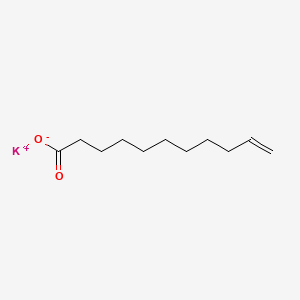
Potassium Undecylenate
The CIR Expert Panel concluded that the following ingredients are safe in the present practices of use andconcentration described in the safety assessment when formulated to be non-irritating and non-sensitizing, which may be basedon a QRA...Potassium Undecylenate... — Cosmetic Ingredient Review (CIR)
- IUPAC name
- potassium undec-10-enoate
- Molecular formula
- C11H19KO2
- Molecular weight
- 222.37 g/mol
- Exact mass
- 222.10221133 Da
- Topological polar surface area
- 40.1 Ų
- Hydrogen-bond donors
- 0
- Hydrogen-bond acceptors
- 2
- Covalent units
- 2
- Defined stereocentres
- 0
Also known as
External database identifiers
- EPA DTXSID:DTXSID50210591
Retrieved from NIH PubChem on 2026-09-02 by checksum-valid CAS matching. Chemical properties do not replace the regulatory decision on this page.
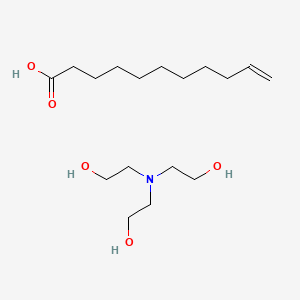
10-Undecenoic acid, compd. with 2,2',2''-nitrilotris(ethanol) (1:1)
- IUPAC name
- 2-[bis(2-hydroxyethyl)amino]ethanol;undec-10-enoic acid
- Molecular formula
- C17H35NO5
- Molecular weight
- 333.5 g/mol
- Exact mass
- 333.25152322 Da
- Topological polar surface area
- 101.0 Ų
- Hydrogen-bond donors
- 4
- Hydrogen-bond acceptors
- 6
- Covalent units
- 2
- Defined stereocentres
- 0
Also known as
External database identifiers
- EPA DTXSID:DTXSID90233441
Retrieved from NIH PubChem on 2026-09-02 by checksum-valid CAS matching. Chemical properties do not replace the regulatory decision on this page.
Record details
Maximum concentration
0.2% (as acid)
INCI glossary name
UNDECYLENIC ACID / POTASSIUM UNDECYLENATE / SODIUM UNDECYLENATE / CALCIUM UNDECYLENATE / MEA-UNDECYLENATE / TEA-UNDECYLENATE
Chemical name
Undec-10-enoic acid and its salts
Regulatory information
SCCS opinions
Key data
Inventory links for UNDECYLENIC ACID / POTASSIUM UNDECYLENATE / SODIUM UNDECYLENATE / CALCIUM UNDECYLENATE / MEA-UNDECYLENATE / TEA-UNDECYLENATE
Related records for UNDECYLENIC ACID / POTASSIUM UNDECYLENATE / SODIUM UNDECYLENATE / CALCIUM UNDECYLENATE / MEA-UNDECYLENATE / TEA-UNDECYLENATE
Direct matches are limited for this record, so nearby entries from Annex V are shown as well.
PHENYL MERCURIC ACETATE / PHENYL MERCURIC BENZOATE
Dibromohexamidine isethionate
2-BROMO-2-NITROPROPANE-1,3-DIOL
FORMIC ACID / SODIUM FORMATE
Dehydroacetic acid / SODIUM DEHYDROACETATE
4-HYDROXYBENZOIC ACID / METHYLPARABEN /POTASSIUM ETHYLPARABEN /POTASSIUM PARABEN /SODIUM METHYLPARA…
What Annex V means for UNDECYLENIC ACID / POTASSIUM UNDECYLENATE / SODIUM UNDECYLENATE / CALCIUM UNDECYLENATE / MEA-UNDECYLENATE / TEA-UNDECYLENATE
UNDECYLENIC ACID / POTASSIUM UNDECYLENATE / SODIUM UNDECYLENATE / CALCIUM UNDECYLENATE / MEA-UNDECYLENATE / TEA-UNDECYLENATE is an approved preservative listed in Annex V of EU Cosmetics Regulation 1223/2009. Only substances on this positive list may be used as cosmetic preservatives in the EU.
Each preservative entry specifies maximum permitted concentrations and applicable product scope. Concentrations must not exceed the listed maximum. Some preservatives require warning statements on the product label.
This record is linked to 6 CosIng inventory ingredients for name and identifier cross-reference. The page also surfaces 12 related annex records with overlapping identifiers, annex logic or naming patterns.
Compliance checklist
- Use concentration must not exceed: 0.2% (as acid)
- Verify the preservative is effective at the permitted concentration for your matrix.
Frequently asked questions
Source note for Annex V record UNDECYLENIC ACID / POTASSIUM UNDECYLENATE / SODIUM UNDECYLENATE / CALCIUM UNDECYLENATE / MEA-UNDECYLENATE / TEA-UNDECYLENATE
This page summarizes one Annex V record for UNDECYLENIC ACID / POTASSIUM UNDECYLENATE / SODIUM UNDECYLENATE / CALCIUM UNDECYLENATE / MEA-UNDECYLENATE / TEA-UNDECYLENATE from public European Commission cosmetic materials and adds linked inventory or identifier matches when available.
Use this record page to review Annex V conditions for UNDECYLENIC ACID / POTASSIUM UNDECYLENATE / SODIUM UNDECYLENATE / CALCIUM UNDECYLENATE / MEA-UNDECYLENATE / TEA-UNDECYLENATE, but confirm any final regulatory decision against the current official annex wording and source files.
Tools & next steps
Check your formula
Paste a full INCI list to detect UNDECYLENIC ACID / POTASSIUM UNDECYLENATE / SODIUM UNDECYLENATE / CALCIUM UNDECYLENATE / MEA-UNDECYLENATE / TEA-UNDECYLENATE and other flagged EU annex records in one pass.
INCI CheckerCompare entries
Compare UNDECYLENIC ACID / POTASSIUM UNDECYLENATE / SODIUM UNDECYLENATE / CALCIUM UNDECYLENATE / MEA-UNDECYLENATE / TEA-UNDECYLENATE side by side with another annex record to review differences in restrictions, concentrations and annex placement.
CompareBrowse the annex
See all records in Annex V and compare regulatory conditions across substances in this annex.
Open Annex V