
4-HYDROXYBENZOIC ACID / METHYLPARABEN /POTASSIUM ETHYLPARABEN /POTASSIUM PARABEN /SODIUM METHYLPARABEN /SODIUM ETHYLPARABEN /ETHYLPARABEN /SODIUM PARABEN / POTASSIUM METHYLPARABEN / CALCIUM PARABEN
4-Hydroxybenzoic acid and its Methyl- and Ethyl-esters, and their salts
4-HYDROXYBENZOIC ACID / METHYLPARABEN /POTASSIUM ETHYLPARABEN /POTASSIUM PARABEN /SODIUM METHYLPARABEN /SODIUM ETHYLPARABEN /ETHYLPARABEN /SODIUM PARABEN / POTASSIUM METHYLPARABEN / CALCIUM PARABEN appears in Annex V as a positive-list preservative entry for EU cosmetics. Maximum concentration in this record: 0,4% (as acid) for single ester 0,8% (as acid) for mixtures of esters.
Reading this entry
"Parabens" is not one regulatory answer. Methyl and ethyl esters sit here with a 0.4% limit; propyl and butyl sit in a stricter entry; and five other esters are prohibited outright in Annex II.
- This entry covers 4-hydroxybenzoic acid and its methyl and ethyl esters and their salts: 0.4% as acid for a single ester, 0.8% for mixtures.
- Propylparaben and butylparaben are entry 12a, capped at 0.14% for the sum of the two.
- Isopropyl-, isobutyl-, phenyl-, benzyl- and pentylparaben are prohibited — Annex II, entries 1374 to 1378.
- The 0.8% ceiling for mixtures spans entries 12 and 12a together, so the two entries are not independent budgets.
A formulator asked whether parabens are permitted in the EU has been asked a question with three answers, and which one applies depends entirely on the ester. The short-chain ones are here: methyl and ethyl, plus 4-hydroxybenzoic acid itself and the sodium, potassium and calcium salts. Up to 0.4% as acid for a single ester, 0.8% for mixtures.
Propylparaben and butylparaben are handled separately in entry 12a, at 0.14% for the sum of the two, and they may not be used in leave-on products for the nappy area of children under three. The two entries are not independent allowances. The 0.8% mixture ceiling is shared across both, and within it the propyl and butyl content still cannot exceed 0.14%.
Five further esters were removed from cosmetic use altogether in 2014 and now appear in Annex II: isopropylparaben, isobutylparaben, phenylparaben, benzylparaben and pentylparaben. For those the answer is not a limit but a prohibition.
So a label reading "paraben-free" is a marketing statement about a family of substances the regulation treats as three separate cases, and an ingredient list showing "paraben" tells you nothing until you know which one.
Checked against
Chemical identity and properties
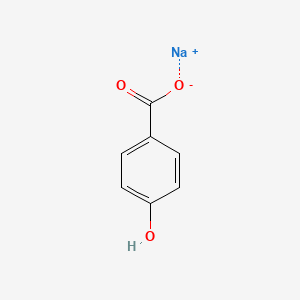
Sodium 4-hydroxybenzoate
Sodium 4-hydroxybenzoate is an organic sodium salt resulting from the replacement of the proton from the carboxy group of 4-hydroxybenzoic acid by a sodium ion. It has a role as a plant metabolite and an algal metabolite. It contains a 4-hydroxybenzoate. — ChEBI
- IUPAC name
- sodium 4-hydroxybenzoate
- Molecular formula
- C7H5NaO3
- Molecular weight
- 160.10 g/mol
- Exact mass
- 160.01363830 Da
- Topological polar surface area
- 60.4 Ų
- Hydrogen-bond donors
- 1
- Hydrogen-bond acceptors
- 3
- Covalent units
- 2
- Defined stereocentres
- 0
Also known as
16 more reported names
External database identifiers
- ChEBI:CHEBI:113449
- ChEMBL:CHEMBL1762656
- EPA DTXSID:DTXSID3059426
Evidence from additional scientific databases
NIH PubChem PUG-View
Attributed physical-property, hazard, environmental and use annotations.
- Note: This chemical does not meet GHS hazard criteria for 3.5% (3 of 86) of reports. Source: European Chemicals Agency (ECHA)
- Signal: Warning Source: European Chemicals Agency (ECHA)
- GHS Hazard Statements: H315 (96.5%): Causes skin irritation [Warning Skin corrosion/irritation]; H319 (96.5%): Causes serious eye irritation [Warning Serious eye damage/eye irritation]; H335 (95.3%): May cause respiratory irritation [Warning Specific target organ toxicity, single exposure; Respiratory tract irritation] Source: European Chemicals Agency (ECHA)
- Precautionary Statement Codes: P261, P264, P264+P265, P271, P280, P302+P352, P304+P340, P305+P351+P338, P319, P321, P332+P317, P337+P317, P362+P364, P403+P233, P405, and P501 (click each P-code to see the statement) Source: European Chemicals Agency (ECHA)
- ECHA C&L Notifications Summary: Aggregated GHS information provided per 86 reports by companies from 6 notifications to the ECHA C&L Inventory. Each notification may be associated with multiple companies.; Reported as not meeting GHS hazard criteria per 3 of 86 reports by companies.; There are 5 notifications provided by 83 of 86 reports by companies with hazard statement code(s).; Information may vary between notifications depending on impurities, additives, and other factors. The percentage value in parenthesis indicates the notified classification ratio from companies that provide hazard codes. Only hazard codes with percentage values above 10% are shown. For more detailed information, please visit ECHA C&L website. Source: European Chemicals Agency (ECHA)
- Cosmetic Ingredient Review Conclusion: The CIR Expert Panel concluded that the following 20 parabens are safe in cosmetics in the present practices of use and concentration described in the safety assessment when the sum of the combined concentration of parabens in any given formulation does not exceed 0.8 %...Sodium Paraben... Source: Cosmetic Ingredient Review (CIR)
- Cosmetic Ingredient Review Finding(s): Safe for use in cosmetics, with qualifications Source: Cosmetic Ingredient Review (CIR)
- Cosmetic Ingredient Review Link: CIR ingredient: Sodium Paraben Source: Cosmetic Ingredient Review (CIR)
Mapped by: Existing checksum-valid CAS to unique PubChem CID match. Retrieved: 2026-08-31. Open source record
Scientific classifications and hazard annotations provide context and do not replace the market-specific regulatory decision shown above.
Additional source coverage and match status
| Source | Result | Checked |
|---|---|---|
| NIH PubChem PUG-View | Exact match | 2026-08-31 |
A recorded no-match is useful evidence that the source was checked; it is not a claim that the substance does not exist elsewhere.
Retrieved from NIH PubChem on 2026-09-02 by checksum-valid CAS matching. Chemical properties do not replace the regulatory decision on this page.
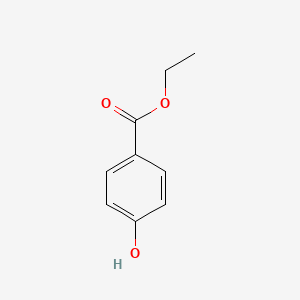
Ethylparaben
Ethylparaben is an ethyl ester resulting from the formal condensation of the carboxy group of 4-hydroxybenzoic acid with ethanol. It has a role as an antifungal agent, an antimicrobial food preservative, a plant metabolite and a phytoestrogen. It is an ethyl ester and a paraben. — ChEBI
- IUPAC name
- ethyl 4-hydroxybenzoate
- Molecular formula
- C9H10O3
- Molecular weight
- 166.17 g/mol
- Exact mass
- 166.062994177 Da
- XLogP3
- 2.5
- Topological polar surface area
- 46.5 Ų
- Hydrogen-bond donors
- 1
- Hydrogen-bond acceptors
- 3
- Covalent units
- 1
- Defined stereocentres
- 0
Also known as
16 more reported names
External database identifiers
- ChEBI:CHEBI:31575
- ChEMBL:CHEMBL15841
- EPA DTXSID:DTXSID9022528
- PubMed:39532263
- PubMed:37690743
- PubMed:35307500
- PubMed:34101200
- PubMed:33113465
- PubMed:31472229
- PubMed:30481674
- PubMed:29162470
- PubMed:27432241
- PubMed:27286252
- PubMed:25349334
- PubMed:25012808
Evidence from additional scientific databases
NIH PubChem PUG-View
Attributed physical-property, hazard, environmental and use annotations.
- Boiling Point: 297-298 °C (decomposition) Source: Hazardous Substances Data Bank (HSDB)
- Boiling Point: 298.00 °C. @ 760.00 mm Hg Source: Human Metabolome Database (HMDB)
- Color/Form: Small, colorless crystals or powder at room temperature Source: Hazardous Substances Data Bank (HSDB)
- Color/Form: Crystals from dilute alcohol Source: Hazardous Substances Data Bank (HSDB)
- Dissociation Constants: pKa = 8.34 Source: Hazardous Substances Data Bank (HSDB)
- LogP: log Kow = 2.47 Source: Hazardous Substances Data Bank (HSDB)
- LogP: 2.47 Source: Human Metabolome Database (HMDB)
- Melting Point: ofp-hydroxybenzoic acid isolated by acidification and not recrystallised: 213 °C to 217 °C, after vacuum drying in a sulphuric acid desiccator Source: EU Food Improvement Agents
- Melting Point: 117 °C Source: Hazardous Substances Data Bank (HSDB)
- Melting Point: 116 °C Source: Human Metabolome Database (HMDB)
- Odor: Odorless Source: Hazardous Substances Data Bank (HSDB)
- Physical Description: Liquid; Other Solid Source: EPA Chemical Data Reporting (CDR)
- Physical Description: Almost odourless, small, colourless crystals or a white, crystalline powder Source: EU Food Improvement Agents
- Physical Description: Colorless solid; [Hawley] Crystalline powder; [MSDSonline] Source: Haz-Map, Information on Hazardous Chemicals and Occupational Diseases
- Physical Description: Solid Source: Human Metabolome Database (HMDB)
- Solubility: In water, 8.85X10+2 mg/L at 25 °C Source: Hazardous Substances Data Bank (HSDB)
- Solubility: Solubility in water at 25 °C is 0.075% w/w; at 20 °C. 0.70% w/w Source: Hazardous Substances Data Bank (HSDB)
- Solubility: Solubilities in various solvents [Table#2496] Source: Hazardous Substances Data Bank (HSDB)
- Solubility: AT 25 °C: 0.5 G/100 G GLYCERIN Source: Hazardous Substances Data Bank (HSDB)
- Solubility: For more Solubility (Complete) data for ETHYLPARABEN (6 total), please visit the HSDB record page. Source: Hazardous Substances Data Bank (HSDB)
- Solubility: 0.885 mg/mL at 25 °C Source: Human Metabolome Database (HMDB)
- Vapor Pressure: 0.0000929 [mmHg] Source: Haz-Map, Information on Hazardous Chemicals and Occupational Diseases
- Carcinogen Classification: No indication of carcinogenicity to humans (not listed by IARC). Source: Toxin and Toxin Target Database (T3DB)
- Note: This chemical does not meet GHS hazard criteria for 60.7% (811 of 1336) of all reports. Source: European Chemicals Agency (ECHA)
- Signal: Danger Source: European Chemicals Agency (ECHA)
- GHS Hazard Statements: H304 (33.5%): May be fatal if swallowed and enters airways [Danger Aspiration hazard]; H315 (38.8%): Causes skin irritation [Warning Skin corrosion/irritation]; H317 (34%): May cause an allergic skin reaction [Warning Sensitization, Skin]; H319 (39.3%): Causes serious eye irritation [Warning Serious eye damage/eye irritation] Source: European Chemicals Agency (ECHA)
- Precautionary Statement Codes: P261, P264, P264+P265, P272, P280, P301+P316, P302+P352, P305+P351+P338, P321, P331, P332+P317, P333+P317, P337+P317, P362+P364, P405, and P501 (click each P-code to see the statement) Source: European Chemicals Agency (ECHA)
- ECHA C&L Notifications Summary: Aggregated GHS information provided per 1336 reports by companies from 10 notifications to the ECHA C&L Inventory. Each notification may be associated with multiple companies.; Reported as not meeting GHS hazard criteria per 811 of 1336 reports by companies.; There are 8 notifications provided by 525 of 1336 reports by companies with hazard statement code(s).; Information may vary between notifications depending on impurities, additives, and other factors. The percentage value in parenthesis indicates the notified classification ratio from companies that provide hazard codes. Only hazard codes with percentage values above 10% are shown. For more detailed information, please visit ECHA C&L website. Source: European Chemicals Agency (ECHA)
- Note: This chemical does not meet GHS hazard criteria for 100% (2 of 2) of all reports. Source: European Chemicals Agency (ECHA)
- GHS Hazard Statements: Not Classified; Reported as not meeting GHS hazard criteria by 2 of 2 companies. For more detailed information, please visit ECHA C&L website. Source: European Chemicals Agency (ECHA)
- ECHA C&L Notifications Summary: Aggregated GHS information provided per 2 reports by companies from 1 notifications to the ECHA C&L Inventory.; Reported as not meeting GHS hazard criteria per 2 of 2 reports by companies.; There are 0 notifications provided by 0 of 2 reports by companies with hazard statement code(s).; Information may vary between notifications depending on impurities, additives, and other factors. The percentage value in parenthesis indicates the notified classification ratio from companies that provide hazard codes. Only hazard codes with percentage values above 10% are shown. For more detailed information, please visit ECHA C&L website. Source: European Chemicals Agency (ECHA)
- GHS Hazard Statements: H401: Toxic to aquatic life [Hazardous to the aquatic environment, acute hazard] Source: Hazardous Substances Data Bank (HSDB)
- Precautionary Statement Codes: P273, and P501 (click each P-code to see the statement) Source: Hazardous Substances Data Bank (HSDB)
- Cosmetic Ingredient Review Conclusion: The CIR Expert Panel concluded that the following 20 parabens are safe in cosmetics in the present practices of use and concentration described in the safety assessment when the sum of the combined concentration of parabens in any given formulation does not exceed 0.8 %...Ehtylparaben.. Source: Cosmetic Ingredient Review (CIR)
- Cosmetic Ingredient Review Finding(s): Safe for use in cosmetics, with qualifications Source: Cosmetic Ingredient Review (CIR)
- Toxicity Summary: IDENTIFICATION AND USE: Ethylparaben forms small colorless crystals, or white powder. Ethylparaben inhibits the growth of fungi and bacteria and is used as a preservative for pharmaceuticals, adhesives, and various cosmetic preparations. HUMAN EXPOSURE AND TOXICITY: Ethylparaben was a skin irritant in man. It gave no evidence of sensitizing potential in a human study. The paraben esters as a generic class are rare sensitizers when applied to the intact skin of man. Application to the damaged skin is a more common cause of sensitization. A methyl:ethyl:propylparaben mixture has been shown on oral administration to exacerbate pre-existing skin complaints. ANIMAL STUDIES: Ethylparaben was an eye irritant in rabbits. A low acute oral toxicity has been demonstrated for ethylparaben in laboratory animals. Limited long-term studies in rats have also indicated a low toxicity and have generated no evidence of carcinogenic activity. Ethylparaben in the diet produced cell proliferation in the forestomach of rats. No evidence of mutagenicity was reported in limited Ames Bacterial tests. Ethylparaben did increase chromosomal aberrations in a Chinese Hamster ovary cell assay, but similar effects Source: Hazardous Substances Data Bank (HSDB)
- Environmental Bioconcentration: An estimated BCF of 20 was calculated for ethylparaben(SRC), using a log Kow of 2.47(1) and a regression derived equation(2). According to a classification scheme(3), this BCF suggests the potential for bioconcentration in aquatic organisms is low(SRC). Source: Hazardous Substances Data Bank (HSDB)
- Environmental Fate: TERRESTRIAL FATE: Based on a classification scheme(1), Koc values ranging from 119 to 209(2) indicate that ethylparaben is expected to have high to moderate mobility in soil(SRC). The pKa of ethylparaben is 8.34(3), indicating that this compound will partially exist in the anion form in the environment and anions generally do not adsorb more strongly to soils containing organic carbon and clay than their neutral counterparts(4). Volatilization of ethylparaben from moist soil surfaces is not expected to be an important fate process(SRC) given an estimated Henry's Law constant of 4.8X10⁻⁹ atm-cu m/mole(SRC), using a fragment constant estimation method(5). Ethylparaben is not expected to volatilize from dry soil surfaces(SRC) based upon an estimated vapor pressure of 9.3X10⁻⁵ mm Hg(SRC), determined from a fragment constant method(6). Half-lives of about 14 days and 3.5 days were measured in aerobic screening tests conducted with phenol- and cresol-acclimated sludge over 7 day and 1 day incubation periods(7,8), respectively, suggesting that biodegradation may be an important fate process in soil(SRC). Source: Hazardous Substances Data Bank (HSDB)
- Environmental Fate: AQUATIC FATE: Based on a classification scheme(1), Koc values ranging from 119 to 209(2), indicate that ethylparaben is not expected to adsorb to suspended solids and sediment(SRC). Volatilization from water surfaces is not expected(3) based upon an estimated Henry's Law constant of 4.8X10⁻⁹ atm-cu m/mole(SRC), developed using a fragment constant estimation method(4). According to a classification scheme(5), an estimated BCF of 20(SRC), from its log Kow of 2.47(6) and a regression-derived equation(7), suggests the potential for bioconcentration in aquatic organisms is low(SRC). Half-lives of about 14 days and 3.5 days were measured in aerobic screening tests conducted with phenol- and cresol-acclimated sludge over 7 day and 1 day incubation periods(8,9), respectively, suggesting that biodegradation may be an important fate process in water(SRC). Source: Hazardous Substances Data Bank (HSDB)
- Environmental Fate: ATMOSPHERIC FATE: According to a model of gas/particle partitioning of semivolatile organic compounds in the atmosphere(1), ethylparaben, which has an estimated vapor pressure of 9.3X10⁻⁵ mm Hg at 25 °C(SRC), determined from a fragment constant method(2), will exist in both the vapor and particulate phases in the ambient atmosphere. Vapor-phase ethylparaben is degraded in the atmosphere by reaction with photochemically-produced hydroxyl radicals(SRC); the half-life for this reaction in air is estimated to be one day(SRC), calculated from its rate constant of 1.3X10⁻¹¹ cu cm/molecule-sec at 25 °C(SRC) that was derived using a structure estimation method(3). Particulate-phase ethylparaben may be removed from the air by wet and dry deposition(SRC). Ethylparaben contains chromophores that absorb at wavelengths >290 nm(4) and therefore may be susceptible to direct photolysis by sunlight(SRC). Source: Hazardous Substances Data Bank (HSDB)
- Consumer Uses: Not Known or Reasonably Ascertainable Source: EPA Chemical Data Reporting (CDR)
- Cosmetic Ingredient Review Link: CIR ingredient: Ethylparaben Source: Cosmetic Ingredient Review (CIR)
- Sources/Uses: Used as a preservative for pharmaceuticals, adhesives, and various cosmetic preparations (inhibits fungal and bacterial growth); [HSDB] The parabens (methyl, ethyl, propyl, and butyl) were the most widely used preservatives in cosmetics (0.1% to 0.8%) until their sensitizing potential was recognized; [Marks, p. 115] Source: Haz-Map, Information on Hazardous Chemicals and Occupational Diseases
- Industrial Processes with risk of exposure: Working with Glues and Adhesives [Category: Other] Source: Haz-Map, Information on Hazardous Chemicals and Occupational Diseases
- Uses: For ethylparaben (USEPA/OPP Pesticide Code: 061202) there are 0 labels match. /SRP: Not registered for current use in the U.S., but approved pesticide uses may change periodically and so federal, state and local authorities must be consulted for currently approved uses./ Source: Hazardous Substances Data Bank (HSDB)
- Uses: Antimicrobial preservative for pharmaceuticals. Source: Hazardous Substances Data Bank (HSDB)
- Uses: Ethyl paraben ... inhibits the growth of fungi and bacteria and is used as a preservative for pharmaceuticals, adhesives, and various cosmetic preparations. Source: Hazardous Substances Data Bank (HSDB)
- Uses: ... Antibacterials that prevent /food spoilage by/ Clostridium botulinum include ... parabens ... /Parabens/ Source: Hazardous Substances Data Bank (HSDB)
- Uses: Ethylparaben is found in alcoholic beverages. Source: Toxin and Toxin Target Database (T3DB)
Mapped by: Existing checksum-valid CAS to unique PubChem CID match. Retrieved: 2026-08-31. Open source record
Scientific classifications and hazard annotations provide context and do not replace the market-specific regulatory decision shown above.
Additional source coverage and match status
| Source | Result | Checked |
|---|---|---|
| NIH PubChem PUG-View | Exact match | 2026-08-31 |
A recorded no-match is useful evidence that the source was checked; it is not a claim that the substance does not exist elsewhere.
Retrieved from NIH PubChem on 2026-09-02 by checksum-valid CAS matching. Chemical properties do not replace the regulatory decision on this page.
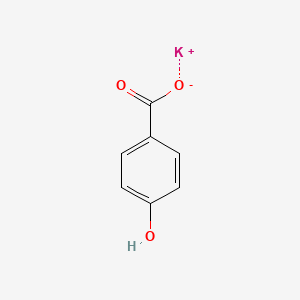
Potassium Paraben
The CIR Expert Panel concluded that the following 20 parabens are safe in cosmetics in the present practices of use and concentration described in the safety assessment when the sum of the combined concentration of parabens in any given formulation does not exceed 0.8 %...Potassium Paraben... — Cosmetic Ingredient Review (CIR)
- IUPAC name
- potassium 4-hydroxybenzoate
- Molecular formula
- C7H5KO3
- Molecular weight
- 176.21 g/mol
- Exact mass
- 175.98757550 Da
- Topological polar surface area
- 60.4 Ų
- Hydrogen-bond donors
- 1
- Hydrogen-bond acceptors
- 3
- Covalent units
- 2
- Defined stereocentres
- 0
Also known as
10 more reported names
External database identifiers
- EPA DTXSID:DTXSID20168378
Retrieved from NIH PubChem on 2026-09-02 by checksum-valid CAS matching. Chemical properties do not replace the regulatory decision on this page.
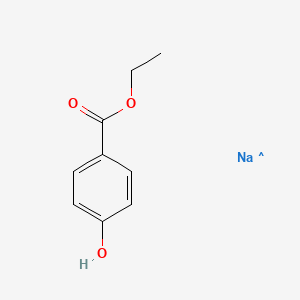
SODIUM ETHYL p-HYDROXYBENZOATE
- Molecular formula
- C9H10NaO3
- Molecular weight
- 189.16 g/mol
- Exact mass
- 189.05276346 Da
- Topological polar surface area
- 46.5 Ų
- Hydrogen-bond donors
- 1
- Hydrogen-bond acceptors
- 3
- Covalent units
- 2
- Defined stereocentres
- 0
Also known as
Retrieved from NIH PubChem on 2026-09-02 by checksum-valid CAS matching. Chemical properties do not replace the regulatory decision on this page.
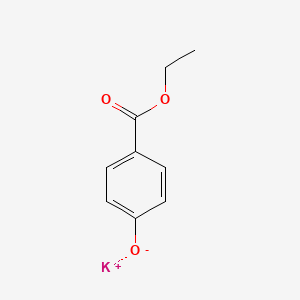
Potassium Ethylparaben
The CIR Expert Panel concluded that the following 20 parabens are safe in cosmetics in the present practices of use and concentration described in the safety assessment when the sum of the combined concentration of parabens in any given formulation does not exceed 0.8 %...Potassium Ethylparaben... — Cosmetic Ingredient Review (CIR)
- IUPAC name
- potassium 4-ethoxycarbonylphenolate
- Molecular formula
- C9H9KO3
- Molecular weight
- 204.26 g/mol
- Exact mass
- 204.01887563 Da
- Topological polar surface area
- 49.4 Ų
- Hydrogen-bond donors
- 0
- Hydrogen-bond acceptors
- 3
- Covalent units
- 2
- Defined stereocentres
- 0
Also known as
9 more reported names
External database identifiers
- EPA DTXSID:DTXSID50189970
Retrieved from NIH PubChem on 2026-09-02 by checksum-valid CAS matching. Chemical properties do not replace the regulatory decision on this page.
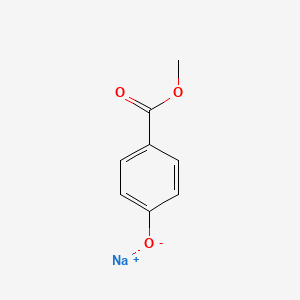
Methylparaben Sodium
The CIR Expert Panel concluded that the following 20 parabens are safe in cosmetics in the present practices of use and concentration described in the safety assessment when the sum of the combined concentration of parabens in any given formulation does not exceed 0.8 %...Sodium Methylparaben... — Cosmetic Ingredient Review (CIR)
- IUPAC name
- sodium 4-methoxycarbonylphenolate
- Molecular formula
- C8H7NaO3
- Molecular weight
- 174.13 g/mol
- Exact mass
- 174.02928836 Da
- Topological polar surface area
- 49.4 Ų
- Hydrogen-bond donors
- 0
- Hydrogen-bond acceptors
- 3
- Covalent units
- 2
- Defined stereocentres
- 0
Also known as
16 more reported names
External database identifiers
- ChEMBL:CHEMBL2106903
- EPA DTXSID:DTXSID1042156
Retrieved from NIH PubChem on 2026-09-02 by checksum-valid CAS matching. Chemical properties do not replace the regulatory decision on this page.
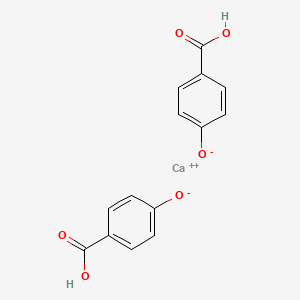
Calcium bis(4-hydroxybenzoate)
- IUPAC name
- calcium bis(4-carboxyphenolate)
- Molecular formula
- C14H10CaO6
- Molecular weight
- 314.30 g/mol
- Exact mass
- 314.0103289 Da
- Topological polar surface area
- 121.0 Ų
- Hydrogen-bond donors
- 2
- Hydrogen-bond acceptors
- 6
- Covalent units
- 3
- Defined stereocentres
- 0
Also known as
External database identifiers
- EPA DTXSID:DTXSID30220234
Retrieved from NIH PubChem on 2026-09-02 by checksum-valid CAS matching. Chemical properties do not replace the regulatory decision on this page.
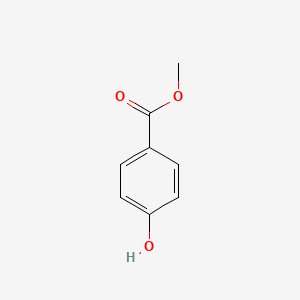
Methylparaben
Methylparaben is a 4-hydroxybenzoate ester resulting from the formal condensation of the carboxy group of 4-hydroxybenzoic acid with methanol. It is the most frequently used antimicrobial preservative in cosmetics. It occurs naturally in several fruits, particularly in blueberries. It has a role as an antifungal agent, a neuroprotective agent, an antimicrobial food preservative and a plant metabolite. — ChEBI
- IUPAC name
- methyl 4-hydroxybenzoate
- Molecular formula
- C8H8O3
- Molecular weight
- 152.15 g/mol
- Exact mass
- 152.047344113 Da
- XLogP3
- 2.0
- Topological polar surface area
- 46.5 Ų
- Hydrogen-bond donors
- 1
- Hydrogen-bond acceptors
- 3
- Covalent units
- 1
- Defined stereocentres
- 0
Also known as
16 more reported names
External database identifiers
- ChEBI:CHEBI:31835
- ChEMBL:CHEMBL325372
- EPA DTXSID:DTXSID4022529
- PubMed:24130033
- PubMed:23032206
- PubMed:23028405
- PubMed:23009993
- PubMed:22967656
- PubMed:22967651
- PubMed:22928552
- PubMed:22917524
- PubMed:22897632
- PubMed:22887738
- PubMed:22814205
- PubMed:22790701
Retrieved from NIH PubChem on 2026-08-31 by checksum-valid CAS matching. Chemical properties do not replace the regulatory decision on this page.
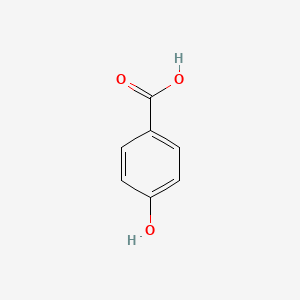
4-Hydroxybenzoic Acid
4-hydroxybenzoic acid is a monohydroxybenzoic acid that is benzoic acid carrying a hydroxy substituent at C-4 of the benzene ring. It has a role as a plant metabolite and an algal metabolite. It is a conjugate acid of a 4-hydroxybenzoate. — ChEBI
- IUPAC name
- 4-hydroxybenzoic acid
- Molecular formula
- C7H6O3
- Molecular weight
- 138.12 g/mol
- Exact mass
- 138.031694049 Da
- XLogP3
- 1.6
- Topological polar surface area
- 57.5 Ų
- Hydrogen-bond donors
- 2
- Hydrogen-bond acceptors
- 3
- Covalent units
- 1
- Defined stereocentres
- 0
Also known as
16 more reported names
External database identifiers
- ChEBI:CHEBI:30763
- ChEMBL:CHEMBL441343
- EPA DTXSID:DTXSID3026647
- PubMed:36746253
- PubMed:32664952
- PubMed:32122340
- PubMed:26090578
- PubMed:24685503
- PubMed:24055644
- PubMed:23074910
- PubMed:23037998
- PubMed:23000746
- PubMed:22980106
- PubMed:22978207
- PubMed:22952860
Retrieved from NIH PubChem on 2026-08-31 by checksum-valid CAS matching. Chemical properties do not replace the regulatory decision on this page.
Record details
Maximum concentration
0,4% (as acid) for single ester 0,8% (as acid) for mixtures of esters
INCI glossary name
4-HYDROXYBENZOIC ACID / METHYLPARABEN /POTASSIUM ETHYLPARABEN /POTASSIUM PARABEN /SODIUM METHYLPARABEN /SODIUM ETHYLPARABEN /ETHYLPARABEN /SODIUM PARABEN / POTASSIUM METHYLPARABEN / CALCIUM PARABEN
Chemical name
4-Hydroxybenzoic acid and its Methyl- and Ethyl-esters, and their salts
Chemical / IUPAC name
4-Hydroxybenzoic acid and its Methyl- and Ethyl-esters, and their salts (4-Hydroxybenzoic acid, methylparaben, potassium ethylparaben, potassium paraben, sodium methylparaben, sodium ethylparaben, ethylparaben, sodium paraben, potassium methylparaben, calcium paraben)
Regulatory information
SCCS opinions
Key data
Inventory links for 4-HYDROXYBENZOIC ACID / METHYLPARABEN /POTASSIUM ETHYLPARABEN /POTASSIUM PARABEN /SODIUM METHYLPARABEN /SODIUM ETHYLPARABEN /ETHYLPARABEN /SODIUM PARABEN / POTASSIUM METHYLPARABEN / CALCIUM PARABEN
SODIUM PARABEN
Related records for 4-HYDROXYBENZOIC ACID / METHYLPARABEN /POTASSIUM ETHYLPARABEN /POTASSIUM PARABEN /SODIUM METHYLPARABEN /SODIUM ETHYLPARABEN /ETHYLPARABEN /SODIUM PARABEN / POTASSIUM METHYLPARABEN / CALCIUM PARABEN
Direct matches are limited for this record, so nearby entries from Annex V are shown as well.
BUTYLPARABEN/PROPYLPARABEN/SODIUM PROPOYLPARABEN/SODIUM BUTYLPARABEN/POTASSIUM BUTYLPARABEN/POTASSI…
Dehydroacetic acid / SODIUM DEHYDROACETATE
FORMIC ACID / SODIUM FORMATE
Dibromohexamidine isethionate
SODIUM SULFITE / AMMONIUM BISULFITE / AMMONIUM SULFITE / POTASSIUM SULFITE / POTASSIUM hydrogen SUL…
o-Phenylphenol, Sodium o-Phenylphenate
PHENYL MERCURIC ACETATE / PHENYL MERCURIC BENZOATE
UNDECYLENIC ACID / POTASSIUM UNDECYLENATE / SODIUM UNDECYLENATE / CALCIUM UNDECYLENATE / MEA-UNDECY…
SORBIC ACID / CALCIUM SORBATE / SODIUM SORBATE / POTASSIUM SORBATE
What Annex V means for 4-HYDROXYBENZOIC ACID / METHYLPARABEN /POTASSIUM ETHYLPARABEN /POTASSIUM PARABEN /SODIUM METHYLPARABEN /SODIUM ETHYLPARABEN /ETHYLPARABEN /SODIUM PARABEN / POTASSIUM METHYLPARABEN / CALCIUM PARABEN
4-HYDROXYBENZOIC ACID / METHYLPARABEN /POTASSIUM ETHYLPARABEN /POTASSIUM PARABEN /SODIUM METHYLPARABEN /SODIUM ETHYLPARABEN /ETHYLPARABEN /SODIUM PARABEN / POTASSIUM METHYLPARABEN / CALCIUM PARABEN is an approved preservative listed in Annex V of EU Cosmetics Regulation 1223/2009. Only substances on this positive list may be used as cosmetic preservatives in the EU.
Each preservative entry specifies maximum permitted concentrations and applicable product scope. Concentrations must not exceed the listed maximum. Some preservatives require warning statements on the product label.
This record is linked to 15 CosIng inventory ingredients for name and identifier cross-reference. The page also surfaces 12 related annex records with overlapping identifiers, annex logic or naming patterns.
Compliance checklist
- Use concentration must not exceed: 0,4% (as acid) for single ester 0,8% (as acid) for mixtures of esters
- Verify the preservative is effective at the permitted concentration for your matrix.
Frequently asked questions
Source note for Annex V record 4-HYDROXYBENZOIC ACID / METHYLPARABEN /POTASSIUM ETHYLPARABEN /POTASSIUM PARABEN /SODIUM METHYLPARABEN /SODIUM ETHYLPARABEN /ETHYLPARABEN /SODIUM PARABEN / POTASSIUM METHYLPARABEN / CALCIUM PARABEN
This page summarizes one Annex V record for 4-HYDROXYBENZOIC ACID / METHYLPARABEN /POTASSIUM ETHYLPARABEN /POTASSIUM PARABEN /SODIUM METHYLPARABEN /SODIUM ETHYLPARABEN /ETHYLPARABEN /SODIUM PARABEN / POTASSIUM METHYLPARABEN / CALCIUM PARABEN from public European Commission cosmetic materials and adds linked inventory or identifier matches when available.
Use this record page to review Annex V conditions for 4-HYDROXYBENZOIC ACID / METHYLPARABEN /POTASSIUM ETHYLPARABEN /POTASSIUM PARABEN /SODIUM METHYLPARABEN /SODIUM ETHYLPARABEN /ETHYLPARABEN /SODIUM PARABEN / POTASSIUM METHYLPARABEN / CALCIUM PARABEN, but confirm any final regulatory decision against the current official annex wording and source files.
Tools & next steps
Check your formula
Paste a full INCI list to detect 4-HYDROXYBENZOIC ACID / METHYLPARABEN /POTASSIUM ETHYLPARABEN /POTASSIUM PARABEN /SODIUM METHYLPARABEN /SODIUM ETHYLPARABEN /ETHYLPARABEN /SODIUM PARABEN / POTASSIUM METHYLPARABEN / CALCIUM PARABEN and other flagged EU annex records in one pass.
INCI CheckerCompare entries
Compare 4-HYDROXYBENZOIC ACID / METHYLPARABEN /POTASSIUM ETHYLPARABEN /POTASSIUM PARABEN /SODIUM METHYLPARABEN /SODIUM ETHYLPARABEN /ETHYLPARABEN /SODIUM PARABEN / POTASSIUM METHYLPARABEN / CALCIUM PARABEN side by side with another annex record to review differences in restrictions, concentrations and annex placement.
CompareBrowse the annex
See all records in Annex V and compare regulatory conditions across substances in this annex.
Open Annex V