
DIHYDROCOUMARIN
DIHYDROCOUMARIN is linked to 1 EU annex record on this page. Inventory note: II/427.
Regulatory evidence by market
This matrix separates verified ingredient rules from sources that are mapped but not yet imported. No imported rule does not mean the ingredient is permitted.
Swipe or scroll horizontally to see every column.
| Market | Evidence status | Records | Source language |
|---|---|---|---|
| European Union | Evidence linked Prohibited entry found Open this evidence | 1 | English and EU languages |
| Great Britain | Evidence linked Prohibited Open this evidence | 1 | English |
| Canada | Evidence linked Restricted Open this evidence | 1 | English and French |
| New Zealand | Evidence linked Prohibited Open this evidence | 1 | English |
| ASEAN | Evidence linked Prohibited Open this evidence | 1 | English and national languages |
| China | Evidence linked Prohibited Open this evidence | 1 | Chinese with selected English material |
| Japan | Source mapped Official source mapped; ingredient rule not imported | 0 | Japanese; official English translation available |
| South Korea | Evidence linked Prohibited Open this evidence | 1 | Korean with some English names |
| United States | Source mapped Official source mapped; ingredient rule not imported | 0 | English |
| Australia | Source mapped Official source mapped; ingredient rule not imported | 0 | English |
| Brazil | Evidence linked Prohibited Open this evidence | 1 | Portuguese with INCI crosswalks |
| India | Evidence linked Prohibited Open this evidence | 1 | English and Hindi |
| Saudi Arabia | Evidence linked Prohibited Open this evidence | 1 | Arabic and English |
Chemical identity and properties
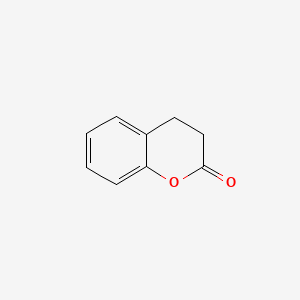
Dihydrocoumarin
3,4-dihydrocoumarin is a chromanone that is the 3,4-dihydro derivative of coumarin. It has a role as a plant metabolite. It is functionally related to a coumarin. — ChEBI
- IUPAC name
- 3,4-dihydrochromen-2-one
- Molecular formula
- C9H8O2
- Molecular weight
- 148.16 g/mol
- Exact mass
- 148.052429494 Da
- XLogP3
- 1.6
- Topological polar surface area
- 26.3 Ų
- Hydrogen-bond donors
- 0
- Hydrogen-bond acceptors
- 2
- Covalent units
- 1
- Defined stereocentres
- 0
Also known as
16 more reported names
External database identifiers
- ChEBI:CHEBI:16151
- ChEMBL:CHEMBL89306
- EPA DTXSID:DTXSID2020474
- PubMed:40784488
- PubMed:29968805
- PubMed:26795242
- PubMed:25027835
- PubMed:22978790
- PubMed:22789709
- PubMed:22719717
- PubMed:22679830
- PubMed:22654578
- PubMed:22590613
- PubMed:22589881
- PubMed:22577559
Evidence from additional scientific databases
NIH PubChem PUG-View
Attributed physical-property, hazard, environmental and use annotations.
- Boiling Point: 522 °F at 760 mmHg (NTP, 1992) Source: CAMEO Chemicals
- Boiling Point: 272 °C Source: Hazardous Substances Data Bank (HSDB)
- Boiling Point: 271.00 to 272.00 °C. @ 760.00 mm Hg Source: Human Metabolome Database (HMDB)
- Boiling Point: 272 °C Source: Joint FAO/WHO Expert Committee on Food Additives (JECFA)
- Color/Form: Leaflets Source: Hazardous Substances Data Bank (HSDB)
- Color/Form: White to light yellow, oily liquid Source: Hazardous Substances Data Bank (HSDB)
- Color/Form: Colorless crystals Source: Hazardous Substances Data Bank (HSDB)
- Density: 1.169 at 64 °F (NTP, 1992) - Denser than water; will sink Source: CAMEO Chemicals
- Density: 1.169 @ 18 °C Source: Hazardous Substances Data Bank (HSDB)
- Density: 1.186-1.192 Source: Joint FAO/WHO Expert Committee on Food Additives (JECFA)
- Flash Point: 266 °F (NTP, 1992) Source: CAMEO Chemicals
- Flash Point: 130 °C Source: Haz-Map, Information on Hazardous Chemicals and Occupational Diseases
- Flash Point: 130 °C Source: Hazardous Substances Data Bank (HSDB)
- Melting Point: 77 °F (NTP, 1992) Source: CAMEO Chemicals
- Melting Point: 25 °C Source: Hazardous Substances Data Bank (HSDB)
- Melting Point: 25 °C Source: Human Metabolome Database (HMDB)
- Odor: Herbal Source: Hazardous Substances Data Bank (HSDB)
- Odor: Odor similar to coumarin at room temp or reminiscent of nitrobenzene at higher temp. Source: Hazardous Substances Data Bank (HSDB)
- Odor: Coconut odor Source: Hazardous Substances Data Bank (HSDB)
- Odor: Hay-like Source: Hazardous Substances Data Bank (HSDB)
- Physical Description: 3,4-dihydrocoumarin is a white to pale yellow clear oily liquid with a sweet odor. Solidifies around room temperature. (NTP, 1992) Source: CAMEO Chemicals
- Physical Description: White to light yellow liquid; Colorless solid; [HSDB] Low melting solid; mp = 24-26 deg C; [MSDSonline] Source: Haz-Map, Information on Hazardous Chemicals and Occupational Diseases
- Physical Description: Solid Source: Human Metabolome Database (HMDB)
- Physical Description: colourless to pale yellow liquid; coconut-like aroma Source: Joint FAO/WHO Expert Committee on Food Additives (JECFA)
- Refractive Index: Index of refraction: 1.5563 @ 20 °C/D Source: Hazardous Substances Data Bank (HSDB)
- Refractive Index: 1.555-1.559 Source: Joint FAO/WHO Expert Committee on Food Additives (JECFA)
- Solubility: less than 1 mg/mL at 68 °F (NTP, 1992) Source: CAMEO Chemicals
- Solubility: Slightly soluble in ether and carbon tetrachloride Source: Hazardous Substances Data Bank (HSDB)
- Solubility: 1:2.5-3.5 IN 70% ALCOHOL Source: Hazardous Substances Data Bank (HSDB)
- Solubility: Soluble in chloroform. Source: Hazardous Substances Data Bank (HSDB)
- Solubility: Soluble in chlorinated solvents Source: Hazardous Substances Data Bank (HSDB)
- Solubility: In water, 3,000 mg/l at 37 °C Source: Hazardous Substances Data Bank (HSDB)
- Solubility: 3 mg/mL at 37 °C Source: Human Metabolome Database (HMDB)
- Solubility: Slightly soluble in water; soluble in oil Source: Joint FAO/WHO Expert Committee on Food Additives (JECFA)
- Solubility: soluble (in ethanol) Source: Joint FAO/WHO Expert Committee on Food Additives (JECFA)
- Vapor Pressure: 13.4 mmHg at 77 °F ; 19.5 mmHg at 108 °F; 27.4 mmHg at 145 °F (NTP, 1992) Source: CAMEO Chemicals
- Vapor Pressure: 13.4 [mmHg] Source: Haz-Map, Information on Hazardous Chemicals and Occupational Diseases
- Substance: 3,4-Dihydrocoumarin Source: NTP Technical Reports
- NTP Technical Report: TR-423: Toxicology and Carcinogenesis Studies of 3,4-Dihydrocoumarin (CASRN 119-84-6) in F344/N Rats and B6C3F1 Mice (Gavage Studies) (1993 ) Source: NTP Technical Reports
- Peer Review Date: 06/23/92 Source: NTP Technical Reports
- Conclusion for Male Rat: Some Evidence Source: NTP Technical Reports
- Conclusion for Female Rat: No Evidence Source: NTP Technical Reports
- Conclusion for Male Mice: No Evidence Source: NTP Technical Reports
- Conclusion for Female Mice: Some Evidence Source: NTP Technical Reports
- Summary: Under the conditions of these 2-year gavage studies, there was some evidence of carcinogenic activity of 3,4-dihydrocoumarin in male F344/N rats based on increased incidences of renal tubule adenomas and focal hyperplasia. The transitional cell carcinomas in two 600 mg/kg males may also have been chemical related. There was no evidence of carcinogenic activity of 3,4-dihydrocoumarin in female F344/N rats receiving 150, 300, or 600 mg/kg. There was no evidence of carcinogenic activity of 3,4-dihydrocoumarin in male B6C3F1 mice receiving 200, 400, or 800 mg/kg. There was some evidence of carcinogenic activity in female B6C3F1 mice based on increased incidences of hepatocellular adenoma and hepatocellular adenoma or carcinoma (combined).; 3,4-Dihydrocoumarin caused ulcers, hyperplasia, and inflammation of the forestomach, parathyroid gland hyperplasia, and increased severity of nephropathy in male rats. Source: NTP Technical Reports
- First Aid: EYES: First check the victim for contact lenses and remove if present. Flush victim's eyes with water or normal saline solution for 20 to 30 minutes while simultaneously calling a hospital or poison control center. Do not put any ointments, oils, or medication in the victim's eyes without specific instructions from a physician. IMMEDIATELY transport the victim after flushing eyes to a hospital even if no symptoms (such as redness or irritation) develop.; SKIN: IMMEDIATELY flood affected skin with water while removing and isolating all contaminated clothing. Gently wash all affected skin areas thoroughly with soap and water. If symptoms such as redness or irritation develop, IMMEDIATELY call a physician and be prepared to transport the victim to a hospital for treatment.; INHALATION: IMMEDIATELY leave the contaminated area; take deep breaths of fresh air. If symptoms (such as wheezing, coughing, shortness of breath, or burning in the mouth, throat, or chest) develop, call a physician and be prepared to transport the victim to a hospital. Provide proper respiratory protection to rescuers entering an unknown atmosphere. Whenever possible, Self-Contained Breathing Apparatus (SCBA) shou Source: CAMEO Chemicals
- Signal: Warning Source: European Chemicals Agency (ECHA)
- GHS Hazard Statements: H302 (> 99.9%): Harmful if swallowed [Warning Acute toxicity, oral]; H317 (97.4%): May cause an allergic skin reaction [Warning Sensitization, Skin] Source: European Chemicals Agency (ECHA)
- Precautionary Statement Codes: P261, P264, P270, P272, P280, P301+P317, P302+P352, P321, P330, P333+P317, P362+P364, and P501 (click each P-code to see the statement) Source: European Chemicals Agency (ECHA)
- ECHA C&L Notifications Summary: Aggregated GHS information provided per 1702 reports by companies from 11 notifications to the ECHA C&L Inventory. Each notification may be associated with multiple companies.; Information may vary between notifications depending on impurities, additives, and other factors. The percentage value in parenthesis indicates the notified classification ratio from companies that provide hazard codes. Only hazard codes with percentage values above 10% are shown. For more detailed information, please visit ECHA C&L website. Source: European Chemicals Agency (ECHA)
- Signal: Warning Source: Hazardous Chemical Information System (HCIS), Safe Work Australia
- GHS Hazard Statements: H302: Harmful if swallowed [Warning Acute toxicity, oral]; H317: May cause an allergic skin reaction [Warning Sensitization, Skin] Source: Hazardous Chemical Information System (HCIS), Safe Work Australia
- Precautionary Statement Codes: P261, P264, P270, P272, P280, P301+P317, P302+P352, P321, P330, P333+P317, P362+P364, and P501 (click each P-code to see the statement) Source: Hazardous Chemical Information System (HCIS), Safe Work Australia
- Sources/Uses: Used in perfumes and flavors--has GRAS status in US; [HSDB] Source: Haz-Map, Information on Hazardous Chemicals and Occupational Diseases
- Uses: ...Used in perfumery industry for its haylike odor. Source: Hazardous Substances Data Bank (HSDB)
- Uses: It has GRAS status and can be used as a food flavor ingredient with a sweet caramel-like taste. Source: Hazardous Substances Data Bank (HSDB)
- Uses: ... In woodruff-type flavor compositions. Source: Hazardous Substances Data Bank (HSDB)
Mapped by: Existing checksum-valid CAS to unique PubChem CID match. Retrieved: 2026-08-31. Open source record
Scientific classifications and hazard annotations provide context and do not replace the market-specific regulatory decision shown above.
Additional source coverage and match status
| Source | Result | Checked |
|---|---|---|
| NIH PubChem PUG-View | Exact match | 2026-08-31 |
A recorded no-match is useful evidence that the source was checked; it is not a claim that the substance does not exist elsewhere.
Retrieved from NIH PubChem on 2026-08-31 by checksum-valid CAS matching. Chemical properties do not replace the regulatory decision on this page.
Inventory details for DIHYDROCOUMARIN
INCI name
DIHYDROCOUMARIN
Record provenance
- Inventory reference
- 84648
- Imported identity
- DIHYDROCOUMARIN
- Source update
- 15/10/2010
Annex records for DIHYDROCOUMARIN
3,4-Dihydrocoumarin, when used as a fragrance ingredient
Key data
Official EU ingredient-name evidence
The ingredient name exactly matches the official 2025 EU glossary of common ingredient names.
The markets do not agree about this substance: it is prohibited in some and permitted under conditions in others, across the 10 markets that hold a rule for it.
Related inventory evidence
Ingredients with overlapping formulation functions
Additional official and scientific sources
11 external databases to check this identity in
Each link searches that source for this identity. What each source is, and its legal weight
How DIHYDROCOUMARIN appears in the CosIng inventory
The CosIng inventory lists DIHYDROCOUMARIN as a cosmetic ingredient and this page links it to 1 annex record. The inventory entry captures names and identifiers, while the annex record shows where the substance is prohibited, restricted or positively listed in EU cosmetics law.
DIHYDROCOUMARIN is also tagged with 2 cosmetic functions in the official data. Function labels describe intended use, but they do not replace regulatory review of linked annex records before formulation or labelling work.
Frequently asked questions
Source note for DIHYDROCOUMARIN
This page combines the CosIng inventory entry for DIHYDROCOUMARIN with 1 linked Annex II–VI record from the local dataset built from public European Commission cosmetic ingredient materials.
Use this inventory page to research DIHYDROCOUMARIN and compare linked records, but verify restrictions and legal status against the current official source text and law before making regulatory decisions.
Tools & next steps
Check your formula
Scan a full INCI list to detect DIHYDROCOUMARIN and any linked EU annex restrictions or allergen flags.
INCI CheckerSearch similar ingredients
Find other inventory ingredients and annex entries related to DIHYDROCOUMARIN, its identifiers or nearby name variants.
Search