
Official EU label nameGlossary entry 29095
TRICLOCARBAN
This record confirms an official common ingredient name for EU cosmetic product labelling. It does not by itself confirm that the substance is permitted, unrestricted or safe.
Global evidence snapshot
The resolved identity has matching regulatory evidence in 7 of 13 indexed market datasets: 9 country records and 2 EU Annex records. Every result and evidence gap is listed below.
Markets checked
13
Markets with evidence
7
Evidence gaps
6
Resolved identifiers
2
Resolved substance identity
CAS:101-20-2
EC:202-924-1
Ingredient index records:
TRICLOCARBAN
Cosmetic functions: ANTIMICROBIAL, DEODORANT, PRESERVATIVE
1-(4-Chlorophenyl)-3-(3,4-dichlorophenyl)urea
Inventory restriction note: III/100 V/23
11 matched or reported names
TRICLOCARBANtriclocarban1-(4-Chlorophenyl)-3-(3,4-dichlorophenyl)urea (13)Triclocarban1-(4-Chlorophenyl)-3-(3,4-dichlorophenyl)urea1-(4-Chlorophenyl)-3-(3,4- dichlorophenyl)urea (triclocarban)Triclocarban§ (1-(4-chlorophenyl)-3-(3,4-dichlorophenyl)urea)Triclocarban (INN)(5) CAS No. 101-20-21-(4-Chlorophenyl)-3-(3,4- dichlorophenyl)urea Triclocarban CAS No 101-20-2트리클로카반(트리클로카바닐리드)1-(4-Chlorophenyl)- 3-(3,4- dichlorophenyl)urea (10) Triclocarban (CAS No. 101-20-2)
Regulatory evidence in all 13 markets
Open each matched record for its scope, concentration, conditions, warnings and official source version.
Swipe or scroll horizontally to see dataset coverage and next actions.
| Market | Result | Records | Dataset | Meaning / next action |
|---|---|---|---|---|
| European Union EU | Restricted | 2Open record 1Open record 2 | Complete annex dataset Regulation (EC) 1223/2009 consolidated to 1 May 2026 | Review every linked record and exact conditions. |
| Great Britain GB | Restricted | 2Open record 1Open record 2 | Complete consolidated annex dataset GB retained Regulation 1223/2009 schedules, effective 15 August 2026 | Review every linked record and exact conditions. |
| Canada CA | No local match | 0 | Complete Hotlist snapshot Health Canada Cosmetic Ingredient Hotlist, 13 August 2025 | The Hotlist is an administrative compliance tool, not an exhaustive safety approval list. |
| New Zealand NZ | Restricted | 2Open record 1Open record 2 | Complete schedules dataset Cosmetic Products Group Standard schedules effective 1 January 2026 | Review every linked record and exact conditions. |
| ASEAN ASEAN | Restricted | 2Open record 1Open record 2 | Complete regional annex dataset ASEAN Cosmetic Directive annexes 2026-1, 22 June 2026 | Review every linked record and exact conditions. |
| China CN | No local match | 0 | Complete prohibited catalogues plus official-source workflow NMPA 2021 banned catalogues plus dynamic IECIC List I/List II system current since 2025 | IECIC listing is not blanket approval; absence may require the new cosmetic ingredient route, and restrictions are checked separately. |
| Japan JP | No local match | 0 | Complete Standards appendices dataset MHLW Standards for Cosmetics official English source and Japanese amendments checked for the imported snapshot | The Japanese text and subsequent notices are canonical; no local match is not a product-compliance conclusion. |
| South Korea KR | Restricted | 1Open record 1 | Complete current appendix dataset MFDS Notice 2026-19, effective 18 March 2026 | Review every linked record and exact conditions. |
| United States US | No local match | 0 | Complete enumerated federal ingredient rules eCFR Title 21 issue date 27 August 2026 | FDA has no general approved-cosmetic-ingredient catalogue; absence from these sections is not approval or proof of safety. |
| Australia AU | No local match | 0 | Complete cosmetic-relevant Poisons Standard subset plus official workflow Therapeutic Goods (Poisons Standard—June 2026) Instrument 2026 | An AICIS Inventory match is not cosmetic approval; no Inventory match can indicate a new, exempted, reported or confidential introduction. |
| Brazil BR | No local match | 0 | Complete prohibited dataset plus current restricted-list workflow ANVISA RDC 1.029/2026 and RDC 1.030/2026, published 15 June 2026 | RDC 1.030/2026 amends rather than replaces the prohibited baseline, and the second restricted-list revision was still under consultation in July 2026. |
| India IN | Restricted | 1Open record 1 | Complete current Part 2 dataset plus official workflow for Parts 1, 3 and 4 Cosmetics Rules 2020 plus current BIS IS 4707 parts (1:2020, 2:2025, 3:2025, 4:2022) | Review every linked record and exact conditions. |
| Saudi Arabia SA | Restricted | 1Open record 1 | Complete official list index SFDA live prohibited/restricted lists, snapshot 30 August 2026 | Review every linked record and exact conditions. |
No market rows match this filter.
Matching market records and conditions
Great Britain
GB retained Regulation 1223/2009 schedules, effective 15 August 2026TriclocarbanPermitted list with conditions
0,2% · Purity criteria: 3,3',4,4'-Tetrachloroazobenzene <1 ppm 3,3',4,4'-Tetrachloroazoxybenzene <1 ppm
GB Cosmetics Regulation, Annex V, entry 23 · 2026-08-15
TriclocarbanRestricted
Rinse-off products · 1,5% · Purity criteria: 3,3',4,4'-Tetrachloroazobenzene ≤ 1 ppm 3,3',4,4'-Tetrachloroazoxybenzene ≤ 1 ppm For purposes other than inhibiting the development of micro-organisms in the product. This purpose has to be apparent from the presentation of the produ…
GB Cosmetics Regulation, Annex III, entry 100 · 2026-08-15
New Zealand
Cosmetic Products Group Standard schedules effective 1 January 20261-(4-Chlorophenyl)-3-(3,4- dichlorophenyl)urea (triclocarban)Permitted list with conditions
Maximum concentration: 0.2% · Other limitations: Purity criteria: 3,3',4,4'-Tetrachloroazobenzene <1 ppm 3,3',4,4'-Tetrachloroazoxybenzene <1 ppm 3,3',4,4'-Tetrachloroazobenzene <1 ppm 3,3',4,4'-Tetrachloroazoxybenzene <1 ppm
Schedule 7, reference 23, source row 82 · effective-2026-01-01
Triclocarban§ (1-(4-chlorophenyl)-3-(3,4-dichlorophenyl)urea)Restricted
Product scope: Rinse-off products · Maximum concentration: 1.5% · Other limitations: Purity criteria: - 3,3',4,4'-Tetrachloroazobenzene: ≤ 1 ppm - 3,3',4,4'-Tetrachloroazoxybenzene: ≤ 1 ppm For purposes other than inhibiting the development of microorganisms in the product. Th…
Schedule 5, reference 100, source row 129 · effective-2026-01-01
ASEAN
ASEAN Cosmetic Directive annexes 2026-1, 22 June 2026Triclocarban (INN)(5) CAS No. 101-20-2Permitted list with conditions
0.2% · Purity criteria: 3,3’,4,4’- Tetrachloroazobenzene < 1 ppm; 3,3’,4,4’-Tetra- chloroazoxybenzene < 1 ppm
ASEAN Annex VI, reference 23 · 2026-1
1-(4-Chlorophenyl)-3-(3,4- dichlorophenyl)urea Triclocarban CAS No 101-20-2Restricted
Rinse-off products · 1.5 % · Purity criteria: 3,3’,4,4’- Tetrachloroazobenzene ≤1 ppm 3,3’,4,4’- Tetrachloroazoxybenzene ≤1 ppm For purposes other than inhibiting the development of microorganisms in the product. This purpose has to be apparent from the presentation of the produ…
ASEAN Annex III, reference 100 · 2026-1
South Korea
MFDS Notice 2026-19, effective 18 March 2026India
Cosmetics Rules 2020 plus current BIS IS 4707 parts (1:2020, 2:2025, 3:2025, 4:2022)Saudi Arabia
SFDA live prohibited/restricted lists, snapshot 30 August 2026Exact Annex II–VI evidence
Annex IIIentry 100
Open full regulatory recordTRICLOCARBAN
Product scope: Rinse-off products
Maximum concentration: 1.5%
Restrictions: Purity criteria: 3, 3', 4, 4'-Tetrachloroazobenzene
Annex Ventry 23
Open full regulatory recordTriclocarban
Product scope: All cosmetic products, with the exception of mouthwash.
Maximum concentration: 0,2 %
Restrictions: Purity criteria: 3,3',4,4'-Tetrachloroazobenzene ≤ 1 ppm 3,3',4,4'-Tetrachloroazoxybenzene ≤ 1 ppm Not to be used in toothpaste intended for children under 6 years of age. Cosmetic products containing that substance that do not comply with the conditions may, provided that they comply with the conditions applicable on 23 April 2024, be placed on the Union market until 31 December 2024 and, if they have already been placed on the market before that date, continue to be made available on the Un…
Warnings: For toothpaste containing Triclocarban the following labelling is obligatory: ‘Not to be used for children under 6 years of age’.
Chemical identity and properties
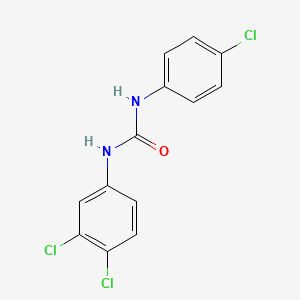
CAS 101-20-2PubChem CID 7547
Triclocarban
Triclocarban is a member of the class of phenylureas that is urea substituted by a 4-chlorophenyl group and a 3,4-dichlorophenyl group at positions 1 and 3 respectively. It has a role as an antimicrobial agent, a xenobiotic, an antiseptic drug, a disinfectant and an environmental contaminant. It is a member of phenylureas, a dichlorobenzene and a member of monochlorobenzenes. It is functionally related to a 1,3-diphenylurea. — ChEBI
- IUPAC name
- 1-(4-chlorophenyl)-3-(3,4-dichlorophenyl)urea
- Molecular formula
- C13H9Cl3N2O
- Molecular weight
- 315.6 g/mol
- Exact mass
- 313.978046 Da
- XLogP3
- 5.3
- Topological polar surface area
- 41.1 Ų
- Hydrogen-bond donors
- 2
- Hydrogen-bond acceptors
- 1
- Covalent units
- 1
- Defined stereocentres
- 0
Also known as
3,4,4'-TRICHLOROCARBANILIDECutisanProcuteneSolubacterCusiterGenofaceTrilocarbanUrea, N-(4-chlorophenyl)-N'-(3,4-dichlorophenyl)-
16 more reported names
3,4,4'-TrichlorodiphenylureaTrichlocarbanTriclocarbanumN-(4-Chlorophenyl)-N'-(3,4-dichlorophenyl)ureaNSC-72005TCC Soap3,4,4'-trichloro carbanilide1-(3',4'-Dichlorophenyl)-3-(4'-chlorophenyl)ureaENT 26925TCC (soap bacteriostat)Carbanilide, 3,4,4'-trichloro-CP 78416N-(3,4-Dichlorophenyl)-N'-(4-chlorophenyl)ureaBGG1Y1ED0YEPA Pesticide Chemical Code 027901CHEBI:48347
External database identifiers
- ChEBI:CHEBI:48347
- ChEMBL:CHEMBL1076347
- EPA DTXSID:DTXSID4026214
- PubMed:38631510
- PubMed:37385329
- PubMed:35413382
- PubMed:35164063
- PubMed:32065294
- PubMed:31868902
- PubMed:31576746
- PubMed:30940137
- PubMed:30657620
- PubMed:30592132
- PubMed:27979590
- PubMed:26827900
Evidence from additional scientific databases
EMBL-EBI ChEBI
Exact identifier matchCHEBI:48347
triclocarban
A member of the class of phenylureas that is urea substituted by a 4-chlorophenyl group and a 3,4-dichlorophenyl group at positions 1 and 3 respectively.
- Formula
- C13H9Cl3N2O
- Average mass
- 315.587 g/mol
- Monoisotopic mass
- 313.97805 Da
- Formal charge
- 0
- phenylureas — is a (CHEBI:134043)
- dichlorobenzene — is a (CHEBI:23697)
- monochlorobenzenes — is a (CHEBI:83403)
- disinfectant — has role (CHEBI:48219)
- antiseptic drug — has role (CHEBI:48218)
- xenobiotic — has role (CHEBI:35703)
- antimicrobial agent — has role (CHEBI:33281)
- environmental contaminant — has role (CHEBI:78298)
- 1,3-diphenylurea — has functional parent (CHEBI:41320)
- disinfectant — has role (CHEBI:48219)
- antiseptic drug — has role (CHEBI:48218)
- xenobiotic — has role (CHEBI:35703)
- antimicrobial agent — has role (CHEBI:33281)
- environmental contaminant — has role (CHEBI:78298)
- phenylureas — is a (CHEBI:134043)
- dichlorobenzene — is a (CHEBI:23697)
- monochlorobenzenes — is a (CHEBI:83403)
Additional curated names
1-(4-chlorophenyl)-3-(3,4-dichlorophenyl)urea1-(3',4'-dichlorophenyl)-3-(4'-chlorophenyl)urea3,4,4'-trichloro carbanilide3,4,4'-trichlorocarbanilide3,4,4'-trichlorodiphenylureaN-(4-chlorophenyl)-N'-(3,4-dichlorophenyl)ureaNSC-72005TCC
Cross-references from this source
Mapped by: Exact CAS cross-reference in the ChEBI compound record. Source updated: 2018-12-13. Retrieved: 2026-08-31. Open source record
NIH PubChem PUG-View
Exact identifier match7547
Attributed physical-property, hazard, environmental and use annotations.
- Boiling Point: 250 °C at 97.8 kPa (733 mm Hg) Source: Hazardous Substances Data Bank (HSDB)
- Color/Form: Fine white plates Source: Hazardous Substances Data Bank (HSDB)
- Color/Form: Fine plates Source: Hazardous Substances Data Bank (HSDB)
- Color/Form: Fine, white to off-white powder Source: Hazardous Substances Data Bank (HSDB)
- Density: 0.336 g/cu cm at 20 °C Source: Hazardous Substances Data Bank (HSDB)
- Dissociation Constants: pKa = 12.7 Source: Hazardous Substances Data Bank (HSDB)
- LogP: log Kow = 4.342 at 25 °C, pH 8.1 Source: Hazardous Substances Data Bank (HSDB)
- Melting Point: 482 to 493 °F (NTP, 1992) Source: CAMEO Chemicals
- Melting Point: 491.2- 493 Source: DrugBank
- Melting Point: 254.4 °C Source: Hazardous Substances Data Bank (HSDB)
- Melting Point: MP: 255.2-256 °C Source: Hazardous Substances Data Bank (HSDB)
- Odor: Slight, characteristic odor Source: Hazardous Substances Data Bank (HSDB)
- Physical Description: Triclocarban appears as fine white plates or white powder. (NTP, 1992) Source: CAMEO Chemicals
- Physical Description: White solid; [Merck Index] Source: Haz-Map, Information on Hazardous Chemicals and Occupational Diseases
- Solubility: less than 1 mg/mL at 79 °F (NTP, 1992) Source: CAMEO Chemicals
- Solubility: Insoluble Source: DrugBank
- Solubility: In water, 0.11 mg/L at 20 °C Source: Hazardous Substances Data Bank (HSDB)
- Solubility: Practically insoluble in water Source: Hazardous Substances Data Bank (HSDB)
- Solubility: 1 g dissolves in 25 mL acetone; 3 mL dimethyl formamide Source: Hazardous Substances Data Bank (HSDB)
- Solubility: In methanol, 1.6 g/L at 35 °C Source: Hazardous Substances Data Bank (HSDB)
- First Aid: EYES: First check the victim for contact lenses and remove if present. Flush victim's eyes with water or normal saline solution for 20 to 30 minutes while simultaneously calling a hospital or poison control center. Do not put any ointments, oils, or medication in the victim's eyes without specific instructions from a physician. IMMEDIATELY transport the victim after flushing eyes to a hospital even if no symptoms (such as redness or irritation) develop.; SKIN: IMMEDIATELY flood affected skin with water while removing and isolating all contaminated clothing. Gently wash all affected skin areas thoroughly with soap and water. If symptoms such as redness or irritation develop, IMMEDIATELY call a physician and be prepared to transport the victim to a hospital for treatment.; INHALATION: IMMEDIATELY leave the contaminated area; take deep breaths of fresh air. If symptoms (such as wheezing, coughing, shortness of breath, or burning in the mouth, throat, or chest) develop, call a physician and be prepared to transport the victim to a hospital. Provide proper respiratory protection to rescuers entering an unknown atmosphere. Whenever possible, Self-Contained Breathing Apparatus (SCBA) shou Source: CAMEO Chemicals
- Signal: Warning Source: European Chemicals Agency (ECHA)
- GHS Hazard Statements: H400 (96.8%): Very toxic to aquatic life [Warning Hazardous to the aquatic environment, acute hazard]; H410 (100%): Very toxic to aquatic life with long lasting effects [Warning Hazardous to the aquatic environment, long-term hazard] Source: European Chemicals Agency (ECHA)
- Precautionary Statement Codes: P273, P391, and P501 (click each P-code to see the statement) Source: European Chemicals Agency (ECHA)
- ECHA C&L Notifications Summary: Aggregated GHS information provided per 185 reports by companies from 6 notifications to the ECHA C&L Inventory. Each notification may be associated with multiple companies.; Information may vary between notifications depending on impurities, additives, and other factors. The percentage value in parenthesis indicates the notified classification ratio from companies that provide hazard codes. Only hazard codes with percentage values above 10% are shown. For more detailed information, please visit ECHA C&L website. Source: European Chemicals Agency (ECHA)
- Signal: Warning Source: Hazardous Substances Data Bank (HSDB)
- GHS Hazard Statements: H400: Very toxic to aquatic life [Warning Hazardous to the aquatic environment, acute hazard]; H410: Very toxic to aquatic life with long lasting effects [Warning Hazardous to the aquatic environment, long-term hazard] Source: Hazardous Substances Data Bank (HSDB)
- Precautionary Statement Codes: P273, P391, and P501 (click each P-code to see the statement) Source: Hazardous Substances Data Bank (HSDB)
- Toxicity Summary: IDENTIFICATION AND USE: Triclocarban (TCC) is a solid. It has anti-microbial activity and is used globally in a wide range of personal cleansing products that include deodorant soaps, detergents, cleansing lotions, and wipes. In North America, TCC is used exclusively as an antimicrobial and preservative in bar and liquid soaps and body washes. HUMAN STUDIES: Studies in humans indicate no evidence of skin sensitization or severe irritation. Petrolatum (0.1mL) containing 0, 1, 3, 6, and 9% TCC was applied continuously for 21 days on ten males. Minimal skin irritation was observed with the 9% concentration. There was no evidence of skin sensitization in volunteers tested with TCC (1.5% and 10%). The potential impact of exposure to TCC on fetal abnormalities was studied in 39 pregnant women diagnosed with fetal or post-birth abnormalities. Significantly increased levels of TCC were detected in maternal sera from mothers with abnormal births. TCC was also studied for its endocrine-disrupting effects. TCC exerted estrogenic activities by inducing luciferase activities in an ER reporter gene assay, promoting the proliferation of the MCF-7 cells, up-regulating the expression of pS2 and dow Source: Hazardous Substances Data Bank (HSDB)
- Environmental Bioconcentration: BCF values for triclocarban in rice fish (Oryzias latipes), exposed for 28 days to 20 and 2.0 ug/L were 80 and 81, respectively(1). A log BCF of 2.86 (BCF = 724) was measured using medaka (Oryzias latipes) exposed to 20 ug/L of triclocarban for 24 hours(2). According to a classification scheme(3), these BCF values suggest bioconcentration in aquatic organisms is moderate to high(SRC). Triclocarban BAFs in algae of 1600 to 2700 from three locations downstream of a waste water treatment plant in Pecan Creek, TX(4). Triclocarban bioaccumulation peaked at day 5 of a 56 day study of worms (Lumbriculus variegatus) in soil containing 22.4 ug/g dry weight triclocarban(5). Body burdens of 25 and 133 ng/g wet wt, corresponding to a biota soil accumulation factor range of 0.22 to 0.7, were reported after 28 days in earthworm (Eisenia foetida) present in 2 soils (Ashkum heavy-textured silty clay loam; Chelsea light-textured fine sand). The soils were amended with municipal (Chicago, IL) biosolids containing an average triclocarban concentration of 9200 ng/g dry wt, resulting in an average trace level soil concentration of 9 ng/g dry wt(6). Source: Hazardous Substances Data Bank (HSDB)
- Environmental Fate: TERRESTRIAL FATE: Based on a classification scheme(1), Koc values of 12,000(2) to 71,687(3) indicate that triclocarban is expected to be immobile in soil(SRC). Volatilization of triclocarban from moist soil surfaces is not expected to be an important fate process(SRC) given an estimated Henry's Law constant of 4.5X10⁻¹¹ atm-cu m/mole(SRC), developed using a fragment constant estimation method(4). Triclocarban is not expected to volatilize from dry soil surfaces(SRC) based upon an estimated vapor pressure of 3.6X10⁻⁹ mm Hg at 25 °C(SRC), determined from a fragment constant method(5). Utilizing the Japanese MITI test, 1% of the Theoretical BOD was reached in 4 weeks(6) indicating that biodegradation is not an important environmental fate process in soil(SRC). However using a continuous flow activated sludge, 50-100% degradation was obtained in 12 weeks, following lag periods of up to two weeks(7). Source: Hazardous Substances Data Bank (HSDB)
- Environmental Fate: TERRESTRIAL FATE: Dewatered municipal biosolids (DMBs) were applied to a field at a rate of approximately 22 Mg dw/ha in October 2008. Pharmaceuticals and personal care products (PPCPs) were monitored in groundwater, tile drainage, soil, DMB aggregates incorporated into the soil post-land application, and in the grain of wheat grown on the field for a period of approximately 1 year following application. Over 80 PPCPs were analyzed in the source DMB. PPCPs selected for in-depth monitoring included ... triclocarban .... PPCPs in tile were observed twice, approximately 3 weeks and 2 months post-application. Of all PPCPs measured in tile drainage, only carbamazepine, ibuprofen, acetaminophen, triclosan, triclocarban, venlafaxine, and citalopram were detected (5-74 ng/L). PPCPs were not detected in groundwater >2 m depth below the soil surface, and concentrations above detection limits at 2 m depth were only observed once just after the first rain event post-application. In groundwater, all compounds found in tile, except carbamazepine, acetaminophen and citalopram, were detected (10-19 ng/L). PPCPs were detected in DMB aggregates incorporated in soil up to 1 year post-application, wit Source: Hazardous Substances Data Bank (HSDB)
- Environmental Fate: AQUATIC FATE: Based on a classification scheme(1), Koc values of 12,000(2) to 71687(3) indicate that triclocarban is expected to adsorb to suspended solids and sediment(SRC). Volatilization from water surfaces is not expected(4) based upon an estimated Henry's Law constant of 4.5X10⁻¹¹ atm-cu m/mole(SRC), developed using a fragment constant estimation method(5). According to a classification scheme(6), BCF values of 80(7) to 724(8) suggest the potential for bioconcentration in aquatic organisms is moderate to high(SRC). Utilizing the Japanese MITI test, 1% of the Theoretical BOD was reached in 4 weeks(7) indicating that biodegradation is not an important environmental fate process in water(SRC). However using a continuous flow activated sludge, 50-100% degradation was obtained in 12 weeks, following lag periods of up to two weeks(9). Source: Hazardous Substances Data Bank (HSDB)
- Environmental Fate: ATMOSPHERIC FATE: According to a model of gas/particle partitioning of semivolatile organic compounds in the atmosphere(1), triclocarban, which has an estimated vapor pressure of 3.6X10⁻⁹ mm Hg at 25 °C(SRC), determined from a fragment constant method(2), is expected to exist solely in the particulate phase in the ambient atmosphere. Particulate-phase triclocarban may be removed from the air by wet and dry deposition(SRC). Triclocarban contains chromophores that absorb at wavelengths >290 nm(3) and, therefore, may be susceptible to direct photolysis by sunlight(SRC). Source: Hazardous Substances Data Bank (HSDB)
- Sources/Uses: Used as an antiseptic in cleaning products; [Merck Index] Used for skin and mucous membrane disinfection; [Reference #1] Source: Haz-Map, Information on Hazardous Chemicals and Occupational Diseases
- Industrial Processes with risk of exposure: Using Disinfectants or Biocides [Category: Clean] Source: Haz-Map, Information on Hazardous Chemicals and Occupational Diseases
- Uses: For 3,4,4'-trichlorocarbanilide (USEPA/OPP Pesticide Code: 027901) there are 0 labels match. /SRP: Not registered for current use in the U.S., but approved pesticide uses may change periodically and so federal, state and local authorities must be consulted for currently approved uses./ Source: Hazardous Substances Data Bank (HSDB)
- Uses: Bacteriostat and antiseptic in soaps and other cleansing compositions. Source: Hazardous Substances Data Bank (HSDB)
- Uses: Bacteriostat in ... plastics. Source: Hazardous Substances Data Bank (HSDB)
- Uses: Triclocarban is an anti-microbial active ingredient used globally in a wide range of personal cleansing products that include deodorant soaps, detergents, cleansing lotions, and wipes. In North America, triclocarban is used exclusively as an antimicrobial and preservative in bar and liquid soaps and body washes. Source: Hazardous Substances Data Bank (HSDB)
- Uses: Deodorant soaps contain an active ingredient such as 3,4,4'-trichlorocarbanilide (trichlocarban) to inhibit the growth of skin bacteria responsible for the formation of odor-causing substances from perspiration Source: Hazardous Substances Data Bank (HSDB)
Mapped by: Existing checksum-valid CAS to unique PubChem CID match. Retrieved: 2026-08-31. Open source record
Scientific classifications and hazard annotations provide context and do not replace the market-specific regulatory decision shown above.
Additional source coverage and match status
| Source | Result | Checked |
|---|---|---|
| EMBL-EBI ChEBI | Exact match | 2026-08-31 |
| NIH PubChem PUG-View | Exact match | 2026-08-31 |
A recorded no-match is useful evidence that the source was checked; it is not a claim that the substance does not exist elsewhere.
Retrieved from NIH PubChem on 2026-08-31 by checksum-valid CAS matching. Chemical properties do not replace the regulatory decision on this page.
Additional authoritative substance research
Each link searches that source for this identity. A link is a research route, not a claim that the source holds an exact record. What each source is, and its legal weight
Take this record further
Official source and scope
Imported from Commission Implementing Decision (EU) 2025/1175 (dataset version EU 2025/1175). The glossary supplies common ingredient names for the ingredient list required by Article 19(1)(g); it is not an approval or safety list.
Open official Decision