
Official EU label nameGlossary entry 29096
TRICLOSAN
This record confirms an official common ingredient name for EU cosmetic product labelling. It does not by itself confirm that the substance is permitted, unrestricted or safe.
Global evidence snapshot
The resolved identity has matching regulatory evidence in 7 of 13 indexed market datasets: 7 country records and 1 EU Annex records. Every result and evidence gap is listed below.
Markets checked
13
Markets with evidence
7
Evidence gaps
6
Resolved identifiers
2
Resolved substance identity
CAS:3380-34-5
EC:222-182-2
Ingredient index records:
TRICLOSAN
Cosmetic functions: ANTIMICROBIAL, DEODORANT, PRESERVATIVE
5-Chloro-2-(2,4-dichlorophenoxy)phenol
Inventory restriction note: V/25
8 matched or reported names
TRICLOSANtriclosanTriclosan5-Chloro-2-(2,4-dichlorophenoxy)phenol5-Chloro-2-(2,4-dichlorophenoxy)phenol (triclosan)5-Chloro-2- (2,4- dichlorophenoxy) phenol (INCI) Triclosan (INN) CAS No. 3380-34-55-Chloro-2- (2,4- dichlorophenoxy) phenol Triclosan CAS No 3380-34-5 Singapore: Not permitted for non- preservative use.트리클로산
Regulatory evidence in all 13 markets
Open each matched record for its scope, concentration, conditions, warnings and official source version.
Swipe or scroll horizontally to see dataset coverage and next actions.
| Market | Result | Records | Dataset | Meaning / next action |
|---|---|---|---|---|
| European Union EU | Conditional positive-list match | 1Open record 1 | Complete annex dataset Regulation (EC) 1223/2009 consolidated to 1 May 2026 | Review every linked record and exact conditions. |
| Great Britain GB | Permitted list with conditions | 1Open record 1 | Complete consolidated annex dataset GB retained Regulation 1223/2009 schedules, effective 15 August 2026 | Review every linked record and exact conditions. |
| Canada CA | Restricted | 1Open record 1 | Complete Hotlist snapshot Health Canada Cosmetic Ingredient Hotlist, 13 August 2025 | Review every linked record and exact conditions. |
| New Zealand NZ | Permitted list with conditions | 1Open record 1 | Complete schedules dataset Cosmetic Products Group Standard schedules effective 1 January 2026 | Review every linked record and exact conditions. |
| ASEAN ASEAN | Restricted | 2Open record 1Open record 2 | Complete regional annex dataset ASEAN Cosmetic Directive annexes 2026-1, 22 June 2026 | Review every linked record and exact conditions. |
| China CN | No local match | 0 | Complete prohibited catalogues plus official-source workflow NMPA 2021 banned catalogues plus dynamic IECIC List I/List II system current since 2025 | IECIC listing is not blanket approval; absence may require the new cosmetic ingredient route, and restrictions are checked separately. |
| Japan JP | No local match | 0 | Complete Standards appendices dataset MHLW Standards for Cosmetics official English source and Japanese amendments checked for the imported snapshot | The Japanese text and subsequent notices are canonical; no local match is not a product-compliance conclusion. |
| South Korea KR | Restricted | 1Open record 1 | Complete current appendix dataset MFDS Notice 2026-19, effective 18 March 2026 | Review every linked record and exact conditions. |
| United States US | No local match | 0 | Complete enumerated federal ingredient rules eCFR Title 21 issue date 27 August 2026 | FDA has no general approved-cosmetic-ingredient catalogue; absence from these sections is not approval or proof of safety. |
| Australia AU | Restricted | 1Open record 1 | Complete cosmetic-relevant Poisons Standard subset plus official workflow Therapeutic Goods (Poisons Standard—June 2026) Instrument 2026 | Review every linked record and exact conditions. |
| Brazil BR | No local match | 0 | Complete prohibited dataset plus current restricted-list workflow ANVISA RDC 1.029/2026 and RDC 1.030/2026, published 15 June 2026 | RDC 1.030/2026 amends rather than replaces the prohibited baseline, and the second restricted-list revision was still under consultation in July 2026. |
| India IN | No local match | 0 | Complete current Part 2 dataset plus official workflow for Parts 1, 3 and 4 Cosmetics Rules 2020 plus current BIS IS 4707 parts (1:2020, 2:2025, 3:2025, 4:2022) | The standards are separate controlled publications; absence from a locally indexed excerpt is not permission. |
| Saudi Arabia SA | No local match | 0 | Complete official list index SFDA live prohibited/restricted lists, snapshot 30 August 2026 | No list match is not permission; Gulf/SFDA product, claim, notification and technical requirements still apply. |
No market rows match this filter.
Matching market records and conditions
Great Britain
GB retained Regulation 1223/2009 schedules, effective 15 August 2026Canada
Health Canada Cosmetic Ingredient Hotlist, 13 August 2025New Zealand
Cosmetic Products Group Standard schedules effective 1 January 2026ASEAN
ASEAN Cosmetic Directive annexes 2026-1, 22 June 20265-Chloro-2- (2,4- dichlorophenoxy) phenol (INCI) Triclosan (INN) CAS No. 3380-34-5Permitted list with conditions
(a) 0.3% (b) 0.2% · (a) Toothpastes Hand soaps Body soaps/Shower gels Deodorants (non- spray) Face powders and blemish concealers Nail products for cleaning the fingernails and toenails before the application of artificial nail systems Shampoo Hair conditioner Facial cleanser (b…
ASEAN Annex VI, reference 25 · 2026-1
5-Chloro-2- (2,4- dichlorophenoxy) phenol Triclosan CAS No 3380-34-5 Singapore: Not permitted for non- preservative use.Restricted
(a) Toothpastes Hand soaps Body soaps/Shower gels Deodorants (non-spray) Face powders and blemish concealers Nail products for cleaning the fingernails and toenails before the application of artificial nail systems Shampoos Hair Conditioners Facial Cleansers (b) Mouthwashes · (a…
ASEAN Annex III, reference 288 · 2026-1
South Korea
MFDS Notice 2026-19, effective 18 March 2026Australia
Therapeutic Goods (Poisons Standard—June 2026) Instrument 2026Exact Annex II–VI evidence
Annex Ventry 25
Open full regulatory recordTriclosan
Product scope: Toothpastes; Hand soaps; Body soaps/Shower gels; Deodorants (non-spray); Face powders and blemish concealers; Nail products for cleaning the fingernails and toenails before the application of artificial nail systems;
Maximum concentration: 0.3%
Restrictions: Not to be used in toothpaste intended for children under 3 years of age. Cosmetic products containing that substance that do not comply with the conditions may, provided that they comply with the conditions applicable on 23 April 2024, be placed on the Union market until 31 December 2024 and, if they have already been placed on the market before that date, continue to be made available on the Union market until 31 October 2025.
Warnings: For toothpaste containing Triclosan the following labelling is obligatory: ‘Not to be used for children under 3 years of age’.
Chemical identity and properties
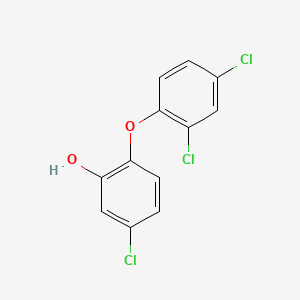
CAS 3380-34-5PubChem CID 5564
Triclosan
Triclosan is an aromatic ether that is phenol which is substituted at C-5 by a chloro group and at C-2 by a 2,4-dichlorophenoxy group. It is widely used as a preservative and antimicrobial agent in personal care products such as soaps, skin creams, toothpaste and deodorants as well as in household items such as plastic chopping boards, sports equipment and shoes. It has a role as an EC 1.3.1.9 [enoyl-[acyl-carrier-protein] reductase (NADH)] inhibitor, a fungicide, an antibacterial agent, a xenobiotic, an antimalarial, an EC 1.5.1.3 (dihydrofolate reductase) inhibitor, a persistent organic pollutant and a drug allergen. It is a dichlorobenzene, a member of phenols, an aromatic ether and a member of monochlorobenzenes. — ChEBI
- IUPAC name
- 5-chloro-2-(2,4-dichlorophenoxy)phenol
- Molecular formula
- C12H7Cl3O2
- Molecular weight
- 289.5 g/mol
- Exact mass
- 287.951163 Da
- XLogP3
- 5.0
- Topological polar surface area
- 29.5 Ų
- Hydrogen-bond donors
- 1
- Hydrogen-bond acceptors
- 2
- Covalent units
- 1
- Defined stereocentres
- 0
Also known as
Cloxifenolum2,4,4'-Trichloro-2'-hydroxydiphenyl etherTriclosanumIrgasan DP300Stri-Dex Cleansing BarStri-Dex Face WashCH 3565Phenol, 5-chloro-2-(2,4-dichlorophenoxy)-
16 more reported names
Lexol 3005-Chloro-2-(2,4-dichloro-phenoxy)-phenolCH-3565Phenyl ether, 2'-hydroxy-2,4,4'-trichloro-NSC-759151CHEBI:1642004NM5039Y5XtriclosanoGermasidolClearskinDermacareFreshandsGermicidaPacificPanachePrevens
External database identifiers
Retrieved from NIH PubChem on 2026-08-31 by checksum-valid CAS matching. Chemical properties do not replace the regulatory decision on this page.
Additional authoritative substance research
Each link searches that source for this identity. A link is a research route, not a claim that the source holds an exact record. What each source is, and its legal weight
Take this record further
Official source and scope
Imported from Commission Implementing Decision (EU) 2025/1175 (dataset version EU 2025/1175). The glossary supplies common ingredient names for the ingredient list required by Article 19(1)(g); it is not an approval or safety list.
Open official Decision