
HYDROXYPROPYL BIS(N-HYDROXYETHYL-P-PHENYLENEDIAMINE) HCL
Hydroxypropyl bis(N-hydroxyethyl-p-phenylenediamine) and its tetrahydro-chloride
HYDROXYPROPYL BIS(N-HYDROXYETHYL-P-PHENYLENEDIAMINE) HCL is listed in Annex III and may only be used under the conditions shown in this record.
Chemical identity and properties
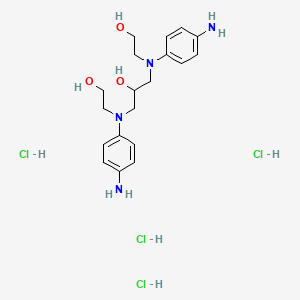
Hydroxypropyl bis(N-hydroxyethyl-p-phenylenediamine) hydrochloride
- IUPAC name
- 1,3-bis[4-amino-N-(2-hydroxyethyl)anilino]propan-2-ol;tetrahydrochloride
- Molecular formula
- C19H32Cl4N4O3
- Molecular weight
- 506.3 g/mol
- Exact mass
- 506.119902 Da
- Topological polar surface area
- 119.0 Ų
- Hydrogen-bond donors
- 9
- Hydrogen-bond acceptors
- 7
- Covalent units
- 5
- Defined stereocentres
- 0
Also known as
9 more reported names
External database identifiers
- EPA DTXSID:DTXSID30155976
Evidence from additional scientific databases
NIH PubChem PUG-View
Attributed physical-property, hazard, environmental and use annotations.
- Signal: Danger Source: European Chemicals Agency (ECHA)
- GHS Hazard Statements: H315 (100%): Causes skin irritation [Warning Skin corrosion/irritation]; H317 (100%): May cause an allergic skin reaction [Warning Sensitization, Skin]; H318 (100%): Causes serious eye damage [Danger Serious eye damage/eye irritation]; H400 (100%): Very toxic to aquatic life [Warning Hazardous to the aquatic environment, acute hazard]; H410 (100%): Very toxic to aquatic life with long lasting effects [Warning Hazardous to the aquatic environment, long-term hazard] Source: European Chemicals Agency (ECHA)
- Precautionary Statement Codes: P261, P264, P264+P265, P272, P273, P280, P302+P352, P305+P354+P338, P317, P321, P332+P317, P333+P317, P362+P364, P391, and P501 (click each P-code to see the statement) Source: European Chemicals Agency (ECHA)
- ECHA C&L Notifications Summary: Aggregated GHS information provided per 2 reports by companies from 2 notifications to the ECHA C&L Inventory. Each notification may be associated with multiple companies.; Information may vary between notifications depending on impurities, additives, and other factors. The percentage value in parenthesis indicates the notified classification ratio from companies that provide hazard codes. Only hazard codes with percentage values above 10% are shown. For more detailed information, please visit ECHA C&L website. Source: European Chemicals Agency (ECHA)
- ECHA C&L Notifications Summary: The GHS information provided by 1 company from 1 notification to the ECHA C&L Inventory. Source: European Chemicals Agency (ECHA)
- Cosmetic Ingredient Review Finding(s): Safe in the present practices of use and concentration. Ingredient, concentration, and use information are available in documents discoverable at https://cir-reports.cir-safety.org Source: Cosmetic Ingredient Review (CIR)
- Cosmetic Ingredient Review Link: CIR ingredient: Hydroxypropyl Bis(N-Hydroxyethyl-p-Phenylenediamine) HCl Source: Cosmetic Ingredient Review (CIR)
Mapped by: Existing checksum-valid CAS to unique PubChem CID match. Retrieved: 2026-08-31. Open source record
Scientific classifications and hazard annotations provide context and do not replace the market-specific regulatory decision shown above.
Additional source coverage and match status
| Source | Result | Checked |
|---|---|---|
| NIH PubChem PUG-View | Exact match | 2026-08-31 |
A recorded no-match is useful evidence that the source was checked; it is not a claim that the substance does not exist elsewhere.
Retrieved from NIH PubChem on 2026-09-02 by checksum-valid CAS matching. Chemical properties do not replace the regulatory decision on this page.
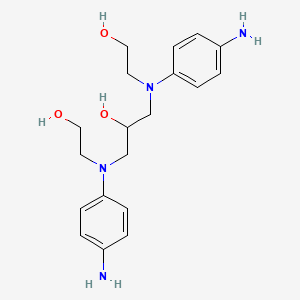
1,3-Bis((4-aminophenyl)-(2-hydroxyethyl)-amino)-propan-2-ol
- IUPAC name
- 1,3-bis[4-amino-N-(2-hydroxyethyl)anilino]propan-2-ol
- Molecular formula
- C19H28N4O3
- Molecular weight
- 360.5 g/mol
- Exact mass
- 360.21614077 Da
- XLogP3
- 0.5
- Topological polar surface area
- 119.0 Ų
- Hydrogen-bond donors
- 5
- Hydrogen-bond acceptors
- 7
- Covalent units
- 1
- Defined stereocentres
- 0
Also known as
External database identifiers
- EPA DTXSID:DTXSID90879823
Evidence from additional scientific databases
NIH PubChem PUG-View
Attributed physical-property, hazard, environmental and use annotations.
Mapped by: Existing checksum-valid CAS to unique PubChem CID match. Retrieved: 2026-08-31. Open source record
Scientific classifications and hazard annotations provide context and do not replace the market-specific regulatory decision shown above.
Additional source coverage and match status
| Source | Result | Checked |
|---|---|---|
| NIH PubChem PUG-View | Exact match | 2026-08-31 |
A recorded no-match is useful evidence that the source was checked; it is not a claim that the substance does not exist elsewhere.
Retrieved from NIH PubChem on 2026-09-02 by checksum-valid CAS matching. Chemical properties do not replace the regulatory decision on this page.
Record details
Product type
Other restrictions
After mixing under oxidative conditions the maximumconcentration applied to hair must not exceed 0.4% (as tetrahydro-chloride)
Warnings
Hair colourants can cause severe allergic reactions
Read and follow instructions
INCI glossary name
HYDROXYPROPYL BIS(N-HYDROXYETHYL-P-PHENYLENEDIAMINE) HCL
Chemical name
Hydroxypropyl bis(N-hydroxyethyl-p-phenylenediamine) and its tetrahydro-chloride
Regulatory information
SCCS opinions
- Request for a Re-evaluation of hair dyes listed in Annex III to Directive 76/768/EEC on Cosmetic Products
- Opinion concerning Use of Permanent Hair Dyes and Bladder Cancer - Updated 2004
- Opinion on Personal Use of Hair Dyes and Cancer Risk
- Opinion on the Use of Permanent Hair Dyes and Bladder Cancer Risk
- Assessment Strategies for Hair Dyes
- Opinion on Hydroxypropyl bis(N-hydroxyethyl-p-phenylenediamine)
- Opinion on Hydroxypropyl bis(N-hydroxyethyl-p-phenylenediamine) HCl
- Memorandum on Hair Dye Substances and their Skin Sensitising Properties
- Opinion on Hydroxypropyl bis(N-hydroxyethyl-p-phenylendediamine) HCl
Identified ingredients
Key data
Inventory links for HYDROXYPROPYL BIS(N-HYDROXYETHYL-P-PHENYLENEDIAMINE) HCL
HYDROXYPROPYL BIS(N-HYDROXYETHYL-P-PHENYLENEDIAMINE) HCL
Related records for HYDROXYPROPYL BIS(N-HYDROXYETHYL-P-PHENYLENEDIAMINE) HCL
N,N-bis(2-Hydroxyethyl)- p-Phenylenediamine Sulfate
1,3-BIS-(2,4-DIAMINOPHENOXY)PROPANE
6-METHOXY-2-METHYLAMINO-3-AMINOPYRIDINE HCL
HYDROXYETHYL-P-PHENYLENE-DIAMINE SULFATE
What Annex III means for HYDROXYPROPYL BIS(N-HYDROXYETHYL-P-PHENYLENEDIAMINE) HCL
HYDROXYPROPYL BIS(N-HYDROXYETHYL-P-PHENYLENEDIAMINE) HCL is a restricted substance under Annex III of EU Cosmetics Regulation 1223/2009. Its use in cosmetics is only permitted under the specific conditions set out in the entry above, including applicable concentration limits, product type restrictions and required warning statements.
When including this substance in a formulation, all conditions — maximum concentration, product scope and warning labels — must be met simultaneously. Compliance with one condition does not override the others.
This record is linked to 1 CosIng inventory ingredient for name and identifier cross-reference. The page also surfaces 12 related annex records with overlapping identifiers, annex logic or naming patterns.
Compliance checklist
- Confirm product type compatibility: Hair dye substance in oxidative hair dye products
- Include required warning statement on product label.
- Document conditions of use in the Product Information File (PIF).
Frequently asked questions
Source note for Annex III record HYDROXYPROPYL BIS(N-HYDROXYETHYL-P-PHENYLENEDIAMINE) HCL
This page summarizes one Annex III record for HYDROXYPROPYL BIS(N-HYDROXYETHYL-P-PHENYLENEDIAMINE) HCL from public European Commission cosmetic materials and adds linked inventory or identifier matches when available.
Use this record page to review Annex III conditions for HYDROXYPROPYL BIS(N-HYDROXYETHYL-P-PHENYLENEDIAMINE) HCL, but confirm any final regulatory decision against the current official annex wording and source files.
Tools & next steps
Check your formula
Paste a full INCI list to detect HYDROXYPROPYL BIS(N-HYDROXYETHYL-P-PHENYLENEDIAMINE) HCL and other flagged EU annex records in one pass.
INCI CheckerCompare entries
Compare HYDROXYPROPYL BIS(N-HYDROXYETHYL-P-PHENYLENEDIAMINE) HCL side by side with another annex record to review differences in restrictions, concentrations and annex placement.
CompareBrowse the annex
See all records in Annex III and compare regulatory conditions across substances in this annex.
Open Annex III