
HEXAMETHYLINDANOPYRAN
1,3,4,6,7,8-Hexahydro-4,6,6,7,8,8-hexamethylindeno(5,6-c)pyran; 1,3,4,6,7,8-Hexahydro-4,6,6,7,8,8-hexamethyl-cyclopenta-gamma-2-benzopyran; abbalide; galaxolide; HHCB; pearlide
HEXAMETHYLINDANOPYRAN is linked to 1 EU annex record on this page.
Regulatory evidence by market
This matrix separates verified ingredient rules from sources that are mapped but not yet imported. No imported rule does not mean the ingredient is permitted.
Swipe or scroll horizontally to see every column.
| Market | Evidence status | Records | Source language |
|---|---|---|---|
| European Union | Evidence linked Restricted entry found Open this evidence | 1 | English and EU languages |
| Great Britain | Source mapped Official source mapped; ingredient rule not imported | 0 | English |
| Canada | Source mapped Official source mapped; ingredient rule not imported | 0 | English and French |
| New Zealand | Source mapped Official source mapped; ingredient rule not imported | 0 | English |
| ASEAN | Source mapped Official source mapped; ingredient rule not imported | 0 | English and national languages |
| China | Source mapped Official source mapped; ingredient rule not imported | 0 | Chinese with selected English material |
| Japan | Source mapped Official source mapped; ingredient rule not imported | 0 | Japanese; official English translation available |
| South Korea | Source mapped Official source mapped; ingredient rule not imported | 0 | Korean with some English names |
| United States | Source mapped Official source mapped; ingredient rule not imported | 0 | English |
| Australia | Source mapped Official source mapped; ingredient rule not imported | 0 | English |
| Brazil | Source mapped Official source mapped; ingredient rule not imported | 0 | Portuguese with INCI crosswalks |
| India | Source mapped Official source mapped; ingredient rule not imported | 0 | English and Hindi |
| Saudi Arabia | Evidence linked Restricted Open this evidence | 1 | Arabic and English |
Chemical identity and properties
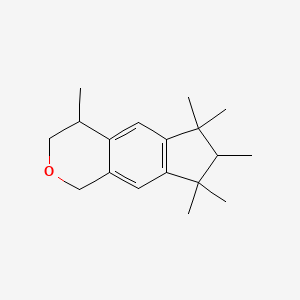
Galaxolide
Galaxolide is an organic heterotricyclic compound that is 1,3,4,6,7,8-hexahydrocyclopenta[g]isochromene substituted by methyl groups at positions 4, 6, 6, 7, 8 and 8 respectively. It is a synthetic musk used as a fragrance in cosmetics. It has a role as a fragrance. It is an organic heterotricyclic compound and a member of isochromenes. — ChEBI
- IUPAC name
- 4,6,6,7,8,8-hexamethyl-1,3,4,7-tetrahydrocyclopenta[g]isochromene
- Molecular formula
- C18H26O
- Molecular weight
- 258.4 g/mol
- Exact mass
- 258.198365449 Da
- XLogP3
- 4.8
- Topological polar surface area
- 9.2 Ų
- Hydrogen-bond donors
- 0
- Hydrogen-bond acceptors
- 1
- Covalent units
- 1
- Defined stereocentres
- 0
Also known as
16 more reported names
External database identifiers
- ChEBI:CHEBI:83784
- ChEMBL:CHEMBL1883305
- EPA DTXSID:DTXSID8027373
- PubMed:37797914
- PubMed:34687775
- PubMed:29427707
- PubMed:23084589
- PubMed:22967629
- PubMed:22813076
- PubMed:22779714
- PubMed:22733515
- PubMed:22709983
- PubMed:22699026
- PubMed:22540536
- PubMed:22489002
Evidence from additional scientific databases
NIH PubChem PUG-View
Attributed physical-property, hazard, environmental and use annotations.
- Boiling Point: BP: 128 °C at 0.8 mm Hg Source: Hazardous Substances Data Bank (HSDB)
- Color/Form: Colorless crystals from ethanol Source: Hazardous Substances Data Bank (HSDB)
- Color/Form: Viscous liquid[ECHA; Search for Chemicals. 1,3,4,6,7,8-hexahydro-4,6,6,7,8,8-hexmethylindeno Source: Hazardous Substances Data Bank (HSDB)
- Color/Form: Almost colorless viscous liquid Source: Hazardous Substances Data Bank (HSDB)
- Density: 1.0054 at 20 °C/4 °C Source: Hazardous Substances Data Bank (HSDB)
- Density: Density: 0.99 to 1.017 g/cu cm at 20 °C Source: Hazardous Substances Data Bank (HSDB)
- Density: Crystal density: 1.087 g/cu cm Source: Hazardous Substances Data Bank (HSDB)
- LogP: log Kow = 5.90 Source: Hazardous Substances Data Bank (HSDB)
- Melting Point: 57-58 °C Source: Hazardous Substances Data Bank (HSDB)
- Melting Point: MP: -10 to 0 °C (mixture of isomers) Source: Hazardous Substances Data Bank (HSDB)
- Odor: Strong musk odor Source: Hazardous Substances Data Bank (HSDB)
- Odor: Odor type: Musk Source: Hazardous Substances Data Bank (HSDB)
- Physical Description: Liquid; CBI; Other Solid Source: EPA Chemical Data Reporting (CDR)
- Physical Description: Colorless solid with a strong odor of musk; mp = 57-58 deg C; [Merck Index] Nearly colorless viscous liquid; [HSDB] Viscous liquid with a musk-like odor; mp = -5 deg C; [CHEMINFO] Viscous liquid; mp = -10-0 deg C; [eChemPortal: ESIS: RAR] Source: Haz-Map, Information on Hazardous Chemicals and Occupational Diseases
- Refractive Index: Index of refraction: 1.5342 at 20 °C/D Source: Hazardous Substances Data Bank (HSDB)
- Solubility: In water, 1.75 mg/L at 25 °C Source: Hazardous Substances Data Bank (HSDB)
- Solubility: In water, 1.65-1.99 mg/L at 25 °C and pH 5-9[ECHA; Search for Chemicals. 1,3,4,6,7,8-hexahydro-4,6,6,7,8,8-hexmethylindeno Source: Hazardous Substances Data Bank (HSDB)
- Vapor Pressure: 0.00054 [mmHg] Source: Haz-Map, Information on Hazardous Chemicals and Occupational Diseases
- Vapor Pressure: 5.45X10⁻⁴ mm Hg at 25 °C Source: Hazardous Substances Data Bank (HSDB)
- Viscosity: Dynamic viscosity: 12,914 mPa.s[ECHA; Search for Chemicals. 1,3,4,6,7,8-hexahydro-4,6,6,7,8,8-hexmethylindeno Source: Hazardous Substances Data Bank (HSDB)
- Signal: Warning Source: Regulation (EC) No 1272/2008 of the European Parliament and of the Council
- GHS Hazard Statements: H400: Very toxic to aquatic life [Warning Hazardous to the aquatic environment, acute hazard]; H410: Very toxic to aquatic life with long lasting effects [Warning Hazardous to the aquatic environment, long-term hazard] Source: Regulation (EC) No 1272/2008 of the European Parliament and of the Council
- Precautionary Statement Codes: P273, P391, and P501 (click each P-code to see the statement) Source: Regulation (EC) No 1272/2008 of the European Parliament and of the Council
- Signal: Warning Source: European Chemicals Agency (ECHA)
- GHS Hazard Statements: H400 (97.9%): Very toxic to aquatic life [Warning Hazardous to the aquatic environment, acute hazard]; H410 (100%): Very toxic to aquatic life with long lasting effects [Warning Hazardous to the aquatic environment, long-term hazard] Source: European Chemicals Agency (ECHA)
- Precautionary Statement Codes: P273, P391, and P501 (click each P-code to see the statement) Source: European Chemicals Agency (ECHA)
- ECHA C&L Notifications Summary: Aggregated GHS information provided per 2093 reports by companies from 18 notifications to the ECHA C&L Inventory. Each notification may be associated with multiple companies.; Information may vary between notifications depending on impurities, additives, and other factors. The percentage value in parenthesis indicates the notified classification ratio from companies that provide hazard codes. Only hazard codes with percentage values above 10% are shown. For more detailed information, please visit ECHA C&L website. Source: European Chemicals Agency (ECHA)
- Signal: Danger Source: NITE-CMC
- GHS Hazard Statements: H360: May damage fertility or the unborn child [Danger Reproductive toxicity]; H400: Very toxic to aquatic life [Warning Hazardous to the aquatic environment, acute hazard]; H410: Very toxic to aquatic life with long lasting effects [Warning Hazardous to the aquatic environment, long-term hazard] Source: NITE-CMC
- Precautionary Statement Codes: P203, P273, P280, P318, P391, P405, and P501 (click each P-code to see the statement) Source: NITE-CMC
- Signal: Warning Source: NITE-CMC
- GHS Hazard Statements: H361: Suspected of damaging fertility or the unborn child [Warning Reproductive toxicity]; H400: Very toxic to aquatic life [Warning Hazardous to the aquatic environment, acute hazard]; H410: Very toxic to aquatic life with long lasting effects [Warning Hazardous to the aquatic environment, long-term hazard] Source: NITE-CMC
- Toxicity Summary: IDENTIFICATION AND USE: Galaxolide (HHCB) is an almost colorless viscous liquid. It is a synthetic, artificial musk fragrance, which is used as a laundry detergent fragrance, as well as an ingredient in perfumes, soaps, and cosmetics. HUMAN STUDIES: No irritation was observed in any of the 42 subjects tested in human repeated insult patch test even after repeated occlusive applications of undiluted material. High concentrations of HHCB can affect steroidogenesis in vitro using the H295R cell line. HHCB was not genotoxic in the micronucleus test with human lymphocytes in vitro in the presence and absence of metabolic activation. ANIMAL STUDIES: HHCB was added to the diet of rats at levels calculated to result in mean daily doses of 5, 15, 50 or 150 mg HHCB/kg. On completion of the 90-day treatment period, three males and three females from the high dose and control groups were maintained for a treatment free period of 4 weeks. No adverse effects were revealed from clinical examination or following extensive histopathological examinations. There were no significant findings at any dose level. Developmental study in rats described axial skeletal malformations at 500 mg/kg per day. In Source: Hazardous Substances Data Bank (HSDB)
- Environmental Bioconcentration: A BCF of 1,584 was measured in fish for galaxolide(SRC), using bluegill sunfish (Lepomis macrochirus) which were exposed to concentrations of 1 and 10 mg/L over an 28-day period(1). According to a classification scheme(2), this BCF suggests the potential for bioconcentration in aquatic organisms is very high(SRC). A polar metabolite accounting for 9-24% of the total radioactivity in tissue was detected(1). Source: Hazardous Substances Data Bank (HSDB)
- Environmental Fate: TERRESTRIAL FATE: Based on a classification scheme(1), an estimated Koc value of 2.0X10+4(SRC), determined from a structure estimation method(2), indicates that galaxolide is expected to be immobile in soil(SRC). Volatilization of galaxolide from moist soil surfaces is expected to be an important fate process(SRC) given an estimated Henry's Law constant of 1.1X10⁻⁴ atm-cu m/mole(SRC), based upon its vapor pressure, 5.45X10⁻⁴ mm Hg(3), and water solubility, 1.75 mg/L(3). However, adsorption to soil is expected to attenuate volatilization(SRC).) Galaxolide is not expected to volatilize from dry soil surfaces(SRC) based upon its vapor pressure(4). A biodegradation half-life in soil of 4 months(3) indicates that biodegradation is not an important environmental fate process in soil(SRC). Source: Hazardous Substances Data Bank (HSDB)
- Environmental Fate: AQUATIC FATE: Based on a classification scheme(1), an estimated Koc value of 2.0X10+4(SRC), determined from a structure estimation method(2), indicates that galaxolide is expected to adsorb to suspended solids and sediment(SRC). Volatilization from water surfaces is expected(3) based upon an estimated Henry's Law constant of 1.1X10⁻⁴ atm-cu m/mole(SRC), derived from its vapor pressure, 5.45X10⁻⁴ mm Hg(4), and water solubility, 1.75 mg/L(4). Using this Henry's Law constant and an estimation method(3), volatilization half-lives for a model river and model lake are 18 hrs and 10 days, respectively(SRC). However, volatilization from water surfaces is expected to be attenuated by adsorption to suspended solids and sediment in the water column. The estimated volatilization half-life from a model pond is 31 months if adsorption is considered(5). According to a classification scheme(6), a BCF of 1584(4) suggests the potential for bioconcentration in aquatic organisms is very high(SRC). A release of 0% CO2 in four weeks using an effluent from a semi-continuous activated sludge (SCAS) in the OECD 302 test(4) indicates that biodegradation is not an important environmental fate process in wate Source: Hazardous Substances Data Bank (HSDB)
- Environmental Fate: ATMOSPHERIC FATE: According to a model of gas/particle partitioning of semivolatile organic compounds in the atmosphere(1), galaxolide, which has a vapor pressure of 5.45X10⁻⁴ mm Hg at 25 °C((SRC), determined from a fragment constant method(2)), will exist in both the vapor and particulate phases in the ambient atmosphere. Vapor-phase galaxolide is degraded in the atmosphere by reaction with photochemically-produced hydroxyl radicals(SRC); the half-life for this reaction in air is estimated to be approximately 10 hrs(SRC), calculated from its rate constant of 2.60X10⁻¹¹ cu cm/molecule-sec at 25 °C(3). Particulate-phase galaxolide may be removed from the air by wet and dry deposition(SRC). Galaxolide does not contain chromophores that absorb at wavelengths >290 nm(4) and, therefore, is not expected to be susceptible to direct photolysis by sunlight(SRC). Source: Hazardous Substances Data Bank (HSDB)
- Consumer Uses: Fragrance Source: EPA Chemical Data Reporting (CDR)
- Industry Uses: Fragrance Source: EPA Chemical Data Reporting (CDR)
- Sources/Uses: Used as fragrance agent in perfumes, soaps, cosmetics, and detergents; [Merck Index] Source: Haz-Map, Information on Hazardous Chemicals and Occupational Diseases
- Uses: Synthetic, artificial musk fragrance. Source: Hazardous Substances Data Bank (HSDB)
- Uses: Fragrance ingredient in perfumes, soaps, cosmetics, and detergents. Source: Hazardous Substances Data Bank (HSDB)
- Uses: HHCB is used to make a fragrance long lasting and have a positive technical effect on its balance bringing the initial and residual smell into harmony. Source: Hazardous Substances Data Bank (HSDB)
Mapped by: Existing checksum-valid CAS to unique PubChem CID match. Retrieved: 2026-08-31. Open source record
Scientific classifications and hazard annotations provide context and do not replace the market-specific regulatory decision shown above.
Additional source coverage and match status
| Source | Result | Checked |
|---|---|---|
| NIH PubChem PUG-View | Exact match | 2026-08-31 |
A recorded no-match is useful evidence that the source was checked; it is not a claim that the substance does not exist elsewhere.
Retrieved from NIH PubChem on 2026-09-02 by checksum-valid CAS matching. Chemical properties do not replace the regulatory decision on this page.
Inventory details for HEXAMETHYLINDANOPYRAN
INCI name
HEXAMETHYLINDANOPYRAN
Description
1,3,4,6,7,8-Hexahydro-4,6,6,7,8,8-hexamethylindeno(5,6-c)pyran; 1,3,4,6,7,8-Hexahydro-4,6,6,7,8,8-hexamethyl-cyclopenta-gamma-2-benzopyran; abbalide; galaxolide; HHCB; pearlide
Record provenance
- Inventory reference
- 56371
- Imported identity
- HEXAMETHYLINDANOPYRAN
- Source update
- 15/10/2010
Annex records for HEXAMETHYLINDANOPYRAN
Key data
Official EU ingredient-name evidence
The ingredient name exactly matches the official 2025 EU glossary of common ingredient names.
Related inventory evidence
Ingredients with overlapping formulation functions
Additional official and scientific sources
11 external databases to check this identity in
Each link searches that source for this identity. What each source is, and its legal weight
How HEXAMETHYLINDANOPYRAN appears in the CosIng inventory
The CosIng inventory lists HEXAMETHYLINDANOPYRAN as a cosmetic ingredient and this page links it to 1 annex record. The inventory entry captures names and identifiers, while the annex record shows where the substance is prohibited, restricted or positively listed in EU cosmetics law.
HEXAMETHYLINDANOPYRAN is also tagged with 2 cosmetic functions in the official data. Function labels describe intended use, but they do not replace regulatory review of linked annex records before formulation or labelling work.
Frequently asked questions
Source note for HEXAMETHYLINDANOPYRAN
This page combines the CosIng inventory entry for HEXAMETHYLINDANOPYRAN with 1 linked Annex II–VI record from the local dataset built from public European Commission cosmetic ingredient materials.
Use this inventory page to research HEXAMETHYLINDANOPYRAN and compare linked records, but verify restrictions and legal status against the current official source text and law before making regulatory decisions.
Tools & next steps
Check your formula
Scan a full INCI list to detect HEXAMETHYLINDANOPYRAN and any linked EU annex restrictions or allergen flags.
INCI CheckerSearch similar ingredients
Find other inventory ingredients and annex entries related to HEXAMETHYLINDANOPYRAN, its identifiers or nearby name variants.
Search