
CHLOROPHENE
Phenol, 4-chloro-2-(phenylmethyl)-
CHLOROPHENE is linked to 1 EU annex record on this page. Inventory note: II/1602.
Regulatory evidence by market
This matrix separates verified ingredient rules from sources that are mapped but not yet imported. No imported rule does not mean the ingredient is permitted.
Swipe or scroll horizontally to see every column.
| Market | Evidence status | Records | Source language |
|---|---|---|---|
| European Union | Evidence linked Prohibited entry found Open this evidence | 1 | English and EU languages |
| Great Britain | Evidence linked Prohibited Open this evidence | 1 | English |
| Canada | Source mapped Official source mapped; ingredient rule not imported | 0 | English and French |
| New Zealand | Evidence linked Prohibited Open this evidence | 1 | English |
| ASEAN | Evidence linked Prohibited Open this evidence | 1 | English and national languages |
| China | Evidence linked Prohibited Open this evidence | 1 | Chinese with selected English material |
| Japan | Source mapped Official source mapped; ingredient rule not imported | 0 | Japanese; official English translation available |
| South Korea | Evidence linked Restricted Open this evidence | 1 | Korean with some English names |
| United States | Source mapped Official source mapped; ingredient rule not imported | 0 | English |
| Australia | Source mapped Official source mapped; ingredient rule not imported | 0 | English |
| Brazil | Evidence linked Prohibited Open this evidence | 1 | Portuguese with INCI crosswalks |
| India | Evidence linked Prohibited Open this evidence | 1 | English and Hindi |
| Saudi Arabia | Evidence linked Prohibited Open this evidence | 1 | Arabic and English |
Chemical identity and properties
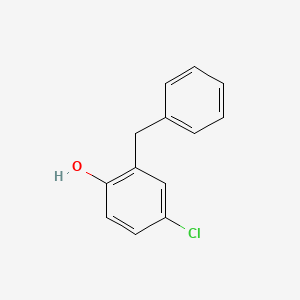
- IUPAC name
- 2-benzyl-4-chlorophenol
- Molecular formula
- C13H11ClO
- Molecular weight
- 218.68 g/mol
- Exact mass
- 218.0498427 Da
- XLogP3
- 4.0
- Topological polar surface area
- 20.2 Ų
- Hydrogen-bond donors
- 1
- Hydrogen-bond acceptors
- 1
- Covalent units
- 1
- Defined stereocentres
- 0
Also known as
16 more reported names
External database identifiers
- ChEBI:CHEBI:228003
- ChEMBL:CHEMBL1328919
- EPA DTXSID:DTXSID5020154
- PubMed:33049310
- PubMed:29228274
- PubMed:28728110
- PubMed:22649928
- PubMed:21251949
- PubMed:20629411
- PubMed:18822043
- PubMed:16678383
- PubMed:15546637
- PubMed:12537123
- PubMed:11417646
- PubMed:8529821
Evidence from additional scientific databases
NIH PubChem PUG-View
Attributed physical-property, hazard, environmental and use annotations.
- Boiling Point: 320 to 324 °F at 3.5 mmHg (NTP, 1992) Source: CAMEO Chemicals
- Boiling Point: 160-162 °C at 3.5 mm Hg Source: Hazardous Substances Data Bank (HSDB)
- Color/Form: White to light tan or pink flakes Source: Hazardous Substances Data Bank (HSDB)
- Density: 1.22 (NTP, 1992) - Denser than water; will sink Source: CAMEO Chemicals
- Density: 1.185 at 58 °C Source: Hazardous Substances Data Bank (HSDB)
- Flash Point: 370 °F (NTP, 1992) Source: CAMEO Chemicals
- LogP: log Kow = 3.6 Source: Hazardous Substances Data Bank (HSDB)
- Melting Point: 119.3 °F (NTP, 1992) Source: CAMEO Chemicals
- Melting Point: 48.5 °C Source: Hazardous Substances Data Bank (HSDB)
- Odor: White to light tan or pink flakes Source: Hazardous Substances Data Bank (HSDB)
- Physical Description: Ortho-benzyl-para-chlorophenol appears as white to light tan or pink flakes or white crystals. Insoluble in water. Slight phenolic odor. (NTP, 1992) Source: CAMEO Chemicals
- Physical Description: White to light tan or pink solid; [Hawley] Source: Haz-Map, Information on Hazardous Chemicals and Occupational Diseases
- Solubility: less than 1 mg/mL at 61 °F (NTP, 1992) Source: CAMEO Chemicals
- Solubility: Highly sol in alcohol and other org solvents Source: Hazardous Substances Data Bank (HSDB)
- Solubility: In water, 149 mg/L at 25 °C Source: Hazardous Substances Data Bank (HSDB)
- Vapor Pressure: 0.1 mmHg at 68 °F (NTP, 1992) Source: CAMEO Chemicals
- Vapor Pressure: 0.0000506 [mmHg] Source: Haz-Map, Information on Hazardous Chemicals and Occupational Diseases
- Vapor Pressure: 1.87X10⁻⁷ kPa = 1.4X10⁻⁶ mm Hg /extrapolated/ Source: Hazardous Substances Data Bank (HSDB)
- Substance: o-Benzyl-p-Chlorophenol Source: NTP Technical Reports
- NTP Technical Report: TR-444: One-Year Initiation/Promotion Study of o-Benzyl-p-Chlorophenol (CASRN 120-32-1) in Swiss (CD-1) Mice (Mouse Skin Study) (1995 ) Source: NTP Technical Reports
- Peer Review Date: 11/17/93 Source: NTP Technical Reports
- Note: Initiation/Promotion Study Source: NTP Technical Reports
- Summary: Under the conditions of this 1-year mouse skin initiation/promotion study in Swiss (CD-1) mice, o -benzyl- p -chlorophenol was a cutaneous irritant and a weak skin tumor promoter relative to strong promoters such as TPA. BCP had no activity as an initiator or as a complete carcinogen. Source: NTP Technical Reports
- NTP Technical Report: TR-424: Toxicology and Carcinogenesis Studies of o-Benzyl-p-Chlorophenol (CASRN 120-32-1) in F344/N Rats and B6C3F1 Mice (Gavage Studies) (1994 ) Source: NTP Technical Reports
- Peer Review Date: 12/01/92 Source: NTP Technical Reports
- Conclusion for Male Rat: No Evidence Source: NTP Technical Reports
- Conclusion for Female Rat: Equivocal Evidence Source: NTP Technical Reports
- Conclusion for Male Mice: Some Evidence Source: NTP Technical Reports
- Conclusion for Female Mice: No Evidence Source: NTP Technical Reports
- Summary: Under the conditions of these 2-year gavage studies, there was no evidence of carcinogenic activity of o-benzyl-p-chlorophenol in male F344/N rats receiving 30, 60, or 120 mg/kg body weight. There was equivocal evidence of carcinogenic activity of o-benzyl-p-chlorophenol in female F344/N rats based on the occurrence of two rare renal transitional cell carcinomas. There was some evidence of carcinogenic activity of o-benzyl-p-chlorophenol in male B6C3F1 mice based on increased incidences of renal tubule adenoma and renal tubule adenoma or carcinoma (combined). There was no evidence of carcinogenic activity of o-benzyl-p-chlorophenol in female B6C3F1, mice receiving 120, 240, or 480 mg/kg.; o-Benzyl-p-chlorophenol was nephrotoxic for male and female F344/N rats and B6C3F1 mice. The severity of nephropathy was increased in male and female rats and the incidence and severity of nephropathy was increased in male and female mice. The incidence and severity of nephropathy increased with length of treatment. Other lesions considered to be associated with the nephropathy and the secondary hyperparathyroidism in male rats and in male and female mice included fibrous osteodystrophy and soft t Source: NTP Technical Reports
- First Aid: EYES: First check the victim for contact lenses and remove if present. Flush victim's eyes with water or normal saline solution for 20 to 30 minutes while simultaneously calling a hospital or poison control center. Do not put any ointments, oils, or medication in the victim's eyes without specific instructions from a physician. IMMEDIATELY transport the victim after flushing eyes to a hospital even if no symptoms (such as redness or irritation) develop.; SKIN: IMMEDIATELY flood affected skin with water while removing and isolating all contaminated clothing. Gently wash all affected skin areas thoroughly with soap and water. IMMEDIATELY call a hospital or poison control center even if no symptoms (such as redness or irritation) develop. IMMEDIATELY transport the victim to a hospital for treatment after washing the affected areas.; INHALATION: IMMEDIATELY leave the contaminated area; take deep breaths of fresh air. If symptoms (such as wheezing, coughing, shortness of breath, or burning in the mouth, throat, or chest) develop, call a physician and be prepared to transport the victim to a hospital. Provide proper respiratory protection to rescuers entering an unknown atmosphere. Whene Source: CAMEO Chemicals
- Signal: Danger Source: Regulation (EC) No 1272/2008 of the European Parliament and of the Council
- GHS Hazard Statements: H315: Causes skin irritation [Warning Skin corrosion/irritation]; H317: May cause an allergic skin reaction [Warning Sensitization, Skin]; H318: Causes serious eye damage [Danger Serious eye damage/eye irritation]; H332: Harmful if inhaled [Warning Acute toxicity, inhalation]; H351: Suspected of causing cancer [Warning Carcinogenicity]; H361f: Suspected of damaging fertility [Warning Reproductive toxicity]; H373: May causes damage to organs through prolonged or repeated exposure [Warning Specific target organ toxicity, repeated exposure]; H400: Very toxic to aquatic life [Warning Hazardous to the aquatic environment, acute hazard]; H410: Very toxic to aquatic life with long lasting effects [Warning Hazardous to the aquatic environment, long-term hazard] Source: Regulation (EC) No 1272/2008 of the European Parliament and of the Council
- Precautionary Statement Codes: P203, P260, P261, P264, P264+P265, P271, P272, P273, P280, P302+P352, P304+P340, P305+P354+P338, P317, P318, P319, P321, P332+P317, P333+P317, P362+P364, P391, P405, and P501 (click each P-code to see the statement) Source: Regulation (EC) No 1272/2008 of the European Parliament and of the Council
- Note: This chemical does not meet GHS hazard criteria for 3.3% (5 of 150) of reports. Source: European Chemicals Agency (ECHA)
- Signal: Danger Source: European Chemicals Agency (ECHA)
- GHS Hazard Statements: H302 (42%): Harmful if swallowed [Warning Acute toxicity, oral]; H315 (69.3%): Causes skin irritation [Warning Skin corrosion/irritation]; H317 (34%): May cause an allergic skin reaction [Warning Sensitization, Skin]; H318 (90.7%): Causes serious eye damage [Danger Serious eye damage/eye irritation]; H332 (31.3%): Harmful if inhaled [Warning Acute toxicity, inhalation]; H335 (37.3%): May cause respiratory irritation [Warning Specific target organ toxicity, single exposure; Respiratory tract irritation]; H351 (31.3%): Suspected of causing cancer [Warning Carcinogenicity]; H361 (28.7%): Suspected of damaging fertility or the unborn child [Warning Reproductive toxicity]; H373 (31.3%): May causes damage to organs through prolonged or repeated exposure [Warning Specific target organ toxicity, repeated exposure]; H400 (66%): Very toxic to aquatic life [Warning Hazardous to the aquatic environment, acute hazard]; H410 (62%): Very toxic to aquatic life with long lasting effects [Warning Hazardous to the aquatic environment, long-term hazard]; H411 (24.7%): Toxic to aquatic life with long lasting effects [Hazardous to the aquatic environment, long-term hazard] Source: European Chemicals Agency (ECHA)
- Precautionary Statement Codes: P203, P260, P261, P264, P264+P265, P270, P271, P272, P273, P280, P301+P317, P302+P352, P304+P340, P305+P354+P338, P317, P318, P319, P321, P330, P332+P317, P333+P317, P362+P364, P391, P403+P233, P405, and P501 (click each P-code to see the statement) Source: European Chemicals Agency (ECHA)
- ECHA C&L Notifications Summary: Aggregated GHS information provided per 150 reports by companies from 14 notifications to the ECHA C&L Inventory. Each notification may be associated with multiple companies.; Reported as not meeting GHS hazard criteria per 5 of 150 reports by companies.; There are 13 notifications provided by 145 of 150 reports by companies with hazard statement code(s).; Information may vary between notifications depending on impurities, additives, and other factors. The percentage value in parenthesis indicates the notified classification ratio from companies that provide hazard codes. Only hazard codes with percentage values above 10% are shown. For more detailed information, please visit ECHA C&L website. Source: European Chemicals Agency (ECHA)
- Signal: Danger Source: NITE-CMC
- GHS Hazard Statements: H315: Causes skin irritation [Warning Skin corrosion/irritation]; H317: May cause an allergic skin reaction [Warning Sensitization, Skin]; H318: Causes serious eye damage [Danger Serious eye damage/eye irritation]; H332: Harmful if inhaled [Warning Acute toxicity, inhalation]; H351: Suspected of causing cancer [Warning Carcinogenicity]; H361: Suspected of damaging fertility or the unborn child [Warning Reproductive toxicity]; H371: May cause damage to organs [Warning Specific target organ toxicity, single exposure]; H372: Causes damage to organs through prolonged or repeated exposure [Danger Specific target organ toxicity, repeated exposure]; H400: Very toxic to aquatic life [Warning Hazardous to the aquatic environment, acute hazard]; H410: Very toxic to aquatic life with long lasting effects [Warning Hazardous to the aquatic environment, long-term hazard] Source: NITE-CMC
- Precautionary Statement Codes: P203, P260, P261, P264, P264+P265, P270, P271, P272, P273, P280, P302+P352, P304+P340, P305+P354+P338, P308+P316, P317, P318, P319, P321, P332+P317, P333+P317, P362+P364, P391, P405, and P501 (click each P-code to see the statement) Source: NITE-CMC
- Signal: Danger Source: Hazardous Chemical Information System (HCIS), Safe Work Australia
- Cosmetic Ingredient Review Conclusion: The CIR Expert Panel concludes that the available data are insufficient to support safety of Dichlorophene or Chlorophene. Source: Cosmetic Ingredient Review (CIR)
- Cosmetic Ingredient Review Finding(s): Ingredients for which the data are insufficient and their use in cosmetics is not supported Source: Cosmetic Ingredient Review (CIR)
- Toxicity Summary: AR binding was observed for clorophene, which were both associated with delays in sexual development and decrements in reproductive performance. Source: Toxin and Toxin Target Database (T3DB)
- Environmental Bioconcentration: A BCF value of 75 was measured for bluegill sunfish(1). Bluegill sunfish (Lepomis machrochirus) were exposed to 0.057 mg/L o-benzyl-p-chlorophenol for a period of 96 hours followed by a depuration period of 96 hours to determine the ability of the fish to metabolize and eliminate o-benzyl-p-chlorophenol. Depuration rate constants were from 4.67 to 6.94/days with a half-life of 0.14 days(1). The rate constant of o-benzyl-p-chlorophenol uptake in fish ranged from 11.8 to 13.8/days with a half-life of 0.06 days. According to a classification scheme(2), this BCF value suggests that bioconcentration in aquatic organisms is moderate(SRC). Source: Hazardous Substances Data Bank (HSDB)
- Environmental Fate: TERRESTRIAL FATE: Based on a classification scheme(1), a Koc value of 2,050(2), indicates that o-benzyl-p-chlorophenol is expected to have slight mobility in soil(SRC). Volatilization from moist soil surfaces is not expected to be an important fate process based upon an estimated Henry's Law constant of 2.7X10⁻⁹ atm-cu m/mole(SRC) derived from its extrapolated vapor pressure, 1.4X10⁻⁶ mm Hg(2), and water solubility, 149 mg/L(2). Volatilization from dry soil surfaces is not expected to be important based on the vapor pressure of this compound(2). Biodegradation of o-benzyl-p-chlorophenol is expected to occur rapidly based on degradation half-lives of 1 to 2 days, in a sewage sludge(2). Source: Hazardous Substances Data Bank (HSDB)
- Environmental Fate: AQUATIC FATE: Based on a classification scheme(1), a Koc value of 2,050 (2), indicates that o-benzyl-p-chlorophenol is expected to adsorb to suspended solids and sediment(SRC). Volatilization from water surfaces is not expected to be an important fate process(3) based upon an estimated Henry's Law constant of 2.7X10⁻⁹ atm-cu m/mole(SRC) derived from its extrapolated vapor pressure, 1.4X10⁻⁶ mm Hg(2), and water solubility, 149 mg/L(2). According to a classification scheme(4), a BCF of 75 measured in fish(2), suggests bioconcentration in aquatic organisms is moderate(SRC). An aqueous photolysis half-life of approximately 0.7 days(2), indicates photolysis in sunlit surface waters will be an important fate process(SRC). In addition, river die-away studies using non-acclimated river water indicates that the biodegradation half-life of o-benzyl-p-chlorophenol is approximately 1 to 3 days(2,5). Source: Hazardous Substances Data Bank (HSDB)
- Environmental Fate: ATMOSPHERIC FATE: According to a model of gas/particle partitioning of semivolatile organic compounds in the atmosphere(1), o-benzyl-p-chlorophenol, which has an extrapolated vapor pressure of 1.4X10⁻⁶ mm Hg at 25 °C(2), is expected to exist in both the vapor and particulate phases in the ambient atmosphere. Vapor-phase o-benzyl-p-chlorophenol is degraded in the atmosphere by reaction with photochemically-produced hydroxyl radicals(SRC); the half-life for this reaction in air is estimated to be about 22 hours (SRC), calculated from its rate constant of 1.8X10⁻¹¹ cu cm/molecule-sec at 25 °C(SRC) that was derived using a structure estimation method(3). Particulate-phase o-benzyl-p-chlorophenol may be removed from the air by wet and dry deposition(SRC). o-Benzyl-p-chlorophenol has been shown to undergo direct photolysis in aqueous solutions with a half-life of approximately 0.7 days(2), which indicates that direct photolysis in the atmosphere may be possible(SRC). Source: Hazardous Substances Data Bank (HSDB)
- Cosmetic Ingredient Review Link: CIR ingredient: Chlorophene Source: Cosmetic Ingredient Review (CIR)
- Sources/Uses: Used in household, hospital, and veterinary disinfectants; Also used as a fungicide, herbicide, antimicrobial, and cosmetics preservative; [HSDB] Used as a disinfectant (swimming pool decks, industrial water systems, poultry houses and other farming premises, food processing, and restaurants); [Reference #1] Source: Haz-Map, Information on Hazardous Chemicals and Occupational Diseases
- Industrial Processes with risk of exposure: Using Disinfectants or Biocides [Category: Clean]; Farming (Pesticides) [Category: Industry] Source: Haz-Map, Information on Hazardous Chemicals and Occupational Diseases
- Uses: For o-benzyl-p-chlorophenol (USEPA/OPP Pesticide Code: 062201) ACTIVE products with label matches. /SRP: Registered for use in the U.S. but approved pesticide uses may change periodically and so federal, state and local authorities must be consulted for currently approved uses./ Source: Hazardous Substances Data Bank (HSDB)
- Uses: Active principle or enhancing agent for disinfectants Source: Hazardous Substances Data Bank (HSDB)
- Uses: Germicide in disinfectant solutions & soap formulations. Source: Hazardous Substances Data Bank (HSDB)
- Uses: o-Benzyl-p-chlorophenol is produced as a fungicide. Source: Hazardous Substances Data Bank (HSDB)
- Uses: For more Uses (Complete) data for O-BENZYL-P-CHLOROPHENOL (7 total), please visit the HSDB record page. Source: Hazardous Substances Data Bank (HSDB)
- Uses: Use (kg; approx.) in Germany (2009): >250; Consumption (g per capita; approx.) in Germany (2009): 0.00305; Calculated removal (%): 47.9 Source: NORMAN Suspect List Exchange
- Uses: Clorophene is used as an antiseptic agent and a disinfectant in hospitals and restaurants. Source: Toxin and Toxin Target Database (T3DB)
Mapped by: Existing checksum-valid CAS to unique PubChem CID match. Retrieved: 2026-08-31. Open source record
Scientific classifications and hazard annotations provide context and do not replace the market-specific regulatory decision shown above.
Additional source coverage and match status
| Source | Result | Checked |
|---|---|---|
| NIH PubChem PUG-View | Exact match | 2026-08-31 |
A recorded no-match is useful evidence that the source was checked; it is not a claim that the substance does not exist elsewhere.
Retrieved from NIH PubChem on 2026-08-31 by checksum-valid CAS matching. Chemical properties do not replace the regulatory decision on this page.
Inventory details for CHLOROPHENE
INCI name
CHLOROPHENE
INN name
clorofene
Description
Phenol, 4-chloro-2-(phenylmethyl)-
Record provenance
- Inventory reference
- 32664
- Imported identity
- CHLOROPHENE
- Source update
- 30/07/2020
Annex records for CHLOROPHENE
Clorofene; chlorophene; 2-benzyl-4-chlorophenol
Key data
- ANTIMICROBIAL
- Preventing and/or slowing down microbial growth.
- PRESERVATIVE
- Exclusively or mainly intended to inhibit the development of micro-organisms in the cosmetic product. All authorised preservatives are substances in the positive list of Annex V to the Cosmetics Regulation 1223/2009.
Official EU ingredient-name evidence
The ingredient name exactly matches the official 2025 EU glossary of common ingredient names.
The markets do not agree about this substance: it is prohibited in some and permitted under conditions in others, across the 9 markets that hold a rule for it.
Related inventory evidence
Ingredients with overlapping formulation functions
Additional official and scientific sources
11 external databases to check this identity in
Each link searches that source for this identity. What each source is, and its legal weight
How CHLOROPHENE appears in the CosIng inventory
The CosIng inventory lists CHLOROPHENE as a cosmetic ingredient and this page links it to 1 annex record. The inventory entry captures names and identifiers, while the annex record shows where the substance is prohibited, restricted or positively listed in EU cosmetics law.
CHLOROPHENE is also tagged with 2 cosmetic functions in the official data. Function labels describe intended use, but they do not replace regulatory review of linked annex records before formulation or labelling work.
Frequently asked questions
Source note for CHLOROPHENE
This page combines the CosIng inventory entry for CHLOROPHENE with 1 linked Annex II–VI record from the local dataset built from public European Commission cosmetic ingredient materials.
Use this inventory page to research CHLOROPHENE and compare linked records, but verify restrictions and legal status against the current official source text and law before making regulatory decisions.
Tools & next steps
Check your formula
Scan a full INCI list to detect CHLOROPHENE and any linked EU annex restrictions or allergen flags.
INCI CheckerSearch similar ingredients
Find other inventory ingredients and annex entries related to CHLOROPHENE, its identifiers or nearby name variants.
Search