
Acrylonitrile
Acrylonitrile is listed in Annex II as a prohibited substance for cosmetic products placed on the EU market.
Chemical identity and properties
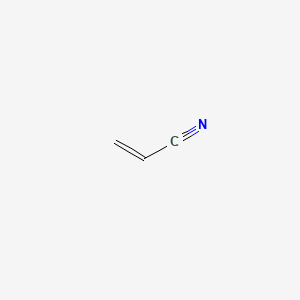
Acrylonitrile
Acrylonitrile is a nitrile that is hydrogen cyanide in which the hydrogen has been replaced by an ethenyl group. It has a role as a mutagen, an antifungal agent, a polar aprotic solvent, a carcinogenic agent and a fungal metabolite. It is a volatile organic compound and an aliphatic nitrile. — ChEBI
- IUPAC name
- prop-2-enenitrile
- Molecular formula
- C3H3N
- Molecular weight
- 53.06 g/mol
- Exact mass
- 53.026549100 Da
- XLogP3
- 0.2
- Topological polar surface area
- 23.8 Ų
- Hydrogen-bond donors
- 0
- Hydrogen-bond acceptors
- 1
- Covalent units
- 1
- Defined stereocentres
- 0
Also known as
16 more reported names
External database identifiers
- ChEBI:CHEBI:28217
- ChEMBL:CHEMBL445612
- EPA DTXSID:DTXSID5020029
- PubMed:39615733
- PubMed:35429547
- PubMed:34668566
- PubMed:33486070
- PubMed:33132245
- PubMed:32529832
- PubMed:32529823
- PubMed:30236600
- PubMed:28965700
- PubMed:26332274
- PubMed:23101384
- PubMed:23085657
Evidence from additional scientific databases
EMBL-EBI ChEBI
acrylonitrile
A nitrile that is hydrogen cyanide in which the hydrogen has been replaced by an ethenyl group.
- Formula
- C3H3N
- Average mass
- 53.064 g/mol
- Monoisotopic mass
- 53.02655 Da
- Formal charge
- 0
- volatile organic compound — is a (CHEBI:134179)
- aliphatic nitrile — is a (CHEBI:80291)
- antifungal agent — has role (CHEBI:35718)
- carcinogenic agent — has role (CHEBI:50903)
- polar aprotic solvent — has role (CHEBI:48358)
- mutagen — has role (CHEBI:25435)
- fungal metabolite — has role (CHEBI:76946)
- antifungal agent — has role (CHEBI:35718)
- carcinogenic agent — has role (CHEBI:50903)
- polar aprotic solvent — has role (CHEBI:48358)
- mutagen — has role (CHEBI:25435)
- fungal metabolite — has role (CHEBI:76946)
- volatile organic compound — is a (CHEBI:134179)
- aliphatic nitrile — is a (CHEBI:80291)
Additional curated names
Cross-references from this source
Mapped by: Exact CAS cross-reference in the ChEBI compound record. Source updated: 2025-01-17. Retrieved: 2026-08-31. Open source record
NIH PubChem PUG-View
Attributed physical-property, hazard, environmental and use annotations.
- Autoignition Temperature: 898 °F (USCG, 1999) Source: CAMEO Chemicals
- Autoignition Temperature: 898 °F (481 °C) Source: Hazardous Substances Data Bank (HSDB)
- Autoignition Temperature: 481 °C Source: ILO-WHO International Chemical Safety Cards (ICSCs)
- Boiling Point: 171 °F at 760 mmHg (EPA, 1998) Source: CAMEO Chemicals
- Boiling Point: 77.2 °C Source: Hazardous Substances Data Bank (HSDB)
- Boiling Point: 77 °C Source: ILO-WHO International Chemical Safety Cards (ICSCs)
- Boiling Point: 171 °F Source: Occupational Safety and Health Administration (OSHA)
- Boiling Point: 77.3 °C @760 [mm Hg] Source: PAC Chemical Database, U.S. Department of Energy
- Boiling Point: 171 °F Source: The National Institute for Occupational Safety and Health (NIOSH)
- Color/Form: Clear, colorless liquid at room temperature Source: Hazardous Substances Data Bank (HSDB)
- Color/Form: Colorless to pale-yellow liquid Source: Hazardous Substances Data Bank (HSDB)
- Density: 0.8004 at 77 °F (EPA, 1998) - Less dense than water; will float Source: CAMEO Chemicals
- Density: 0.8007 at 25 °C Source: Hazardous Substances Data Bank (HSDB)
- Density: Relative density (water = 1): 0.8 Source: ILO-WHO International Chemical Safety Cards (ICSCs)
- Density: 0.81 Source: Occupational Safety and Health Administration (OSHA)
- Density: 0.806 @ 20°C Source: PAC Chemical Database, U.S. Department of Energy
- Density: 0.81 Source: The National Institute for Occupational Safety and Health (NIOSH)
- Flash Point: 32 °F (EPA, 1998) Source: CAMEO Chemicals
- Flash Point: -5 °C (23 °F) - closed cup Source: Hazardous Substances Data Bank (HSDB)
- Flash Point: 32 °F(0 °C)(open cup) Source: Hazardous Substances Data Bank (HSDB)
- Flash Point: -1 °C c.c. Source: ILO-WHO International Chemical Safety Cards (ICSCs)
- Flash Point: 30 °F Source: Occupational Safety and Health Administration (OSHA)
- Flash Point: 30 °F Source: The National Institute for Occupational Safety and Health (NIOSH)
- LogP: log Kow = 0.25 Source: Hazardous Substances Data Bank (HSDB)
- LogP: 0.25 Source: ILO-WHO International Chemical Safety Cards (ICSCs)
- Melting Point: -116 °F (EPA, 1998) Source: CAMEO Chemicals
- Melting Point: -83.51 °C Source: Hazardous Substances Data Bank (HSDB)
- Melting Point: -84 °C Source: ILO-WHO International Chemical Safety Cards (ICSCs)
- Melting Point: -116 °F Source: Occupational Safety and Health Administration (OSHA)
- Melting Point: -83.48 °C Source: PAC Chemical Database, U.S. Department of Energy
- Melting Point: -116 °F Source: The National Institute for Occupational Safety and Health (NIOSH)
- Odor: Practically odorless, or with a very slight odor of peach kernels Source: Hazardous Substances Data Bank (HSDB)
- Odor: Sweet odor Source: Hazardous Substances Data Bank (HSDB)
- Odor: Irritating odor Source: Hazardous Substances Data Bank (HSDB)
- Odor: Unpleasant odor Source: Hazardous Substances Data Bank (HSDB)
- Odor: Onion, garlic, pungent Source: Hazardous Substances Data Bank (HSDB)
- Physical Description: Acrylonitrile, stabilized appears as a clear colorless liquid with a strong pungent odor. Flash point 32 °F. Prolonged exposure to the vapors or skin contact harmful. Density 6.7 lb / gal. Vapors heavier than air. Combustion produces toxic oxides of nitrogen. Requires storage and handling in closed systems. Used in insecticides and to make plastics, fibers and other chemicals. Rate of onset: Immediate Persistence: Minutes to hours Odor threshold: 17 ppm Source/use/other hazard: Plastics, coatings, adhesives industries; dyes; pharmaceuticals; flam gas. Source: CAMEO Chemicals
- Physical Description: Liquid; Other Solid; CBI Source: EPA Chemical Data Reporting (CDR)
- Physical Description: Colorless to pale-yellow liquid with an unpleasant odor. [Note: Odor can only be detected above the PEL.]; [NIOSH] Source: Haz-Map, Information on Hazardous Chemicals and Occupational Diseases
- Physical Description: COLOURLESS OR PALE YELLOW LIQUID WITH PUNGENT ODOUR. Source: ILO-WHO International Chemical Safety Cards (ICSCs)
- Physical Description: Colorless to pale-yellow liquid with an unpleasant odor. Source: Occupational Safety and Health Administration (OSHA)
- Physical Description: Colorless to pale-yellow liquid with an unpleasant odor. [Note: Odor can only be detected above the PEL.] Source: The National Institute for Occupational Safety and Health (NIOSH)
- Refractive Index: Index of refraction: 1.3911 at 20 °C/D Source: Hazardous Substances Data Bank (HSDB)
- Solubility: 10 to 50 mg/mL at 70.9 °F (NTP, 1992) Source: CAMEO Chemicals
- Solubility: Solubility of water in acrylonitrile: 3.1 parts water/100 parts acrylonitrile Source: Hazardous Substances Data Bank (HSDB)
- Solubility: In water, 7.45X10+4 mg/L at 25 °C Source: Hazardous Substances Data Bank (HSDB)
- Solubility: Very soluble in ethanol, acetone, benzene, ether Source: Hazardous Substances Data Bank (HSDB)
- Solubility: Acrylonitrile is ... miscible with ethanol, carbon tetrachloride, ethyl acetate, ethylene cyanohydrin, liquid carbon dioxide, ... toluene, petroleum ether, and xylene. Source: Hazardous Substances Data Bank (HSDB)
- Solubility: Solubility in water, g/100ml at 20 °C: 7 Source: ILO-WHO International Chemical Safety Cards (ICSCs)
- Solubility: 7% Source: The National Institute for Occupational Safety and Health (NIOSH)
- Vapor Pressure: 100 mmHg at 73.4 °F (EPA, 1998) Source: CAMEO Chemicals
- Vapor Pressure: 109.0 [mmHg] Source: Haz-Map, Information on Hazardous Chemicals and Occupational Diseases
- Vapor Pressure: 109 mm Hg at 25 °C Source: Hazardous Substances Data Bank (HSDB)
- Vapor Pressure: Vapor pressure, kPa at 20 °C: 11.0 Source: ILO-WHO International Chemical Safety Cards (ICSCs)
- Vapor Pressure: 83 mmHg Source: Occupational Safety and Health Administration (OSHA)
- Vapor Pressure: 83 [mm Hg] @20 °C Source: PAC Chemical Database, U.S. Department of Energy
- Vapor Pressure: 83 mmHg Source: The National Institute for Occupational Safety and Health (NIOSH)
- Viscosity: 0.34 sq mm/s at 25 °C Source: Hazardous Substances Data Bank (HSDB)
- pH: pH = 6.0-7.5 Source: Hazardous Substances Data Bank (HSDB)
- IARC Carcinogenic Agent: Acrylonitrile Source: International Agency for Research on Cancer (IARC)
- IARC Carcinogenic Classes: Group 1: Carcinogenic to humans Source: International Agency for Research on Cancer (IARC)
- IARC Monographs: Volume 19: (1979) Some Monomers, Plastics and Synthetic Elastomers, and Acrolein; Volume Sup 7: Overall Evaluations of Carcinogenicity: An Updating of IARC Monographs Volumes 1 to 42, 1987; 440 pages; ISBN 92-832-1411-0 (out of print); Volume 71: (1999) Re-evaluation of Some Organic Chemicals, Hydrazine and Hydrogen Peroxide (Part 1, Part 2, Part 3); Volume 136: (2025) Talc and Acrylonitrile Source: International Agency for Research on Cancer (IARC)
- Publication Year: 2025 online Source: International Agency for Research on Cancer (IARC)
- Evaluation Year: 2024 Source: International Agency for Research on Cancer (IARC)
- Substance: Acrylonitrile Source: NTP Technical Reports
- NTP Technical Report: TR-506: Toxicology and Carcinogenesis Studies of Acrylonitrile (CASRN 107-13-1) in B6C3F1 Mice (Gavage Studies) (2001 ) Source: NTP Technical Reports
- Peer Review Date: 05/03/01 Source: NTP Technical Reports
- Conclusion for Male Rat: Chemical Not Tested in Species/Sex Source: NTP Technical Reports
- Conclusion for Female Rat: Chemical Not Tested in Species/Sex Source: NTP Technical Reports
- Conclusion for Male Mice: Clear Evidence Source: NTP Technical Reports
- Conclusion for Female Mice: Clear Evidence Source: NTP Technical Reports
- Exposure Routes: The substance can be absorbed into the body by inhalation of its vapour, through the skin and by ingestion. Source: ILO-WHO International Chemical Safety Cards (ICSCs)
- Exposure Routes: inhalation, skin absorption, ingestion, skin and/or eye contact Source: The National Institute for Occupational Safety and Health (NIOSH)
- Exposure Routes: Oral (L96) ; inhalation (L96) ; dermal (L96) Source: Toxin and Toxin Target Database (T3DB)
- First Aid: Warning: Effects, including skin reactions, may be delayed. Caution is advised. Vital signs should be monitored closely. Heart palpitation may begin within minutes after exposure.; Note: Acrylonitrile is very readily absorbed through the skin.; Signs and Symptoms of Acrylonitrile Exposure: Signs and symptoms of acute exposure to acrylonitrile may include hypertension (high blood pressure) and tachycardia (rapid heart rate), followed by hypotension (low blood pressure) and bradycardia (slow heart rate). Cherry-red mucous membranes and blood, cardiac arrhythmias, and other cardiac abnormalities are common. Cyanosis (blue tint to the skin and mucous membranes) is not a consistent finding. Tachypnea (rapid respiratory rate) may be followed by respiratory depression. Lung hemorrhage and pulmonary edema may also occur. Headache, vertigo (dizziness), agitation, and giddiness may be followed by combative behavior, convulsions, paralysis, protruding eyeballs, dilated and unreactive pupils, and coma. Acrylonitrile is irritating to the skin and mucous membranes. Lacrimation (tearing) and a burning sensation of the mouth and throat are common. Excessive salivation, nausea, and vomiting may als Source: CAMEO Chemicals
- ERG2024, Guide 131P (Acrylonitrile, stabilized): General First Aid:; · Call 911 or emergency medical service.; · Ensure that medical personnel are aware of the material(s) involved, take precautions to protect themselves and avoid contamination.; · Move victim to fresh air if it can be done safely.; · Administer oxygen if breathing is difficult.; · If victim is not breathing:; -- DO NOT perform mouth-to-mouth resuscitation; the victim may have ingested or inhaled the substance.; -- If equipped and pulse detected, wash face and mouth, then give artificial respiration using a proper respiratory medical device (bag-valve mask, pocket mask equipped with a one-way valve or other device).; -- If no pulse detected or no respiratory medical device available, provide continuous compressions. Conduct a pulse check every two minutes or monitor for any signs of spontaneous respirations.; · Remove and isolate contaminated clothing and shoes.; · For minor skin contact, avoid spreading material on unaffected skin.; · In case of contact with substance, remove immediately by flushing skin or eyes with running water for at least 20 minutes.; · For severe burns, immediate medical attention is required.; · Effects of exposure (inhalation, ingestion, Source: Emergency Response Guidebook (ERG)
- First Aid: (General first aid procedures); Eye: Irrigate immediately - If this chemical contacts the eyes, immediately wash (irrigate) the eyes with large amounts of water, occasionally lifting the lower and upper lids. Get medical attention immediately.; Skin: Water wash immediately - If this chemical contacts the skin, immediately wash the contaminated skin with water. If this chemical penetrates the clothing, immediately remove the clothing and wash the skin with water. If symptoms occur after washing, get medical attention immediately.; Breathing: Respiratory support; Swallow: Medical attention immediately - If this chemical has been swallowed, get medical attention immediately. Source: The National Institute for Occupational Safety and Health (NIOSH)
- Signal: Danger Source: Regulation (EC) No 1272/2008 of the European Parliament and of the Council
- GHS Hazard Statements: H225: Highly Flammable liquid and vapor [Danger Flammable liquids]; H301: Toxic if swallowed [Danger Acute toxicity, oral]; H311: Toxic in contact with skin [Danger Acute toxicity, dermal]; H315: Causes skin irritation [Warning Skin corrosion/irritation]; H317: May cause an allergic skin reaction [Warning Sensitization, Skin]; H318: Causes serious eye damage [Danger Serious eye damage/eye irritation]; H331: Toxic if inhaled [Danger Acute toxicity, inhalation]; H335: May cause respiratory irritation [Warning Specific target organ toxicity, single exposure; Respiratory tract irritation]; H350: May cause cancer [Danger Carcinogenicity]; H411: Toxic to aquatic life with long lasting effects [Hazardous to the aquatic environment, long-term hazard] Source: Regulation (EC) No 1272/2008 of the European Parliament and of the Council
- Precautionary Statement Codes: P203, P210, P233, P240, P241, P242, P243, P261, P262, P264, P264+P265, P270, P271, P272, P273, P280, P301+P316, P302+P352, P303+P361+P353, P304+P340, P305+P354+P338, P316, P317, P318, P319, P321, P330, P332+P317, P333+P317, P361+P364, P362+P364, P370+P378, P391, P403+P233, P403+P235, P405, and P501 (click each P-code to see the statement) Source: Regulation (EC) No 1272/2008 of the European Parliament and of the Council
- Note: This chemical does not meet GHS hazard criteria for 0.2% (2 of 1097) of reports. Source: European Chemicals Agency (ECHA)
- Signal: Danger Source: European Chemicals Agency (ECHA)
- GHS Hazard Statements: H225 (99.8%): Highly Flammable liquid and vapor [Danger Flammable liquids]; H301 (97.8%): Toxic if swallowed [Danger Acute toxicity, oral]; H311 (97.2%): Toxic in contact with skin [Danger Acute toxicity, dermal]; H315 (99.8%): Causes skin irritation [Warning Skin corrosion/irritation]; H317 (99.8%): May cause an allergic skin reaction [Warning Sensitization, Skin]; H318 (99.8%): Causes serious eye damage [Danger Serious eye damage/eye irritation]; H331 (97.1%): Toxic if inhaled [Danger Acute toxicity, inhalation]; H335 (99.8%): May cause respiratory irritation [Warning Specific target organ toxicity, single exposure; Respiratory tract irritation]; H350 (99.8%): May cause cancer [Danger Carcinogenicity]; H361 (15.2%): Suspected of damaging fertility or the unborn child [Warning Reproductive toxicity]; H411 (97.8%): Toxic to aquatic life with long lasting effects [Hazardous to the aquatic environment, long-term hazard] Source: European Chemicals Agency (ECHA)
- Precautionary Statement Codes: P203, P210, P233, P240, P241, P242, P243, P261, P262, P264, P264+P265, P270, P271, P272, P273, P280, P301+P316, P302+P352, P303+P361+P353, P304+P340, P305+P354+P338, P316, P317, P318, P319, P321, P330, P332+P317, P333+P317, P361+P364, P362+P364, P370+P378, P391, P403+P233, P403+P235, P405, and P501 (click each P-code to see the statement) Source: European Chemicals Agency (ECHA)
- ECHA C&L Notifications Summary: Aggregated GHS information provided per 1097 reports by companies from 27 notifications to the ECHA C&L Inventory. Each notification may be associated with multiple companies.; Reported as not meeting GHS hazard criteria per 2 of 1097 reports by companies.; There are 26 notifications provided by 1095 of 1097 reports by companies with hazard statement code(s).; Information may vary between notifications depending on impurities, additives, and other factors. The percentage value in parenthesis indicates the notified classification ratio from companies that provide hazard codes. Only hazard codes with percentage values above 10% are shown. For more detailed information, please visit ECHA C&L website. Source: European Chemicals Agency (ECHA)
- Signal: Danger Source: NITE-CMC
- GHS Hazard Statements: H225: Highly Flammable liquid and vapor [Danger Flammable liquids]; H301: Toxic if swallowed [Danger Acute toxicity, oral]; H310: Fatal in contact with skin [Danger Acute toxicity, dermal]; H315: Causes skin irritation [Warning Skin corrosion/irritation]; H317: May cause an allergic skin reaction [Warning Sensitization, Skin]; H318: Causes serious eye damage [Danger Serious eye damage/eye irritation]; H330: Fatal if inhaled [Danger Acute toxicity, inhalation]; H335: May cause respiratory irritation [Warning Specific target organ toxicity, single exposure; Respiratory tract irritation]; H336: May cause drowsiness or dizziness [Warning Specific target organ toxicity, single exposure; Narcotic effects]; H350: May cause cancer [Danger Carcinogenicity]; H360: May damage fertility or the unborn child [Danger Reproductive toxicity]; H370: Causes damage to organs [Danger Specific target organ toxicity, single exposure]; H372: Causes damage to organs through prolonged or repeated exposure [Danger Specific target organ toxicity, repeated exposure]; H401: Toxic to aquatic life [Hazardous to the aquatic environment, acute hazard]; H411: Toxic to aquatic life with long lasting effects [Hazardou Source: NITE-CMC
- Precautionary Statement Codes: P203, P210, P233, P240, P241, P242, P243, P260, P261, P262, P264, P264+P265, P270, P271, P272, P273, P280, P284, P301+P316, P302+P352, P303+P361+P353, P304+P340, P305+P354+P338, P308+P316, P316, P317, P318, P319, P320, P321, P330, P332+P317, P333+P317, P361+P364, P362+P364, P370+P378, P391, P403+P233, P403+P235, P405, and P501 (click each P-code to see the statement) Source: NITE-CMC
- GHS Hazard Statements: H401: Toxic to aquatic life [Hazardous to the aquatic environment, acute hazard]; H411: Toxic to aquatic life with long lasting effects [Hazardous to the aquatic environment, long-term hazard] Source: NITE-CMC
- Health Effects: Exposure to high levels of cyanide for a short time harms the brain and heart and can even cause coma, seizures, apnea, cardiac arrest and death. Chronic inhalation of cyanide causes breathing difficulties, chest pain, vomiting, blood changes, headaches, and enlargement of the thyroid gland. Skin contact with cyanide salts can irritate and produce sores. (L96, L97) Source: Toxin and Toxin Target Database (T3DB)
- NFPA Health Rating: 4 - Materials that, under emergency conditions, can be lethal. Source: Hazardous Substances Data Bank (HSDB)
- NFPA Fire Rating: 3 - Liquids and solids that can be ignited under almost all ambient temperature conditions. Materials produce hazardous atmospheres with air under almost all ambient temperatures or, though unaffected by ambient temperatures, are readily ignited under almost all conditions. Source: Hazardous Substances Data Bank (HSDB)
- NFPA Instability Rating: 2 - Materials that readily undergo violent chemical changes at elevated temperatures and pressures. Source: Hazardous Substances Data Bank (HSDB)
- NFPA Specific Notice: W - No water: Materials that react violently or explosively with water. Source: Hazardous Substances Data Bank (HSDB)
- Target Organs: Cancer, Developmental (effects during periods when organs are developing), Gastrointestinal (Stomach and Intestines, part of the digestive system), Neurological (Nervous System), Respiratory (From the Nose to the Lungs) Source: Agency for Toxic Substances and Disease Registry (ATSDR)
- Target Organs: Respiratory Source: EPA Integrated Risk Information System (IRIS)
- Target Organs: Eyes, skin, cardiovascular system, liver, kidneys, central nervous system Source: The National Institute for Occupational Safety and Health (NIOSH)
- Toxicity Summary: IDENTIFICATION AND USE: Acrylonitrile is a clear, colorless liquid at room temperature. Acrylonitrile is used as a monomer for acrylic and modacrylic fibers and whiskers, in copolymers with styrene and butadiene (ABS resins), in the manufacture of adiponitrile, and in nitrile rubbers. Acrylonitrile is no longer used as a fumigant and nitrile resins made with acrylonitrile are no longer used to make beverage bottles. HUMAN STUDIES: Dermal exposure to acrylonitrile causes irritation, burns, and blisters. Additionally, dermal exposure to acrylonitrile can lead to systemic toxicity and lethality. Chronic effects can also occur after exposure to acrylonitrile vapors or liquid. 576 Japanese workers exposed to 5-20 ppm acrylonitrile over 10 yr showed headache, fatigue, nausea, and weakness with symptoms of anemia, jaundice, conjunctivitis, and abnormal whole blood and serum specific gravity, cholinesterase, urobilinogen, bilirubin, urinary protein, and sugar values, indicative of liver injury and a general toxic effect. In cultured human bronchial epithelial cells acrylonitrile induced cytotoxicity, sister chromatid exchanges and DNA single strand breaks. Acrylonitrile affected semen qual Source: Hazardous Substances Data Bank (HSDB)
- Toxicity Summary: Organic nitriles decompose into cyanide ions both in vivo and in vitro. Consequently the primary mechanism of toxicity for organic nitriles is their production of toxic cyanide ions or hydrogen cyanide. Cyanide is an inhibitor of cytochrome c oxidase in the fourth complex of the electron transport chain (found in the membrane of the mitochondria of eukaryotic cells). It complexes with the ferric iron atom in this enzyme. The binding of cyanide to this cytochrome prevents transport of electrons from cytochrome c oxidase to oxygen. As a result, the electron transport chain is disrupted and the cell can no longer aerobically produce ATP for energy. Tissues that mainly depend on aerobic respiration, such as the central nervous system and the heart, are particularly affected. Cyanide is also known produce some of its toxic effects by binding to catalase, glutathione peroxidase, methemoglobin, hydroxocobalamin, phosphatase, tyrosinase, ascorbic acid oxidase, xanthine oxidase, succinic dehydrogenase, and Cu/Zn superoxide dismutase. Cyanide binds to the ferric ion of methemoglobin to form inactive cyanmethemoglobin. (L97) Source: Toxin and Toxin Target Database (T3DB)
- Environmental Bioconcentration: A whole body BCF of 48 was determined for bluegills exposed to acrylonitrile for 28 days (or until equilibrium was obtained) in a flowing water system(1). According to a classification scheme(2), this BCF suggests the potential for bioconcentration in aquatic organisms is moderate(SRC). Source: Hazardous Substances Data Bank (HSDB)
- Environmental Fate: TERRESTRIAL FATE: Based on a classification scheme(1), an estimated Koc value of 29(SRC), determined from a log Kow of 0.25(2) and a regression-derived equation(3), indicates that acrylonitrile is expected to have very high mobility in soil(SRC). Volatilization of acrylonitrile from moist soil surfaces is expected to be an important fate process(SRC) given a Henry's Law constant of 1.38X10⁻⁴ atm-cu m/mole(4). Acrylonitrile is expected to volatilize from dry soil surfaces(SRC) based upon a vapor pressure of 109 mm Hg at 25 °C(5). Complete biodegradation of a low concentration of acrylonitrile was <2 days to 6 days depending on soil type with slow degradation reported in unacclimated soils exposed to high concentrations of acrylonitrile(6); these findings suggest that biodegradation may be an important environmental fate process in soil under certain conditions(SRC). Source: Hazardous Substances Data Bank (HSDB)
- Environmental Fate: AQUATIC FATE: Based on a classification scheme(1), an estimated Koc value of 29(SRC), determined from a log Kow of 0.25(2) and a regression-derived equation(3), indicates that acrylonitrile is not expected to adsorb to suspended solids and sediment(SRC). Volatilization from water surfaces is expected(4) based upon a Henry's Law constant of 1.38X10⁻⁴ atm-cu m/mole(5). Using this Henry's Law constant and an estimation method(4), volatilization half-lives for a model river and model lake are 7 hrs and 4 days, respectively(SRC). According to a classification scheme(6), a BCF of 48(7) suggests bioconcentration in aquatic organisms is moderate(SRC). Acrylonitrile was stable to aqueous hydrolysis in the pH range of 4-10 over a 10-day observation period(8) suggesting that hydrolyis is not important under environmental conditions (pH 5 to 9). Complete degradation in 6-20 days using various freshwater inoculums(8,9) suggests that biodegradation may be an important environmental fate process in water(SRC). Source: Hazardous Substances Data Bank (HSDB)
- Environmental Fate: ATMOSPHERIC FATE: According to a model of gas/particle partitioning of semivolatile organic compounds in the atmosphere(1), acrylonitrile, which has a vapor pressure of 109 mm Hg at 25 °C(2), is expected to exist solely as a vapor in the ambient atmosphere. Vapor-phase acrylonitrile is degraded in the atmosphere by reaction with photochemically-produced hydroxyl radicals(SRC); the half-life for this reaction in air is estimated to be 1.5 hours(SRC), calculated from its rate constant of 1.11X10⁻¹¹ cu cm/molecule-sec at 25 °C(3). The half-life for reaction with ozone in air is estimated to be 83 days(SRC), calculated from its rate constant of 1.38X10⁻¹⁹ cu cm/molecule-sec at 25 °C(4). Acrylonitrile does not absorb UV light at wavelengths >290 nm(5) and, therefore, is not expected to be susceptible to direct photolysis by sunlight(SRC). Source: Hazardous Substances Data Bank (HSDB)
- Consumer Uses: Intermediate Source: EPA Chemical Data Reporting (CDR)
- Industry Uses: Other; Solvent; Monomers; Not Known or Reasonably Ascertainable; Intermediate Source: EPA Chemical Data Reporting (CDR)
- Uses: Acrylonitrile is primarily used in the manufacture of acrylic and modacrylic fibers. It is also used as a raw material in the manufacture of plastics (acrylonitrile-butadiene-styrene and styrene-acrylonitrile resins), adiponitrile, acrylamide, and nitrile rubbers and barrier resins. Source: EPA Hazardous Air Pollutants
- Sources/Uses: Used as a monomer in the production of acrylic fibers and acrylonitrile-butadiene-styrene resins; Also used to produce adiponitrile; Was used in the past as a fumigant and to make nitrile resins for beverage bottles; [ACGIH] Used in the plastics, coatings, and adhesive industries; [Merck Index] Source: Haz-Map, Information on Hazardous Chemicals and Occupational Diseases
- Restricted Notes: No longer used as a fumigant in the U.S. [EPA Pesticides] Source: Haz-Map, Information on Hazardous Chemicals and Occupational Diseases
- Industrial Processes with risk of exposure: Working with Glues and Adhesives [Category: Other]; Firefighting [Category: Other]; Burning Synthetic Polymers [Category: Burn] Source: Haz-Map, Information on Hazardous Chemicals and Occupational Diseases
- Uses: For acrylonitrile (USEPA/OPP Pesticide Code: 000601) there are 0 labels match. /SRP: Not registered for current use in the U.S., but approved pesticide uses may change periodically and so federal, state and local authorities must be consulted for currently approved uses./ Source: Hazardous Substances Data Bank (HSDB)
- Uses: ... Cyanoethylation of cotton; synthetic soil blocks (acrylonitrile polymerized wood pulp); ... monomer for a semiconductive polymer that can be used like inorganic oxide catalysts in dehydrogenation of tert-butanol to isobutylene and water. Source: Hazardous Substances Data Bank (HSDB)
- Uses: The major end uses of acrylonitrile are acrylic fiber, acrylonitrile-butadiene-styrene (ABS) resins, adiponitrile, acrylamide, nitrile rubbers, and carbon fibers. Source: Hazardous Substances Data Bank (HSDB)
- Uses: Acrylonitrile is used as a monomer for acrylic and modacrylic fibers and whiskers; in copolymers with styrene and butadiene (ABS resins); in the manufacture of adiponitrile; and in nitrile rubbers. Acrylonitrile is no longer used as a fumigant and nitrile resins made with acrylonitrile are no longer used to make beverage bottles. Source: Hazardous Substances Data Bank (HSDB)
- Uses: For more Uses (Complete) data for Acrylonitrile (6 total), please visit the HSDB record page. Source: Hazardous Substances Data Bank (HSDB)
- Uses: Acrylonitrile is used principally as a monomer in the manufacture of synthetic polymers, especially polyacrylonitrile which comprises acrylic fibers. Acrylic fibers are, among other uses, precursor for well-known carbon-fiber. It is also a component of synthetic rubber and small amounts may be used as a fumigant. (L583) Source: Toxin and Toxin Target Database (T3DB)
Mapped by: Existing checksum-valid CAS to unique PubChem CID match. Retrieved: 2026-08-31. Open source record
Scientific classifications and hazard annotations provide context and do not replace the market-specific regulatory decision shown above.
Additional source coverage and match status
| Source | Result | Checked |
|---|---|---|
| EMBL-EBI ChEBI | Exact match | 2026-08-31 |
| NIH PubChem PUG-View | Exact match | 2026-08-31 |
A recorded no-match is useful evidence that the source was checked; it is not a claim that the substance does not exist elsewhere.
Retrieved from NIH PubChem on 2026-09-02 by checksum-valid CAS matching. Chemical properties do not replace the regulatory decision on this page.
Record details
Chemical name
Acrylonitrile
Regulatory information
SCCS opinions
- Opinion concerning Chemical Ingredients in Cosmetic Products classified as Carcinogenic, Mutagenic or Toxic to Reproduction according to the Chemicals Directive 67/548/EECC
- Opinion concerning Chemical Ingredients in Cosmetic Products classified as Carcinogenic, Mutagenic or Toxic to Reproduction according to the Chemicals Directive 67/548/EEC
CMR
| Category | Carcinogenic | Mutagenic | Reprotoxic |
|---|---|---|---|
| Cat. 1B | ✓ | — | — |
Key data
Inventory links for Acrylonitrile
Related records for Acrylonitrile
Direct matches are limited for this record, so nearby entries from Annex II are shown as well.
Acrylamide, unless regulated elsewhere in this Regulation
2-Ethylhexyl[[[3,5-bis(1,1-dimethylethyl)-4-hydroxyphenyl]-methyl]thio]acetate
Dinoseb, its salts and esters with the exception of those specified elsewhere in this list
bis(2-Methoxyethyl) phthalate
bis(2-Ethylhexyl) phthalate; (Diethylhexyl phthalate)
2,4-Dinitrotoluene [1]; Dinitrotoluene, technical grade [2]
bis(2-Methoxyethyl) ether (Dimethoxydiglycol)
What Annex II means for Acrylonitrile
Acrylonitrile is listed as a prohibited substance under Annex II of EU Cosmetics Regulation 1223/2009 and must not be intentionally added. Article 17 separately addresses unintended small quantities that are technically unavoidable under good manufacturing practice and compatible with the Article 3 safety requirement.
Formulators must screen their ingredients and raw materials to ensure none contain this substance. Suppliers should provide documentation confirming absence when requested.
This record is linked to 1 CosIng inventory ingredient for name and identifier cross-reference. The page also surfaces 12 related annex records with overlapping identifiers, annex logic or naming patterns.
Compliance checklist
- Verify this substance is absent from all raw materials and finished formulations.
- Request absence confirmation or CoA from raw material suppliers.
- Document the screening result in the Product Information File (PIF).
- This substance has CMR classification. Review the CMR table above and verify current Annex II/III status before use.
Frequently asked questions
Source note for Annex II record Acrylonitrile
This page summarizes one Annex II record for Acrylonitrile from public European Commission cosmetic materials and adds linked inventory or identifier matches when available.
Use this record page to review Annex II conditions for Acrylonitrile, but confirm any final regulatory decision against the current official annex wording and source files.
Tools & next steps
Check your formula
Paste a full INCI list to detect Acrylonitrile and other flagged EU annex records in one pass.
INCI CheckerCompare entries
Compare Acrylonitrile side by side with another annex record to review differences in restrictions, concentrations and annex placement.
CompareBrowse the annex
See all records in Annex II and compare regulatory conditions across substances in this annex.
Open Annex II