
bis(2-Methoxyethyl) phthalate
bis(2-Methoxyethyl) phthalate is listed in Annex II as a prohibited substance for cosmetic products placed on the EU market.
Chemical identity and properties
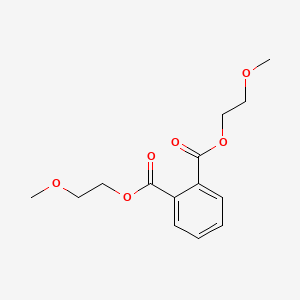
Dimethoxyethyl phthalate
bis(2-methoxyethyl) phthalate has been reported in Lonicera japonica with data available. — LOTUS - the natural products occurrence database
- IUPAC name
- bis(2-methoxyethyl) benzene-1,2-dicarboxylate
- Molecular formula
- C14H18O6
- Molecular weight
- 282.29 g/mol
- Exact mass
- 282.11033829 Da
- XLogP3
- 1.4
- Topological polar surface area
- 71.1 Ų
- Hydrogen-bond donors
- 0
- Hydrogen-bond acceptors
- 6
- Covalent units
- 1
- Defined stereocentres
- 0
Also known as
16 more reported names
External database identifiers
- ChEMBL:CHEMBL1302251
- EPA DTXSID:DTXSID8025094
- PubMed:34214916
- PubMed:24503621
- PubMed:20684992
Evidence from additional scientific databases
NIH PubChem PUG-View
Attributed physical-property, hazard, environmental and use annotations.
- Autoignition Temperature: 750 °F (399 °C) Source: Hazardous Substances Data Bank (HSDB)
- Boiling Point: 340 °C Source: Hazardous Substances Data Bank (HSDB)
- Boiling Point: BP: 230 deg at 10 mm Hg Source: Hazardous Substances Data Bank (HSDB)
- Color/Form: Oily liquid Source: Hazardous Substances Data Bank (HSDB)
- Color/Form: PRACTICALLY COLORLESS, OILY LIQ Source: Hazardous Substances Data Bank (HSDB)
- Density: 1.1596 g/cu cm at 20 °C Source: Hazardous Substances Data Bank (HSDB)
- Flash Point: 410 °F (210 °C) (Open cup) Source: Hazardous Substances Data Bank (HSDB)
- Melting Point: Freezing point: -45 °C Source: Hazardous Substances Data Bank (HSDB)
- Odor: VERY SLIGHT Source: Hazardous Substances Data Bank (HSDB)
- Odor: Mild odor Source: Hazardous Substances Data Bank (HSDB)
- Physical Description: Nearly colorless liquid; [HSDB] Source: Haz-Map, Information on Hazardous Chemicals and Occupational Diseases
- Refractive Index: Index of Refraction = 1.502 at 20 °C/D Source: Hazardous Substances Data Bank (HSDB)
- Solubility: Phthalate esters are soluble to various extents in many common organic solvents and oils, but have a relatively low solubility in water. /Phthalate esters/ Source: Hazardous Substances Data Bank (HSDB)
- Solubility: SLIGHTLY SOL IN WATER (0.8%) @ 20 °C Source: Hazardous Substances Data Bank (HSDB)
- Solubility: MISCIBLE WITH ABSOLUTE ALC Source: Hazardous Substances Data Bank (HSDB)
- Solubility: INSOL IN MINERAL OILS Source: Hazardous Substances Data Bank (HSDB)
- Solubility: In water, 8500 mg/L, temperature not specified Source: Hazardous Substances Data Bank (HSDB)
- Vapor Pressure: 0.000228 [mmHg] Source: Haz-Map, Information on Hazardous Chemicals and Occupational Diseases
- Vapor Pressure: VP: 0.01 MM HG AT 20 °C Source: Hazardous Substances Data Bank (HSDB)
- Vapor Pressure: Vapor pressures for phthalate esters are extremely low, contributing much to their thermal stability in plastics. /Phthalate esters/ Source: Hazardous Substances Data Bank (HSDB)
- Viscosity: 32 cP Source: Hazardous Substances Data Bank (HSDB)
- Signal: Danger Source: Regulation (EC) No 1272/2008 of the European Parliament and of the Council
- GHS Hazard Statements: H360Df: May damage the unborn child; Suspected of damaging fertility [Danger Reproductive toxicity] Source: Regulation (EC) No 1272/2008 of the European Parliament and of the Council
- Precautionary Statement Codes: P203, P280, P318, P405, and P501 (click each P-code to see the statement) Source: Regulation (EC) No 1272/2008 of the European Parliament and of the Council
- Signal: Danger Source: European Chemicals Agency (ECHA)
- GHS Hazard Statements: H360 (100%): May damage fertility or the unborn child [Danger Reproductive toxicity] Source: European Chemicals Agency (ECHA)
- Precautionary Statement Codes: P203, P280, P318, P405, and P501 (click each P-code to see the statement) Source: European Chemicals Agency (ECHA)
- ECHA C&L Notifications Summary: Aggregated GHS information provided per 231 reports by companies from 5 notifications to the ECHA C&L Inventory.; Information may vary between notifications depending on impurities, additives, and other factors. The percentage value in parenthesis indicates the notified classification ratio from companies that provide hazard codes. Only hazard codes with percentage values above 10% are shown. For more detailed information, please visit ECHA C&L website. Source: European Chemicals Agency (ECHA)
- Signal: Danger Source: NITE-CMC
- GHS Hazard Statements: H360: May damage fertility or the unborn child [Danger Reproductive toxicity]; H371: May cause damage to organs [Warning Specific target organ toxicity, single exposure]; H373: May causes damage to organs through prolonged or repeated exposure [Warning Specific target organ toxicity, repeated exposure] Source: NITE-CMC
- Precautionary Statement Codes: P203, P260, P264, P270, P280, P308+P316, P318, P319, P405, and P501 (click each P-code to see the statement) Source: NITE-CMC
- Signal: Danger Source: Hazardous Chemical Information System (HCIS), Safe Work Australia
- GHS Hazard Statements: H360Df: May damage the unborn child; Suspected of damaging fertility [Danger Reproductive toxicity] Source: Hazardous Chemical Information System (HCIS), Safe Work Australia
- NFPA Health Rating: 0 - Materials that, under emergency conditions, would offer no hazard beyond that of ordinary combustible materials. Source: Hazardous Substances Data Bank (HSDB)
- NFPA Fire Rating: 1 - Materials that must be preheated before ignition can occur. Materials require considerable preheating, under all ambient temperature conditions, before ignition and combustion can occur. Source: Hazardous Substances Data Bank (HSDB)
- NFPA Instability Rating: 0 - Materials that in themselves are normally stable, even under fire conditions. Source: Hazardous Substances Data Bank (HSDB)
- Environmental Bioconcentration: An estimated BCF of 1.4 was calculated in fish for bis(2-methoxyethyl) phthalate(SRC), using an estimated log Kow of 1.11(1) and a regression-derived equation(2). According to a classification scheme(3), this BCF suggests the potential for bioconcentration in aquatic organisms is low(SRC). Source: Hazardous Substances Data Bank (HSDB)
- Environmental Fate: TERRESTRIAL FATE: Based on a classification scheme(1), an estimated Koc value of 38(SRC), determined from a water solubility of 8500 mg/L(2) and a regression-derived equation(3), indicates that bis(2-methoxyethyl) phthalate is expected to have very high mobility in soil(SRC). Volatilization of bis(2-methoxyethyl) phthalate from moist soil surfaces is not expected to be an important fate process(SRC) given an estimated Henry's Law constant of 2.8X10⁻¹³ atm-cu m/mole(SRC), using a fragment constant estimation method(4). Bis(2-methoxyethyl) phthalate is not expected to volatilize from dry soil surfaces(SRC) based upon an estimated vapor pressure of 2.3X10⁻⁴ mm Hg(SRC), determined from a fragment constant method(5). Bis(2-methoxyethyl) phthalate was biodegraded 19.3% using an enzyme extracted from N. erythropolis(6), suggesting that bis(2-methoxyethyl) phthalate is susceptible to biodegradation(SRC). Source: Hazardous Substances Data Bank (HSDB)
- Environmental Fate: AQUATIC FATE: Based on a classification scheme(1), an estimated Koc value of 38(SRC), determined from a water solubility of 8500 mg/L(2}and a regression-derived equation(3), indicates that bis(2-methoxyethyl) phthalate is not expected to adsorb to suspended solids and sediment(SRC). Volatilization from water surfaces is not expected(3) based upon an estimated Henry's Law constant of 2.8X10⁻¹³ atm-cu m/mole(SRC), developed using a fragment constant estimation method(4). According to a classification scheme(5), an estimated BCF of 1.4(SRC), from an estimated log Kow(6) and a regression-derived equation(7), suggests the potential for bioconcentration in aquatic organisms is low(SRC). Hydrolysis is not expected to be an important process(SRC) based on estimated hydrolysis half-lives of 1.3 years and 49 days at pHs 7 and 8, respectively(8). Bis(2-methoxyethyl) phthalate was biodegraded 19.3% using an enzyme extracted from Nocardia erythropolis(9), suggesting that bis(2-methoxyethyl) phthalate may be susceptible to biodegradation(SRC). Source: Hazardous Substances Data Bank (HSDB)
- Environmental Fate: ATMOSPHERIC FATE: According to a model of gas/particle partitioning of semivolatile organic compounds in the atmosphere(1), bis(2-methoxyethyl) phthalate, which has an estimated vapor pressure of 2.3X10⁻⁴ mm Hg at 25 °C(SRC), determined from a fragment constant method(2), is expected to exist solely as a vapor in the ambient atmosphere. Vapor-phase bis(2-methoxyethyl) phthalate is degraded in the atmosphere by reaction with photochemically-produced hydroxyl radicals(SRC); the half-life for this reaction in air is estimated to be 20 hours(SRC), calculated from its rate constant of 1.9X10⁻¹¹ cu cm/molecule-sec at 25 °C(SRC) that was derived using a structure estimation method(3). Bis(2-methoxyethyl) phthalate does contain chromophores that absorb at wavelengths >290 nm(4) and therefore may be susceptible to direct photolysis by sunlight(SRC). Source: Hazardous Substances Data Bank (HSDB)
- Sources/Uses: Used as a plasticizer (especially for cellulose acetate), a solvent, and in molding compositions, adhesives, laminating cements, and flash bulb lacquers; [HSDB] Source: Haz-Map, Information on Hazardous Chemicals and Occupational Diseases
- Industrial Processes with risk of exposure: Working with Glues and Adhesives [Category: Other] Source: Haz-Map, Information on Hazardous Chemicals and Occupational Diseases
- Uses: ... Plasticizer for cellulosic resins and some vinyl ester resins. Source: Hazardous Substances Data Bank (HSDB)
- Uses: Plasticizer, especially for cellulose acetate; solvent Source: Hazardous Substances Data Bank (HSDB)
- Uses: Molding compositions, adhesives, laminating cements, and flash bulb lacquers Source: Hazardous Substances Data Bank (HSDB)
Mapped by: Existing checksum-valid CAS to unique PubChem CID match. Retrieved: 2026-08-31. Open source record
Scientific classifications and hazard annotations provide context and do not replace the market-specific regulatory decision shown above.
Additional source coverage and match status
| Source | Result | Checked |
|---|---|---|
| NIH PubChem PUG-View | Exact match | 2026-08-31 |
A recorded no-match is useful evidence that the source was checked; it is not a claim that the substance does not exist elsewhere.
Retrieved from NIH PubChem on 2026-09-02 by checksum-valid CAS matching. Chemical properties do not replace the regulatory decision on this page.
Record details
Chemical name
bis(2-Methoxyethyl) phthalate
Regulatory information
SCCS opinions
- Opinion concerning Chemical Ingredients in Cosmetic Products classified as Carcinogenic, Mutagenic or Toxic to Reproduction according to the Chemicals Directive 67/548/EECC
- Opinion concerning Chemical Ingredients in Cosmetic Products classified as Carcinogenic, Mutagenic or Toxic to Reproduction according to the Chemicals Directive 67/548/EEC
CMR
| Category | Carcinogenic | Mutagenic | Reprotoxic |
|---|---|---|---|
| Cat. 1B | — | — | ✓ |
Key data
Related records for bis(2-Methoxyethyl) phthalate
Direct matches are limited for this record, so nearby entries from Annex II are shown as well.
bis(2-Ethylhexyl) phthalate; (Diethylhexyl phthalate)
bis(2-Methoxyethyl) ether (Dimethoxydiglycol)
2-Ethylhexyl[[[3,5-bis(1,1-dimethylethyl)-4-hydroxyphenyl]-methyl]thio]acetate
Acrylamide, unless regulated elsewhere in this Regulation
Dinoseb, its salts and esters with the exception of those specified elsewhere in this list
What Annex II means for bis(2-Methoxyethyl) phthalate
bis(2-Methoxyethyl) phthalate is listed as a prohibited substance under Annex II of EU Cosmetics Regulation 1223/2009 and must not be intentionally added. Article 17 separately addresses unintended small quantities that are technically unavoidable under good manufacturing practice and compatible with the Article 3 safety requirement.
Formulators must screen their ingredients and raw materials to ensure none contain this substance. Suppliers should provide documentation confirming absence when requested.
The page also surfaces 12 related annex records with overlapping identifiers, annex logic or naming patterns.
Compliance checklist
- Verify this substance is absent from all raw materials and finished formulations.
- Request absence confirmation or CoA from raw material suppliers.
- Document the screening result in the Product Information File (PIF).
- This substance has CMR classification. Review the CMR table above and verify current Annex II/III status before use.
Frequently asked questions
Source note for Annex II record bis(2-Methoxyethyl) phthalate
This page summarizes one Annex II record for bis(2-Methoxyethyl) phthalate from public European Commission cosmetic materials and adds linked inventory or identifier matches when available.
Use this record page to review Annex II conditions for bis(2-Methoxyethyl) phthalate, but confirm any final regulatory decision against the current official annex wording and source files.
Tools & next steps
Check your formula
Paste a full INCI list to detect bis(2-Methoxyethyl) phthalate and other flagged EU annex records in one pass.
INCI CheckerCompare entries
Compare bis(2-Methoxyethyl) phthalate side by side with another annex record to review differences in restrictions, concentrations and annex placement.
CompareBrowse the annex
See all records in Annex II and compare regulatory conditions across substances in this annex.
Open Annex II