
Acetone oxime
Acetone oxime is listed in Annex II as a prohibited substance for cosmetic products placed on the EU market.
Chemical identity and properties
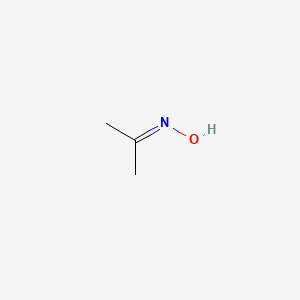
- IUPAC name
- N-propan-2-ylidenehydroxylamine
- Molecular formula
- C3H7NO
- Molecular weight
- 73.09 g/mol
- Exact mass
- 73.052763847 Da
- XLogP3
- 0.1
- Topological polar surface area
- 32.6 Ų
- Hydrogen-bond donors
- 1
- Hydrogen-bond acceptors
- 2
- Covalent units
- 1
- Defined stereocentres
- 0
Also known as
16 more reported names
External database identifiers
- ChEBI:CHEBI:15349
- EPA DTXSID:DTXSID6020010
- PubMed:3401844
Evidence from additional scientific databases
NIH PubChem PUG-View
Attributed physical-property, hazard, environmental and use annotations.
- Boiling Point: 133 °C Source: Hazardous Substances Data Bank (HSDB)
- Boiling Point: Boiling point = 134.8 °C at 728 mm Hg Source: Hazardous Substances Data Bank (HSDB)
- Color/Form: Columnar prisms Source: Hazardous Substances Data Bank (HSDB)
- Color/Form: Colorless crystals Source: Hazardous Substances Data Bank (HSDB)
- Density: Density: 0.9113 g/cm cu at 62 °C Source: Hazardous Substances Data Bank (HSDB)
- Dissociation Constants: pK = 12.42 at 24.9 °C Source: Hazardous Substances Data Bank (HSDB)
- LogP: log Kow = 0.12 Source: Hazardous Substances Data Bank (HSDB)
- Melting Point: 61 °C Source: Hazardous Substances Data Bank (HSDB)
- Physical Description: Crystals with a chloral odor; [Hawley] White powder; [Alfa Aesar MSDS] Source: Haz-Map, Information on Hazardous Chemicals and Occupational Diseases
- Refractive Index: Refractive index = 1.4156 at 20 °C Source: Hazardous Substances Data Bank (HSDB)
- Solubility: In water, 30.0 to 32.7% w/w at 20.0 °C Source: Hazardous Substances Data Bank (HSDB)
- Solubility: Soluble in water Source: Hazardous Substances Data Bank (HSDB)
- Solubility: Soluble in ethanol, diethyl ether, chloroform, ligroin Source: Hazardous Substances Data Bank (HSDB)
- Vapor Pressure: 3.12 [mmHg] Source: Haz-Map, Information on Hazardous Chemicals and Occupational Diseases
- Vapor Pressure: 1.82 mm Hg at 25 °C (242 hPa) Source: Hazardous Substances Data Bank (HSDB)
- Signal: Danger Source: Regulation (EC) No 1272/2008 of the European Parliament and of the Council
- GHS Hazard Statements: H312: Harmful in contact with skin [Warning Acute toxicity, dermal]; H317: May cause an allergic skin reaction [Warning Sensitization, Skin]; H318: Causes serious eye damage [Danger Serious eye damage/eye irritation]; H336: May cause drowsiness or dizziness [Warning Specific target organ toxicity, single exposure; Narcotic effects]; H350: May cause cancer [Danger Carcinogenicity]; H373: May causes damage to organs through prolonged or repeated exposure [Warning Specific target organ toxicity, repeated exposure] Source: Regulation (EC) No 1272/2008 of the European Parliament and of the Council
- Precautionary Statement Codes: P203, P260, P261, P264+P265, P271, P272, P280, P302+P352, P304+P340, P305+P354+P338, P317, P318, P319, P321, P333+P317, P362+P364, P403+P233, P405, and P501 (click each P-code to see the statement) Source: Regulation (EC) No 1272/2008 of the European Parliament and of the Council
- Signal: Danger Source: European Chemicals Agency (ECHA)
- GHS Hazard Statements: H228 (99.3%): Flammable solid [Danger Flammable solids]; H312 (80.9%): Harmful in contact with skin [Warning Acute toxicity, dermal]; H317 (94.7%): May cause an allergic skin reaction [Warning Sensitization, Skin]; H318 (96.7%): Causes serious eye damage [Danger Serious eye damage/eye irritation]; H351 (81.6%): Suspected of causing cancer [Warning Carcinogenicity] Source: European Chemicals Agency (ECHA)
- Precautionary Statement Codes: P203, P210, P240, P241, P261, P264+P265, P272, P280, P302+P352, P305+P354+P338, P317, P318, P321, P333+P317, P362+P364, P370+P378, P405, and P501 (click each P-code to see the statement) Source: European Chemicals Agency (ECHA)
- ECHA C&L Notifications Summary: Aggregated GHS information provided per 152 reports by companies from 11 notifications to the ECHA C&L Inventory. Each notification may be associated with multiple companies.; Information may vary between notifications depending on impurities, additives, and other factors. The percentage value in parenthesis indicates the notified classification ratio from companies that provide hazard codes. Only hazard codes with percentage values above 10% are shown. For more detailed information, please visit ECHA C&L website. Source: European Chemicals Agency (ECHA)
- Signal: Danger Source: Hazardous Substances Data Bank (HSDB)
- GHS Hazard Statements: H228: Flammable solid [Danger Flammable solids]; H312: Harmful in contact with skin [Warning Acute toxicity, dermal]; H317: May cause an allergic skin reaction [Warning Sensitization, Skin]; H318: Causes serious eye damage [Danger Serious eye damage/eye irritation]; H351: Suspected of causing cancer [Warning Carcinogenicity] Source: Hazardous Substances Data Bank (HSDB)
- Precautionary Statement Codes: P203, P210, P240, P241, P261, P264+P265, P272, P280, P302+P352, P305+P354+P338, P317, P318, P321, P333+P317, P362+P364, P370+P378, P405, and P501 (click each P-code to see the statement) Source: Hazardous Substances Data Bank (HSDB)
- Toxicity Summary: IDENTIFICATION AND USE: Acetoxime is a solid. It is used in organic synthesis (intermediate), as a solvent for cellulose ethers, and as a primer for diesel fuels. HUMAN STUDIES: Acetoxime has been tested in vitro as an experimental medication for herpes infection. ANIMAL STUDIES: Acetoxime was tested for carcinogenicity by chronic administration in the drinking water to male and female rats. The dose of 1.0 g/liter was administered 5 days/week for 18 months (total dose, 6.2 -7.0 g/rat). Acetoxime induced benign hepatocellular adenomas in 80% of the males but did not produce tumors in the females. The 90 day-NOAEL of the test substance in rats by the oral route was 15 mg/kg bw/day in both sexes. No effects were observed in the reproductive organs or tissues up to the highest dose tested (50 mg/kg bw/day). Acetoxime was negative in the Ames test with TA97, TA98, TA100 and TA1535 with and without metabolic activation. Acetoxime was genotoxic in Drosophila melanogaster. When tested in vivo acetoxime was found to induce a specific pattern of base damage in rat liver DNA and RNA, including the induction of increased levels of 8-hydroxyguanine. Because acetoxime was a weaker carcinogen in Source: Hazardous Substances Data Bank (HSDB)
- Environmental Bioconcentration: An estimated BCF of 3 was calculated in fish for acetoxime(SRC), using a log Kow of 0.12(1) and a regression-derived equation(2). According to a classification scheme(3), this BCF suggests the potential for bioconcentration in aquatic organisms is low(SRC). Source: Hazardous Substances Data Bank (HSDB)
- Environmental Fate: TERRESTRIAL FATE: Based on a classification scheme(1), an estimated Koc value of 1.3(SRC), determined from a log Kow of 0.12(2) and a regression-derived equation(3), indicates that acetoxime is expected to have very high mobility in soil(SRC). The pKa of acetoxime is 12.42(4), indicating that this compound will exist as its neutral species in the environment (pH 5-9). Volatilization of acetoxime from moist soil surfaces is expected to be an important fate process(SRC) given an estimated Henry's Law constant of 7.8X10⁻⁶ atm-cu m/mole(SRC), developed using a fragment constant estimation method(3). Acetoxime is expected to volatilize from dry soil surfaces(SRC) based upon a vapor pressure of 1.82 mm Hg at 25 °C(5). A 0% of theoretical BOD using domestic sewage in the Closed Bottle test(6) suggests that biodegradation is not an important environmental fate process in soil(SRC). Source: Hazardous Substances Data Bank (HSDB)
- Environmental Fate: AQUATIC FATE: Based on a classification scheme(1), an estimated Koc value of 1.3(SRC), determined from a log Kow of 0.12(2) and a regression-derived equation(3), indicates that acetoxime is not expected to adsorb to suspended solids and sediment(SRC). Volatilization from water surfaces is expected(4) based upon an estimated Henry's Law constant of 7.8X10⁻⁶ atm-cu m/mole(SRC), developed using a fragment constant estimation method(3). Using this Henry's Law constant and an estimation method(5), volatilization half-lives for a model river and model lake are 4 days and 33 days, respectively(SRC). According to a classification scheme(6), an estimated BCF of 3.2(SRC), from its log Kow(2) and a regression-derived equation(3), suggests the potential for bioconcentration in aquatic organisms is low. A 0% of theoretical BOD using domestic sewage in the Closed Bottle test(7) suggests that biodegradation is not an important environmental fate process in water(SRC). Source: Hazardous Substances Data Bank (HSDB)
- Environmental Fate: ATMOSPHERIC FATE: According to a model of gas/particle partitioning of semivolatile organic compounds in the atmosphere(1), acetoxime, which has a vapor pressure of 1.82 mm Hg at 25 °C(2), is expected to exist solely as a vapor in the ambient atmosphere. Vapor-phase acetoxime is degraded in the atmosphere by reaction with photochemically-produced hydroxyl radicals(SRC); the half-life for this reaction in air is estimated to be 48 days(SRC), calculated from its rate constant of 3.3X10⁻¹³ cu cm/molecule-sec at 25 °C(SRC) that was derived using a structure estimation method(3). Acetoxime does not contain chromophores that absorb at wavelengths >290 nm(4) and, therefore, is not expected to be susceptible to direct photolysis by sunlight(SRC). Source: Hazardous Substances Data Bank (HSDB)
- Sources/Uses: Used as a solvent (cellulose ethers), primer (diesel fuels), and intermediate (organic synthesis); [Hawley] Source: Haz-Map, Information on Hazardous Chemicals and Occupational Diseases
- Uses: MEDICATION Source: Hazardous Substances Data Bank (HSDB)
- Uses: Organic synthesis (intermediate); solvent for cellulose ethers; primer for diesel fuels. Source: Hazardous Substances Data Bank (HSDB)
Mapped by: Existing checksum-valid CAS to unique PubChem CID match. Retrieved: 2026-08-31. Open source record
Scientific classifications and hazard annotations provide context and do not replace the market-specific regulatory decision shown above.
Additional source coverage and match status
| Source | Result | Checked |
|---|---|---|
| NIH PubChem PUG-View | Exact match | 2026-08-31 |
A recorded no-match is useful evidence that the source was checked; it is not a claim that the substance does not exist elsewhere.
Retrieved from NIH PubChem on 2026-09-02 by checksum-valid CAS matching. Chemical properties do not replace the regulatory decision on this page.
Record details
Chemical name
Acetone oxime
Regulatory information
Key data
Related records for Acetone oxime
Direct matches are limited for this record, so nearby entries from Annex II are shown as well.
reaction mass of 1,3-dioxan-5-ol and 1,3-dioxolan-4-ylmethanol
2-(dimethylamino)-2-[(4-methylphenyl)methyl]-1-[4-(morpholin-4-yl)phenyl]butan-1-one
Multi-walled Carbon Tubes (synthetic graphite in tubular shape) with a geometric tube diameter rang…
2,3-epoxypropyl neodecanoate
foramsulfuron (ISO); 2-{[(4,6-dimethoxypyrimidin-2-yl)carbamoyl]sulfamoyl}-4-formamido-N,N-dimethyl…
Benthiavalicarb-isopropyl (ISO); isopropyl [(S)-1-{[(R)-1-(6-fluoro-1,3-benzothiazol-2-yl)ethyl]car…
3,3'-dimethylbiphenyl-4,4'-diyl diisocyanate
7-oxabicyclo[4.1.0]hept-3-ylmethyl 7-oxabicyclo[4.1.0]heptane-3-carboxylate
Sodium 3-(allyloxy)-2-hydroxypropanesulphonate
difenoconazole (ISO); 1-({2-[2-chloro-4-(4-chlorophenoxy)phenyl]-4-methyl-1,3-dioxolan-2-yl}methyl)…
What Annex II means for Acetone oxime
Acetone oxime is listed as a prohibited substance under Annex II of EU Cosmetics Regulation 1223/2009 and must not be intentionally added. Article 17 separately addresses unintended small quantities that are technically unavoidable under good manufacturing practice and compatible with the Article 3 safety requirement.
Formulators must screen their ingredients and raw materials to ensure none contain this substance. Suppliers should provide documentation confirming absence when requested.
The page also surfaces 12 related annex records with overlapping identifiers, annex logic or naming patterns.
Compliance checklist
- Verify this substance is absent from all raw materials and finished formulations.
- Request absence confirmation or CoA from raw material suppliers.
- Document the screening result in the Product Information File (PIF).
Frequently asked questions
Source note for Annex II record Acetone oxime
This page summarizes one Annex II record for Acetone oxime from public European Commission cosmetic materials and adds linked inventory or identifier matches when available.
Use this record page to review Annex II conditions for Acetone oxime, but confirm any final regulatory decision against the current official annex wording and source files.
Tools & next steps
Check your formula
Paste a full INCI list to detect Acetone oxime and other flagged EU annex records in one pass.
INCI CheckerCompare entries
Compare Acetone oxime side by side with another annex record to review differences in restrictions, concentrations and annex placement.
CompareBrowse the annex
See all records in Annex II and compare regulatory conditions across substances in this annex.
Open Annex II