
Nickel bis(sulfamidate); nickel sulfamate
Nickel bis(sulfamidate); nickel sulfamate is listed in Annex II as a prohibited substance for cosmetic products placed on the EU market.
Chemical identity and properties
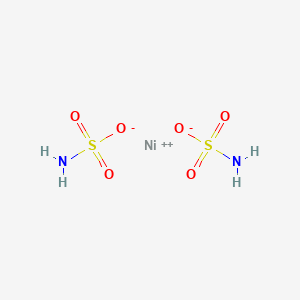
Nickel sulfamate
Nickel sulfamate is a chemical compound of nickel. Nickel is a chemical compound with the atomic number 28. It is found abundantly in nature in laterite ore minerals, such as limonite, garnierite, and pentlandite. Nickel has a biological role and is found in certain enzymes, including urease, hydrogenase, methylcoenzyme M reductase, and carbon monoxide dehydrogenase. (L40, L41) — Toxin and Toxin Target Database (T3DB)
- IUPAC name
- nickel(2+) disulfamate
- Molecular formula
- H4N2NiO6S2
- Molecular weight
- 250.87 g/mol
- Exact mass
- 249.886420 Da
- Topological polar surface area
- 183.0 Ų
- Hydrogen-bond donors
- 2
- Hydrogen-bond acceptors
- 8
- Covalent units
- 3
- Defined stereocentres
- 0
Also known as
16 more reported names
External database identifiers
- EPA DTXSID:DTXSID2065622
Retrieved from NIH PubChem on 2026-09-02 by checksum-valid CAS matching. Chemical properties do not replace the regulatory decision on this page.
Record details
Chemical name
Nickel bis(sulfamidate); nickel sulfamate
Chemical / IUPAC name
Nickel bis(sulfamidate); nickel sulfamate
Regulatory information
CMR
| Category | Carcinogenic | Mutagenic | Reprotoxic |
|---|---|---|---|
| Cat. 1B | ✓ | — | ✓ |
| Cat. 2 | — | ✓ | — |
Key data
Related records for Nickel bis(sulfamidate); nickel sulfamate
Direct matches are limited for this record, so nearby entries from Annex II are shown as well.
Nickel dipotassium bis(sulfate) [1]; Diammonium nickel bis(sulfate) [2]
Nickel diformate [1]; Formic acid, nickel salt [2]; Formic acid, copper nickel salt [3]
Nickel diperchlorate; perchloric acid, nickel(II) salt
Nickel di(acetate) [1]; Nickel acetate [2]
Slimes and sludges, copper electrolyte refining, decopperised
Slimes and sludges, copper electrolytic refining, decopperised, nickel sulfate
Nickel bis(4-cyclohexylbutyrate)
Nickel(II) stearate; nickel(II) octadecanoate
Nickel dinitrate [1]; Nitric acid, nickel salt [2]
What Annex II means for Nickel bis(sulfamidate); nickel sulfamate
Nickel bis(sulfamidate); nickel sulfamate is listed as a prohibited substance under Annex II of EU Cosmetics Regulation 1223/2009 and must not be intentionally added. Article 17 separately addresses unintended small quantities that are technically unavoidable under good manufacturing practice and compatible with the Article 3 safety requirement.
Formulators must screen their ingredients and raw materials to ensure none contain this substance. Suppliers should provide documentation confirming absence when requested.
The page also surfaces 12 related annex records with overlapping identifiers, annex logic or naming patterns.
Compliance checklist
- Verify this substance is absent from all raw materials and finished formulations.
- Request absence confirmation or CoA from raw material suppliers.
- Document the screening result in the Product Information File (PIF).
- This substance has CMR classification. Review the CMR table above and verify current Annex II/III status before use.
Frequently asked questions
Source note for Annex II record Nickel bis(sulfamidate); nickel sulfamate
This page summarizes one Annex II record for Nickel bis(sulfamidate); nickel sulfamate from public European Commission cosmetic materials and adds linked inventory or identifier matches when available.
Use this record page to review Annex II conditions for Nickel bis(sulfamidate); nickel sulfamate, but confirm any final regulatory decision against the current official annex wording and source files.
Tools & next steps
Check your formula
Paste a full INCI list to detect Nickel bis(sulfamidate); nickel sulfamate and other flagged EU annex records in one pass.
INCI CheckerCompare entries
Compare Nickel bis(sulfamidate); nickel sulfamate side by side with another annex record to review differences in restrictions, concentrations and annex placement.
CompareBrowse the annex
See all records in Annex II and compare regulatory conditions across substances in this annex.
Open Annex II