
Simazine
Listed by the Saudi Food and Drug Authority as prohibited in cosmetic products.
Regulatory decision and full conditions
- Status
- Prohibited
- Legal role
- Binding rule
- Regulatory summary
- Listed by the Saudi Food and Drug Authority as prohibited in cosmetic products.
- Conditions and restrictions
- A prohibition entry may contain no separate condition text because the regulatory outcome is the prohibition itself. Open the cited source and apply the market-wide requirements below.
Substance identity
- Official source name
- Simazine
- CAS
- 122-34-9
- EC
- Not supplied in this source row
- Identity mapping
- standalone:official_sfda_record
Cross-market snapshot for this identity
Exact linked records currently present in this site. An absent market means no imported exact match, not permission to use the substance.
European Union
1 linked record
Open supporting recordGreat Britain
1 linked record
Open supporting recordNew Zealand
1 linked record
Open supporting recordASEAN
1 linked record
Open supporting recordChina
1 linked record · 1 with specific conditions
Open supporting recordSouth Korea
1 linked record
Open supporting recordBrazil
1 linked record · 1 with specific conditions
Open supporting recordIndia
1 linked record · 1 with specific conditions
Open supporting recordSaudi Arabia
Current record1 linked record
Open supporting record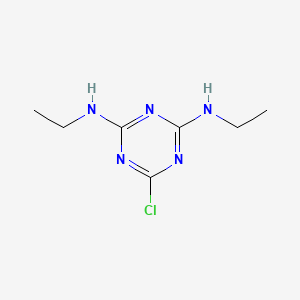
Verified chemistry for CAS 122-34-9
Simazine
Simazine is a diamino-1,3,5-triazine that is N,N'-diethyl-1,3,5-triazine-2,4-diamine substituted by a chloro group at position 6. It has a role as a herbicide, a xenobiotic and an environmental contaminant. It is a chloro-1,3,5-triazine and a diamino-1,3,5-triazine. — ChEBI
- IUPAC name
- 6-chloro-2-N,4-N-diethyl-1,3,5-triazine-2,4-diamine
- Molecular formula
- C7H12ClN5
- Molecular weight
- 201.66 g/mol
- Exact mass
- 201.0781231 Da
- Monoisotopic mass
- 201.0781231 Da
- XLogP3
- 2.2
- Topological polar surface area
- 62.7 Ų
- Molecular complexity
- 131.0
- Formal charge
- 0
- Hydrogen-bond donors
- 2
- Hydrogen-bond acceptors
- 5
- Rotatable bonds
- 4
- Heavy atoms
- 13
- Covalent units
- 1
Names and synonyms reported to PubChem
16 more reported names
External database identifiers
- ChEBI:CHEBI:27496
- ChEMBL:CHEMBL1605837
- EPA DTXSID:DTXSID4021268
- PubMed:34936186
- PubMed:32822773
- PubMed:29137186
- PubMed:29115391
- PubMed:27513680
- PubMed:27431321
- PubMed:27384423
- PubMed:26955487
- PubMed:26771455
- PubMed:25461544
- PubMed:22984576
- PubMed:21367690
Advanced structure statistics
- Defined atom stereocentres
- 0
- Undefined atom stereocentres
- 0
- Defined bond stereocentres
- 0
- Undefined bond stereocentres
- 0
- 3D pharmacophore features
- 5
- 3D rings
- 1
- 3D hydrophobes
- 0
- 3D acceptor features
- 0
- 3D donor features
- 2
- 3D anionic centres
- 0
- 3D cationic centres
- 2
- 3D conformers
- 10
- Effective 3D rotors
- 4.0
Machine-readable structure identifiers
- SMILES
CCNC1=NC(=NC(=N1)Cl)NCC- InChI
InChI=1S/C7H12ClN5/c1-3-9-6-11-5(8)12-7(13-6)10-4-2/h3-4H2,1-2H3,(H2,9,10,11,12,13)- InChIKey
ODCWYMIRDDJXKW-UHFFFAOYSA-N
Evidence from additional scientific databases
NIH PubChem PUG-View
Attributed physical-property, hazard, environmental and use annotations.
- Color/Form: White solid Source: Hazardous Substances Data Bank (HSDB)
- Color/Form: Colorless powder Source: Hazardous Substances Data Bank (HSDB)
- Color/Form: Crystals from ethanol or methyl Cellosolve Source: Hazardous Substances Data Bank (HSDB)
- Density: 1.302 at 68 °F (NTP, 1992) - Denser than water; will sink Source: CAMEO Chemicals
- Density: 1.33 at 22 °C /as per source/ Source: Hazardous Substances Data Bank (HSDB)
- Density: 1.3 g/cm³ Source: ILO-WHO International Chemical Safety Cards (ICSCs)
- Density: 1.302 Source: Occupational Safety and Health Administration (OSHA)
- Dissociation Constants: pKa = 1.62 at 20 °C Source: Hazardous Substances Data Bank (HSDB)
- LogP: log Kow = 2.18 Source: Hazardous Substances Data Bank (HSDB)
- LogP: 2.1 Source: ILO-WHO International Chemical Safety Cards (ICSCs)
- Melting Point: 437 to 441 °F (NTP, 1992) Source: CAMEO Chemicals
- Melting Point: 225 to 227 °C (decomp) Source: Hazardous Substances Data Bank (HSDB)
- Melting Point: 437-441 °F Source: Occupational Safety and Health Administration (OSHA)
- Physical Description: Simazine is a white to off-white crystalline powder. (NTP, 1992) Source: CAMEO Chemicals
- Physical Description: Colorless to white crystals; [EXTOXNET] Source: Haz-Map, Information on Hazardous Chemicals and Occupational Diseases
- Physical Description: WHITE CRYSTALLINE POWDER. Source: ILO-WHO International Chemical Safety Cards (ICSCs)
- Physical Description: White to off-white crystalline powder. Source: Occupational Safety and Health Administration (OSHA)
- Solubility: less than 1 mg/mL at 72 °F (NTP, 1992) Source: CAMEO Chemicals
- Solubility: 400 PPM IN METHANOL @ 20 °C Source: Hazardous Substances Data Bank (HSDB)
- Solubility: 3.0 ppm in n-pentane at 25 °C Source: Hazardous Substances Data Bank (HSDB)
- Solubility: Slightly sol in ethyl cellosolve, dioxane Source: Hazardous Substances Data Bank (HSDB)
- Solubility: In water, 6.2 mg/L (pH 7, 20 °C) Source: Hazardous Substances Data Bank (HSDB)
- Solubility: In ethanol 570, acetone 1500, toluene 130, n-octanol 390, n-hexane 3.1 (all in mg/L, 25 °C). Source: Hazardous Substances Data Bank (HSDB)
- Solubility: Solubility in water: none Source: ILO-WHO International Chemical Safety Cards (ICSCs)
- Vapor Pressure: 6.1e-09 mmHg at 68 °F (NTP, 1992) Source: CAMEO Chemicals
- Vapor Pressure: 0.00000002 [mmHg] Source: Haz-Map, Information on Hazardous Chemicals and Occupational Diseases
- Vapor Pressure: 2.2X10⁻⁸ mm Hg at 25 °C Source: Hazardous Substances Data Bank (HSDB)
- Vapor Pressure: Vapor pressure, Pa at 20 °C: 8.1x10 Source: ILO-WHO International Chemical Safety Cards (ICSCs)
- Vapor Pressure: 6.1x10(-9) Source: Occupational Safety and Health Administration (OSHA)
- IARC Carcinogenic Agent: Simazine Source: International Agency for Research on Cancer (IARC)
- IARC Carcinogenic Classes: Group 3: Not classifiable as to its carcinogenicity to humans Source: International Agency for Research on Cancer (IARC)
- IARC Monographs: Volume 53: (1991) Occupational Exposures in Insecticide Application, and Some Pesticides; Volume 73: (1999) Some Chemicals that Cause Tumours of the Kidney or Urinary Bladder in Rodents and Some Other Substances Source: International Agency for Research on Cancer (IARC)
- Publication Year: 1999 Source: International Agency for Research on Cancer (IARC)
- Evaluation Year: 1998 Source: International Agency for Research on Cancer (IARC)
- Carcinogen Classification: 3, not classifiable as to its carcinogenicity to humans. (L135) Source: Toxin and Toxin Target Database (T3DB)
- Exposure Routes: The substance can be absorbed into the body by inhalation of its aerosol and by ingestion. Source: ILO-WHO International Chemical Safety Cards (ICSCs)
- First Aid: EYES: First check the victim for contact lenses and remove if present. Flush victim's eyes with water or normal saline solution for 20 to 30 minutes while simultaneously calling a hospital or poison control center. Do not put any ointments, oils, or medication in the victim's eyes without specific instructions from a physician. IMMEDIATELY transport the victim after flushing eyes to a hospital even if no symptoms (such as redness or irritation) develop.; SKIN: IMMEDIATELY flood affected skin with water while removing and isolating all contaminated clothing. Gently wash all affected skin areas thoroughly with soap and water. If symptoms such as redness or irritation develop, IMMEDIATELY call a physician and be prepared to transport the victim to a hospital for treatment.; INHALATION: IMMEDIATELY leave the contaminated area; take deep breaths of fresh air. If symptoms (such as wheezing, coughing, shortness of breath, or burning in the mouth, throat, or chest) develop, call a physician and be prepared to transport the victim to a hospital. Provide proper respiratory protection to rescuers entering an unknown atmosphere. Whenever possible, Self-Contained Breathing Apparatus (SCBA) shou Source: CAMEO Chemicals
- Signal: Warning Source: Regulation (EC) No 1272/2008 of the European Parliament and of the Council
- GHS Hazard Statements: H351: Suspected of causing cancer [Warning Carcinogenicity]; H400: Very toxic to aquatic life [Warning Hazardous to the aquatic environment, acute hazard]; H410: Very toxic to aquatic life with long lasting effects [Warning Hazardous to the aquatic environment, long-term hazard] Source: Regulation (EC) No 1272/2008 of the European Parliament and of the Council
- Precautionary Statement Codes: P203, P273, P280, P318, P391, P405, and P501 (click each P-code to see the statement) Source: Regulation (EC) No 1272/2008 of the European Parliament and of the Council
- Signal: Warning Source: European Chemicals Agency (ECHA)
- GHS Hazard Statements: H302 (51.7%): Harmful if swallowed [Warning Acute toxicity, oral]; H319 (51.7%): Causes serious eye irritation [Warning Serious eye damage/eye irritation]; H351 (100%): Suspected of causing cancer [Warning Carcinogenicity]; H400 (100%): Very toxic to aquatic life [Warning Hazardous to the aquatic environment, acute hazard]; H410 (100%): Very toxic to aquatic life with long lasting effects [Warning Hazardous to the aquatic environment, long-term hazard] Source: European Chemicals Agency (ECHA)
- Precautionary Statement Codes: P203, P264, P264+P265, P270, P273, P280, P301+P317, P305+P351+P338, P318, P330, P337+P317, P391, P405, and P501 (click each P-code to see the statement) Source: European Chemicals Agency (ECHA)
- ECHA C&L Notifications Summary: Aggregated GHS information provided per 87 reports by companies from 9 notifications to the ECHA C&L Inventory. Each notification may be associated with multiple companies.; Information may vary between notifications depending on impurities, additives, and other factors. The percentage value in parenthesis indicates the notified classification ratio from companies that provide hazard codes. Only hazard codes with percentage values above 10% are shown. For more detailed information, please visit ECHA C&L website. Source: European Chemicals Agency (ECHA)
- Signal: Danger Source: NITE-CMC
- GHS Hazard Statements: H320: Causes eye irritation [Warning Serious eye damage/eye irritation]; H335: May cause respiratory irritation [Warning Specific target organ toxicity, single exposure; Respiratory tract irritation]; H336: May cause drowsiness or dizziness [Warning Specific target organ toxicity, single exposure; Narcotic effects]; H351: Suspected of causing cancer [Warning Carcinogenicity]; H361: Suspected of damaging fertility or the unborn child [Warning Reproductive toxicity]; H372: Causes damage to organs through prolonged or repeated exposure [Danger Specific target organ toxicity, repeated exposure]; H373: May causes damage to organs through prolonged or repeated exposure [Warning Specific target organ toxicity, repeated exposure]; H400: Very toxic to aquatic life [Warning Hazardous to the aquatic environment, acute hazard]; H410: Very toxic to aquatic life with long lasting effects [Warning Hazardous to the aquatic environment, long-term hazard] Source: NITE-CMC
- Precautionary Statement Codes: P203, P260, P261, P264, P264+P265, P270, P271, P273, P280, P304+P340, P305+P351+P338, P318, P319, P337+P317, P391, P403+P233, P405, and P501 (click each P-code to see the statement) Source: NITE-CMC
- Signal: Warning Source: NITE-CMC
- GHS Hazard Statements: H317: May cause an allergic skin reaction [Warning Sensitization, Skin]; H320: Causes eye irritation [Warning Serious eye damage/eye irritation]; H373: May causes damage to organs through prolonged or repeated exposure [Warning Specific target organ toxicity, repeated exposure] Source: NITE-CMC
- Target Organs: Hematologic Source: EPA Integrated Risk Information System (IRIS)
- Environmental Bioconcentration: BCFs of 2.3 to 3.2 and 9.7 to 14.6 were measured in carp at 0.1 and 0.01 mg/L, respectively(1). BCFs up to 55 have been reported in the literature(2). BCFs of 0.76 to 0.95 were measured in green sunfish (Lepomas cyanellus)(3), <1 in bluegill sunfish(4), and 5 and 2, in bluegill sunfish and catfish, respectively(2). According to a classification scheme(5), these BCFs suggest the bioconcentration in aquatic organisms is low to moderate(SRC). Source: Hazardous Substances Data Bank (HSDB)
- Environmental Fate: TERRESTRIAL FATE: Based on a classification scheme(1), Koc values ranging from 78 to 3,559(2,3), indicate that simazine is expected to have high to slight mobility in soil(SRC). Increasing sorption has been observed with decreasing pH(4). Volatilization of simazine from moist soil surfaces is not expected to be important(SRC) given an estimated Henry's Law constant of 9.4X10⁻¹⁰ atm-cu m/mole(SRC), derived from its vapor pressure, 2.2X10⁻⁸ mm Hg(5) and water solubility of 6.2 mg/L(5). Simazine is not expected to volatilize from dry soil surfaces based on its vapor pressure(5). The half-lives for degradation (purportedly mainly soil-catalyzed hydrolysis) of simazine in Hatzenbuhl soil at pH 4.8 and Neuhofen soil at pH 6.5 are 45 and 100 days, respectively(6). Estimated soil hydrolysis half-lives in Wongan Hills loamy sand at 9, 20, and 28 °C were 144, 37, and 21 days, respectively(7). Humic and fulvic acids have been observed to favor the hydrolysis of triazine molecules(8). Microbial breakdown in soil results in degradation of simazine at very variable rates, half-lives range from 27 to 102 days (median 49 days); temperature and moisture are the main factors affecting the rates(5). Source: Hazardous Substances Data Bank (HSDB)
- Environmental Fate: TERRESTRIAL FATE: It has been reported that simazine and other s-triazines can be utilized by certain soil microorganisms as a source of energy(1). Microbial degradation products of simazine in soil include 2-chloro-4-amino-6-ethylamino-1,3,5-triazine and 2,4-dihydroxy-6-amino-1,3,5-triazine(1). Mineralization of 10.4% of (14)C-labeled simazine in 110 days has been reported in a clay-lime soil; no degradation of simazine was detected in a soil suspension test without the addition of glucose as an energy source suggesting that degradation of simazine in these soil experiments was due to co-metabolism(2). Reported persistence of simazine in soil varies from a half-life of <1 month(3) to no degradation being observed in 3.5 months(4). The amount of organic matter in the soil may have a significant effect on the persistence of simazine(3). Additions of 1%, 5%, and 10% leaf compost to soil gave simazine half-lives of about 140, 60, and 40 days, respectively(3). Source: Hazardous Substances Data Bank (HSDB)
- Environmental Fate: AQUATIC FATE: Based on a classification scheme(1), Koc values ranging from 78 to 3,559(2,3), indicate that some adsorption of simazine to suspended solids and sediment in the water column is expected(SRC). Increasing sorption has been observed with decreasing pH(14). Simazine is not expected to volatilize from water surfaces(4) based on an estimated Henry's Law constant of 9.4X10⁻¹⁰ atm-cu m/mole(SRC), derived from its vapor pressure, 2.2X10⁻⁸ mm Hg(5) and water solubility of 6.2 mg/L(5). According to a classification scheme(6), BCFs ranging from <1 to 55(7-9) suggest bioconcentration in aquatic organisms is low to moderate(SRC). Simazine is stable at pH 7 and 9 but the hydrolysis half-life at pH 5 and 25 °C is 70 days(10). The product of simazine hydrolysis is 2-hydroxy-4,6-bis(ethylamino)-1,3,5-triazine(10). Humic and fulvic acids have been observed to favor the hydrolysis of triazine molecules(11). Biodegradation in surface water samples from three ponds in Nagoya City, Japan, ranged from 0 to 30% after four days incubation; after 7 days incubation, biodegradation ranged from 0 to 24%(12). In Po River water, an initial simazine concentration of 5 ug/L was reduced to 3.1 and 2.5 Source: Hazardous Substances Data Bank (HSDB)
- Environmental Fate: AQUATIC FATE: Dissipation of simazine in pond and lake water was variable, with half-lives ranging from 50 to 700 days. The degradation compound G-28279 /1,3,5-triazine-2,4-diamine, 6-chloro-N-ethyl-; CAS Number 1007-28-9/ was identified in lake water samples. Source: Hazardous Substances Data Bank (HSDB)
- Environmental Fate: For more Environmental Fate (Complete) data for SIMAZINE (6 total), please visit the HSDB record page. Source: Hazardous Substances Data Bank (HSDB)
- Sources/Uses: Used as a broadleaf herbicide; [EXTOXNET] Inhibits photosynthesis in weeds after application to soil; Used in crops (apples, oranges, almonds, corn), lawns, and in ponds and aquariums (algicide); [ACGIH] Source: Haz-Map, Information on Hazardous Chemicals and Occupational Diseases
- Industrial Processes with risk of exposure: Farming (Pesticides) [Category: Industry] Source: Haz-Map, Information on Hazardous Chemicals and Occupational Diseases
- Uses: For simazine (USEPA/OPP Pesticide Code: 80807) ACTIVE products with label matches. /SRP: Registered for use in the U.S. but approved pesticide uses may change periodically and so federal, state and local authorities must be consulted for currently approved uses./ Source: Hazardous Substances Data Bank (HSDB)
- Uses: Simazine is a selective herbicide used for control of broadleaf weeds and annual grasses in corn, established alfalfa, fruit, nuts, asparagus, ornamentals, and turf. Source: Hazardous Substances Data Bank (HSDB)
- Uses: Selective systemic herbicide. Control of most germinating annual grasses and broad-leaved weeds. Source: Hazardous Substances Data Bank (HSDB)
- Uses: Simazine is also used for selective control of algae and submerged weeds in ponds. It is approved for algae control in swimming pools, large aquaria, ornamental fish ponds, fountains, and recirculating water cooling towers. Source: Hazardous Substances Data Bank (HSDB)
- Uses: For more Uses (Complete) data for SIMAZINE (7 total), please visit the HSDB record page. Source: Hazardous Substances Data Bank (HSDB)
- Uses: This is a man-made compound that is used as a pesticide. Source: Toxin and Toxin Target Database (T3DB)
Mapped by: Existing checksum-valid CAS to unique PubChem CID match. Retrieved: 2026-08-31. Open source record
Scientific classifications and hazard annotations provide context and do not replace the market-specific regulatory decision shown above.
Additional source coverage and match status
| Source | Result | Checked |
|---|---|---|
| NIH PubChem PUG-View | Exact match | 2026-08-31 |
A recorded no-match is useful evidence that the source was checked; it is not a claim that the substance does not exist elsewhere.
Retrieved from NIH PubChem on 2026-09-02 by checksum-valid CAS matching. Chemical properties do not replace the regulatory decision on this page.
Official source and provenance
- Registered source
- Saudi SFDA prohibited and restricted ingredient lists
- Source reference
- SFDA prohibited list, page 101, row 6
- Source record ID
prohibited-100-6- Source version
- live-snapshot-2026-08-30
- Source language
- English
- Translation status
- Original is English
- Snapshot checked
- 2026-08-30 05:18 UTC
- Validation method
- complete SFDA paginated HTML snapshot; strict page/row counts
- SHA-256
ceb6cc636e6b1f4b3013f88ce0297217b49d6194342c6ece5c03b1e04256d71a
Registered dataset notes
- Dataset coverage
- Prohibited and restricted substances with CAS, EC and conditions
- Authority note
- Official SFDA dated lists; version and hash each release
How this record fits the market dataset
Status distribution
Condition text is present on 0 of 2090 current records. An empty condition field is interpreted according to the record type above; it is never converted into an unrestricted-use claim.
Saudi Arabia market context
Complete official list index
Coverage version: SFDA live prohibited/restricted lists, snapshot 30 August 2026
Every page and entry in the public SFDA prohibited and restricted ingredient indexes; restricted detail pages remain the source for conditions.
Verification checklist
- Search names and CAS across both SFDA lists.
- Open the cited restricted-entry detail and apply every condition.
- Check current SFDA/GSO technical regulations and updates.
- Complete eCosma notification, label and responsible-party requirements.
Official market sources
- Saudi SFDA prohibited and restricted ingredient listsOfficial SFDA dated lists; version and hash each release
Verification workflow and record completeness
Before using this result in a compliance decision
- Confirm that “Simazine” and every CAS/EC identifier refer to the material in your supplier specification.
- Search names and CAS across both SFDA lists.
- Open the cited restricted-entry detail and apply every condition.
- Check current SFDA/GSO technical regulations and updates.
- Complete eCosma notification, label and responsible-party requirements.
- Document the source version and recheck the regulator before manufacture, notification or market placement.
Fields available in this record
- Official substance nameAvailable
- CASAvailable
- ECNot supplied
- Separate condition textNot present in source row
- Effective dateNot supplied
- Snapshot hash and methodAvailable
Questions this page answers
Stable citation
Simazine. SFDA prohibited list, page 101, row 6. Saudi Arabia. Source version live-snapshot-2026-08-30. CosIng Checker regulatory record: https://cosingchecker.com/regulations/sa/records/10605/
Cite the regulator as the legal authority. This page is a structured evidence index and verification aid, not a substitute for the official text or professional legal assessment.
Interpretation and limits for Saudi Arabia
This official record identifies the substance as prohibited for cosmetic use in the stated market scope.
Do not rely on a formulation containing this identity until the cited source, effective date and exact substance match have been verified.
How to interpret the legal role
The cited row forms part of a binding rule or legally incorporated list for this market.
Evidence on this page
- Recorded outcome: Prohibited
- Legal role: Binding rule
- Source version: live-snapshot-2026-08-30
What it does not prove
No list match is not permission; Gulf/SFDA product, claim, notification and technical requirements still apply.
Further authoritative substance research
None of these sources overrides the market decision above.
Cosmetic Ingredient Review safety assessments
Expert Panel conclusions, assessed ingredient groups, use conditions, dates and report documents
Independent expert review considered by FDA; not a government approval or binding market rule
Research this identity at the sourceFDA Global Substance Registration System
UNII identifiers, preferred names, substance types, codes and public substance relationships
Identity registry only; UNII availability does not imply FDA review or approval
Research this identity at the sourceILO/WHO International Chemical Safety Cards
Hazards, symptoms, first aid, storage, incompatibilities and physical properties for covered chemicals
International occupational chemical-safety reference; not cosmetic-use approval
Research this identity at the sourceJapan NITE-CHRIP
Chemical identity, Japanese and foreign legal lists, GHS hazards and exposure-related information
Chemical-management evidence; cosmetic status remains governed by the applicable MHLW standard and market rules
Research this identity at the sourceNIOSH Pocket Guide to Chemical Hazards
REL, PEL, IDLH, properties, exposure routes, symptoms, target organs, first aid and measurement methods for covered workplace chemicals
US occupational-health guidance and limits; not a cosmetic ingredient decision
Research this identity at the sourceOECD eChemPortal
Gateway to authority-owned physical-property, fate, ecotoxicity, toxicity, exposure and GHS records
Discovery gateway; each linked authority remains responsible for its data
Research this identity at the sourceUS EPA CompTox CTX APIs
API key required for importDTXSID identity, experimental and predicted properties, toxicity, bioactivity, exposure and environmental data
Scientific and computational evidence; predictions must remain labelled and do not determine cosmetic legality
Research this identity at the source