
(乙二酰双亚氨乙烯)双((邻-氯苯 基)二乙基铵)盐, 如: 安贝氯铵 — (Oxalylbis(iminoethylene)) bis ((o-chlorobenzyl) diethylammonium)salts, e.g. ambenonium chloride (INN) (CAS No. 115-79-7)
(Oxalylbis(iminoethylene)) bis ((o-chlorobenzyl) diethylammonium)salts, e.g. ambenonium chloride (INN) (CAS No. 115-79-7)
The NMPA binding 2021 catalogue prohibits this raw material in cosmetic formulas in China.
Regulatory decision and full conditions
- Status
- Prohibited
- Legal role
- Binding rule
- Regulatory summary
- The NMPA binding 2021 catalogue prohibits this raw material in cosmetic formulas in China.
- Conditions and restrictions
Prohibited in cosmetic product formulas. Verify the cited Chinese source identity and any later NMPA amendment before use.
Substance identity
- Official source name
- (乙二酰双亚氨乙烯)双((邻-氯苯 基)二乙基铵)盐, 如: 安贝氯铵 — (Oxalylbis(iminoethylene)) bis ((o-chlorobenzyl) diethylammonium)salts, e.g. ambenonium chloride (INN) (CAS No. 115-79-7)
- CAS
- 115-79-7
- EC
- Not supplied in this source row
- Identity mapping
- standalone:official_nmpa_record
Cross-market snapshot for this identity
Exact linked records currently present in this site. An absent market means no imported exact match, not permission to use the substance.
European Union
1 linked record
Open supporting recordGreat Britain
1 linked record
Open supporting recordNew Zealand
1 linked record
Open supporting recordASEAN
1 linked record
Open supporting recordChina
Current record1 linked record · 1 with specific conditions
Open supporting recordSouth Korea
1 linked record · 1 with specific conditions
Open supporting recordBrazil
1 linked record · 1 with specific conditions
Open supporting recordIndia
1 linked record · 1 with specific conditions
Open supporting recordSaudi Arabia
1 linked record
Open supporting record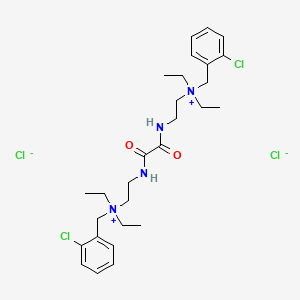
Verified chemistry for CAS 115-79-7
Ambenonium Chloride
Ambenonium chloride is a symmetrical oxalamide-based bis-quaternary ammonium salt having ethyl and 2-chlorobenzyl groups attached to the nitrogens. It has a role as a neurotransmitter agent and an EC 3.1.1.8 (cholinesterase) inhibitor. It is a quaternary ammonium salt and an organic chloride salt. — ChEBI
- IUPAC name
- (2-chlorophenyl)methyl-[2-[[2-[2-[(2-chlorophenyl)methyl-diethylazaniumyl]ethylamino]-2-oxoacetyl]amino]ethyl]-diethylazanium dichloride
- Molecular formula
- C28H42Cl4N4O2
- Molecular weight
- 608.5 g/mol
- Exact mass
- 608.203237 Da
- Monoisotopic mass
- 606.206187 Da
- Topological polar surface area
- 58.2 Ų
- Molecular complexity
- 614.0
- Formal charge
- 0
- Hydrogen-bond donors
- 2
- Hydrogen-bond acceptors
- 4
- Rotatable bonds
- 14
- Heavy atoms
- 38
- Covalent units
- 3
Names and synonyms reported to PubChem
16 more reported names
External database identifiers
- ChEBI:CHEBI:2628
- ChEMBL:CHEMBL1200541
- EPA DTXSID:DTXSID3022582
- PubMed:33844597
- PubMed:11132996
- PubMed:11099780
- PubMed:8010419
- PubMed:3912090
Advanced structure statistics
- Defined atom stereocentres
- 0
- Undefined atom stereocentres
- 0
- Defined bond stereocentres
- 0
- Undefined bond stereocentres
- 0
- 3D conformers
- 0
Machine-readable structure identifiers
- SMILES
CC[N+](CC)(CCNC(=O)C(=O)NCC[N+](CC)(CC)CC1=CC=CC=C1Cl)CC2=CC=CC=C2Cl.[Cl-].[Cl-]- InChI
InChI=1S/C28H40Cl2N4O2.2ClH/c1-5-33(6-2,21-23-13-9-11-15-25(23)29)19-17-31-27(35)28(36)32-18-20-34(7-3,8-4)22-24-14-10-12-16-26(24)30;;/h9-16H,5-8,17-22H2,1-4H3;2*1H- InChIKey
DXUUXWKFVDVHIK-UHFFFAOYSA-N
Evidence from additional scientific databases
NIH PubChem PUG-View
Attributed physical-property, hazard, environmental and use annotations.
- Carcinogen Classification: No indication of carcinogenicity to humans (not listed by IARC). Source: Toxin and Toxin Target Database (T3DB)
- Exposure Routes: Oral - poorly absorbed from the gastrointestinal tract. Source: Toxin and Toxin Target Database (T3DB)
- Signal: Danger Source: European Chemicals Agency (ECHA)
- GHS Hazard Statements: H300 (100%): Fatal if swallowed [Danger Acute toxicity, oral] Source: European Chemicals Agency (ECHA)
- Precautionary Statement Codes: P264, P270, P301+P316, P321, P330, P405, and P501 (click each P-code to see the statement) Source: European Chemicals Agency (ECHA)
- ECHA C&L Notifications Summary: Aggregated GHS information provided per 38 reports by companies from 1 notifications to the ECHA C&L Inventory.; Information may vary between notifications depending on impurities, additives, and other factors. The percentage value in parenthesis indicates the notified classification ratio from companies that provide hazard codes. Only hazard codes with percentage values above 10% are shown. For more detailed information, please visit ECHA C&L website. Source: European Chemicals Agency (ECHA)
- Health Effects: Acute exposure to cholinesterase inhibitors can cause a cholinergic crisis characterized by severe nausea/vomiting, salivation, sweating, bradycardia, hypotension, collapse, and convulsions. Increasing muscle weakness is a possibility and may result in death if respiratory muscles are involved. Accumulation of ACh at motor nerves causes overstimulation of nicotinic expression at the neuromuscular junction. When this occurs symptoms such as muscle weakness, fatigue, muscle cramps, fasciculation, and paralysis can be seen. When there is an accumulation of ACh at autonomic ganglia this causes overstimulation of nicotinic expression in the sympathetic system. Symptoms associated with this are hypertension, and hypoglycemia. Overstimulation of nicotinic acetylcholine receptors in the central nervous system, due to accumulation of ACh, results in anxiety, headache, convulsions, ataxia, depression of respiration and circulation, tremor, general weakness, and potentially coma. When there is expression of muscarinic overstimulation due to excess acetylcholine at muscarinic acetylcholine receptors symptoms of visual disturbances, tightness in chest, wheezing due to bronchoconstriction, incre Source: Toxin and Toxin Target Database (T3DB)
- Toxicity Summary: Ambenonium is a cholinesterase or acetylcholinesterase (AChE) inhibitor. A cholinesterase inhibitor (or 'anticholinesterase') suppresses the action of acetylcholinesterase. Because of its essential function, chemicals that interfere with the action of acetylcholinesterase are potent neurotoxins, causing excessive salivation and eye-watering in low doses, followed by muscle spasms and ultimately death. Nerve gases and many substances used in insecticides have been shown to act by binding a serine in the active site of acetylcholine esterase, inhibiting the enzyme completely. Acetylcholine esterase breaks down the neurotransmitter acetylcholine, which is released at nerve and muscle junctions, in order to allow the muscle or organ to relax. The result of acetylcholine esterase inhibition is that acetylcholine builds up and continues to act so that any nerve impulses are continually transmitted and muscle contractions do not stop. Among the most common acetylcholinesterase inhibitors are phosphorus-based compounds, which are designed to bind to the active site of the enzyme. The structural requirements are a phosphorus atom bearing two lipophilic groups, a leaving group (such as a hal Source: Toxin and Toxin Target Database (T3DB)
- Uses: Ambenonium is used to treat muscle weakness due to muscle disease (myasthenia gravis). Source: Toxin and Toxin Target Database (T3DB)
Mapped by: Existing checksum-valid CAS to unique PubChem CID match. Retrieved: 2026-08-31. Open source record
Scientific classifications and hazard annotations provide context and do not replace the market-specific regulatory decision shown above.
Additional source coverage and match status
| Source | Result | Checked |
|---|---|---|
| NIH PubChem PUG-View | Exact match | 2026-08-31 |
A recorded no-match is useful evidence that the source was checked; it is not a claim that the substance does not exist elsewhere.
Retrieved from NIH PubChem on 2026-09-02 by checksum-valid CAS matching. Chemical properties do not replace the regulatory decision on this page.
Official source and provenance
- Registered source
- China NMPA banned raw-material catalogues (2021)
- Source reference
- NMPA 2021 Catalogue of Raw Materials Banned for Cosmetics, entry 995
- Source record ID
chemical-995- Source version
- NMPA Announcement No. 74 of 2021, effective 2021-05-26
- Source language
- Chinese with source English/Latin identity
- Translation status
- Official English translation · English translation
- Effective date
- 2021-05-26
- Source updated
- 2021-05-26
- Snapshot checked
- 2026-08-31 14:13 UTC
- Validation method
- pdfplumber tables; exact 1,284 + 109 row counts and contiguous source numbering
- SHA-256
8848aa3e0c7ac5e74f56fc27927336c4fc2e5bc80137da087c2ca9ba2d2c075e
Registered dataset notes
- Dataset coverage
- All 1,284 banned raw materials and 109 banned plant/animal raw materials effective from 26 May 2021
- Authority note
- Binding NMPA catalogues replacing Tables 1 and 2 of the 2015 Technical Specification
How this record fits the market dataset
Status distribution
Condition text is present on 1393 of 1393 current records. An empty condition field is interpreted according to the record type above; it is never converted into an unrestricted-use claim.
China market context
Complete prohibited catalogues plus official-source workflow
Coverage version: NMPA 2021 banned catalogues plus dynamic IECIC List I/List II system current since 2025
All 1,284 banned raw materials and 109 banned plant/animal raw materials, plus the official workflow for the dynamic existing-ingredient inventory, other technical restrictions and new ingredients.
Verification checklist
- Search the current NMPA IECIC List I and List II by Chinese name and identity.
- Check prohibited/restricted and positive lists in the current Safety and Technical Standards.
- Review technical purpose, use history and any monitoring period.
- Confirm Chinese labelling, safety assessment and filing/registration duties.
Official market sources
- China NMPA IECIC dynamic inventoryOfficial NMPA inventory, not a blanket permission or safety decision
- China draft mandatory cosmetic safety standardConsultation draft — not current law and not a substitute for the effective NMPA catalogues
- China NMPA banned raw-material catalogues (2021)Binding NMPA catalogues replacing Tables 1 and 2 of the 2015 Technical Specification
Verification workflow and record completeness
Before using this result in a compliance decision
- Confirm that “(乙二酰双亚氨乙烯)双((邻-氯苯 基)二乙基铵)盐, 如: 安贝氯铵 — (Oxalylbis(iminoethylene)) bis ((o-chlorobenzyl) diethylammonium)salts, e.g. ambenonium chloride (INN) (CAS No. 115-79-7)” and every CAS/EC identifier refer to the material in your supplier specification.
- Search the current NMPA IECIC List I and List II by Chinese name and identity.
- Check prohibited/restricted and positive lists in the current Safety and Technical Standards.
- Review technical purpose, use history and any monitoring period.
- Confirm Chinese labelling, safety assessment and filing/registration duties.
- Document the source version and recheck the regulator before manufacture, notification or market placement.
Fields available in this record
- Official substance nameAvailable
- CASAvailable
- ECNot supplied
- Separate condition textAvailable
- Effective dateAvailable
- Snapshot hash and methodAvailable
Questions this page answers
Stable citation
(乙二酰双亚氨乙烯)双((邻-氯苯 基)二乙基铵)盐, 如: 安贝氯铵 — (Oxalylbis(iminoethylene)) bis ((o-chlorobenzyl) diethylammonium)salts, e.g. ambenonium chloride (INN) (CAS No. 115-79-7). NMPA 2021 Catalogue of Raw Materials Banned for Cosmetics, entry 995. China. Source version NMPA Announcement No. 74 of 2021, effective 2021-05-26. CosIng Checker regulatory record: https://cosingchecker.com/regulations/cn/records/12684/
Cite the regulator as the legal authority. This page is a structured evidence index and verification aid, not a substitute for the official text or professional legal assessment.
Interpretation and limits for China
This official record identifies the substance as prohibited for cosmetic use in the stated market scope.
Do not rely on a formulation containing this identity until the cited source, effective date and exact substance match have been verified.
How to interpret the legal role
The cited row forms part of a binding rule or legally incorporated list for this market.
Evidence on this page
- Recorded outcome: Prohibited
- Legal role: Binding rule
- Source version: NMPA Announcement No. 74 of 2021, effective 2021-05-26
- Effective date: 2021-05-26
What it does not prove
IECIC listing is not blanket approval; absence may require the new cosmetic ingredient route, and restrictions are checked separately.
Further authoritative substance research
None of these sources overrides the market decision above.
Cosmetic Ingredient Review safety assessments
Expert Panel conclusions, assessed ingredient groups, use conditions, dates and report documents
Independent expert review considered by FDA; not a government approval or binding market rule
Research this identity at the sourceFDA Global Substance Registration System
UNII identifiers, preferred names, substance types, codes and public substance relationships
Identity registry only; UNII availability does not imply FDA review or approval
Research this identity at the sourceILO/WHO International Chemical Safety Cards
Hazards, symptoms, first aid, storage, incompatibilities and physical properties for covered chemicals
International occupational chemical-safety reference; not cosmetic-use approval
Research this identity at the sourceJapan NITE-CHRIP
Chemical identity, Japanese and foreign legal lists, GHS hazards and exposure-related information
Chemical-management evidence; cosmetic status remains governed by the applicable MHLW standard and market rules
Research this identity at the sourceNIOSH Pocket Guide to Chemical Hazards
REL, PEL, IDLH, properties, exposure routes, symptoms, target organs, first aid and measurement methods for covered workplace chemicals
US occupational-health guidance and limits; not a cosmetic ingredient decision
Research this identity at the sourceOECD eChemPortal
Gateway to authority-owned physical-property, fate, ecotoxicity, toxicity, exposure and GHS records
Discovery gateway; each linked authority remains responsible for its data
Research this identity at the sourceUS EPA CompTox CTX APIs
API key required for importDTXSID identity, experimental and predicted properties, toxicity, bioactivity, exposure and environmental data
Scientific and computational evidence; predictions must remain labelled and do not determine cosmetic legality
Research this identity at the source