
Coal tar dye
Canada Hotlist: Coal tar dye
Health Canada lists this ingredient as restricted; the listed conditions and warnings apply.
Regulatory decision and full conditions
- Status
- Restricted
- Legal role
- Official guidance
- Regulatory summary
- Health Canada lists this ingredient as restricted; the listed conditions and warnings apply.
- Conditions and restrictions
Synonyms or related compounds: Toluene-2,5-diamine; Toluene-2,5-diamine sulfate; See also “ p -Phenylenediamine and its salts ” | a) Not permitted in the area of the eye as indicated in section 14 of the Cosmetic Regulations. | b) In hair dyes as indicated in section 22 of the Cosmetic Regulations. · Warnings: On the inner label and the outer label of the cosmetic: "CAUTION: this product contains ingredients that may cause skin irritation on certain individuals and a preliminary test according to accompanying directions should first be made. This product must not be used for dying the eyelashes or eyebrows. To do so may cause blindness." Instructions to the following effect accompany each package of hair dye: The preparation may cause serious inflammation of the skin in some persons, and a preliminary test should always be carried out to determine whether or not special sensitivity exists; and To make the test, a small area of skin behind the ear or on the inner surface of the forearm should be cleansed, using either soap and water or alcohol, and a small quantity of the hair dye, as prepared for use, should be applied to the area and allowed to dry. After 24 hours, the area should be washed gently with soap and water. If no irritation or inflammation is apparent, it is usually assumed that no hypersensitivity to the dye exists. The test should, however, be carried out before each application. On no account should the hair dye be used for dyeing eyebrows or eyelashes as severe inflammation of the eye or even blindness may result."
Substance identity
- Official source name
- Coal tar dye
- CAS
- 95-70-5; 615-50-9
- EC
- Not supplied in this source row
- Identity mapping
- Exact CAS: 95-70-5
- Linked ingredient
- TOLUENE-2,5-DIAMINE
Linked CosIng identity data
Names and aliases
CosIng description: 2-Methyl-p-phenylenediamine (CI 76042)
EU inventory restriction note: III/9a
Recorded cosmetic function: HAIR DYEING
Function pages:HAIR DYEING
View the complete ingredient profileCross-market snapshot for this identity
Exact linked records currently present in this site. An absent market means no imported exact match, not permission to use the substance.
European Union
1 linked record · 1 with specific conditions
Open supporting recordGreat Britain
1 linked record · 1 with specific conditions
Open supporting recordCanada
Current record1 linked record · 1 with specific conditions
Open supporting recordNew Zealand
2 linked records · 2 with specific conditions
Open supporting recordASEAN
1 linked record · 1 with specific conditions
Open supporting recordSouth Korea
4 linked records · 2 with specific conditions
Open supporting recordIndia
1 linked record · 1 with specific conditions
Open supporting recordSaudi Arabia
1 linked record
Open supporting record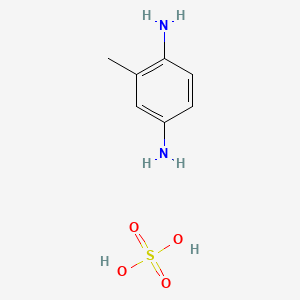
Verified chemistry for CAS 615-50-9
2,5-Diaminotoluene sulfate
2,5-diaminotoluene sulfate is an organic sulfate salt obtained by combining 2,5-diaminotoluene with one molar equivalent of sulfuric acid; occurs as an intermediate during hair dye formulation. It has a role as an allergen. It is a diamine and an organic sulfate salt. It is functionally related to a 2-methyl-1,4-phenylenediamine. — ChEBI
- IUPAC name
- 2-methylbenzene-1,4-diamine;sulfuric acid
- Molecular formula
- C7H12N2O4S
- Molecular weight
- 220.25 g/mol
- Exact mass
- 220.05177804 Da
- Monoisotopic mass
- 220.05177804 Da
- Topological polar surface area
- 135.0 Ų
- Molecular complexity
- 174.0
- Formal charge
- 0
- Hydrogen-bond donors
- 4
- Hydrogen-bond acceptors
- 6
- Rotatable bonds
- 0
- Heavy atoms
- 14
- Covalent units
- 2
Names and synonyms reported to PubChem
16 more reported names
External database identifiers
- ChEBI:CHEBI:156544
Advanced structure statistics
- Defined atom stereocentres
- 0
- Undefined atom stereocentres
- 0
- Defined bond stereocentres
- 0
- Undefined bond stereocentres
- 0
- 3D conformers
- 0
Machine-readable structure identifiers
- SMILES
CC1=C(C=CC(=C1)N)N.OS(=O)(=O)O- InChI
InChI=1S/C7H10N2.H2O4S/c1-5-4-6(8)2-3-7(5)9;1-5(2,3)4/h2-4H,8-9H2,1H3;(H2,1,2,3,4)- InChIKey
KZTWOUOZKZQDMN-UHFFFAOYSA-N
Retrieved from NIH PubChem on 2026-08-31 by checksum-valid CAS matching. Chemical properties do not replace the regulatory decision on this page.
Verified chemistry for CAS 95-70-5
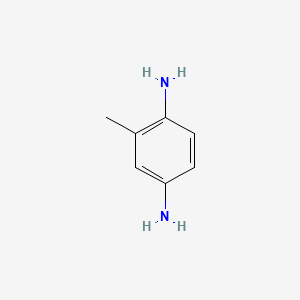
2,5-Diaminotoluene
2-methyl-1,4-phenylenediamine is a diamine in which the two amino groups are substituted into toluene at the 2- and 5-positions. It has a role as an allergen. It derives from a hydride of a toluene. — ChEBI
- IUPAC name
- 2-methylbenzene-1,4-diamine
- Molecular formula
- C7H10N2
- Molecular weight
- 122.17 g/mol
- Exact mass
- 122.084398327 Da
- Monoisotopic mass
- 122.084398327 Da
- XLogP3
- 0.6
- Topological polar surface area
- 52.0 Ų
- Molecular complexity
- 92.0
- Formal charge
- 0
- Hydrogen-bond donors
- 2
- Hydrogen-bond acceptors
- 2
- Rotatable bonds
- 0
- Heavy atoms
- 9
- Covalent units
- 1
Names and synonyms reported to PubChem
16 more reported names
External database identifiers
Advanced structure statistics
- Defined atom stereocentres
- 0
- Undefined atom stereocentres
- 0
- Defined bond stereocentres
- 0
- Undefined bond stereocentres
- 0
- 3D pharmacophore features
- 5
- 3D rings
- 1
- 3D hydrophobes
- 0
- 3D acceptor features
- 0
- 3D donor features
- 2
- 3D anionic centres
- 0
- 3D cationic centres
- 2
- 3D conformers
- 1
- Effective 3D rotors
- 0.0
Machine-readable structure identifiers
- SMILES
CC1=C(C=CC(=C1)N)N- InChI
InChI=1S/C7H10N2/c1-5-4-6(8)2-3-7(5)9/h2-4H,8-9H2,1H3- InChIKey
OBCSAIDCZQSFQH-UHFFFAOYSA-N
Retrieved from NIH PubChem on 2026-08-31 by checksum-valid CAS matching. Chemical properties do not replace the regulatory decision on this page.
Official source and provenance
- Registered source
- Health Canada Cosmetic Ingredient Hotlist
- Source reference
- Hotlist restricted entry 30
- Source record ID
restricted:30- Source version
- Health Canada Hotlist 2025-08-13
- Source language
- English
- Translation status
- Original is English
- Source updated
- 2025-08-13
- Snapshot checked
- 2026-08-30 04:07 UTC
- Validation method
- strict HTML tables t1=490 and t2=90
- SHA-256
8b52ff573d08373ee90121f6a701b3607e4a3d6fc748a7d56171eb53510af91a
Registered dataset notes
- Dataset coverage
- Administrative prohibitions, restrictions, conditions and warning requirements
- Authority note
- Official Health Canada compliance indicator; not a complete safety clearance
How this record fits the market dataset
Status distribution
Condition text is present on 172 of 580 current records. An empty condition field is interpreted according to the record type above; it is never converted into an unrestricted-use claim.
Canada market context
Complete Hotlist snapshot
Coverage version: Health Canada Cosmetic Ingredient Hotlist, 13 August 2025
All prohibited and restricted Hotlist entries, including conditions and warning requirements published in the official list.
Verification checklist
- Search English/French names and CAS identifiers.
- Apply every restriction, concentration and label warning.
- Check Food and Drugs Act/Cosmetic Regulations requirements.
- Recheck the current Hotlist before notification or sale.
Official market sources
- Health Canada Cosmetic Ingredient HotlistOfficial Health Canada compliance indicator; not a complete safety clearance
Verification workflow and record completeness
Before using this result in a compliance decision
- Confirm that “Coal tar dye” and every CAS/EC identifier refer to the material in your supplier specification.
- Search English/French names and CAS identifiers.
- Apply every restriction, concentration and label warning.
- Check Food and Drugs Act/Cosmetic Regulations requirements.
- Recheck the current Hotlist before notification or sale.
- Document the source version and recheck the regulator before manufacture, notification or market placement.
Fields available in this record
- Official substance nameAvailable
- CASAvailable
- ECNot supplied
- Separate condition textAvailable
- Effective dateNot supplied
- Snapshot hash and methodAvailable
Questions this page answers
Stable citation
Coal tar dye. Hotlist restricted entry 30. Canada. Source version Health Canada Hotlist 2025-08-13. CosIng Checker regulatory record: https://cosingchecker.com/regulations/ca/records/520/
Cite the regulator as the legal authority. This page is a structured evidence index and verification aid, not a substitute for the official text or professional legal assessment.
Interpretation and limits for Canada
This substance is not unrestricted: cosmetic use is subject to the conditions in the cited official record.
Check product type, body area, concentration, purity and warning requirements before deciding whether a formulation is compliant.
How to interpret the legal role
The authority uses this source as compliance guidance; the underlying legislation remains controlling.
Evidence on this page
- Recorded outcome: Restricted
- Legal role: Official guidance
- Source version: Health Canada Hotlist 2025-08-13
What it does not prove
The Hotlist is an administrative compliance tool, not an exhaustive safety approval list.
Further authoritative substance research
None of these sources overrides the market decision above.
Cosmetic Ingredient Review safety assessments
Expert Panel conclusions, assessed ingredient groups, use conditions, dates and report documents
Independent expert review considered by FDA; not a government approval or binding market rule
Research this identity at the sourceFDA Global Substance Registration System
UNII identifiers, preferred names, substance types, codes and public substance relationships
Identity registry only; UNII availability does not imply FDA review or approval
Research this identity at the sourceILO/WHO International Chemical Safety Cards
Hazards, symptoms, first aid, storage, incompatibilities and physical properties for covered chemicals
International occupational chemical-safety reference; not cosmetic-use approval
Research this identity at the sourceJapan NITE-CHRIP
Chemical identity, Japanese and foreign legal lists, GHS hazards and exposure-related information
Chemical-management evidence; cosmetic status remains governed by the applicable MHLW standard and market rules
Research this identity at the sourceNIOSH Pocket Guide to Chemical Hazards
REL, PEL, IDLH, properties, exposure routes, symptoms, target organs, first aid and measurement methods for covered workplace chemicals
US occupational-health guidance and limits; not a cosmetic ingredient decision
Research this identity at the sourceOECD eChemPortal
Gateway to authority-owned physical-property, fate, ecotoxicity, toxicity, exposure and GHS records
Discovery gateway; each linked authority remains responsible for its data
Research this identity at the sourceUS EPA CompTox CTX APIs
API key required for importDTXSID identity, experimental and predicted properties, toxicity, bioactivity, exposure and environmental data
Scientific and computational evidence; predictions must remain labelled and do not determine cosmetic legality
Research this identity at the source