
Ftalato de bis(2-metoxietila)
ANVISA lists this substance among materials that may not be used in personal-hygiene products, cosmetics or perfumes in Brazil.
Regulatory decision and full conditions
- Status
- Prohibited
- Legal role
- Binding rule
- Regulatory summary
- ANVISA lists this substance among materials that may not be used in personal-hygiene products, cosmetics or perfumes in Brazil.
- Conditions and restrictions
Ftalato de bis(2-metoxietila)
Substance identity
- Official source name
- Ftalato de bis(2-metoxietila)
- CAS
- 117-82-8
- EC
- 204-212-6
- Identity mapping
- standalone:official_anvisa_record
Cross-market snapshot for this identity
Exact linked records currently present in this site. An absent market means no imported exact match, not permission to use the substance.
European Union
1 linked record
Open supporting recordGreat Britain
1 linked record
Open supporting recordNew Zealand
1 linked record
Open supporting recordASEAN
1 linked record
Open supporting recordChina
1 linked record · 1 with specific conditions
Open supporting recordSouth Korea
1 linked record
Open supporting recordBrazil
Current record1 linked record · 1 with specific conditions
Open supporting recordIndia
1 linked record · 1 with specific conditions
Open supporting recordSaudi Arabia
1 linked record
Open supporting record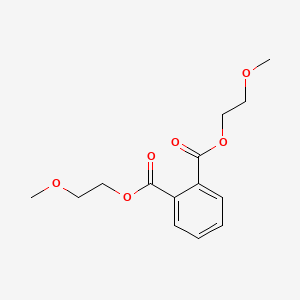
Verified chemistry for CAS 117-82-8
Dimethoxyethyl phthalate
bis(2-methoxyethyl) phthalate has been reported in Lonicera japonica with data available. — LOTUS - the natural products occurrence database
- IUPAC name
- bis(2-methoxyethyl) benzene-1,2-dicarboxylate
- Molecular formula
- C14H18O6
- Molecular weight
- 282.29 g/mol
- Exact mass
- 282.11033829 Da
- Monoisotopic mass
- 282.11033829 Da
- XLogP3
- 1.4
- Topological polar surface area
- 71.1 Ų
- Molecular complexity
- 274.0
- Formal charge
- 0
- Hydrogen-bond donors
- 0
- Hydrogen-bond acceptors
- 6
- Rotatable bonds
- 10
- Heavy atoms
- 20
- Covalent units
- 1
Names and synonyms reported to PubChem
16 more reported names
External database identifiers
- ChEMBL:CHEMBL1302251
- EPA DTXSID:DTXSID8025094
- PubMed:34214916
- PubMed:24503621
- PubMed:20684992
Advanced structure statistics
- Defined atom stereocentres
- 0
- Undefined atom stereocentres
- 0
- Defined bond stereocentres
- 0
- Undefined bond stereocentres
- 0
- 3D pharmacophore features
- 5
- 3D rings
- 1
- 3D hydrophobes
- 0
- 3D acceptor features
- 4
- 3D donor features
- 0
- 3D anionic centres
- 0
- 3D cationic centres
- 0
- 3D conformers
- 10
- Effective 3D rotors
- 10.0
Machine-readable structure identifiers
- SMILES
COCCOC(=O)C1=CC=CC=C1C(=O)OCCOC- InChI
InChI=1S/C14H18O6/c1-17-7-9-19-13(15)11-5-3-4-6-12(11)14(16)20-10-8-18-2/h3-6H,7-10H2,1-2H3- InChIKey
HSUIVCLOAAJSRE-UHFFFAOYSA-N
Evidence from additional scientific databases
NIH PubChem PUG-View
Attributed physical-property, hazard, environmental and use annotations.
- Autoignition Temperature: 750 °F (399 °C) Source: Hazardous Substances Data Bank (HSDB)
- Boiling Point: 340 °C Source: Hazardous Substances Data Bank (HSDB)
- Boiling Point: BP: 230 deg at 10 mm Hg Source: Hazardous Substances Data Bank (HSDB)
- Color/Form: Oily liquid Source: Hazardous Substances Data Bank (HSDB)
- Color/Form: PRACTICALLY COLORLESS, OILY LIQ Source: Hazardous Substances Data Bank (HSDB)
- Density: 1.1596 g/cu cm at 20 °C Source: Hazardous Substances Data Bank (HSDB)
- Flash Point: 410 °F (210 °C) (Open cup) Source: Hazardous Substances Data Bank (HSDB)
- Melting Point: Freezing point: -45 °C Source: Hazardous Substances Data Bank (HSDB)
- Odor: VERY SLIGHT Source: Hazardous Substances Data Bank (HSDB)
- Odor: Mild odor Source: Hazardous Substances Data Bank (HSDB)
- Physical Description: Nearly colorless liquid; [HSDB] Source: Haz-Map, Information on Hazardous Chemicals and Occupational Diseases
- Refractive Index: Index of Refraction = 1.502 at 20 °C/D Source: Hazardous Substances Data Bank (HSDB)
- Solubility: Phthalate esters are soluble to various extents in many common organic solvents and oils, but have a relatively low solubility in water. /Phthalate esters/ Source: Hazardous Substances Data Bank (HSDB)
- Solubility: SLIGHTLY SOL IN WATER (0.8%) @ 20 °C Source: Hazardous Substances Data Bank (HSDB)
- Solubility: MISCIBLE WITH ABSOLUTE ALC Source: Hazardous Substances Data Bank (HSDB)
- Solubility: INSOL IN MINERAL OILS Source: Hazardous Substances Data Bank (HSDB)
- Solubility: In water, 8500 mg/L, temperature not specified Source: Hazardous Substances Data Bank (HSDB)
- Vapor Pressure: 0.000228 [mmHg] Source: Haz-Map, Information on Hazardous Chemicals and Occupational Diseases
- Vapor Pressure: VP: 0.01 MM HG AT 20 °C Source: Hazardous Substances Data Bank (HSDB)
- Vapor Pressure: Vapor pressures for phthalate esters are extremely low, contributing much to their thermal stability in plastics. /Phthalate esters/ Source: Hazardous Substances Data Bank (HSDB)
- Viscosity: 32 cP Source: Hazardous Substances Data Bank (HSDB)
- Signal: Danger Source: Regulation (EC) No 1272/2008 of the European Parliament and of the Council
- GHS Hazard Statements: H360Df: May damage the unborn child; Suspected of damaging fertility [Danger Reproductive toxicity] Source: Regulation (EC) No 1272/2008 of the European Parliament and of the Council
- Precautionary Statement Codes: P203, P280, P318, P405, and P501 (click each P-code to see the statement) Source: Regulation (EC) No 1272/2008 of the European Parliament and of the Council
- Signal: Danger Source: European Chemicals Agency (ECHA)
- GHS Hazard Statements: H360 (100%): May damage fertility or the unborn child [Danger Reproductive toxicity] Source: European Chemicals Agency (ECHA)
- Precautionary Statement Codes: P203, P280, P318, P405, and P501 (click each P-code to see the statement) Source: European Chemicals Agency (ECHA)
- ECHA C&L Notifications Summary: Aggregated GHS information provided per 231 reports by companies from 5 notifications to the ECHA C&L Inventory.; Information may vary between notifications depending on impurities, additives, and other factors. The percentage value in parenthesis indicates the notified classification ratio from companies that provide hazard codes. Only hazard codes with percentage values above 10% are shown. For more detailed information, please visit ECHA C&L website. Source: European Chemicals Agency (ECHA)
- Signal: Danger Source: NITE-CMC
- GHS Hazard Statements: H360: May damage fertility or the unborn child [Danger Reproductive toxicity]; H371: May cause damage to organs [Warning Specific target organ toxicity, single exposure]; H373: May causes damage to organs through prolonged or repeated exposure [Warning Specific target organ toxicity, repeated exposure] Source: NITE-CMC
- Precautionary Statement Codes: P203, P260, P264, P270, P280, P308+P316, P318, P319, P405, and P501 (click each P-code to see the statement) Source: NITE-CMC
- Signal: Danger Source: Hazardous Chemical Information System (HCIS), Safe Work Australia
- GHS Hazard Statements: H360Df: May damage the unborn child; Suspected of damaging fertility [Danger Reproductive toxicity] Source: Hazardous Chemical Information System (HCIS), Safe Work Australia
- NFPA Health Rating: 0 - Materials that, under emergency conditions, would offer no hazard beyond that of ordinary combustible materials. Source: Hazardous Substances Data Bank (HSDB)
- NFPA Fire Rating: 1 - Materials that must be preheated before ignition can occur. Materials require considerable preheating, under all ambient temperature conditions, before ignition and combustion can occur. Source: Hazardous Substances Data Bank (HSDB)
- NFPA Instability Rating: 0 - Materials that in themselves are normally stable, even under fire conditions. Source: Hazardous Substances Data Bank (HSDB)
- Environmental Bioconcentration: An estimated BCF of 1.4 was calculated in fish for bis(2-methoxyethyl) phthalate(SRC), using an estimated log Kow of 1.11(1) and a regression-derived equation(2). According to a classification scheme(3), this BCF suggests the potential for bioconcentration in aquatic organisms is low(SRC). Source: Hazardous Substances Data Bank (HSDB)
- Environmental Fate: TERRESTRIAL FATE: Based on a classification scheme(1), an estimated Koc value of 38(SRC), determined from a water solubility of 8500 mg/L(2) and a regression-derived equation(3), indicates that bis(2-methoxyethyl) phthalate is expected to have very high mobility in soil(SRC). Volatilization of bis(2-methoxyethyl) phthalate from moist soil surfaces is not expected to be an important fate process(SRC) given an estimated Henry's Law constant of 2.8X10⁻¹³ atm-cu m/mole(SRC), using a fragment constant estimation method(4). Bis(2-methoxyethyl) phthalate is not expected to volatilize from dry soil surfaces(SRC) based upon an estimated vapor pressure of 2.3X10⁻⁴ mm Hg(SRC), determined from a fragment constant method(5). Bis(2-methoxyethyl) phthalate was biodegraded 19.3% using an enzyme extracted from N. erythropolis(6), suggesting that bis(2-methoxyethyl) phthalate is susceptible to biodegradation(SRC). Source: Hazardous Substances Data Bank (HSDB)
- Environmental Fate: AQUATIC FATE: Based on a classification scheme(1), an estimated Koc value of 38(SRC), determined from a water solubility of 8500 mg/L(2}and a regression-derived equation(3), indicates that bis(2-methoxyethyl) phthalate is not expected to adsorb to suspended solids and sediment(SRC). Volatilization from water surfaces is not expected(3) based upon an estimated Henry's Law constant of 2.8X10⁻¹³ atm-cu m/mole(SRC), developed using a fragment constant estimation method(4). According to a classification scheme(5), an estimated BCF of 1.4(SRC), from an estimated log Kow(6) and a regression-derived equation(7), suggests the potential for bioconcentration in aquatic organisms is low(SRC). Hydrolysis is not expected to be an important process(SRC) based on estimated hydrolysis half-lives of 1.3 years and 49 days at pHs 7 and 8, respectively(8). Bis(2-methoxyethyl) phthalate was biodegraded 19.3% using an enzyme extracted from Nocardia erythropolis(9), suggesting that bis(2-methoxyethyl) phthalate may be susceptible to biodegradation(SRC). Source: Hazardous Substances Data Bank (HSDB)
- Environmental Fate: ATMOSPHERIC FATE: According to a model of gas/particle partitioning of semivolatile organic compounds in the atmosphere(1), bis(2-methoxyethyl) phthalate, which has an estimated vapor pressure of 2.3X10⁻⁴ mm Hg at 25 °C(SRC), determined from a fragment constant method(2), is expected to exist solely as a vapor in the ambient atmosphere. Vapor-phase bis(2-methoxyethyl) phthalate is degraded in the atmosphere by reaction with photochemically-produced hydroxyl radicals(SRC); the half-life for this reaction in air is estimated to be 20 hours(SRC), calculated from its rate constant of 1.9X10⁻¹¹ cu cm/molecule-sec at 25 °C(SRC) that was derived using a structure estimation method(3). Bis(2-methoxyethyl) phthalate does contain chromophores that absorb at wavelengths >290 nm(4) and therefore may be susceptible to direct photolysis by sunlight(SRC). Source: Hazardous Substances Data Bank (HSDB)
- Sources/Uses: Used as a plasticizer (especially for cellulose acetate), a solvent, and in molding compositions, adhesives, laminating cements, and flash bulb lacquers; [HSDB] Source: Haz-Map, Information on Hazardous Chemicals and Occupational Diseases
- Industrial Processes with risk of exposure: Working with Glues and Adhesives [Category: Other] Source: Haz-Map, Information on Hazardous Chemicals and Occupational Diseases
- Uses: ... Plasticizer for cellulosic resins and some vinyl ester resins. Source: Hazardous Substances Data Bank (HSDB)
- Uses: Plasticizer, especially for cellulose acetate; solvent Source: Hazardous Substances Data Bank (HSDB)
- Uses: Molding compositions, adhesives, laminating cements, and flash bulb lacquers Source: Hazardous Substances Data Bank (HSDB)
Mapped by: Existing checksum-valid CAS to unique PubChem CID match. Retrieved: 2026-08-31. Open source record
Scientific classifications and hazard annotations provide context and do not replace the market-specific regulatory decision shown above.
Additional source coverage and match status
| Source | Result | Checked |
|---|---|---|
| NIH PubChem PUG-View | Exact match | 2026-08-31 |
A recorded no-match is useful evidence that the source was checked; it is not a claim that the substance does not exist elsewhere.
Retrieved from NIH PubChem on 2026-09-02 by checksum-valid CAS matching. Chemical properties do not replace the regulatory decision on this page.
Official source and provenance
- Registered source
- Brazil ANVISA consolidated prohibited substances — RDC 529/2021 through RDC 1.030/2026
- Source reference
- RDC 529/2021 consolidated annex, entry 678 (through RDC 1.030/2026)
- Source record ID
annex:678- Source version
- RDC 529/2021 consolidated through RDC 1.030/2026
- Source language
- Portuguese with official English identity where published
- Translation status
- Official English translation · English translation
- Effective date
- 2026-06-15
- Source updated
- 2026-06-15
- Snapshot checked
- 2026-08-31 15:26 UTC
- Validation method
- pdfplumber government baseline + 4 RDC 1.030 exclusions + 15 additions; 1,387 substantive rows
- SHA-256
a212e85540a186a842664fbdd4f351af0b1b4baeeb0c4765b9b52c6ce91c1e84
Registered dataset notes
- Dataset coverage
- All 1,387 substantive current prohibited rows after applying RDC 1.030/2026 additions, amendments and exclusions to RDC 529/2021
- Authority note
- Binding consolidated prohibited list for personal-hygiene products, cosmetics and perfumes
How this record fits the market dataset
Status distribution
Condition text is present on 1387 of 1387 current records. An empty condition field is interpreted according to the record type above; it is never converted into an unrestricted-use claim.
Brazil market context
Complete prohibited dataset plus current restricted-list workflow
Coverage version: ANVISA RDC 1.029/2026 and RDC 1.030/2026, published 15 June 2026
All 1,387 substantive current prohibited rows in RDC 529/2021 consolidated through RDC 1.030/2026, plus the current RDC 1.029 restricted-list and identity workflow.
Verification checklist
- Resolve Portuguese, INCI and CAS identity with the ANVISA crosswalk.
- Check the consolidated prohibited list including RDC 1.030/2026 changes.
- Apply RDC 1.029/2026 restrictions and the still-effective complementary rules.
- Verify Mercosur incorporation, regularisation, labelling and transition periods.
Official market sources
- Brazil ANVISA INCI translation panelIdentity and labelling crosswalk only; regulatory lists must be sourced separately
- Brazil ANVISA restricted substances — RDC 1.029/2026Binding ANVISA resolution effective on publication; replaced RDC 530/2021 for this list part
- Brazil ANVISA consolidated prohibited substances — RDC 529/2021 through RDC 1.030/2026Binding consolidated prohibited list for personal-hygiene products, cosmetics and perfumes
Verification workflow and record completeness
Before using this result in a compliance decision
- Confirm that “Ftalato de bis(2-metoxietila)” and every CAS/EC identifier refer to the material in your supplier specification.
- Resolve Portuguese, INCI and CAS identity with the ANVISA crosswalk.
- Check the consolidated prohibited list including RDC 1.030/2026 changes.
- Apply RDC 1.029/2026 restrictions and the still-effective complementary rules.
- Verify Mercosur incorporation, regularisation, labelling and transition periods.
- Document the source version and recheck the regulator before manufacture, notification or market placement.
Fields available in this record
- Official substance nameAvailable
- CASAvailable
- ECAvailable
- Separate condition textAvailable
- Effective dateAvailable
- Snapshot hash and methodAvailable
Questions this page answers
Stable citation
Ftalato de bis(2-metoxietila). RDC 529/2021 consolidated annex, entry 678 (through RDC 1.030/2026). Brazil. Source version RDC 529/2021 consolidated through RDC 1.030/2026. CosIng Checker regulatory record: https://cosingchecker.com/regulations/br/records/13878/
Cite the regulator as the legal authority. This page is a structured evidence index and verification aid, not a substitute for the official text or professional legal assessment.
Interpretation and limits for Brazil
This official record identifies the substance as prohibited for cosmetic use in the stated market scope.
Do not rely on a formulation containing this identity until the cited source, effective date and exact substance match have been verified.
How to interpret the legal role
The cited row forms part of a binding rule or legally incorporated list for this market.
Evidence on this page
- Recorded outcome: Prohibited
- Legal role: Binding rule
- Source version: RDC 529/2021 consolidated through RDC 1.030/2026
- Effective date: 2026-06-15
What it does not prove
RDC 1.030/2026 amends rather than replaces the prohibited baseline, and the second restricted-list revision was still under consultation in July 2026.
Further authoritative substance research
None of these sources overrides the market decision above.
Cosmetic Ingredient Review safety assessments
Expert Panel conclusions, assessed ingredient groups, use conditions, dates and report documents
Independent expert review considered by FDA; not a government approval or binding market rule
Research this identity at the sourceFDA Global Substance Registration System
UNII identifiers, preferred names, substance types, codes and public substance relationships
Identity registry only; UNII availability does not imply FDA review or approval
Research this identity at the sourceILO/WHO International Chemical Safety Cards
Hazards, symptoms, first aid, storage, incompatibilities and physical properties for covered chemicals
International occupational chemical-safety reference; not cosmetic-use approval
Research this identity at the sourceJapan NITE-CHRIP
Chemical identity, Japanese and foreign legal lists, GHS hazards and exposure-related information
Chemical-management evidence; cosmetic status remains governed by the applicable MHLW standard and market rules
Research this identity at the sourceNIOSH Pocket Guide to Chemical Hazards
REL, PEL, IDLH, properties, exposure routes, symptoms, target organs, first aid and measurement methods for covered workplace chemicals
US occupational-health guidance and limits; not a cosmetic ingredient decision
Research this identity at the sourceOECD eChemPortal
Gateway to authority-owned physical-property, fate, ecotoxicity, toxicity, exposure and GHS records
Discovery gateway; each linked authority remains responsible for its data
Research this identity at the sourceUS EPA CompTox CTX APIs
API key required for importDTXSID identity, experimental and predicted properties, toxicity, bioactivity, exposure and environmental data
Scientific and computational evidence; predictions must remain labelled and do not determine cosmetic legality
Research this identity at the source