
BARIUM CHLORIDE
BARIUM CHLORIDE is linked to 1 EU annex record on this page. Inventory note: II/46.
Regulatory evidence by market
This matrix separates verified ingredient rules from sources that are mapped but not yet imported. No imported rule does not mean the ingredient is permitted.
Swipe or scroll horizontally to see every column.
| Market | Evidence status | Records | Source language |
|---|---|---|---|
| European Union | Evidence linked Prohibited entry found Open this evidence | 1 | English and EU languages |
| Great Britain | Source mapped Official source mapped; ingredient rule not imported | 0 | English |
| Canada | Source mapped Official source mapped; ingredient rule not imported | 0 | English and French |
| New Zealand | Source mapped Official source mapped; ingredient rule not imported | 0 | English |
| ASEAN | Source mapped Official source mapped; ingredient rule not imported | 0 | English and national languages |
| China | Source mapped Official source mapped; ingredient rule not imported | 0 | Chinese with selected English material |
| Japan | Source mapped Official source mapped; ingredient rule not imported | 0 | Japanese; official English translation available |
| South Korea | Evidence linked Prohibited Open this evidence | 1 | Korean with some English names |
| United States | Source mapped Official source mapped; ingredient rule not imported | 0 | English |
| Australia | Source mapped Official source mapped; ingredient rule not imported | 0 | English |
| Brazil | Source mapped Official source mapped; ingredient rule not imported | 0 | Portuguese with INCI crosswalks |
| India | Source mapped Official source mapped; ingredient rule not imported | 0 | English and Hindi |
| Saudi Arabia | Source mapped Official source mapped; ingredient rule not imported | 0 | Arabic and English |
Chemical identity and properties
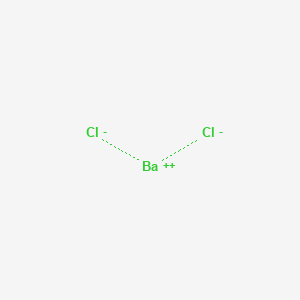
Barium chloride
Barium chloride appears as white crystals. A salt arising from the direct reaction of barium and chlorine. Toxic by ingestion. (NTP, 1992) — CAMEO Chemicals
- IUPAC name
- barium(2+) dichloride
- Molecular formula
- BaCl2
- Molecular weight
- 208.23 g/mol
- Exact mass
- 207.842952 Da
- Topological polar surface area
- 0.0 Ų
- Hydrogen-bond donors
- 0
- Hydrogen-bond acceptors
- 2
- Covalent units
- 3
- Defined stereocentres
- 0
Also known as
16 more reported names
Evidence from additional scientific databases
EMBL-EBI ChEBI
barium chloride
The inorganic dichloride salt of barium.
- Formula
- Ba.2Cl
- Average mass
- 208.234 g/mol
- Monoisotopic mass
- 207.84295 Da
- Formal charge
- 0
- inorganic chloride — is a (CHEBI:36093)
- barium salt — is a (CHEBI:63320)
- potassium channel blocker — has role (CHEBI:50509)
- NMR chemical shift reference compound — has role (CHEBI:228364)
- potassium channel blocker — has role (CHEBI:50509)
- NMR chemical shift reference compound — has role (CHEBI:228364)
- inorganic chloride — is a (CHEBI:36093)
- barium salt — is a (CHEBI:63320)
- 21601246 Source: PubMed
Additional curated names
Cross-references from this source
- CAS: 10361-37-2 — ChemIDplus
- CAS: 10361-37-2 — NIST Chemistry WebBook
- REGISTRY_NUMBER: 1209229 — Reaxys
- REGISTRY_NUMBER: 8128158 — Reaxys
- MANUAL_X_REF: Barium_chloride — Wikipedia
- MANUAL_X_REF: CPD0-1592 — MetaCyc
Mapped by: Exact CAS cross-reference in the ChEBI compound record. Source updated: 2024-06-06. Retrieved: 2026-08-31. Open source record
NIH PubChem PUG-View
Attributed physical-property, hazard, environmental and use annotations.
- Boiling Point: 2840 °F at 760 mmHg (NTP, 1992) Source: CAMEO Chemicals
- Boiling Point: 1560 °C Source: Hazardous Substances Data Bank (HSDB)
- Boiling Point: 1560 °C Source: ILO-WHO International Chemical Safety Cards (ICSCs)
- Boiling Point: 1560 °C @760 [mm Hg] Source: PAC Chemical Database, U.S. Department of Energy
- Boiling Point: 2840 °F Source: The National Institute for Occupational Safety and Health (NIOSH)
- Color/Form: White orthorhombic crystals Source: Hazardous Substances Data Bank (HSDB)
- Color/Form: White solid Source: Hazardous Substances Data Bank (HSDB)
- Density: 3.856 (NTP, 1992) - Denser than water; will sink Source: CAMEO Chemicals
- Density: 3.9 g/cu cm Source: Hazardous Substances Data Bank (HSDB)
- Density: 3.9 g/cm³ Source: ILO-WHO International Chemical Safety Cards (ICSCs)
- Density: 3.9 @25 °C Source: PAC Chemical Database, U.S. Department of Energy
- Density: 3.86 Source: The National Institute for Occupational Safety and Health (NIOSH)
- Melting Point: 1764 to 1765 °F transition to cubic crystals at 1697 °F (NTP, 1992) Source: CAMEO Chemicals
- Melting Point: 961 °C Source: Hazardous Substances Data Bank (HSDB)
- Melting Point: 960 °C Source: ILO-WHO International Chemical Safety Cards (ICSCs)
- Melting Point: 961 °C Source: PAC Chemical Database, U.S. Department of Energy
- Melting Point: 1765 °F Source: The National Institute for Occupational Safety and Health (NIOSH)
- Odor: Odorless Source: Hazardous Substances Data Bank (HSDB)
- Physical Description: Barium chloride appears as white crystals. A salt arising from the direct reaction of barium and chlorine. Toxic by ingestion. (NTP, 1992) Source: CAMEO Chemicals
- Physical Description: CBI; Dry Powder; Liquid Source: EPA Chemical Data Reporting (CDR)
- Physical Description: Colorless solid; [Hawley] White solid; [HSDB] White odorless solid; Soluble in water; [MSDSonline] Source: Haz-Map, Information on Hazardous Chemicals and Occupational Diseases
- Physical Description: ODOURLESS COLOURLESS CRYSTALS. Source: ILO-WHO International Chemical Safety Cards (ICSCs)
- Physical Description: White, odorless solid. Source: The National Institute for Occupational Safety and Health (NIOSH)
- Solubility: 38 % (NIOSH, 2024) Source: CAMEO Chemicals
- Solubility: 37.0 g/100 g water at 25 °C Source: Hazardous Substances Data Bank (HSDB)
- Solubility: Solubility in water as weight %: 24%, 0 °C; 26.3%, 20 °C; 28.9%, 40 °C; 31.7%, 60 °C; 34.4%, 80 °C, 26.2%, 100 °C Source: Hazardous Substances Data Bank (HSDB)
- Solubility: Practically insoluble in ethanol Source: Hazardous Substances Data Bank (HSDB)
- Solubility: Solubility in water, g/100ml: 36 Source: ILO-WHO International Chemical Safety Cards (ICSCs)
- Solubility: 38% Source: The National Institute for Occupational Safety and Health (NIOSH)
- Vapor Pressure: Low (NIOSH, 2024) Source: CAMEO Chemicals
- Vapor Pressure: Essentially zero Source: Hazardous Substances Data Bank (HSDB)
- Vapor Pressure: Low Source: The National Institute for Occupational Safety and Health (NIOSH)
- Carcinogen Classification: No indication of carcinogenicity to humans (not listed by IARC). Source: Toxin and Toxin Target Database (T3DB)
- Exposure Routes: The substance can be absorbed into the body by inhalation of its aerosol and by ingestion. Source: ILO-WHO International Chemical Safety Cards (ICSCs)
- Exposure Routes: inhalation, ingestion, skin and/or eye contact Source: The National Institute for Occupational Safety and Health (NIOSH)
- Exposure Routes: Oral (L214) ; inhalation (L214) Source: Toxin and Toxin Target Database (T3DB)
- First Aid: EYES: First check the victim for contact lenses and remove if present. Flush victim's eyes with water or normal saline solution for 20 to 30 minutes while simultaneously calling a hospital or poison control center. Do not put any ointments, oils, or medication in the victim's eyes without specific instructions from a physician. IMMEDIATELY transport the victim after flushing eyes to a hospital even if no symptoms (such as redness or irritation) develop.; SKIN: IMMEDIATELY flood affected skin with water while removing and isolating all contaminated clothing. Gently wash all affected skin areas thoroughly with soap and water. If symptoms such as redness or irritation develop, IMMEDIATELY call a physician and be prepared to transport the victim to a hospital for treatment.; INHALATION: IMMEDIATELY leave the contaminated area; take deep breaths of fresh air. IMMEDIATELY call a physician and be prepared to transport the victim to a hospital even if no symptoms (such as wheezing, coughing, shortness of breath, or burning in the mouth, throat, or chest) develop. Provide proper respiratory protection to rescuers entering an unknown atmosphere. Whenever possible, Self-Contained Breathing Ap Source: CAMEO Chemicals
- First Aid: (General first aid procedures); Eye: Irrigate immediately - If this chemical contacts the eyes, immediately wash (irrigate) the eyes with large amounts of water, occasionally lifting the lower and upper lids. Get medical attention immediately.; Skin: Water flush immediately - If this chemical contacts the skin, immediately flush the contaminated skin with water. If this chemical penetrates the clothing, immediately remove the clothing and flush the skin with water. Get medical attention promptly.; Breathing: Respiratory support; Swallow: Medical attention immediately - If this chemical has been swallowed, get medical attention immediately. Source: The National Institute for Occupational Safety and Health (NIOSH)
- Signal: Danger Source: Regulation (EC) No 1272/2008 of the European Parliament and of the Council
- GHS Hazard Statements: H301: Toxic if swallowed [Danger Acute toxicity, oral]; H332: Harmful if inhaled [Warning Acute toxicity, inhalation] Source: Regulation (EC) No 1272/2008 of the European Parliament and of the Council
- Precautionary Statement Codes: P261, P264, P270, P271, P301+P316, P304+P340, P317, P321, P330, P405, and P501 (click each P-code to see the statement) Source: Regulation (EC) No 1272/2008 of the European Parliament and of the Council
- Note: This chemical does not meet GHS hazard criteria for 0.3% (3 of 881) of reports. Source: European Chemicals Agency (ECHA)
- Signal: Danger Source: European Chemicals Agency (ECHA)
- GHS Hazard Statements: H301 (99.5%): Toxic if swallowed [Danger Acute toxicity, oral]; H319 (75%): Causes serious eye irritation [Warning Serious eye damage/eye irritation]; H332 (99.7%): Harmful if inhaled [Warning Acute toxicity, inhalation]; H413 (14.2%): May cause long lasting harmful effects to aquatic life [Hazardous to the aquatic environment, long-term hazard] Source: European Chemicals Agency (ECHA)
- Precautionary Statement Codes: P261, P264, P264+P265, P270, P271, P273, P280, P301+P316, P304+P340, P305+P351+P338, P317, P321, P330, P337+P317, P405, and P501 (click each P-code to see the statement) Source: European Chemicals Agency (ECHA)
- ECHA C&L Notifications Summary: Aggregated GHS information provided per 881 reports by companies from 11 notifications to the ECHA C&L Inventory. Each notification may be associated with multiple companies.; Reported as not meeting GHS hazard criteria per 3 of 881 reports by companies.; There are 10 notifications provided by 878 of 881 reports by companies with hazard statement code(s).; Information may vary between notifications depending on impurities, additives, and other factors. The percentage value in parenthesis indicates the notified classification ratio from companies that provide hazard codes. Only hazard codes with percentage values above 10% are shown. For more detailed information, please visit ECHA C&L website. Source: European Chemicals Agency (ECHA)
- Signal: Danger Source: NITE-CMC
- GHS Hazard Statements: H301: Toxic if swallowed [Danger Acute toxicity, oral]; H315: Causes skin irritation [Warning Skin corrosion/irritation]; H319: Causes serious eye irritation [Warning Serious eye damage/eye irritation]; H335: May cause respiratory irritation [Warning Specific target organ toxicity, single exposure; Respiratory tract irritation]; H370: Causes damage to organs [Danger Specific target organ toxicity, single exposure]; H372: Causes damage to organs through prolonged or repeated exposure [Danger Specific target organ toxicity, repeated exposure]; H402: Harmful to aquatic life [Hazardous to the aquatic environment, acute hazard]; H412: Harmful to aquatic life with long lasting effects [Hazardous to the aquatic environment, long-term hazard] Source: NITE-CMC
- Precautionary Statement Codes: P260, P261, P264, P264+P265, P270, P271, P273, P280, P301+P316, P302+P352, P304+P340, P305+P351+P338, P308+P316, P319, P321, P330, P332+P317, P337+P317, P362+P364, P403+P233, P405, and P501 (click each P-code to see the statement) Source: NITE-CMC
- GHS Hazard Statements: H301: Toxic if swallowed [Danger Acute toxicity, oral]; H315: Causes skin irritation [Warning Skin corrosion/irritation]; H335: May cause respiratory irritation [Warning Specific target organ toxicity, single exposure; Respiratory tract irritation]; H336: May cause drowsiness or dizziness [Warning Specific target organ toxicity, single exposure; Narcotic effects]; H370: Causes damage to organs [Danger Specific target organ toxicity, single exposure]; H371: May cause damage to organs [Warning Specific target organ toxicity, single exposure]; H372: Causes damage to organs through prolonged or repeated exposure [Danger Specific target organ toxicity, repeated exposure]; H373: May causes damage to organs through prolonged or repeated exposure [Warning Specific target organ toxicity, repeated exposure] Source: NITE-CMC
- Health Effects: The health effects of the different barium compounds depend on how well the compound dissolves in water or the stomach contents. At low doses, barium acts as a muscle stimulant, while higher doses affect the nervous system, causing cardiac irregularities, tremors, weakness, anxiety, dyspnea, paralysisand possibly death. Barium may also cause gastrointestinal disturbances, damage the kidneys and cause decreases in body weight. (L214) Source: Toxin and Toxin Target Database (T3DB)
- Target Organs: Eyes, skin, respiratory system, heart, central nervous system Source: The National Institute for Occupational Safety and Health (NIOSH)
- Toxicity Summary: Barium is a competitive potassium channel antagonist that blocks the passive efflux of intracellular potassium, resulting in a shift of potassium from extracellular to intracellular compartments. The intracellular translocation of potassium results in a decreased resting membrane potential, making the muscle fibers electrically unexcitable and causing paralysis. Some of these barium's effects may also be due to barium induced neuromuscular blockade and membrane depolarization. (L214) Source: Toxin and Toxin Target Database (T3DB)
- Industry Uses: Not Known or Reasonably Ascertainable; Flux agent; Intermediate Source: EPA Chemical Data Reporting (CDR)
- Sources/Uses: Used to manufacture pigments, color lakes, glass, and mordant for acid dyes; for weighting and dyeing textile fabrics; in aluminum refining; as pesticide; as boiler compound for softening water; for tanning and finishing leather; in treating wool for stuffing mattresses; in lubrication oil additives; as an intermediate for barium salts; as intermediate for steel hardening compounds; in the production of magnesium metal; in chemical analysis; as 5% constituent of material (ternary eutectic salt) effective in extinguishing fires of uranium and plutonium; [HSDB] Source: Haz-Map, Information on Hazardous Chemicals and Occupational Diseases
- Industrial Processes with risk of exposure: Aluminum Producing [Category: Industry]; Steel Producing [Category: Industry]; Metal Preparation and Pouring [Category: Foundry]; Textiles (Fiber & Fabric Manufacturing) [Category: Industry]; Leather Tanning and Processing [Category: Industry]; Glass Manufacturing [Category: Industry] Source: Haz-Map, Information on Hazardous Chemicals and Occupational Diseases
- Uses: Manufacture pigments, color lakes, glass, mordant for acid dyes; weighting and dyeing textile fabrics; in aluminum refining; as pesticide; boiler cmpd for softening water; tanning and finishing leather. Source: Hazardous Substances Data Bank (HSDB)
- Uses: Used in treating wool for stuffing mattresses. Source: Hazardous Substances Data Bank (HSDB)
- Uses: Chemicals (artificial barium sulfate, other barium salts); reagents, lubrication oil additives; boiler compounds, textile dying, pigments, manufacture of white leather. /Barium chloride dihydrate/ Source: Hazardous Substances Data Bank (HSDB)
- Uses: For chlorine and sodium hydroxide manufacture, as flux for magnesium alloys. /Barium chloride, dihydrate/ Source: Hazardous Substances Data Bank (HSDB)
- Uses: For more Uses (Complete) data for Barium chloride (7 total), please visit the HSDB record page. Source: Hazardous Substances Data Bank (HSDB)
- Uses: Barium chloride is used in the laboratory as a test for sulfate ion. In industry, barium chloride is mainly used in the purification of brine solution in caustic chlorine plants and also in the manufacture of heat treatment salts, case hardening of steel, in the manufacture of pigments, and in the manufacture of other barium salts. It is also used in fireworks to give a bright green color. (L204) Source: Toxin and Toxin Target Database (T3DB)
Mapped by: Existing checksum-valid CAS to unique PubChem CID match. Retrieved: 2026-08-31. Open source record
Scientific classifications and hazard annotations provide context and do not replace the market-specific regulatory decision shown above.
Additional source coverage and match status
| Source | Result | Checked |
|---|---|---|
| EMBL-EBI ChEBI | Exact match | 2026-08-31 |
| NIH PubChem PUG-View | Exact match | 2026-08-31 |
A recorded no-match is useful evidence that the source was checked; it is not a claim that the substance does not exist elsewhere.
Retrieved from NIH PubChem on 2026-09-02 by checksum-valid CAS matching. Chemical properties do not replace the regulatory decision on this page.
Inventory details for BARIUM CHLORIDE
INCI name
BARIUM CHLORIDE
Record provenance
- Inventory reference
- 85025
- Imported identity
- BARIUM CHLORIDE
- Source update
- 15/10/2010
Annex records for BARIUM CHLORIDE
Barium salts, with the exception of barium sulphide under the conditions laid down in Annex III and…
Key data
Official EU ingredient-name evidence
The ingredient name exactly matches the official 2025 EU glossary of common ingredient names.
Related inventory evidence
Ingredients with overlapping formulation functions
Additional official and scientific sources
11 external databases to check this identity in
Each link searches that source for this identity. What each source is, and its legal weight
How BARIUM CHLORIDE appears in the CosIng inventory
The CosIng inventory lists BARIUM CHLORIDE as a cosmetic ingredient and this page links it to 1 annex record. The inventory entry captures names and identifiers, while the annex record shows where the substance is prohibited, restricted or positively listed in EU cosmetics law.
BARIUM CHLORIDE is also tagged with 1 cosmetic function in the official data. Function labels describe intended use, but they do not replace regulatory review of linked annex records before formulation or labelling work.
Frequently asked questions
Source note for BARIUM CHLORIDE
This page combines the CosIng inventory entry for BARIUM CHLORIDE with 1 linked Annex II–VI record from the local dataset built from public European Commission cosmetic ingredient materials.
Use this inventory page to research BARIUM CHLORIDE and compare linked records, but verify restrictions and legal status against the current official source text and law before making regulatory decisions.
Tools & next steps
Check your formula
Scan a full INCI list to detect BARIUM CHLORIDE and any linked EU annex restrictions or allergen flags.
INCI CheckerSearch similar ingredients
Find other inventory ingredients and annex entries related to BARIUM CHLORIDE, its identifiers or nearby name variants.
Search