
BASIC VIOLET 10
BASIC VIOLET 10 is linked to 1 EU annex record on this page. Inventory note: II/398.
Regulatory evidence by market
This matrix separates verified ingredient rules from sources that are mapped but not yet imported. No imported rule does not mean the ingredient is permitted.
Swipe or scroll horizontally to see every column.
| Market | Evidence status | Records | Source language |
|---|---|---|---|
| European Union | Evidence linked Prohibited entry found Open this evidence | 1 | English and EU languages |
| Great Britain | Evidence linked Prohibited Open this evidence | 1 | English |
| Canada | Evidence linked Prohibited Open this evidence | 1 | English and French |
| New Zealand | Evidence linked Prohibited Open this evidence | 1 | English |
| ASEAN | Evidence linked Prohibited Open this evidence | 1 | English and national languages |
| China | Evidence linked Prohibited Open this evidence | 1 | Chinese with selected English material |
| Japan | Source mapped Official source mapped; ingredient rule not imported | 0 | Japanese; official English translation available |
| South Korea | Evidence linked Prohibited Open this evidence | 1 | Korean with some English names |
| United States | Source mapped Official source mapped; ingredient rule not imported | 0 | English |
| Australia | Source mapped Official source mapped; ingredient rule not imported | 0 | English |
| Brazil | Evidence linked Prohibited Open this evidence | 1 | Portuguese with INCI crosswalks |
| India | Evidence linked Prohibited Open this evidence | 1 | English and Hindi |
| Saudi Arabia | Evidence linked Prohibited Open this evidence | 1 | Arabic and English |
Chemical identity and properties
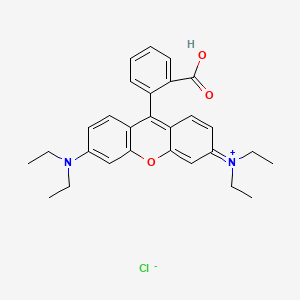
Rhodamine B
Rhodamine B is an organic chloride salt having N-[9-(2-carboxyphenyl)-6-(diethylamino)-3H-xanthen-3-ylidene]-N-ethylethanaminium as the counterion. An amphoteric dye commonly used as a fluorochrome. It has a role as a fluorescent probe, a fluorochrome and a histological dye. It is an organic chloride salt and a xanthene dye. It contains a rhodamine B(1+). — ChEBI
- IUPAC name
- [9-(2-carboxyphenyl)-6-(diethylamino)xanthen-3-ylidene]-diethylazanium chloride
- Molecular formula
- C28H31ClN2O3
- Molecular weight
- 479.0 g/mol
- Exact mass
- 478.2023205 Da
- Topological polar surface area
- 52.8 Ų
- Hydrogen-bond donors
- 1
- Hydrogen-bond acceptors
- 5
- Covalent units
- 2
- Defined stereocentres
- 0
Also known as
16 more reported names
External database identifiers
- ChEBI:CHEBI:52334
- ChEMBL:CHEMBL428971
- EPA DTXSID:DTXSID6042369
Retrieved from NIH PubChem on 2026-08-31 by checksum-valid CAS matching. Chemical properties do not replace the regulatory decision on this page.
Inventory details for BASIC VIOLET 10
INCI name
BASIC VIOLET 10
Record provenance
- Inventory reference
- 84501
- Imported identity
- BASIC VIOLET 10
- Source update
- 09/07/2015
Annex records for BASIC VIOLET 10
Colouring agent CI 45170, Colouring agent CI 45170:1 (Basic Violet 10)
Key data
- COLORANT
- Exclusively or mainly intended to colour the cosmetic product, the body as a whole or certain parts thereof, by absorption or reflection of visible light. All authorised colorants are substances in the positive list of Annex IV to the Cosmetics Regulation 1223/2009.
Official EU ingredient-name evidence
The ingredient name exactly matches the official 2025 EU glossary of common ingredient names.
Related inventory evidence
Ingredients with overlapping formulation functions
Additional official and scientific sources
11 external databases to check this identity in
Each link searches that source for this identity. What each source is, and its legal weight
How BASIC VIOLET 10 appears in the CosIng inventory
The CosIng inventory lists BASIC VIOLET 10 as a cosmetic ingredient and this page links it to 1 annex record. The inventory entry captures names and identifiers, while the annex record shows where the substance is prohibited, restricted or positively listed in EU cosmetics law.
BASIC VIOLET 10 is also tagged with 1 cosmetic function in the official data. Function labels describe intended use, but they do not replace regulatory review of linked annex records before formulation or labelling work.
Frequently asked questions
Source note for BASIC VIOLET 10
This page combines the CosIng inventory entry for BASIC VIOLET 10 with 1 linked Annex II–VI record from the local dataset built from public European Commission cosmetic ingredient materials.
Use this inventory page to research BASIC VIOLET 10 and compare linked records, but verify restrictions and legal status against the current official source text and law before making regulatory decisions.
Tools & next steps
Check your formula
Scan a full INCI list to detect BASIC VIOLET 10 and any linked EU annex restrictions or allergen flags.
INCI CheckerSearch similar ingredients
Find other inventory ingredients and annex entries related to BASIC VIOLET 10, its identifiers or nearby name variants.
Search