
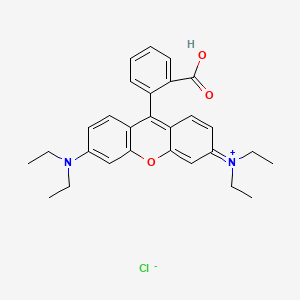
CAS 81-88-9PubChem CID 6694
Rhodamine B
Rhodamine B is an organic chloride salt having N-[9-(2-carboxyphenyl)-6-(diethylamino)-3H-xanthen-3-ylidene]-N-ethylethanaminium as the counterion. An amphoteric dye commonly used as a fluorochrome. It has a role as a fluorescent probe, a fluorochrome and a histological dye. It is an organic chloride salt and a xanthene dye. It contains a rhodamine B(1+). — ChEBI
- IUPAC name
- [9-(2-carboxyphenyl)-6-(diethylamino)xanthen-3-ylidene]-diethylazanium chloride
- Molecular formula
- C28H31ClN2O3
- Molecular weight
- 479.0 g/mol
- Exact mass
- 478.2023205 Da
- Topological polar surface area
- 52.8 Ų
- Hydrogen-bond donors
- 1
- Hydrogen-bond acceptors
- 5
- Covalent units
- 2
- Defined stereocentres
- 0
Also known as
Basic Violet 10Brilliant Pink BTetraethylrhodamineRhodamine B chlorideCalcozine Red BXSymulex Magenta FRhodamineRhodamine O
16 more reported names
Rheonine BRhodamine FBGeranium lake NRhodamine BARhodamine BFRhodamine BLRhodamine BNRhodamine BSRhodamine BXRhodamine BXLRhodamine BXPBasic Rose RedRhodamine Lake Red BSymulex Pink FADC Rhodamine BEdicol Suppa Rose BS
External database identifiers
- ChEBI:CHEBI:52334
- ChEMBL:CHEMBL428971
- EPA DTXSID:DTXSID6042369
Retrieved from NIH PubChem on 2026-08-31 by checksum-valid CAS matching. Chemical properties do not replace the regulatory decision on this page.