
PHENYL MERCURIC CHLORIDE
Chlorophenylmercury
PHENYL MERCURIC CHLORIDE is linked to 1 EU annex record on this page. Inventory note: V/17.
Regulatory evidence by market
This matrix separates verified ingredient rules from sources that are mapped but not yet imported. No imported rule does not mean the ingredient is permitted.
Swipe or scroll horizontally to see every column.
| Market | Evidence status | Records | Source language |
|---|---|---|---|
| European Union | Evidence linked Positive-list entry with conditions Open this evidence | 1 | English and EU languages |
| Great Britain | Source mapped Official source mapped; ingredient rule not imported | 0 | English |
| Canada | Source mapped Official source mapped; ingredient rule not imported | 0 | English and French |
| New Zealand | Source mapped Official source mapped; ingredient rule not imported | 0 | English |
| ASEAN | Source mapped Official source mapped; ingredient rule not imported | 0 | English and national languages |
| China | Source mapped Official source mapped; ingredient rule not imported | 0 | Chinese with selected English material |
| Japan | Source mapped Official source mapped; ingredient rule not imported | 0 | Japanese; official English translation available |
| South Korea | Source mapped Official source mapped; ingredient rule not imported | 0 | Korean with some English names |
| United States | Source mapped Official source mapped; ingredient rule not imported | 0 | English |
| Australia | Source mapped Official source mapped; ingredient rule not imported | 0 | English |
| Brazil | Source mapped Official source mapped; ingredient rule not imported | 0 | Portuguese with INCI crosswalks |
| India | Source mapped Official source mapped; ingredient rule not imported | 0 | English and Hindi |
| Saudi Arabia | Source mapped Official source mapped; ingredient rule not imported | 0 | Arabic and English |
Chemical identity and properties
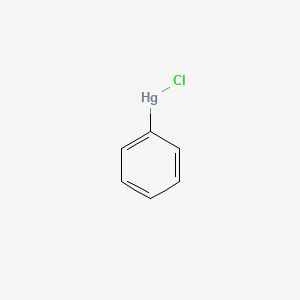
Phenylmercuric Chloride
Phenylmercuric chloride is an organomercuric compound. Mercury is a heavy, silvery d-block metal and one of six elements that are liquid at or near room temperature and pressure. It is a naturally occuring substance, and combines with other elements such as chlorine, sulfur, or oxygen to form inorganic mercury compounds (salts). Mercury also combines with carbon to make organic mercury compounds. (L1) — Toxin and Toxin Target Database (T3DB)
- IUPAC name
- chloro(phenyl)mercury
- Molecular formula
- C6H5ClHg
- Molecular weight
- 313.15 g/mol
- Exact mass
- 313.978621 Da
- Topological polar surface area
- 0.0 Ų
- Hydrogen-bond donors
- 0
- Hydrogen-bond acceptors
- 0
- Covalent units
- 1
- Defined stereocentres
- 0
Also known as
16 more reported names
External database identifiers
- EPA DTXSID:DTXSID4042129
- PubMed:17489621
- PubMed:13717574
- PubMed:9144456
Evidence from additional scientific databases
NIH PubChem PUG-View
Attributed physical-property, hazard, environmental and use annotations.
- Color/Form: White satiny leaflets Source: Hazardous Substances Data Bank (HSDB)
- LogP: log Kow= 1.78 Source: Hazardous Substances Data Bank (HSDB)
- Melting Point: 250-252 °C Source: Hazardous Substances Data Bank (HSDB)
- Physical Description: White solid; [Merck Index] White powder; [MSDSonline] Source: Haz-Map, Information on Hazardous Chemicals and Occupational Diseases
- Solubility: Sol in about 20,000 parts cold water; slightly sol in hot alcohol; sol in benzene, ether, pyridine Source: Hazardous Substances Data Bank (HSDB)
- Vapor Pressure: 0.02 [mmHg] Source: Haz-Map, Information on Hazardous Chemicals and Occupational Diseases
- Carcinogen Classification: No indication of carcinogenicity (not listed by IARC). (L135) Source: Toxin and Toxin Target Database (T3DB)
- Exposure Routes: Oral (L7) ; inhalation (L7) ; dermal (L7) Source: Toxin and Toxin Target Database (T3DB)
- Signal: Danger Source: European Chemicals Agency (ECHA)
- GHS Hazard Statements: H300+H310+H330 (22.2%): Fatal if swallowed, in contact with skin or if inhaled [Danger Acute toxicity, oral; acute toxicity, dermal; acute toxicity, inhalation]; H300 (100%): Fatal if swallowed [Danger Acute toxicity, oral]; H310 (100%): Fatal in contact with skin [Danger Acute toxicity, dermal]; H330 (100%): Fatal if inhaled [Danger Acute toxicity, inhalation]; H373 (100%): May causes damage to organs through prolonged or repeated exposure [Warning Specific target organ toxicity, repeated exposure]; H400 (100%): Very toxic to aquatic life [Warning Hazardous to the aquatic environment, acute hazard]; H410 (100%): Very toxic to aquatic life with long lasting effects [Warning Hazardous to the aquatic environment, long-term hazard] Source: European Chemicals Agency (ECHA)
- Precautionary Statement Codes: P260, P262, P264, P270, P271, P273, P280, P284, P301+P316, P302+P352, P304+P340, P316, P319, P320, P321, P330, P361+P364, P391, P403+P233, P405, and P501 (click each P-code to see the statement) Source: European Chemicals Agency (ECHA)
- ECHA C&L Notifications Summary: Aggregated GHS information provided per 9 reports by companies from 4 notifications to the ECHA C&L Inventory. Each notification may be associated with multiple companies.; Information may vary between notifications depending on impurities, additives, and other factors. The percentage value in parenthesis indicates the notified classification ratio from companies that provide hazard codes. Only hazard codes with percentage values above 10% are shown. For more detailed information, please visit ECHA C&L website. Source: European Chemicals Agency (ECHA)
- Health Effects: Mercury mainly affects the nervous system. Exposure to high levels of metallic, inorganic, or organic mercury can permanently damage the brain, kidneys, and developing fetus. Effects on brain functioning may result in irritability, shyness, tremors, changes in vision or hearing, and memory problems. Acrodynia, a type of mercury poisoning in children, is characterized by pain and pink discoloration of the hands and feet. Mercury poisoning can also cause Hunter-Russell syndrome and Minamata disease. (L7) Source: Toxin and Toxin Target Database (T3DB)
- Toxicity Summary: High-affinity binding of the divalent mercuric ion to thiol or sulfhydryl groups of proteins is believed to be the major mechanism for the activity of mercury. Through alterations in intracellular thiol status, mercury can promote oxidative stress, lipid peroxidation, mitochondrial dysfunction, and changes in heme metabolism. Mercury is known to bind to microsomal and mitochondrial enzymes, resulting in cell injury and death. For example, mercury is known to inhibit aquaporins, halting water flow across the cell membrane. It also inhibits the protein LCK, which causes decreased T-cell signalling and immune system depression. Mercury is also believed to inhibit neuronal excitability by acting on the postsynaptic neuronal membrane. It also affects the nervous system by inhibiting protein kinase C and alkaline phosphatase, which impairs brain microvascular formation and function, as well as alters the blood-brain barrier. Organic mercury exerts developmental effects by binding to tubulin, preventing microtubule assembly and causing mitotic inhibition. Mercury also produces an autoimmune response, likely by modification of major histocompatibility complex (MHC) class II molecules, self Source: Toxin and Toxin Target Database (T3DB)
- Sources/Uses: Used formerly as antimycotic, antisyphilitic, diuretic, agricultural fungicide, antiseptic, and germicide; Not currently registered with the EPA for use in the US; [HSDB] Source: Haz-Map, Information on Hazardous Chemicals and Occupational Diseases
- Restricted Notes: Use in paints as a biocide was discontinued in 1991 in the US; [HSDB] Source: Haz-Map, Information on Hazardous Chemicals and Occupational Diseases
- Industrial Processes with risk of exposure: Using Disinfectants or Biocides [Category: Clean]; Farming (Pesticides) [Category: Industry] Source: Haz-Map, Information on Hazardous Chemicals and Occupational Diseases
- Uses: For Phenylmercuric Chloride (USEPA/OPP PC Code: 066007) there are 0 labels match. /SRP: Not registered for current use in the U.S./ Source: Hazardous Substances Data Bank (HSDB)
- Uses: Antimycotic /Former use/ Source: Hazardous Substances Data Bank (HSDB)
- Uses: Used as antisyphilitic and diuretic ... use for this purpose has been restricted or stopped because of ... numerous side effects and toxicity /Former use/ Source: Hazardous Substances Data Bank (HSDB)
- Uses: Agricultural fungicide /Former use/ Source: Hazardous Substances Data Bank (HSDB)
- Uses: For more Uses (Complete) data for PHENYLMERCURIC CHLORIDE (7 total), please visit the HSDB record page. Source: Hazardous Substances Data Bank (HSDB)
Mapped by: Existing checksum-valid CAS to unique PubChem CID match. Retrieved: 2026-08-31. Open source record
Scientific classifications and hazard annotations provide context and do not replace the market-specific regulatory decision shown above.
Additional source coverage and match status
| Source | Result | Checked |
|---|---|---|
| EMBL-EBI ChEBI | No exact record | 2026-08-31 |
| NIH PubChem PUG-View | Exact match | 2026-08-31 |
A recorded no-match is useful evidence that the source was checked; it is not a claim that the substance does not exist elsewhere.
Retrieved from NIH PubChem on 2026-08-31 by checksum-valid CAS matching. Chemical properties do not replace the regulatory decision on this page.
Inventory details for PHENYL MERCURIC CHLORIDE
INCI name
PHENYL MERCURIC CHLORIDE
Description
Chlorophenylmercury
Record provenance
- Inventory reference
- 59213
- Imported identity
- PHENYL MERCURIC CHLORIDE
- Source update
- 16/10/2010
Annex records for PHENYL MERCURIC CHLORIDE
PHENYL MERCURIC ACETATE / PHENYL MERCURIC BENZOATE
Key data
- PRESERVATIVE
- Exclusively or mainly intended to inhibit the development of micro-organisms in the cosmetic product. All authorised preservatives are substances in the positive list of Annex V to the Cosmetics Regulation 1223/2009.
Official EU ingredient-name evidence
The ingredient name exactly matches the official 2025 EU glossary of common ingredient names.
Related inventory evidence
Ingredients with overlapping formulation functions
Additional official and scientific sources
11 external databases to check this identity in
Each link searches that source for this identity. What each source is, and its legal weight
How PHENYL MERCURIC CHLORIDE appears in the CosIng inventory
The CosIng inventory lists PHENYL MERCURIC CHLORIDE as a cosmetic ingredient and this page links it to 1 annex record. The inventory entry captures names and identifiers, while the annex record shows where the substance is prohibited, restricted or positively listed in EU cosmetics law.
PHENYL MERCURIC CHLORIDE is also tagged with 1 cosmetic function in the official data. Function labels describe intended use, but they do not replace regulatory review of linked annex records before formulation or labelling work.
Frequently asked questions
Source note for PHENYL MERCURIC CHLORIDE
This page combines the CosIng inventory entry for PHENYL MERCURIC CHLORIDE with 1 linked Annex II–VI record from the local dataset built from public European Commission cosmetic ingredient materials.
Use this inventory page to research PHENYL MERCURIC CHLORIDE and compare linked records, but verify restrictions and legal status against the current official source text and law before making regulatory decisions.
Tools & next steps
Check your formula
Scan a full INCI list to detect PHENYL MERCURIC CHLORIDE and any linked EU annex restrictions or allergen flags.
INCI CheckerSearch similar ingredients
Find other inventory ingredients and annex entries related to PHENYL MERCURIC CHLORIDE, its identifiers or nearby name variants.
Search