
P-CRESOL
Phenol, 4-methyl-
P-CRESOL is listed in the EU CosIng inventory, but no direct annex records are linked on this page yet.
Regulatory evidence by market
This matrix separates verified ingredient rules from sources that are mapped but not yet imported. No imported rule does not mean the ingredient is permitted.
Swipe or scroll horizontally to see every column.
| Market | Evidence status | Records | Source language |
|---|---|---|---|
| European Union | Source mapped Inventory entry; no linked annex rule | 0 | English and EU languages |
| Great Britain | Source mapped Official source mapped; ingredient rule not imported | 0 | English |
| Canada | Evidence linked Prohibited Open this evidence | 1 | English and French |
| New Zealand | Source mapped Official source mapped; ingredient rule not imported | 0 | English |
| ASEAN | Source mapped Official source mapped; ingredient rule not imported | 0 | English and national languages |
| China | Source mapped Official source mapped; ingredient rule not imported | 0 | Chinese with selected English material |
| Japan | Source mapped Official source mapped; ingredient rule not imported | 0 | Japanese; official English translation available |
| South Korea | Source mapped Official source mapped; ingredient rule not imported | 0 | Korean with some English names |
| United States | Source mapped Official source mapped; ingredient rule not imported | 0 | English |
| Australia | Source mapped Official source mapped; ingredient rule not imported | 0 | English |
| Brazil | Source mapped Official source mapped; ingredient rule not imported | 0 | Portuguese with INCI crosswalks |
| India | Source mapped Official source mapped; ingredient rule not imported | 0 | English and Hindi |
| Saudi Arabia | Source mapped Official source mapped; ingredient rule not imported | 0 | Arabic and English |
Chemical identity and properties
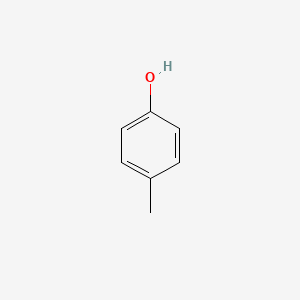
P-Cresol
P-cresol is a cresol that consists of toluene substituted by a hydroxy group at position 4. It is a metabolite of aromatic amino acid metabolism produced by intestinal microflora in humans and animals. It has a role as a uremic toxin, an Escherichia coli metabolite and a human metabolite. — ChEBI
- IUPAC name
- 4-methylphenol
- Molecular formula
- C7H8O
- Molecular weight
- 108.14 g/mol
- Exact mass
- 108.057514874 Da
- XLogP3
- 1.9
- Topological polar surface area
- 20.2 Ų
- Hydrogen-bond donors
- 1
- Hydrogen-bond acceptors
- 1
- Covalent units
- 1
- Defined stereocentres
- 0
Also known as
16 more reported names
External database identifiers
- ChEBI:CHEBI:17847
- ChEMBL:CHEMBL16645
- EPA DTXSID:DTXSID7021869
- PubMed:32757783
- PubMed:32421801
- PubMed:32105654
- PubMed:31742356
- PubMed:30910523
- PubMed:29214717
- PubMed:25668154
- PubMed:24387763
- PubMed:23466501
- PubMed:23125805
- PubMed:23122098
- PubMed:23094894
Evidence from additional scientific databases
EMBL-EBI ChEBI
p-cresol
A cresol that consists of toluene substituted by a hydroxy group at position 4. It is a metabolite of aromatic amino acid metabolism produced by intestinal microflora in humans and animals.
- Formula
- C7H8O
- Average mass
- 108.140 g/mol
- Monoisotopic mass
- 108.05751 Da
- Formal charge
- 0
- cresol — is a (CHEBI:25399)
- uremic toxin — has role (CHEBI:64584)
- human metabolite — has role (CHEBI:77746)
- Escherichia coli metabolite — has role (CHEBI:76971)
- uremic toxin — has role (CHEBI:64584)
- human metabolite — has role (CHEBI:77746)
- Escherichia coli metabolite — has role (CHEBI:76971)
- cresol — is a (CHEBI:25399)
Additional curated names
Cross-references from this source
- CAS: 106-44-5 — ChemIDplus
- CAS: 106-44-5 — KEGG COMPOUND
- CAS: 106-44-5 — NIST Chemistry WebBook
- REGISTRY_NUMBER: 1305151 — Reaxys
- REGISTRY_NUMBER: 2779 — Gmelin
- MANUAL_X_REF: C00002645 — KNApSAcK
- MANUAL_X_REF: c0127 — UM-BBD
- MANUAL_X_REF: C01468 — KEGG COMPOUND
- MANUAL_X_REF: CPD-108 — MetaCyc
- MANUAL_X_REF: DB01688 — DrugBank
- MANUAL_X_REF: HMDB0001858 — HMDB
- MANUAL_X_REF: PCR — PDBeChem
- MANUAL_X_REF: P-cresol — Wikipedia
Mapped by: Exact CAS cross-reference in the ChEBI compound record. Source updated: 2016-10-07. Retrieved: 2026-08-31. Open source record
NIH PubChem PUG-View
Attributed physical-property, hazard, environmental and use annotations.
- Autoignition Temperature: 1038 °F (USCG, 1999) Source: CAMEO Chemicals
- Autoignition Temperature: 1038 °F (558 °C) Source: Hazardous Substances Data Bank (HSDB)
- Autoignition Temperature: 555 °C Source: ILO-WHO International Chemical Safety Cards (ICSCs)
- Boiling Point: 395.2 °F at 760 mmHg (NTP, 1992) Source: CAMEO Chemicals
- Boiling Point: 201.9 °C Source: DrugBank
- Boiling Point: 201.9 °C Source: Hazardous Substances Data Bank (HSDB)
- Boiling Point: 201.80 to 202.00 °C. @ 760.00 mm Hg Source: Human Metabolome Database (HMDB)
- Boiling Point: 202 °C Source: ILO-WHO International Chemical Safety Cards (ICSCs)
- Boiling Point: 201-202 °C Source: Joint FAO/WHO Expert Committee on Food Additives (JECFA)
- Boiling Point: 396 °F Source: The National Institute for Occupational Safety and Health (NIOSH)
- Color/Form: Crystalline solid [Note: A liquid above 95 degees F] Source: Hazardous Substances Data Bank (HSDB)
- Density: 1.034 at 68 °F (USCG, 1999) - Denser than water; will sink Source: CAMEO Chemicals
- Density: 1.0185 at 40 °C/4 °C Source: Hazardous Substances Data Bank (HSDB)
- Density: Percent in saturated air at 25 °C: 0.0142; density of saturated air at 25 °C: 1.00039 (Air= 1) Source: Hazardous Substances Data Bank (HSDB)
- Density: 1.02 g/cm³ Source: ILO-WHO International Chemical Safety Cards (ICSCs)
- Density: 1.04 Source: The National Institute for Occupational Safety and Health (NIOSH)
- pKa: 10.3 (at 25 °C) Source: DrugBank
- Dissociation Constants: pKa = 10.26 Source: Hazardous Substances Data Bank (HSDB)
- Flash Point: 187 °F (NTP, 1992) Source: CAMEO Chemicals
- Flash Point: 85 °C (185 °F) - closed cup Source: Hazardous Substances Data Bank (HSDB)
- Flash Point: 187 °F (86 °C) (Closed cup) Source: Hazardous Substances Data Bank (HSDB)
- Flash Point: 86 °C c.c. Source: ILO-WHO International Chemical Safety Cards (ICSCs)
- Flash Point: 187 °F Source: The National Institute for Occupational Safety and Health (NIOSH)
- LogP: 1.94 Source: DrugBank
- LogP: log Kow = 1.94 Source: Hazardous Substances Data Bank (HSDB)
- LogP: 1.94 Source: Human Metabolome Database (HMDB)
- LogP: 1.94 Source: ILO-WHO International Chemical Safety Cards (ICSCs)
- Melting Point: 94.6 °F (NTP, 1992) Source: CAMEO Chemicals
- Melting Point: 35.5 °C Source: DrugBank
- Melting Point: 34.77 °C Source: Hazardous Substances Data Bank (HSDB)
- Melting Point: 35.5 °C Source: Human Metabolome Database (HMDB)
- Melting Point: 35 °C Source: ILO-WHO International Chemical Safety Cards (ICSCs)
- Melting Point: 95 °F Source: The National Institute for Occupational Safety and Health (NIOSH)
- Odor: Phenolic odor Source: Hazardous Substances Data Bank (HSDB)
- Odor: Sweet, tarry odor Source: Hazardous Substances Data Bank (HSDB)
- Physical Description: P-cresol is a colorless solid with a tar like odor. Sinks and mixes slowly with water. (USCG, 1999) Source: CAMEO Chemicals
- Physical Description: Liquid Source: EPA Chemical Data Reporting (CDR)
- Physical Description: Solid with a phenolic odor; mp = 35.5 deg C; [Merck Index] Colorless solid that darkens on exposure to light and air; [ICSC] Colorless, white, or pink solid; [NTP] Colorless crystals; [Sigma-Aldrich MSDS] Source: Haz-Map, Information on Hazardous Chemicals and Occupational Diseases
- Physical Description: Solid Source: Human Metabolome Database (HMDB)
- Physical Description: COLOURLESS CRYSTALS WITH CHARACTERISTIC ODOUR. TURNS DARK ON EXPOSURE TO AIR AND LIGHT. Source: ILO-WHO International Chemical Safety Cards (ICSCs)
- Physical Description: Colourless to pink crystals, tarry-smoky medicinal odour Source: Joint FAO/WHO Expert Committee on Food Additives (JECFA)
- Physical Description: Crystalline solid with a sweet, tarry odor. [Note: A liquid above 95 °F.] Source: The National Institute for Occupational Safety and Health (NIOSH)
- Refractive Index: Index of refraction = 1.5395 at 20 °C/D Source: Hazardous Substances Data Bank (HSDB)
- Solubility: less than 1 mg/mL at 70 °F (NTP, 1992) Source: CAMEO Chemicals
- Solubility: 21500 mg/L (at 25 °C) Source: DrugBank
- Solubility: In water, 2.15X10+4 mg/L at 25 °C Source: Hazardous Substances Data Bank (HSDB)
- Solubility: 2.5 g in 100 mL water at 50 °C; 5.0 g in 100 mL water at 100 °C. Soluble in aqueous alkali hydroxides. Souble in organic solvents. Source: Hazardous Substances Data Bank (HSDB)
- Solubility: Miscible with ethanol, ether, acetone, benzene and carbon tetrachloride Source: Hazardous Substances Data Bank (HSDB)
- Solubility: Soluble in vegetable oils, glycerin and dilute alkai Source: Hazardous Substances Data Bank (HSDB)
- Solubility: 21.5 mg/mL at 25 °C Source: Human Metabolome Database (HMDB)
- Solubility: Solubility in water, g/100ml at 25 °C: 1.9 (moderate) Source: ILO-WHO International Chemical Safety Cards (ICSCs)
- Solubility: slightly soluble in water Source: Joint FAO/WHO Expert Committee on Food Additives (JECFA)
- Solubility: very soluble (in ethanol) Source: Joint FAO/WHO Expert Committee on Food Additives (JECFA)
- Solubility: 2% Source: The National Institute for Occupational Safety and Health (NIOSH)
- Vapor Pressure: 0.04 mmHg at 68 °F ; 0.11 mmHg at 77 °F (NTP, 1992) Source: CAMEO Chemicals
- Vapor Pressure: 0.11 [mmHg] Source: Haz-Map, Information on Hazardous Chemicals and Occupational Diseases
- Vapor Pressure: 0.11 mm Hg at 25 °C Source: Hazardous Substances Data Bank (HSDB)
- Vapor Pressure: Vapor pressure, Pa at 25 °C: 15 Source: ILO-WHO International Chemical Safety Cards (ICSCs)
- Vapor Pressure: (77 °F): 0.11 mmHg Source: The National Institute for Occupational Safety and Health (NIOSH)
- Viscosity: 4.48 mPa.s (cP) at 50 °C Source: Hazardous Substances Data Bank (HSDB)
- Carcinogen Classification: No indication of carcinogenicity to humans (not listed by IARC). Source: Toxin and Toxin Target Database (T3DB)
- Exposure Routes: The substance can be absorbed into the body by inhalation, through the skin and by ingestion. Serious local effects by all routes of exposure. Source: ILO-WHO International Chemical Safety Cards (ICSCs)
- Exposure Routes: inhalation, skin absorption, ingestion, skin and/or eye contact Source: The National Institute for Occupational Safety and Health (NIOSH)
- Exposure Routes: Inhalation (L528) ; dermal (L528) ; oral (L528) Source: Toxin and Toxin Target Database (T3DB)
- First Aid: EYES: First check the victim for contact lenses and remove if present. Flush victim's eyes with water or normal saline solution for 20 to 30 minutes while simultaneously calling a hospital or poison control center. Do not put any ointments, oils, or medication in the victim's eyes without specific instructions from a physician. IMMEDIATELY transport the victim after flushing eyes to a hospital even if no symptoms (such as redness or irritation) develop.; SKIN: IMMEDIATELY flood affected skin with water while removing and isolating all contaminated clothing. Gently wash all affected skin areas thoroughly with soap and water. IMMEDIATELY call a hospital or poison control center even if no symptoms (such as redness or irritation) develop. IMMEDIATELY transport the victim to a hospital for treatment after washing the affected areas.; INHALATION: IMMEDIATELY leave the contaminated area; take deep breaths of fresh air. If symptoms (such as wheezing, coughing, shortness of breath, or burning in the mouth, throat, or chest) develop, call a physician and be prepared to transport the victim to a hospital. Provide proper respiratory protection to rescuers entering an unknown atmosphere. Whene Source: CAMEO Chemicals
- First Aid: (General first aid procedures); Eye: Irrigate immediately - If this chemical contacts the eyes, immediately wash (irrigate) the eyes with large amounts of water, occasionally lifting the lower and upper lids. Get medical attention immediately.; Skin: Soap wash immediately - If this chemical contacts the skin, immediately wash the contaminated skin with soap and water. If this chemical penetrates the clothing, immediately remove the clothing, wash the skin with soap and water, and get medical attention promptly.; Breathing: Respiratory support; Swallow: Medical attention immediately - If this chemical has been swallowed, get medical attention immediately. Source: The National Institute for Occupational Safety and Health (NIOSH)
- Signal: Danger Source: Regulation (EC) No 1272/2008 of the European Parliament and of the Council
- GHS Hazard Statements: H301: Toxic if swallowed [Danger Acute toxicity, oral]; H311: Toxic in contact with skin [Danger Acute toxicity, dermal]; H314: Causes severe skin burns and eye damage [Danger Skin corrosion/irritation] Source: Regulation (EC) No 1272/2008 of the European Parliament and of the Council
- Precautionary Statement Codes: P260, P262, P264, P270, P280, P301+P316, P301+P330+P331, P302+P352, P302+P361+P354, P304+P340, P305+P354+P338, P316, P321, P330, P361+P364, P363, P405, and P501 (click each P-code to see the statement) Source: Regulation (EC) No 1272/2008 of the European Parliament and of the Council
- Signal: Danger Source: European Chemicals Agency (ECHA)
- GHS Hazard Statements: H301+H311 (16.1%): Toxic if swallowed or in contact with skin [Danger Acute toxicity, oral; acute toxicity, dermal]; H301 (100%): Toxic if swallowed [Danger Acute toxicity, oral]; H311 (100%): Toxic in contact with skin [Danger Acute toxicity, dermal]; H314 (100%): Causes severe skin burns and eye damage [Danger Skin corrosion/irritation]; H412 (11.5%): Harmful to aquatic life with long lasting effects [Hazardous to the aquatic environment, long-term hazard] Source: European Chemicals Agency (ECHA)
- Precautionary Statement Codes: P260, P262, P264, P270, P273, P280, P301+P316, P301+P330+P331, P302+P352, P302+P361+P354, P304+P340, P305+P354+P338, P316, P321, P330, P361+P364, P363, P405, and P501 (click each P-code to see the statement) Source: European Chemicals Agency (ECHA)
- ECHA C&L Notifications Summary: Aggregated GHS information provided per 2745 reports by companies from 23 notifications to the ECHA C&L Inventory. Each notification may be associated with multiple companies.; Information may vary between notifications depending on impurities, additives, and other factors. The percentage value in parenthesis indicates the notified classification ratio from companies that provide hazard codes. Only hazard codes with percentage values above 10% are shown. For more detailed information, please visit ECHA C&L website. Source: European Chemicals Agency (ECHA)
- Signal: Danger Source: NITE-CMC
- GHS Hazard Statements: H301: Toxic if swallowed [Danger Acute toxicity, oral]; H311: Toxic in contact with skin [Danger Acute toxicity, dermal]; H314: Causes severe skin burns and eye damage [Danger Skin corrosion/irritation]; H318: Causes serious eye damage [Danger Serious eye damage/eye irritation]; H351: Suspected of causing cancer [Warning Carcinogenicity]; H370: Causes damage to organs [Danger Specific target organ toxicity, single exposure]; H372: Causes damage to organs through prolonged or repeated exposure [Danger Specific target organ toxicity, repeated exposure]; H373: May causes damage to organs through prolonged or repeated exposure [Warning Specific target organ toxicity, repeated exposure]; H401: Toxic to aquatic life [Hazardous to the aquatic environment, acute hazard]; H412: Harmful to aquatic life with long lasting effects [Hazardous to the aquatic environment, long-term hazard] Source: NITE-CMC
- Precautionary Statement Codes: P203, P260, P262, P264, P264+P265, P270, P273, P280, P301+P316, P301+P330+P331, P302+P352, P302+P361+P354, P304+P340, P305+P354+P338, P308+P316, P316, P317, P318, P319, P321, P330, P361+P364, P363, P405, and P501 (click each P-code to see the statement) Source: NITE-CMC
- GHS Hazard Statements: H301: Toxic if swallowed [Danger Acute toxicity, oral]; H311: Toxic in contact with skin [Danger Acute toxicity, dermal]; H314: Causes severe skin burns and eye damage [Danger Skin corrosion/irritation]; H318: Causes serious eye damage [Danger Serious eye damage/eye irritation]; H335: May cause respiratory irritation [Warning Specific target organ toxicity, single exposure; Respiratory tract irritation]; H370: Causes damage to organs [Danger Specific target organ toxicity, single exposure]; H373: May causes damage to organs through prolonged or repeated exposure [Warning Specific target organ toxicity, repeated exposure] Source: NITE-CMC
- Precautionary Statement Codes: P260, P261, P262, P264, P264+P265, P270, P271, P280, P301+P316, P301+P330+P331, P302+P352, P302+P361+P354, P304+P340, P305+P354+P338, P308+P316, P316, P317, P319, P321, P330, P361+P364, P363, P403+P233, P405, and P501 (click each P-code to see the statement) Source: NITE-CMC
- Health Effects: Acute exposure to cholinesterase inhibitors can cause a cholinergic crisis characterized by severe nausea/vomiting, salivation, sweating, bradycardia, hypotension, collapse, and convulsions. Increasing muscle weakness is a possibility and may result in death if respiratory muscles are involved. Accumulation of ACh at motor nerves causes overstimulation of nicotinic expression at the neuromuscular junction. When this occurs symptoms such as muscle weakness, fatigue, muscle cramps, fasciculation, and paralysis can be seen. When there is an accumulation of ACh at autonomic ganglia this causes overstimulation of nicotinic expression in the sympathetic system. Symptoms associated with this are hypertension, and hypoglycemia. Overstimulation of nicotinic acetylcholine receptors in the central nervous system, due to accumulation of ACh, results in anxiety, headache, convulsions, ataxia, depression of respiration and circulation, tremor, general weakness, and potentially coma. When there is expression of muscarinic overstimulation due to excess acetylcholine at muscarinic acetylcholine receptors symptoms of visual disturbances, tightness in chest, wheezing due to bronchoconstriction, incre Source: Toxin and Toxin Target Database (T3DB)
- NFPA Health Rating: 3 - Materials that, under emergency conditions, can cause serious or permanent injury. Source: Hazardous Substances Data Bank (HSDB)
- NFPA Fire Rating: 2 - Materials that must be moderately heated or exposed to relatively high ambient temperatures before ignition can occur. Materials would not under normal conditions form hazardous atmospheres with air, but under high ambient temperatures or under moderate heating could release vapor in sufficient quantities to produce hazardous atmospheres with air. Source: Hazardous Substances Data Bank (HSDB)
- NFPA Instability Rating: 0 - Materials that in themselves are normally stable, even under fire conditions. Source: Hazardous Substances Data Bank (HSDB)
- Target Organs: Eyes, skin, respiratory system, central nervous system, liver, kidneys, pancreas, cardiovascular system Source: The National Institute for Occupational Safety and Health (NIOSH)
- Cosmetic Ingredient Review Conclusion: The CIR Expert panel concludes Sodium p-Chloro-m-Cresol, p-Chloro-m-Cresol, Chlorothymol, m-Cresol, o-Cresol, Isopropyl Cresols, Thymol, o-Cymen-5-ol, Cavacrol are safe at concentrations up to 0.5% in cosmetics; however, the available data are insufficient to support the safety of p-Cresol and Mixed Cresols for use in cosmetic products. Source: Cosmetic Ingredient Review (CIR)
- Cosmetic Ingredient Review Finding(s): Ingredients for which the data are insufficient and their use in cosmetics is not supported Source: Cosmetic Ingredient Review (CIR)
- Toxicity Summary: IDENTIFICATION AND USE: p-Cresol is a crystalline solid below 95 °F. It has been used in explosive, petroleum, photographic, paint and agricultural industries, for making synthetic resins; in disinfectants and fumigants; as industrial solvent. p-Cresol is used in the formulation of antioxidants. p-Cresol has many applications in the fragrance and dye industries. Synthetic food flavors also contain p-cresol. It is used as local antiseptic, parasiticide, disinfectant in veterinary. HUMAN EXPOSURE AND TOXICITY: p-Cresol, an end product of aromatic amino acids, is produced from food proteins by intestinal bacteria, and is detectable in blood, urine and feces. p-Cresol may contribute to atherosclerosis and thrombosis in patients with uremia. Higher serum levels of p-cresol in chronic kidney disease populations have been associated with increased cardiovascular mortality. p-Cresol reduced the spontaneous contraction rates of cardiomyocytes, and caused irregular cardiomyocyte beating. In acute p-cresol-poisoning and long-term exposure to cresol as in severe uremic patients, p-cresol may potentially inhibit blood clot formation and lead to hemorrhagic disorders via inhibition of platelet a Source: Hazardous Substances Data Bank (HSDB)
- Toxicity Summary: p-Cresol is a cholinesterase or acetylcholinesterase (AChE) inhibitor. A cholinesterase inhibitor (or 'anticholinesterase') suppresses the action of acetylcholinesterase. Because of its essential function, chemicals that interfere with the action of acetylcholinesterase are potent neurotoxins, causing excessive salivation and eye-watering in low doses, followed by muscle spasms and ultimately death. Nerve gases and many substances used in insecticides have been shown to act by binding a serine in the active site of acetylcholine esterase, inhibiting the enzyme completely. Acetylcholine esterase breaks down the neurotransmitter acetylcholine, which is released at nerve and muscle junctions, in order to allow the muscle or organ to relax. The result of acetylcholine esterase inhibition is that acetylcholine builds up and continues to act so that any nerve impulses are continually transmitted and muscle contractions do not stop. Among the most common acetylcholinesterase inhibitors are phosphorus-based compounds, which are designed to bind to the active site of the enzyme. The structural requirements are a phosphorus atom bearing two lipophilic groups, a leaving group (such as a halid Source: Toxin and Toxin Target Database (T3DB)
- Environmental Bioconcentration: An estimated BCF of 9 was calculated for p-cresol(SRC), using a log Kow of 1.94(1) and a regression-derived equation(2). According to a classification scheme(3), this BCF value suggests the potential for bioconcentration in aquatic organisms is low. Source: Hazardous Substances Data Bank (HSDB)
- Environmental Fate: TERRESTRIAL FATE: Based on a classification scheme(1), a measured Koc range of 27-500(2-4) indicates that p-cresol is expected to have very high to moderate mobility in soil(SRC). Volatilization of p-cresol from moist soil surfaces is expected to occur(SRC) given a Henry's Law constant of 1.0X10⁻⁶ atm-cu m/mole(5). p-Cresol may volatilize from dry soil surfaces(SRC) based upon a vapor pressure of 0.11 mm Hg at 25 °C(6). Based upon available test results, including OECD screening methods, p-cresol can be considered as being readily biodegradable under aerobic conditions(7). Biodegradation half-lives of 1 and 0.5 days were reported for 2 agricultural soils(8). Source: Hazardous Substances Data Bank (HSDB)
- Environmental Fate: AQUATIC FATE: Based on a classification scheme(1), a measured soil Koc range of 27-500(2-4) and a reported sediment Koc of 645(4) indicate that p-cresol is not expected to adsorb to suspended solids and sediment in water(SRC). Volatilization from water surfaces is expected(5) based upon a Henry's Law constant of 1.0X10⁻⁶ atm-cu m/mole(6). Using this Henry's Law constant and an estimation method(5), volatilization half-lives for a model river and model lake are 38 and 281 days, respectively(SRC). According to a classification scheme(7), an estimated BCF of 9(SRC), from a log Kow of 1.94(8), and a regression derived equation(9), suggests the potential for bioconcentration in aquatic organisms is low. Based upon available test results, including OECD screening methods, p-cresol can be considered as being readily biodegradable under aerobic conditions(10). Aerobic biodegradation is considered to be the major removal mechanism for p-cresol in the hydrosphere(10). Complete degradation of p-cresol occurred within 4 and 6 days using Lake Tahoe, CA water(11). p-Cresol is a phenol and phenols in surface waters exposed to sunlight react with photo-oxidants (such as hydroxyl radicals, peroxy r Source: Hazardous Substances Data Bank (HSDB)
- Environmental Fate: ATMOSPHERIC FATE: According to a model of gas/particle partitioning of semivolatile organic compounds in the atmosphere(1), p-cresol, which has a vapor pressure of 0.11 mm Hg at 25 °C(2), is expected to exist solely as a vapor in the ambient atmosphere. Vapor-phase p-cresol is degraded in the atmosphere by reaction with photochemically-produced hydroxyl radicals(SRC); the half-life for this reaction in air is estimated to be 7 hours(SRC) from its rate constant of 4.96X10⁻¹¹ cu cm/molecule-sec at 21 °C(3). Vapor-phase p-cresol is also degraded in the atmosphere by reaction with nitrate radicals(SRC); the half-life for this reaction in air is estimated to be 3 minutes(SRC) from its rate constant of 1.66X10⁻¹¹ cu cm/molecule-sec at 25 °C(3). The nitrate radical is the dominant atmospheric oxidant during the night-time in most atmospheric environments(4), therefore, night-time degradation appears to be a major atmospheric loss process for p-cresol(SRC). p-Cresol absorbs at wavelengths >290 nm(5) and, therefore, may be susceptible to direct photolysis by sunlight(SRC). p-Cresol has been detected in rain water(6,7) indicating it may be removed from the air by wet deposition(SRC). Source: Hazardous Substances Data Bank (HSDB)
- Consumer Uses: Solvent; Binder; Processing aids, specific to petroleum production; Intermediate; Cleaning agent; Fragrance; Not Known or Reasonably Ascertainable Source: EPA Chemical Data Reporting (CDR)
- Industry Uses: Dye; Intermediate; Processing aids, specific to petroleum production; Catalyst; Not Known or Reasonably Ascertainable; Corrosion inhibitor; Cleaning agent; Fragrance; Fuel agents; Antioxidant; Fuel; Surfactant (surface active agent); Processing aids not otherwise specified; Other; Solvent Source: EPA Chemical Data Reporting (CDR)
- Cosmetic Ingredient Review Link: CIR ingredient: p-Cresol Source: Cosmetic Ingredient Review (CIR)
- Sources/Uses: Used as an industrial solvent, to make synthetic resins, and in disinfectants and fungicides; [Merck Index] Used to make explosives, fragrances, antioxidants, lubricating oils, motor oils, rubbers, polymers, elastomers, and other chemicals; Also used as a metal cleaning agent, solvent for wire enamels, ore flotation agent, coal desulfurizing agent, flavoring agent, and in the petroleum, photographic, paint, dye, and agricultural industries; [HSDB] Used in degreasing compounds, paintbrush cleaners, engine cleaners, and in the textile industry; [NTP] Naturally occurring in many plants, human urine, petroleum, and coal tar, as well as emissions from the combustion of wastes, coal, wood, vehicles, and cigarettes; Used primarily as an intermediate for BHT (antioxidant), other antioxidants, anisaldehyde, and other intermediates; Uses for all cresol isomers include as preservatives or stabilizers in cleaning/washing agents, surface treatment products, paints, adhesives, binding agents, corrosion inhibitors, and impregnation materials; [OECD SIDS: m-/p-Cresol Category - 2003] Source: Haz-Map, Information on Hazardous Chemicals and Occupational Diseases
- Industrial Processes with risk of exposure: Metal Degreasing [Category: Clean]; Textiles (Fiber & Fabric Manufacturing) [Category: Industry]; Painting (Solvents) [Category: Paint]; Working with Glues and Adhesives [Category: Other]; Using Disinfectants or Biocides [Category: Clean]; Farming (Pesticides) [Category: Industry]; Photographic Processing [Category: Other]; Metal Extraction and Refining [Category: Industry] Source: Haz-Map, Information on Hazardous Chemicals and Occupational Diseases
- Uses: Chemical intermediate for tricresyl phosphate & cresyl diphenyl phosphate; agent in production of disinfectants, explosives, & synthetic perfumery materials; metal cleaning agent; solvent for wire enamels; agent in ore flotation; monomer for phenolic resins Source: Hazardous Substances Data Bank (HSDB)
- Uses: Organic sulfur is removed from coal by extraction with p-cresol. Source: Hazardous Substances Data Bank (HSDB)
- Uses: p-Cresol has been used in synthetic resins, explosive, petroleum, photographic, paint and agricultural industries. Source: Hazardous Substances Data Bank (HSDB)
- Uses: For making synthetic resins; in disinfectants and fumigants; as industrial solvent. Source: Hazardous Substances Data Bank (HSDB)
- Uses: For more Uses (Complete) data for p-CRESOL (11 total), please visit the HSDB record page. Source: Hazardous Substances Data Bank (HSDB)
- Uses: Cresols are used as solvents, disinfectants and deodorizers, as well as to make other chemicals. They may be formed normally in the body from other compounds. Cresols are found in many foods and in wood and tobacco smoke, crude oil, coal tar, and in chemical mixtures used as wood preservatives. Small organisms in soil and water produce cresols when they break down materials in the environment. Breathing air containing cresols is the primary source of exposure. Exposure may also result from drinking contaminated water, eating contaminated food and coming into contact with liquids containing cresols. (L528) Source: Toxin and Toxin Target Database (T3DB)
Mapped by: Existing checksum-valid CAS to unique PubChem CID match. Retrieved: 2026-08-31. Open source record
Scientific classifications and hazard annotations provide context and do not replace the market-specific regulatory decision shown above.
Additional source coverage and match status
| Source | Result | Checked |
|---|---|---|
| EMBL-EBI ChEBI | Exact match | 2026-08-31 |
| NIH PubChem PUG-View | Exact match | 2026-08-31 |
A recorded no-match is useful evidence that the source was checked; it is not a claim that the substance does not exist elsewhere.
Retrieved from NIH PubChem on 2026-09-02 by checksum-valid CAS matching. Chemical properties do not replace the regulatory decision on this page.
Inventory details for P-CRESOL
INCI name
P-CRESOL
Description
Phenol, 4-methyl-
Record provenance
- Inventory reference
- 35872
- Imported identity
- P-CRESOL
- Source update
- 15/10/2010
Annex records for P-CRESOL
Key data
- ANTIMICROBIAL
- Preventing and/or slowing down microbial growth.
- PERFUMING
- Used for perfume and aromatic raw materials.
Official EU ingredient-name evidence
The ingredient name exactly matches the official 2025 EU glossary of common ingredient names.
Related inventory evidence
Ingredients with overlapping formulation functions
Additional official and scientific sources
11 external databases to check this identity in
Each link searches that source for this identity. What each source is, and its legal weight
How P-CRESOL appears in the CosIng inventory
The CosIng inventory lists P-CRESOL as a cosmetic ingredient and this page links it to 0 annex records. The inventory entry captures names and identifiers, while the annex records show where the substance is prohibited, restricted or positively listed in EU cosmetics law.
P-CRESOL is also tagged with 2 cosmetic functions in the official data. Function labels describe intended use, but they do not replace regulatory review of linked annex records before formulation or labelling work.
Frequently asked questions
Source note for P-CRESOL
This page reproduces the CosIng inventory entry for P-CRESOL from public European Commission cosmetic ingredient materials and shows linked identifiers even when no direct annex match is currently attached.
Use this inventory page to research P-CRESOL and compare linked records, but verify restrictions and legal status against the current official source text and law before making regulatory decisions.
Tools & next steps
Check your formula
Scan a full INCI list to detect P-CRESOL and any linked EU annex restrictions or allergen flags.
INCI CheckerSearch similar ingredients
Find other inventory ingredients and annex entries related to P-CRESOL, its identifiers or nearby name variants.
Search