
CI 77289
Chromic oxide hydrated; Chromium (III) hydroxide; dichromium trioxide
CI 77289 is linked to 1 EU annex record on this page. Inventory note: IV/130.
Regulatory evidence by market
This matrix separates verified ingredient rules from sources that are mapped but not yet imported. No imported rule does not mean the ingredient is permitted.
Swipe or scroll horizontally to see every column.
| Market | Evidence status | Records | Source language |
|---|---|---|---|
| European Union | Evidence linked Positive-list entry with conditions Open this evidence | 1 | English and EU languages |
| Great Britain | Source mapped Official source mapped; ingredient rule not imported | 0 | English |
| Canada | Source mapped Official source mapped; ingredient rule not imported | 0 | English and French |
| New Zealand | Evidence linked Permitted list with conditions Open this evidence | 1 | English |
| ASEAN | Source mapped Official source mapped; ingredient rule not imported | 0 | English and national languages |
| China | Source mapped Official source mapped; ingredient rule not imported | 0 | Chinese with selected English material |
| Japan | Source mapped Official source mapped; ingredient rule not imported | 0 | Japanese; official English translation available |
| South Korea | Source mapped Official source mapped; ingredient rule not imported | 0 | Korean with some English names |
| United States | Source mapped Official source mapped; ingredient rule not imported | 0 | English |
| Australia | Source mapped Official source mapped; ingredient rule not imported | 0 | English |
| Brazil | Source mapped Official source mapped; ingredient rule not imported | 0 | Portuguese with INCI crosswalks |
| India | Source mapped Official source mapped; ingredient rule not imported | 0 | English and Hindi |
| Saudi Arabia | Source mapped Official source mapped; ingredient rule not imported | 0 | Arabic and English |
Chemical identity and properties
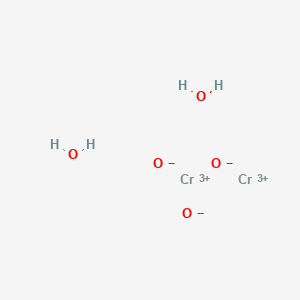
C.I. Pigment Green 18
- IUPAC name
- bis(chromium(3+));tris(oxygen(2-));dihydrate
- Molecular formula
- Cr2H4O5
- Molecular weight
- 188.02 g/mol
- Exact mass
- 187.886883 Da
- Topological polar surface area
- 5.0 Ų
- Hydrogen-bond donors
- 2
- Hydrogen-bond acceptors
- 5
- Covalent units
- 7
- Defined stereocentres
- 0
Also known as
8 more reported names
Evidence from additional scientific databases
NIH PubChem PUG-View
Attributed physical-property, hazard, environmental and use annotations.
- Physical Description: Dry Powder Source: EPA Chemical Data Reporting (CDR)
- Physical Description: Light green finely divided powder; [MSDSonline] A brilliant emerald-green pigment called Guignet's green; [Ullmann] Source: Haz-Map, Information on Hazardous Chemicals and Occupational Diseases
- Note: This chemical does not meet GHS hazard criteria for 91.7% (11 of 12) of all reports. Source: European Chemicals Agency (ECHA)
- GHS Hazard Statements: Not Classified; Reported as not meeting GHS hazard criteria by 11 of 12 companies (only 8.3% companies provided GHS information). For more detailed information, please visit ECHA C&L website. Source: European Chemicals Agency (ECHA)
- ECHA C&L Notifications Summary: Aggregated GHS information provided per 12 reports by companies from 2 notifications to the ECHA C&L Inventory.; Reported as not meeting GHS hazard criteria per 11 of 12 reports by companies.; There is 1 notification provided by 1 of 12 reports by companies with hazard statement code(s).; Information may vary between notifications depending on impurities, additives, and other factors. The percentage value in parenthesis indicates the notified classification ratio from companies that provide hazard codes. Only hazard codes with percentage values above 10% are shown. For more detailed information, please visit ECHA C&L website. Source: European Chemicals Agency (ECHA)
- Industry Uses: Pigment Source: EPA Chemical Data Reporting (CDR)
- Sources/Uses: A purified colorant used to color various foods, drugs, and cosmetics; [MSDSonline] Hydrated chromium oxide green is a pigment similar to Guignet's green; it is prepared differently and has less intense color; [Ullmann] Source: Haz-Map, Information on Hazardous Chemicals and Occupational Diseases
Mapped by: Existing checksum-valid CAS to unique PubChem CID match. Retrieved: 2026-08-31. Open source record
Scientific classifications and hazard annotations provide context and do not replace the market-specific regulatory decision shown above.
Additional source coverage and match status
| Source | Result | Checked |
|---|---|---|
| NIH PubChem PUG-View | Exact match | 2026-08-31 |
A recorded no-match is useful evidence that the source was checked; it is not a claim that the substance does not exist elsewhere.
Retrieved from NIH PubChem on 2026-09-02 by checksum-valid CAS matching. Chemical properties do not replace the regulatory decision on this page.
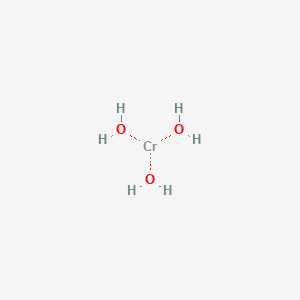
Chromium trihydroxide
Chromium trihydroxide is a hydroxide of chromium. Chromium is a chemical element which has the symbol Cr and atomic number 24. It is found naturally occuring in rocks, animals, plants, and soil, and is usually mined as chromite ore. Chromium is most toxic in its +6 oxidation state (chromium(VI)) due to its greater ability to enter cells and higher redox potential. Trivalent chromium (chromium(III)) however, is biologically necessary for sugar and lipid metabolism in humans. (L17) — Toxin and Toxin Target Database (T3DB)
- IUPAC name
- chromium;trihydrate
- Molecular formula
- CrH6O3
- Molecular weight
- 106.042 g/mol
- Exact mass
- 105.972199 Da
- Topological polar surface area
- 3.0 Ų
- Hydrogen-bond donors
- 3
- Hydrogen-bond acceptors
- 3
- Covalent units
- 4
- Defined stereocentres
- 0
Also known as
16 more reported names
External database identifiers
- EPA DTXSID:DTXSID0051651
Evidence from additional scientific databases
NIH PubChem PUG-View
Attributed physical-property, hazard, environmental and use annotations.
- Color/Form: Green, gelatinous precipitate Source: Hazardous Substances Data Bank (HSDB)
- Physical Description: Large Crystals; Wet Solid; Other Solid Source: EPA Chemical Data Reporting (CDR)
- Physical Description: Blue to green solid; [ICSC] Practically insoluble in water; [Merck Index] Source: Haz-Map, Information on Hazardous Chemicals and Occupational Diseases
- Physical Description: BLUE-TO-GREEN POWDER OR BLACK PARTICLES. Source: ILO-WHO International Chemical Safety Cards (ICSCs)
- Solubility: In an experiment performed under inert gas atmosphere, the solubility /in water/ of freshly precipitated chromium(III) hydroxide was determined from under-saturation and from over-saturation at different pH. As an amphoteric hydroxide, the solubility curve of chromium(III) hydroxide is parabolic, depending on pH. The solubility is as follows: >pH 4: moderately soluble; pH 6.8 - 11.5: insoluble; > pH 11.5 - 14 slightly soluble ... at pH 4, the solubility was about 520 mg/L; at pH 6.8 to 11.8, the solubility was about 0.005 mg/L Source: Hazardous Substances Data Bank (HSDB)
- Solubility: Insoluble in water Source: Hazardous Substances Data Bank (HSDB)
- Solubility: Soluble in acids and strong alkalies Source: Hazardous Substances Data Bank (HSDB)
- Solubility: Solubility in water: none Source: ILO-WHO International Chemical Safety Cards (ICSCs)
- pH: Trivalent chromium compounds are amphoteric Source: Hazardous Substances Data Bank (HSDB)
- Carcinogen Classification: 3, not classifiable as to its carcinogenicity to humans. (L135) Source: Toxin and Toxin Target Database (T3DB)
- Exposure Routes: The substance can be absorbed into the body by inhalation and by ingestion. Source: ILO-WHO International Chemical Safety Cards (ICSCs)
- Exposure Routes: Oral (L16) ; inhalation (L16) ; dermal (L16) Source: Toxin and Toxin Target Database (T3DB)
- Note: This chemical does not meet GHS hazard criteria for 87.4% (208 of 238) of all reports. Source: European Chemicals Agency (ECHA)
- GHS Hazard Statements: H412 (11.8%): Harmful to aquatic life with long lasting effects [Hazardous to the aquatic environment, long-term hazard] Source: European Chemicals Agency (ECHA)
- Precautionary Statement Codes: P273, and P501 (click each P-code to see the statement) Source: European Chemicals Agency (ECHA)
- ECHA C&L Notifications Summary: Aggregated GHS information provided per 238 reports by companies from 4 notifications to the ECHA C&L Inventory.; Reported as not meeting GHS hazard criteria per 208 of 238 reports by companies.; There are 2 notifications provided by 30 of 238 reports by companies with hazard statement code(s).; Information may vary between notifications depending on impurities, additives, and other factors. The percentage value in parenthesis indicates the notified classification ratio from companies that provide hazard codes. Only hazard codes with percentage values above 10% are shown. For more detailed information, please visit ECHA C&L website. Source: European Chemicals Agency (ECHA)
- Note: This chemical does not meet GHS hazard criteria for 100% (37 of 37) of all reports. Source: European Chemicals Agency (ECHA)
- GHS Hazard Statements: Not Classified; Reported as not meeting GHS hazard criteria by 37 of 37 companies. For more detailed information, please visit ECHA C&L website. Source: European Chemicals Agency (ECHA)
- ECHA C&L Notifications Summary: Aggregated GHS information provided per 37 reports by companies from 1 notifications to the ECHA C&L Inventory.; Reported as not meeting GHS hazard criteria per 37 of 37 reports by companies.; There are 0 notifications provided by 0 of 37 reports by companies with hazard statement code(s).; Information may vary between notifications depending on impurities, additives, and other factors. The percentage value in parenthesis indicates the notified classification ratio from companies that provide hazard codes. Only hazard codes with percentage values above 10% are shown. For more detailed information, please visit ECHA C&L website. Source: European Chemicals Agency (ECHA)
- Signal: Danger Source: NITE-CMC
- GHS Hazard Statements: H317: May cause an allergic skin reaction [Warning Sensitization, Skin]; H334: May cause allergy or asthma symptoms or breathing difficulties if inhaled [Danger Sensitization, respiratory] Source: NITE-CMC
- Precautionary Statement Codes: P233, P260, P261, P271, P272, P280, P284, P302+P352, P304+P340, P321, P333+P317, P342+P316, P362+P364, P403, and P501 (click each P-code to see the statement) Source: NITE-CMC
- Health Effects: Chromium in its trivalent state is not very toxic. It may be oxidized to hexavalent chromium, a known carcinogen. Hexavalent chromium has also been shown to affect reproduction and development. (A12) Source: Toxin and Toxin Target Database (T3DB)
- Toxicity Summary: IDENTIFICATION AND USE: Chromium trihydroxide (chromic acid) is a green, gelatinous precipitate. It is used as pigment, e.g. Guignet's green; in tanning industry; as a mordant, and as catalyst for organic reactions. HUMAN EXPOSURE AND TOXICITY: Fatal case was described involving 35-year-old woman who developed severe acidosis, massive gastrointestinal hemorrhage, acute renal failure, and hepatic injury following ingestion of chromic acid (50 mL) and died 12 hours after ingestion. Postmortem liver biopsy revealed a fatty degeneration with chromium concentration 3.6 umol/g. The kidney, with chromium concentration 2.6 umol/g, had extensive necrosis and ischemic lesions. Changes in renal function among ferrochromium workers in a ferroalloy facility in China were investigated (exposed to chromium compounds such a sodium-chromate and chromium-hydroxide). The results of this study suggest that long-term exposure to chromium produces chronic renal injury, mainly involving the proximal tubule. A urinary chromium concentration of greater than 15 ug/g of creatinine can be proposed as a threshold dosage for nephrotoxicity, and gamma-glutamyl-transferase, NAG and alkaline-phosphatase are all ea Source: Hazardous Substances Data Bank (HSDB)
- Toxicity Summary: Trivalent chromium may also form complexes with peptides, proteins, and DNA, resulting in DNA-protein crosslinks, DNA strand breaks, DNA-DNA interstrand crosslinks, chromium-DNA adducts, chromosomal aberrations and alterations in cellular signaling pathways. It has been shown to induce carcinogenesis by overstimulating cellular regulatory pathways and increasing peroxide levels by activating certain mitogen-activated protein kinases. It can also cause transcriptional repression by cross-linking histone deacetylase 1-DNA methyltransferase 1 complexes to CYP1A1 promoter chromatin, inhibiting histone modification. Chromium may increase its own toxicity by modifying metal regulatory transcription factor 1, causing the inhibition of zinc-induced metallothionein transcription. (A12, L16, A34, A35, A36) Source: Toxin and Toxin Target Database (T3DB)
- Environmental Bioconcentration: BCF values of soluble chromium(III) for bottom-feeding bivalves (oyster (Crassostrea virginica), blue mussel (Mytilus edulis), and soft shell clam (Mya arenaria)) range from 86 to 192(1). However, chromium trihydroxide is relatively insoluble between pH 6.8 and 11 (0.005 mg/L)(1). Source: Hazardous Substances Data Bank (HSDB)
- Industry Uses: Other; Catalyst Source: EPA Chemical Data Reporting (CDR)
- Sources/Uses: Used as a pigment, mordant, catalyst, and tanning chemical; [Merck Index #2225] Source: Haz-Map, Information on Hazardous Chemicals and Occupational Diseases
- Industrial Processes with risk of exposure: Painting (Pigments, Binders, and Biocides) [Category: Paint]; Leather Tanning and Processing [Category: Industry]; Textiles (Printing, Dyeing, or Finishing) [Category: Industry] Source: Haz-Map, Information on Hazardous Chemicals and Occupational Diseases
- Uses: Chromium(III) hydroxide hydrates are used for the production of chromium(III) salts by reaction with the corresponding acids. /Chromium(III) hydroxide hydrates/ Source: Hazardous Substances Data Bank (HSDB)
- Uses: As pigment; in tanning industry; as mordant; as catalyst for organic reactions. Source: Hazardous Substances Data Bank (HSDB)
- Uses: Guignet's green. Source: Hazardous Substances Data Bank (HSDB)
- Uses: Useful as catalyst in dehydrogenation of alcohols and paraffins, hydrogenation of olefins. /Chromic hydroxide trihydrate/ Source: Hazardous Substances Data Bank (HSDB)
- Uses: For more Uses (Complete) data for CHROMIUM TRIHYDROXIDE (10 total), please visit the HSDB record page. Source: Hazardous Substances Data Bank (HSDB)
Mapped by: Existing checksum-valid CAS to unique PubChem CID match. Retrieved: 2026-08-31. Open source record
Scientific classifications and hazard annotations provide context and do not replace the market-specific regulatory decision shown above.
Additional source coverage and match status
| Source | Result | Checked |
|---|---|---|
| NIH PubChem PUG-View | Exact match | 2026-08-31 |
A recorded no-match is useful evidence that the source was checked; it is not a claim that the substance does not exist elsewhere.
Retrieved from NIH PubChem on 2026-08-31 by checksum-valid CAS matching. Chemical properties do not replace the regulatory decision on this page.
Inventory details for CI 77289
INCI name
CI 77289
Description
Chromic oxide hydrated; Chromium (III) hydroxide; dichromium trioxide
Record provenance
- Inventory reference
- 32824
- Imported identity
- CI 77289
- Source update
- 12/08/2020
Annex records for CI 77289
Key data
- COLORANT
- Exclusively or mainly intended to colour the cosmetic product, the body as a whole or certain parts thereof, by absorption or reflection of visible light. All authorised colorants are substances in the positive list of Annex IV to the Cosmetics Regulation 1223/2009.
Official EU ingredient-name evidence
The ingredient name exactly matches the official 2025 EU glossary of common ingredient names.
Related inventory evidence
Ingredients with overlapping formulation functions
Additional official and scientific sources
11 external databases to check this identity in
Each link searches that source for this identity. What each source is, and its legal weight
How CI 77289 appears in the CosIng inventory
The CosIng inventory lists CI 77289 as a cosmetic ingredient and this page links it to 1 annex record. The inventory entry captures names and identifiers, while the annex record shows where the substance is prohibited, restricted or positively listed in EU cosmetics law.
CI 77289 is also tagged with 1 cosmetic function in the official data. Function labels describe intended use, but they do not replace regulatory review of linked annex records before formulation or labelling work.
Frequently asked questions
Source note for CI 77289
This page combines the CosIng inventory entry for CI 77289 with 1 linked Annex II–VI record from the local dataset built from public European Commission cosmetic ingredient materials.
Use this inventory page to research CI 77289 and compare linked records, but verify restrictions and legal status against the current official source text and law before making regulatory decisions.
Tools & next steps
Check your formula
Scan a full INCI list to detect CI 77289 and any linked EU annex restrictions or allergen flags.
INCI CheckerSearch similar ingredients
Find other inventory ingredients and annex entries related to CI 77289, its identifiers or nearby name variants.
Search