
Official EU label nameGlossary entry 6572
CINOXATE
This record confirms an official common ingredient name for EU cosmetic product labelling. It does not by itself confirm that the substance is permitted, unrestricted or safe.
Global evidence snapshot
The resolved identity has matching regulatory evidence in 3 of 13 indexed market datasets: 3 country records and 0 EU Annex records. Every result and evidence gap is listed below.
Markets checked
13
Markets with evidence
3
Evidence gaps
10
Resolved identifiers
2
Resolved substance identity
CAS:104-28-9
EC:203-191-0
Ingredient index records:
4 matched or reported names
CINOXATEcinoxateCinoxate시녹세이트
Regulatory evidence in all 13 markets
Open each matched record for its scope, concentration, conditions, warnings and official source version.
Swipe or scroll horizontally to see dataset coverage and next actions.
| Market | Result | Records | Dataset | Meaning / next action |
|---|---|---|---|---|
| European Union EU | No local match | 0 | Complete annex dataset Regulation (EC) 1223/2009 consolidated to 1 May 2026 | No annex match only means that these five annexes did not return a match; CosIng identity data and other EU obligations still need review. |
| Great Britain GB | No local match | 0 | Complete consolidated annex dataset GB retained Regulation 1223/2009 schedules, effective 15 August 2026 | No annex match is not approval and does not cover Northern Ireland, which follows the applicable EU framework. |
| Canada CA | No local match | 0 | Complete Hotlist snapshot Health Canada Cosmetic Ingredient Hotlist, 13 August 2025 | The Hotlist is an administrative compliance tool, not an exhaustive safety approval list. |
| New Zealand NZ | Permitted list with conditions | 1Open record 1 | Complete schedules dataset Cosmetic Products Group Standard schedules effective 1 January 2026 | Review every linked record and exact conditions. |
| ASEAN ASEAN | No local match | 0 | Complete regional annex dataset ASEAN Cosmetic Directive annexes 2026-1, 22 June 2026 | Regional annex coverage does not replace member-state implementation dates, notifications or national deviations. |
| China CN | No local match | 0 | Complete prohibited catalogues plus official-source workflow NMPA 2021 banned catalogues plus dynamic IECIC List I/List II system current since 2025 | IECIC listing is not blanket approval; absence may require the new cosmetic ingredient route, and restrictions are checked separately. |
| Japan JP | Restricted | 1Open record 1 | Complete Standards appendices dataset MHLW Standards for Cosmetics official English source and Japanese amendments checked for the imported snapshot | Review every linked record and exact conditions. |
| South Korea KR | Restricted | 1Open record 1 | Complete current appendix dataset MFDS Notice 2026-19, effective 18 March 2026 | Review every linked record and exact conditions. |
| United States US | No local match | 0 | Complete enumerated federal ingredient rules eCFR Title 21 issue date 27 August 2026 | FDA has no general approved-cosmetic-ingredient catalogue; absence from these sections is not approval or proof of safety. |
| Australia AU | No local match | 0 | Complete cosmetic-relevant Poisons Standard subset plus official workflow Therapeutic Goods (Poisons Standard—June 2026) Instrument 2026 | An AICIS Inventory match is not cosmetic approval; no Inventory match can indicate a new, exempted, reported or confidential introduction. |
| Brazil BR | No local match | 0 | Complete prohibited dataset plus current restricted-list workflow ANVISA RDC 1.029/2026 and RDC 1.030/2026, published 15 June 2026 | RDC 1.030/2026 amends rather than replaces the prohibited baseline, and the second restricted-list revision was still under consultation in July 2026. |
| India IN | No local match | 0 | Complete current Part 2 dataset plus official workflow for Parts 1, 3 and 4 Cosmetics Rules 2020 plus current BIS IS 4707 parts (1:2020, 2:2025, 3:2025, 4:2022) | The standards are separate controlled publications; absence from a locally indexed excerpt is not permission. |
| Saudi Arabia SA | No local match | 0 | Complete official list index SFDA live prohibited/restricted lists, snapshot 30 August 2026 | No list match is not permission; Gulf/SFDA product, claim, notification and technical requirements still apply. |
No market rows match this filter.
Matching market records and conditions
Japan
MHLW Standards for Cosmetics official English source and Japanese amendments checked for the imported snapshotSouth Korea
MFDS Notice 2026-19, effective 18 March 2026Chemical identity and properties
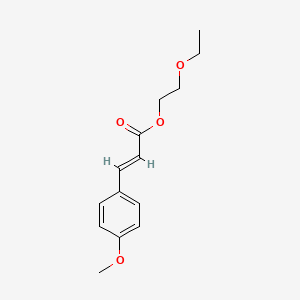
CAS 104-28-9PubChem CID 5373773
Cinoxate
2-ethoxyethyl-p-methoxycinnamate is a viscous clear to pale yellow liquid. Insoluble in water. (NTP, 1992) — CAMEO Chemicals
- IUPAC name
- 2-ethoxyethyl (E)-3-(4-methoxyphenyl)prop-2-enoate
- Molecular formula
- C14H18O4
- Molecular weight
- 250.29 g/mol
- Exact mass
- 250.12050905 Da
- XLogP3
- 2.4
- Topological polar surface area
- 44.8 Ų
- Hydrogen-bond donors
- 0
- Hydrogen-bond acceptors
- 4
- Covalent units
- 1
- Defined stereocentres
- 0
Also known as
PhiasolSundareGive-TanCinoxatoGiv Tan F2-ETHOXYETHYL P-METHOXYCINNAMATECinoxatum2-Propenoic acid, 3-(4-methoxyphenyl)-, 2-ethoxyethyl ester
16 more reported names
2-Ethoxyethyl-p-methoxycinnamate3-(4-Methoxyphenyl)-2-propenoic acid 2-ethoxyethyl ester5437O7N5BHCinnamic acid, p-methoxy-, 2-ethoxyethyl ester2-ethoxyethyl (2E)-3-(4-methoxyphenyl)prop-2-enoateRefChem:577241203-191-0Giv-tan F2-ethoxyethyl 3-(4-methoxyphenyl)prop-2-enoatePropenoic acid, 3-(4-methoxyphenyl)-, 2-ethoxyethyl esterGiv TanfCaswell No. 427ECinoxatum [INN-Latin]Cinoxato [INN-Spanish]CCRIS 4813HSDB 7424
External database identifiers
- ChEMBL:CHEMBL2104045
- EPA DTXSID:DTXSID101167513
Evidence from additional scientific databases
NIH PubChem PUG-View
Exact identifier match5373773
Attributed physical-property, hazard, environmental and use annotations.
- Boiling Point: 388 °C at 760 mm Hg /Extrapolated from 185 °C at 2 mm Hg/ Source: Hazardous Substances Data Bank (HSDB)
- Boiling Point: BP: 185 °C at 2 mm Hg Source: Hazardous Substances Data Bank (HSDB)
- Color/Form: Viscous liquid, may have slight yellow tinge Source: Hazardous Substances Data Bank (HSDB)
- Density: 1.1000 to 1.1035 at 77 °F (NTP, 1992) Source: CAMEO Chemicals
- Density: 1.102 g/cu cm at 25 °C Source: Hazardous Substances Data Bank (HSDB)
- Flash Point: greater than 212 °F (NTP, 1992) Source: CAMEO Chemicals
- Melting Point: Solidifies below -25 °C Source: Hazardous Substances Data Bank (HSDB)
- Odor: Practically odorless Source: Hazardous Substances Data Bank (HSDB)
- Physical Description: 2-ethoxyethyl-p-methoxycinnamate is a viscous clear to pale yellow liquid. Insoluble in water. (NTP, 1992) Source: CAMEO Chemicals
- Physical Description: Viscous liquid; May be slightly yellow; [Merck Index] Source: Haz-Map, Information on Hazardous Chemicals and Occupational Diseases
- Refractive Index: Index of refraction: 1.567 at 20 °C Source: Hazardous Substances Data Bank (HSDB)
- Solubility: Insoluble (NTP, 1992) Source: CAMEO Chemicals
- Solubility: Practically insoluble in water with a solubility of approximately 0.05%. Source: Hazardous Substances Data Bank (HSDB)
- Solubility: Soluble in glycerol 0.5%, propolyene glycol 5%; miscible with alcohols and vegetable oils Source: Hazardous Substances Data Bank (HSDB)
- Vapor Pressure: 0.00034 [mmHg] Source: Haz-Map, Information on Hazardous Chemicals and Occupational Diseases
- First Aid: EYES: First check the victim for contact lenses and remove if present. Flush victim's eyes with water or normal saline solution for 20 to 30 minutes while simultaneously calling a hospital or poison control center. Do not put any ointments, oils, or medication in the victim's eyes without specific instructions from a physician. IMMEDIATELY transport the victim after flushing eyes to a hospital even if no symptoms (such as redness or irritation) develop.; SKIN: IMMEDIATELY flood affected skin with water while removing and isolating all contaminated clothing. Gently wash all affected skin areas thoroughly with soap and water. If symptoms such as redness or irritation develop, IMMEDIATELY call a physician and be prepared to transport the victim to a hospital for treatment.; INHALATION: IMMEDIATELY leave the contaminated area; take deep breaths of fresh air. If symptoms (such as wheezing, coughing, shortness of breath, or burning in the mouth, throat, or chest) develop, call a physician and be prepared to transport the victim to a hospital. Provide proper respiratory protection to rescuers entering an unknown atmosphere. Whenever possible, Self-Contained Breathing Apparatus (SCBA) shou Source: CAMEO Chemicals
- Environmental Bioconcentration: An estimated BCF of 26 was calculated for cinoxate in fish(SRC), using an estimated log Kow of 2.65(1) and a regression-derived equation(1). According to a classification scheme(2), this BCF suggests the potential for bioconcentration in aquatic organisms is low(SRC). Source: Hazardous Substances Data Bank (HSDB)
- Environmental Fate: TERRESTRIAL FATE: Based on a classification scheme(1), an estimated Koc value of 208(SRC), determined from a structure estimation method(2), indicates that cinoxate is expected to have moderate mobility in soil(SRC). Volatilization of cinoxate from moist soil surfaces is not expected to be an important fate process(SRC) given an estimated Henry's Law constant of 5.1X10⁻⁹ atm-cu m/mole(SRC), using a fragment constant estimation method(2). Cinoxate is not expected to volatilize from dry soil surfaces(SRC) based upon an estimated vapor pressure of 1.6X10⁻⁵ mm Hg(SRC), determined from a fragment constant method(2). Cinoxate absorbs UV light in the sunlight spectrum(3) and, therefore, may be susceptible to direct photolysis on soil surfaces exposed to sunlight(SRC). No relevant data were available to assess the importance of biodegradation in the environment(SRC). Source: Hazardous Substances Data Bank (HSDB)
- Environmental Fate: AQUATIC FATE: Based on a classification scheme(1), an estimated Koc value of 208(SRC), determined from a structure estimation method(2), indicates that cinoxate may have some moderate adsorption to suspended solids and sediment(SRC). Volatilization from water surfaces is not expected(3) based upon an estimated Henry's Law constant of 5.1X10⁻⁹ atm-cu m/mole(SRC), developed using a fragment constant estimation method(1). According to a classification scheme(4), an estimated BCF of 26(SRC), from an estimated log Kow of 2.65(2) and a regression-derived equation(2), suggests the potential for bioconcentration in aquatic organisms is low (SRC). A base-catalyzed second-order hydrolysis rate constant of 2.5X10⁻² L/mole-sec(SRC) was estimated using a structure estimation method(2); this corresponds to half-lives of 8.9 and 0.89 years at pH values of 7 and 8, respectively(2). Cinoxate absorbs UV light in the sunlight spectrum(5) and, therefore, may be susceptible to direct photolysis on water surfaces exposed to sunlight(SRC). No relevant data were available to assess the importance of biodegradation in the environment(SRC). Source: Hazardous Substances Data Bank (HSDB)
- Environmental Fate: ATMOSPHERIC FATE: According to a model of gas/particle partitioning of semivolatile organic compounds in the atmosphere(1), cinoxate, which has an estimated vapor pressure of 1.6X10⁻⁵ mm Hg at 25 °C(SRC), determined from a fragment constant method(2), will exist in both the vapor and particulate phases in the ambient atmosphere. Vapor-phase cinoxate is degraded in the atmosphere by reaction with photochemically-produced hydroxyl radicals(SRC); the half-life for this reaction in air is estimated to be 6.7 hours(SRC), calculated from its rate constant of 5.7X10⁻¹¹ cu cm/molecule-sec at 25 °C(SRC) that was derived using a structure estimation method(2). Vapor-phase cinoxate is also degraded in the atmosphere by reaction with ozone (SRC); the half-life for this reaction in air is estimated to be about 19 hours(SRC), calculated from its rate constant of 1.6X10⁻¹⁷ cu cm/molecule-sec at 25 °C(SRC) that was derived using a structure estimation method(2). Particulate-phase cinoxate may be removed from the air by wet and dry deposition(SRC). Cinoxate absorbs UV light in the sunlight spectrum(3) and, therefore, may be susceptible to direct photolysis by sunlight(SRC). Source: Hazardous Substances Data Bank (HSDB)
- Sources/Uses: Used as ultraviolet screen; [Merck Index] The cinnamates are a group of chemically related substances that are used as fragrances and flavorings and less frequently as sunscreens. [Marks, p. 219] Source: Haz-Map, Information on Hazardous Chemicals and Occupational Diseases
- Uses: For cinoxate (USEPA/OPP Pesticide Code: 076604) there are 0 labels match. /SRP: Not registered for current use in the U.S., but approved pesticide uses may change periodically and so federal, state and local authorities must be consulted for currently approved uses./ Source: Hazardous Substances Data Bank (HSDB)
- Uses: The active ingredient is no longer contained in any registered products ... "cancelled." Source: Hazardous Substances Data Bank (HSDB)
- Uses: Ultraviolet screen Source: Hazardous Substances Data Bank (HSDB)
- Uses: Sunscreening Agents Source: Hazardous Substances Data Bank (HSDB)
Mapped by: Existing checksum-valid CAS to unique PubChem CID match. Retrieved: 2026-08-31. Open source record
Scientific classifications and hazard annotations provide context and do not replace the market-specific regulatory decision shown above.
Additional source coverage and match status
| Source | Result | Checked |
|---|---|---|
| EMBL-EBI ChEBI | No exact record | 2026-08-31 |
| NIH PubChem PUG-View | Exact match | 2026-08-31 |
A recorded no-match is useful evidence that the source was checked; it is not a claim that the substance does not exist elsewhere.
Retrieved from NIH PubChem on 2026-09-02 by checksum-valid CAS matching. Chemical properties do not replace the regulatory decision on this page.
Additional authoritative substance research
Each link searches that source for this identity. A link is a research route, not a claim that the source holds an exact record. What each source is, and its legal weight
Take this record further
Official source and scope
Imported from Commission Implementing Decision (EU) 2025/1175 (dataset version EU 2025/1175). The glossary supplies common ingredient names for the ingredient list required by Article 19(1)(g); it is not an approval or safety list.
Open official Decision