
Official EU label nameGlossary entry 24110
RESORCINOL
This record confirms an official common ingredient name for EU cosmetic product labelling. It does not by itself confirm that the substance is permitted, unrestricted or safe.
Global evidence snapshot
The resolved identity has matching regulatory evidence in 9 of 13 indexed market datasets: 8 country records and 1 EU Annex records. Every result and evidence gap is listed below.
Markets checked
13
Markets with evidence
9
Evidence gaps
4
Resolved identifiers
2
Resolved substance identity
CAS:108-46-3
EC:203-585-2
Ingredient index records:
RESORCINOL
Cosmetic functions: ANTIOXIDANT, DENATURANT, HAIR DYEING, PERFUMING
Resorcinol (CI 76505)
Inventory restriction note: III/22
7 matched or reported names
RESORCINOL1,3-benzenediolResorcinolResorcinol (1,3-benzenediol)1,3-benzenediol Resorcinol CAS No. 108-46-3레조시놀1,3-benzenediol Resorc- inol (CAS No. 108-46-3)
Regulatory evidence in all 13 markets
Open each matched record for its scope, concentration, conditions, warnings and official source version.
Swipe or scroll horizontally to see dataset coverage and next actions.
| Market | Result | Records | Dataset | Meaning / next action |
|---|---|---|---|---|
| European Union EU | Restricted | 1Open record 1 | Complete annex dataset Regulation (EC) 1223/2009 consolidated to 1 May 2026 | Review every linked record and exact conditions. |
| Great Britain GB | Restricted | 1Open record 1 | Complete consolidated annex dataset GB retained Regulation 1223/2009 schedules, effective 15 August 2026 | Review every linked record and exact conditions. |
| Canada CA | Restricted | 1Open record 1 | Complete Hotlist snapshot Health Canada Cosmetic Ingredient Hotlist, 13 August 2025 | Review every linked record and exact conditions. |
| New Zealand NZ | Restricted | 1Open record 1 | Complete schedules dataset Cosmetic Products Group Standard schedules effective 1 January 2026 | Review every linked record and exact conditions. |
| ASEAN ASEAN | Restricted | 1Open record 1 | Complete regional annex dataset ASEAN Cosmetic Directive annexes 2026-1, 22 June 2026 | Review every linked record and exact conditions. |
| China CN | No local match | 0 | Complete prohibited catalogues plus official-source workflow NMPA 2021 banned catalogues plus dynamic IECIC List I/List II system current since 2025 | IECIC listing is not blanket approval; absence may require the new cosmetic ingredient route, and restrictions are checked separately. |
| Japan JP | No local match | 0 | Complete Standards appendices dataset MHLW Standards for Cosmetics official English source and Japanese amendments checked for the imported snapshot | The Japanese text and subsequent notices are canonical; no local match is not a product-compliance conclusion. |
| South Korea KR | Restricted | 1Open record 1 | Complete current appendix dataset MFDS Notice 2026-19, effective 18 March 2026 | Review every linked record and exact conditions. |
| United States US | No local match | 0 | Complete enumerated federal ingredient rules eCFR Title 21 issue date 27 August 2026 | FDA has no general approved-cosmetic-ingredient catalogue; absence from these sections is not approval or proof of safety. |
| Australia AU | Restricted | 1Open record 1 | Complete cosmetic-relevant Poisons Standard subset plus official workflow Therapeutic Goods (Poisons Standard—June 2026) Instrument 2026 | Review every linked record and exact conditions. |
| Brazil BR | No local match | 0 | Complete prohibited dataset plus current restricted-list workflow ANVISA RDC 1.029/2026 and RDC 1.030/2026, published 15 June 2026 | RDC 1.030/2026 amends rather than replaces the prohibited baseline, and the second restricted-list revision was still under consultation in July 2026. |
| India IN | Restricted | 1Open record 1 | Complete current Part 2 dataset plus official workflow for Parts 1, 3 and 4 Cosmetics Rules 2020 plus current BIS IS 4707 parts (1:2020, 2:2025, 3:2025, 4:2022) | Review every linked record and exact conditions. |
| Saudi Arabia SA | Restricted | 1Open record 1 | Complete official list index SFDA live prohibited/restricted lists, snapshot 30 August 2026 | Review every linked record and exact conditions. |
No market rows match this filter.
Matching market records and conditions
Great Britain
GB retained Regulation 1223/2009 schedules, effective 15 August 2026Canada
Health Canada Cosmetic Ingredient Hotlist, 13 August 2025New Zealand
Cosmetic Products Group Standard schedules effective 1 January 2026ASEAN
ASEAN Cosmetic Directive annexes 2026-1, 22 June 2026South Korea
MFDS Notice 2026-19, effective 18 March 2026Australia
Therapeutic Goods (Poisons Standard—June 2026) Instrument 2026India
Cosmetics Rules 2020 plus current BIS IS 4707 parts (1:2020, 2:2025, 3:2025, 4:2022)Saudi Arabia
SFDA live prohibited/restricted lists, snapshot 30 August 2026Exact Annex II–VI evidence
Annex IIIentry 22
Open full regulatory recordRESORCINOL
Product scope: (a) Hair dye substance in oxidative hair dye products (b) Products intended for colouring eyelashes (c) Hair lotions and shampoos
Maximum concentration: (c) 0,5%
Restrictions: (For (a) and (b): After mixing under oxidative conditions the maximum concentration applied to hair or eyeslashes must not exceed 1,25 % (b) Professional use only
Warnings: (a) To be printed on the label: The mixing ratio. “ Hair colorants can cause severe allergic reactions. Read and follow instructions. This product is not intended for use on persons under the age of 16. Temporary ‘black henna’ tattoos may increase your risk of allergy. Do not colour your hair if: —…
Chemical identity and properties
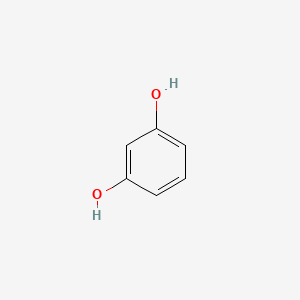
CAS 108-46-3PubChem CID 5054
Resorcinol
Resorcinol is a benzenediol that is benzene dihydroxylated at positions 1 and 3. It has a role as a sensitiser and an erythropoietin inhibitor. It is a phenolic donor, a benzenediol and a member of resorcinols. — ChEBI
- IUPAC name
- benzene-1,3-diol
- Molecular formula
- C6H6O2
- Molecular weight
- 110.11 g/mol
- Exact mass
- 110.036779430 Da
- XLogP3
- 0.8
- Topological polar surface area
- 40.5 Ų
- Hydrogen-bond donors
- 2
- Hydrogen-bond acceptors
- 2
- Covalent units
- 1
- Defined stereocentres
- 0
Also known as
1,3-Benzenediol1,3-DihydroxybenzeneResorcinm-Hydroxyphenolm-Hydroquinonem-Dihydroxybenzene3-HydroxyphenolResorcine
16 more reported names
m-Benzenediolm-DioxybenzenePelagol RSDihydroxybenzolPelagol Grey RSResorzinDeveloper ODeveloper RDeveloper RSFouramine RSFourrine EWResorcinolumFourrine 79Nako TGGDurafur developer GC.I. Oxidation Base 31
External database identifiers
- ChEBI:CHEBI:27810
- ChEMBL:CHEMBL24147
- EPA DTXSID:DTXSID2021238
- PubMed:40527391
- PubMed:40355721
- PubMed:31967339
- PubMed:31629072
- PubMed:30849679
- PubMed:30806763
- PubMed:29621941
- PubMed:27965148
- PubMed:26865668
- PubMed:26795242
- PubMed:26262998
- PubMed:26198647
Evidence from additional scientific databases
NIH PubChem PUG-View
Exact identifier match5054
Attributed physical-property, hazard, environmental and use annotations.
- Autoignition Temperature: 1125 °F (USCG, 1999) Source: CAMEO Chemicals
- Autoignition Temperature: 1126 °F (608 °C) Source: Hazardous Substances Data Bank (HSDB)
- Autoignition Temperature: 607 °C Source: ILO-WHO International Chemical Safety Cards (ICSCs)
- Boiling Point: 531 to 536 °F at 760 mmHg (NTP, 1992) Source: CAMEO Chemicals
- Boiling Point: 280 °C, but volatilizes at lower temperature and is slightly volatile with steam Source: Hazardous Substances Data Bank (HSDB)
- Boiling Point: 178.00 °C. @ 16.00 mm Hg Source: Human Metabolome Database (HMDB)
- Boiling Point: 280 °C Source: ILO-WHO International Chemical Safety Cards (ICSCs)
- Boiling Point: 277-281 °C Source: Joint FAO/WHO Expert Committee on Food Additives (JECFA)
- Boiling Point: 531 °F Source: Occupational Safety and Health Administration (OSHA)
- Boiling Point: 276.5 °C @760 [mm Hg] Source: PAC Chemical Database, U.S. Department of Energy
- Boiling Point: 531 °F Source: The National Institute for Occupational Safety and Health (NIOSH)
- Color/Form: White needle-like crystals Source: Hazardous Substances Data Bank (HSDB)
- Color/Form: Needles from benzene; platelets from water Source: Hazardous Substances Data Bank (HSDB)
- Color/Form: Rhombic tablets and pyramids Source: Hazardous Substances Data Bank (HSDB)
- Color/Form: Platelets from ethanol. Very white crystals Source: Hazardous Substances Data Bank (HSDB)
- Color/Form: For more Color/Form (Complete) data for RESORCINOL (6 total), please visit the HSDB record page. Source: Hazardous Substances Data Bank (HSDB)
- Density: 1.2 at 68 °F (USCG, 1999) - Denser than water; will sink Source: CAMEO Chemicals
- Density: 1.278 g/cu cm at 20 °C Source: Hazardous Substances Data Bank (HSDB)
- Density: Density of saturated air: 1.0739 (Air = 1); Percent in saturated air: 2.64% by volume (25 °C) Source: Hazardous Substances Data Bank (HSDB)
- Density: Density, solid (g/cu cm; 20 °C): 1.278 (alpha-phase), 1.327 (beta phase); Density aqueous solution (5.0 mol/L, 20 °C): 1.1101 g/cu cm Source: Hazardous Substances Data Bank (HSDB)
- Density: 1.28 g/cm³ Source: ILO-WHO International Chemical Safety Cards (ICSCs)
- Density: 1.27 at 68 °F Source: Occupational Safety and Health Administration (OSHA)
- Density: 1.278 @ 20°C Source: PAC Chemical Database, U.S. Department of Energy
- Density: 1.27 Source: The National Institute for Occupational Safety and Health (NIOSH)
- Dissociation Constants: pKa1 = 9.30; pKa2 = 11.06 Source: Hazardous Substances Data Bank (HSDB)
- Flash Point: 261 °F (NTP, 1992) Source: CAMEO Chemicals
- Flash Point: 261 °F Source: Haz-Map, Information on Hazardous Chemicals and Occupational Diseases
- Flash Point: 261 °F (Closed cup) Source: Hazardous Substances Data Bank (HSDB)
- Flash Point: 127 °C (261 °F) (Closed cup) Source: Hazardous Substances Data Bank (HSDB)
- Flash Point: 261 °F (127 °C) (Closed cup) Source: Hazardous Substances Data Bank (HSDB)
- Flash Point: 127 °C c.c. Source: ILO-WHO International Chemical Safety Cards (ICSCs)
- Flash Point: 261 °F Source: Occupational Safety and Health Administration (OSHA)
- Flash Point: 261 °F Source: The National Institute for Occupational Safety and Health (NIOSH)
- LogP: log Kow = 0.80 Source: Hazardous Substances Data Bank (HSDB)
- LogP: 0.80 Source: Human Metabolome Database (HMDB)
- LogP: 0.79-0.93 Source: ILO-WHO International Chemical Safety Cards (ICSCs)
- Melting Point: 228 to 232 °F (NTP, 1992) Source: CAMEO Chemicals
- Melting Point: 109.8 °C Source: Hazardous Substances Data Bank (HSDB)
- Melting Point: Heat of fusion at mp: 21.0 kJ/mol; Heat of vaporization (kJ/mol): 78.2 at 110 °C, 75.2 at 150 °C, 72.0 at 190 °C Source: Hazardous Substances Data Bank (HSDB)
- Melting Point: 111 °C Source: Human Metabolome Database (HMDB)
- Melting Point: 110 °C Source: ILO-WHO International Chemical Safety Cards (ICSCs)
- Melting Point: 228-232 °F Source: Occupational Safety and Health Administration (OSHA)
- Melting Point: 109.4 °C Source: PAC Chemical Database, U.S. Department of Energy
- Melting Point: 228 °F Source: The National Institute for Occupational Safety and Health (NIOSH)
- Odor: Faint, characteristic odor Source: Hazardous Substances Data Bank (HSDB)
- Physical Description: Resorcinol is a very white crystalline solid that becomes pink on exposure to light if not completely pure. Burns although ignition is difficult. Density approximately 1.28 g / cm3. Irritating to skin and eyes. Toxic by skin absorption. Used to make plastics and pharmaceuticals. Source: CAMEO Chemicals
- Physical Description: Other Solid; Dry Powder; CBI; Large Crystals Source: EPA Chemical Data Reporting (CDR)
- Physical Description: White needles, plates, crystals, flakes, or powder with a faint odor. [Note: Turns pink on exposure to air or light, or contact with iron.]; [NIOSH] Source: Haz-Map, Information on Hazardous Chemicals and Occupational Diseases
- Physical Description: Solid Source: Human Metabolome Database (HMDB)
- Physical Description: WHITE CRYSTALS. TURNS PINK ON EXPOSURE TO AIR AND LIGHT OR ON CONTACT WITH IRON. Source: ILO-WHO International Chemical Safety Cards (ICSCs)
- Physical Description: White needle-like crystals Source: Joint FAO/WHO Expert Committee on Food Additives (JECFA)
- Physical Description: White needles, plates, crystals, flakes, or powder with a faint odor. Turns pink on exposure to light if not completely pure. Source: Occupational Safety and Health Administration (OSHA)
- Physical Description: White needles, plates, crystals, flakes, or powder with a faint odor. [Note: Turns pink on exposure to air or light, or contact with iron.] Source: The National Institute for Occupational Safety and Health (NIOSH)
- Refractive Index: Index of refraction = 1.578 at 25 °C/D Source: Hazardous Substances Data Bank (HSDB)
- Solubility: greater than or equal to 100 mg/mL at 65.3 °F (NTP, 1992) Source: CAMEO Chemicals
- Solubility: In water, 7.17X10+5 mg/L at 25 °C Source: Hazardous Substances Data Bank (HSDB)
- Solubility: 1 g dissolves in 0.9 mL water at room temperature, 0.2 mL water at 80 °C Source: Hazardous Substances Data Bank (HSDB)
- Solubility: 1 g dissolves in 0.9 mL alcohol; freely soluble in ether, glycerol; slightly soluble in chloroform Source: Hazardous Substances Data Bank (HSDB)
- Solubility: Very soluble in carbon tetrachloride; soluble in ethanol, ethyl ether; slightly soluble in benzene, chloroform Source: Hazardous Substances Data Bank (HSDB)
- Solubility: Soluble in DMSO /dimethyl sulfoxide/, acetone at greater than or equal to 100 mg/mL at 18 °C Source: Hazardous Substances Data Bank (HSDB)
- Solubility: 717 mg/mL at 25 °C Source: Human Metabolome Database (HMDB)
- Solubility: Solubility in water, g/100ml: 140 Source: ILO-WHO International Chemical Safety Cards (ICSCs)
- Solubility: soluble in water Source: Joint FAO/WHO Expert Committee on Food Additives (JECFA)
- Solubility: moderately soluble (in ethanol) Source: Joint FAO/WHO Expert Committee on Food Additives (JECFA)
- Solubility: 110% Source: The National Institute for Occupational Safety and Health (NIOSH)
- Vapor Pressure: 1 mmHg at 227.1 °F ; 0.0002 mmHg at 77 °F (NTP, 1992) Source: CAMEO Chemicals
- Vapor Pressure: 0.000489 [mmHg] Source: Haz-Map, Information on Hazardous Chemicals and Occupational Diseases
- Vapor Pressure: Vapor pressure = 1 mm Hg at 108.4 °C Source: Hazardous Substances Data Bank (HSDB)
- Vapor Pressure: 4.89X10⁻⁴ mm Hg at 25 °C Source: Hazardous Substances Data Bank (HSDB)
- Vapor Pressure: Vapor pressure, Pa at 20 °C: 0.065 Source: ILO-WHO International Chemical Safety Cards (ICSCs)
- Vapor Pressure: 0.0002 mmHg at 77 °F Source: Occupational Safety and Health Administration (OSHA)
- Vapor Pressure: (77 °F): 0.0002 mmHg Source: The National Institute for Occupational Safety and Health (NIOSH)
- IARC Carcinogenic Agent: Resorcinol Source: International Agency for Research on Cancer (IARC)
- IARC Carcinogenic Classes: Group 3: Not classifiable as to its carcinogenicity to humans Source: International Agency for Research on Cancer (IARC)
- IARC Monographs: Volume 15: (1977) Some Fumigants, the Herbicides 2,4-D and 2,4,5-T, Chlorinated Dibenzodioxins and Miscellaneous Industrial Chemicals; Volume Sup 7: Overall Evaluations of Carcinogenicity: An Updating of IARC Monographs Volumes 1 to 42, 1987; 440 pages; ISBN 92-832-1411-0 (out of print); Volume 71: (1999) Re-evaluation of Some Organic Chemicals, Hydrazine and Hydrogen Peroxide (Part 1, Part 2, Part 3) Source: International Agency for Research on Cancer (IARC)
- Publication Year: 1999 Source: International Agency for Research on Cancer (IARC)
- Evaluation Year: 1998 Source: International Agency for Research on Cancer (IARC)
- Substance: Resorcinol Source: NTP Technical Reports
- NTP Technical Report: TR-403: Toxicology and Carcinogenesis Studies of Resorcinol (CASRN 108-46-3) in F344 Rats and B6C3F1 Mice (Gavage Studies) (1992 ) Source: NTP Technical Reports
- Peer Review Date: 03/11/91 Source: NTP Technical Reports
- Conclusion for Male Rat: No Evidence Source: NTP Technical Reports
- Conclusion for Female Rat: No Evidence Source: NTP Technical Reports
- Conclusion for Male Mice: No Evidence Source: NTP Technical Reports
- Conclusion for Female Mice: No Evidence Source: NTP Technical Reports
- Exposure Routes: The substance can be absorbed into the body by inhalation of its aerosol, through the skin and by ingestion. Source: ILO-WHO International Chemical Safety Cards (ICSCs)
- Exposure Routes: inhalation, ingestion, skin and/or eye contact Source: The National Institute for Occupational Safety and Health (NIOSH)
- First Aid: EYES: First check the victim for contact lenses and remove if present. Flush victim's eyes with water or normal saline solution for 20 to 30 minutes while simultaneously calling a hospital or poison control center. Do not put any ointments, oils, or medication in the victim's eyes without specific instructions from a physician. IMMEDIATELY transport the victim after flushing eyes to a hospital even if no symptoms (such as redness or irritation) develop.; SKIN: IMMEDIATELY flood affected skin with water while removing and isolating all contaminated clothing. Gently wash all affected skin areas thoroughly with soap and water. If symptoms such as redness or irritation develop, IMMEDIATELY call a physician and be prepared to transport the victim to a hospital for treatment.; INHALATION: IMMEDIATELY leave the contaminated area; take deep breaths of fresh air. If symptoms (such as wheezing, coughing, shortness of breath, or burning in the mouth, throat, or chest) develop, call a physician and be prepared to transport the victim to a hospital. Provide proper respiratory protection to rescuers entering an unknown atmosphere. Whenever possible, Self-Contained Breathing Apparatus (SCBA) shou Source: CAMEO Chemicals
- ERG2024, Guide 153 (Resorcinol): General First Aid:; · Call 911 or emergency medical service.; · Ensure that medical personnel are aware of the material(s) involved, take precautions to protect themselves and avoid contamination.; · Move victim to fresh air if it can be done safely.; · Administer oxygen if breathing is difficult.; · If victim is not breathing:; -- DO NOT perform mouth-to-mouth resuscitation; the victim may have ingested or inhaled the substance.; -- If equipped and pulse detected, wash face and mouth, then give artificial respiration using a proper respiratory medical device (bag-valve mask, pocket mask equipped with a one-way valve or other device).; -- If no pulse detected or no respiratory medical device available, provide continuous compressions. Conduct a pulse check every two minutes or monitor for any signs of spontaneous respirations.; · Remove and isolate contaminated clothing and shoes.; · For minor skin contact, avoid spreading material on unaffected skin.; · In case of contact with substance, remove immediately by flushing skin or eyes with running water for at least 20 minutes.; · For severe burns, immediate medical attention is required.; · Effects of exposure (inhalation, ingestion, Source: Emergency Response Guidebook (ERG)
- First Aid: (General first aid procedures); Eye: Irrigate immediately - If this chemical contacts the eyes, immediately wash (irrigate) the eyes with large amounts of water, occasionally lifting the lower and upper lids. Get medical attention immediately.; Skin: Water wash immediately - If this chemical contacts the skin, immediately wash the contaminated skin with water. If this chemical penetrates the clothing, immediately remove the clothing and wash the skin with water. If symptoms occur after washing, get medical attention immediately.; Breathing: Respiratory support; Swallow: Medical attention immediately - If this chemical has been swallowed, get medical attention immediately. Source: The National Institute for Occupational Safety and Health (NIOSH)
- Signal: Danger Source: Regulation (EC) No 1272/2008 of the European Parliament and of the Council
- GHS Hazard Statements: H302: Harmful if swallowed [Warning Acute toxicity, oral]; H315: Causes skin irritation [Warning Skin corrosion/irritation]; H317: May cause an allergic skin reaction [Warning Sensitization, Skin]; H319: Causes serious eye irritation [Warning Serious eye damage/eye irritation]; H370: Causes damage to organs [Danger Specific target organ toxicity, single exposure]; H400: Very toxic to aquatic life [Warning Hazardous to the aquatic environment, acute hazard] Source: Regulation (EC) No 1272/2008 of the European Parliament and of the Council
- Precautionary Statement Codes: P260, P261, P264, P264+P265, P270, P272, P273, P280, P301+P317, P302+P352, P305+P351+P338, P308+P316, P321, P330, P332+P317, P333+P317, P337+P317, P362+P364, P391, P405, and P501 (click each P-code to see the statement) Source: Regulation (EC) No 1272/2008 of the European Parliament and of the Council
- Signal: Danger Source: European Chemicals Agency (ECHA)
- GHS Hazard Statements: H302 (> 99.9%): Harmful if swallowed [Warning Acute toxicity, oral]; H315 (> 99.9%): Causes skin irritation [Warning Skin corrosion/irritation]; H317 (15.2%): May cause an allergic skin reaction [Warning Sensitization, Skin]; H319 (90.6%): Causes serious eye irritation [Warning Serious eye damage/eye irritation]; H370 (15.1%): Causes damage to organs [Danger Specific target organ toxicity, single exposure]; H371 (11.2%): May cause damage to organs [Warning Specific target organ toxicity, single exposure]; H400 (99.9%): Very toxic to aquatic life [Warning Hazardous to the aquatic environment, acute hazard] Source: European Chemicals Agency (ECHA)
- Precautionary Statement Codes: P260, P261, P264, P264+P265, P270, P272, P273, P280, P301+P317, P302+P352, P305+P351+P338, P308+P316, P321, P330, P332+P317, P333+P317, P337+P317, P362+P364, P391, P405, and P501 (click each P-code to see the statement) Source: European Chemicals Agency (ECHA)
- ECHA C&L Notifications Summary: Aggregated GHS information provided per 2727 reports by companies from 51 notifications to the ECHA C&L Inventory. Each notification may be associated with multiple companies.; Information may vary between notifications depending on impurities, additives, and other factors. The percentage value in parenthesis indicates the notified classification ratio from companies that provide hazard codes. Only hazard codes with percentage values above 10% are shown. For more detailed information, please visit ECHA C&L website. Source: European Chemicals Agency (ECHA)
- Signal: Warning Source: NITE-CMC
- GHS Hazard Statements: H317: May cause an allergic skin reaction [Warning Sensitization, Skin]; H319: Causes serious eye irritation [Warning Serious eye damage/eye irritation]; H400: Very toxic to aquatic life [Warning Hazardous to the aquatic environment, acute hazard] Source: NITE-CMC
- Precautionary Statement Codes: P261, P264+P265, P272, P273, P280, P302+P352, P305+P351+P338, P321, P333+P317, P337+P317, P362+P364, P391, and P501 (click each P-code to see the statement) Source: NITE-CMC
- Signal: Danger Source: NITE-CMC
- GHS Hazard Statements: H302: Harmful if swallowed [Warning Acute toxicity, oral]; H315: Causes skin irritation [Warning Skin corrosion/irritation]; H317: May cause an allergic skin reaction [Warning Sensitization, Skin]; H318: Causes serious eye damage [Danger Serious eye damage/eye irritation]; H370: Causes damage to organs [Danger Specific target organ toxicity, single exposure] Source: NITE-CMC
- NFPA Health Rating: 3 - Materials that, under emergency conditions, can cause serious or permanent injury. Source: Hazardous Substances Data Bank (HSDB)
- NFPA Fire Rating: 1 - Materials that must be preheated before ignition can occur. Materials require considerable preheating, under all ambient temperature conditions, before ignition and combustion can occur. Source: Hazardous Substances Data Bank (HSDB)
- NFPA Instability Rating: 0 - Materials that in themselves are normally stable, even under fire conditions. Source: Hazardous Substances Data Bank (HSDB)
- Target Organs: Eyes, skin, respiratory system, cardiovascular system, central nervous system, blood, spleen, liver, kidneys Source: The National Institute for Occupational Safety and Health (NIOSH)
- Cosmetic Ingredient Review Finding(s): Safe in the present practices of use and concentration. Ingredient, concentration, and use information are available in documents discoverable at https://cir-reports.cir-safety.org Source: Cosmetic Ingredient Review (CIR)
- Toxicity Summary: IDENTIFICATION AND USE: Resorcinol is a white crystalline compound with a faint odor and bitter-sweet taste. It exists in at least two crystalline modifications. Crystalline resorcinol turns pale red in the presence of light and air and is hygroscopic. It is miscible in water. It is used in tanning, photography; manufacture of resins, resin adhesives, hexylresorcinol, p-aminosalicylic acid, explosives, dyes, tires, rubber products; in cosmetics; dyeing and printing textiles; and as a reagent for zinc. It is not registered for current pesticide use in the U.S., but approved pesticide uses may change periodically and so federal, state and local authorities must be consulted for currently approved uses. Resorcinol is also a medication, used as an antifungal, antibacterial, mildly keratolytic and local irritant agent. It is a pharmaceutical agent used topically in dermatological treatments such as acne and related skin conditions. It could also be used in combination with the other acne treatment agents such as sulphur. HUMAN EXPOSURE AND TOXICITY: An application of 3-25% solution of resorcinol to skin may cause redness, itching, dermatitis, edema or corrosion of affected area. Potenti Source: Hazardous Substances Data Bank (HSDB)
- Environmental Bioconcentration: An estimated BCF of 3 was calculated in fish for resorcinol(SRC), using a log Kow of 0.80(1) and a regression-derived equation(2). According to a classification scheme(3), this BCF suggests the potential for bioconcentration in aquatic organisms is low(SRC). Source: Hazardous Substances Data Bank (HSDB)
- Environmental Fate: TERRESTRIAL FATE: Based on a classification scheme(1), a Koc value of 10.36(2) indicates that resorcinol is expected to have very high mobility in soil(SRC). The pKa1 of resorcinol is 9.30(3), indicating that this compound will exist partially in the anion form in the environment and anions generally do not adsorb more strongly to soils containing organic carbon and clay than their neutral counterparts(4). Volatilization of resorcinol from moist soil surfaces is not expected to be an important fate process(SRC) given an estimated Henry's Law constant of 9.9X10⁻¹¹ atm-cu m/mole(SRC), based upon its vapor pressure, 4.89X10⁻⁴ mm Hg(5), and water solubility, 7.17X10+5 mg/L(6). Resorcinol is not expected to volatilize from dry soil surfaces(SRC) based upon its vapor pressure(5). Utilizing the Japanese MITI test, 100% of the Theoretical BOD was reached in 2 weeks(7) indicating that biodegradation is an important environmental fate process in soil(SRC). Source: Hazardous Substances Data Bank (HSDB)
- Environmental Fate: AQUATIC FATE: Based on a classification scheme(1), a Koc value of 10.36(2) indicates that resorcinol is not expected to adsorb to suspended solids and sediment(SRC). Volatilization from water surfaces is not expected(3) based upon an estimated Henry's Law constant of 9.9X10⁻¹¹ atm-cu m/mole(SRC), derived from its vapor pressure, 4.89X10⁻⁴ mm Hg(4), and water solubility, 7.17X10+5 mg/L(5). As a class, phenols react relatively rapidly in sunlit natural water via reaction with photochemically produced hydroxyl radicals and peroxy radicals(6). According to a classification scheme(7), an estimated BCF of 3(SRC), from its log Kow of 0.80(8) and a regression-derived equation(9), suggests the potential for bioconcentration in aquatic organisms is low(SRC). Utilizing the Japanese MITI test, 100% of the Theoretical BOD was reached in 2 weeks(10) indicating that biodegradation is an important environmental fate process in water(SRC). Source: Hazardous Substances Data Bank (HSDB)
- Environmental Fate: ATMOSPHERIC FATE: According to a model of gas/particle partitioning of semivolatile organic compounds in the atmosphere(1), resorcinol, which has a vapor pressure of 4.89X10⁻⁴ mm Hg at 25 °C(2), will exist in both the vapor and particulate phases in the ambient atmosphere. Vapor-phase resorcinol is degraded in the atmosphere by reaction with photochemically-produced hydroxyl radicals(SRC); the half-life for this reaction in air is estimated to be 1 hour(SRC), calculated from its rate constant of 2.0X10⁻¹⁰ cu cm/molecule-sec at 25 °C(SRC) that was derived using a structure estimation method(3). The vapor-phase reaction of resorcinol with nitrate radicals may be an important atmospheric removal process in urban areas at night(4). Particulate-phase resorcinol may be removed from the air by wet and dry deposition(SRC). As a class, phenols react relatively rapidly in sunlit natural water via reaction with photochemically produced hydroxyl radicals and peroxy radicals(5). Therefore, resorcinol may be susceptible to direct photolysis by sunlight(SRC). Source: Hazardous Substances Data Bank (HSDB)
- Consumer Uses: Not Known or Reasonably Ascertainable; Adhesion/cohesion promoter; Binder Source: EPA Chemical Data Reporting (CDR)
- Industry Uses: Not Known or Reasonably Ascertainable; Dye; Adhesion/cohesion promoter; Intermediate; Other; Binder; Polymerization promoter; Monomers Source: EPA Chemical Data Reporting (CDR)
- Cosmetic Ingredient Review Link: CIR ingredient: Resorcinol Source: Cosmetic Ingredient Review (CIR)
- Sources/Uses: Used in tanning, photography, tire building, and in the manufacturing of resorcinol-formaldehyde resins; also used in dyes, cosmetics, pharmaceuticals, skin creams, laminates, and adhesives; [ACGIH] Source: Haz-Map, Information on Hazardous Chemicals and Occupational Diseases
- Industrial Processes with risk of exposure: Working with Glues and Adhesives [Category: Other]; Plastic Composites Manufacturing [Category: Industry]; Leather Tanning and Processing [Category: Industry]; Photographic Processing [Category: Other]; Dressing Hair [Category: Other] Source: Haz-Map, Information on Hazardous Chemicals and Occupational Diseases
- Uses: For resorcinol (USEPA/OPP Pesticide Code: 071401) there are 0 labels match. /SRP: Not registered for current use in the U.S., but approved pesticide uses may change periodically and so federal, state and local authorities must be consulted for currently approved uses./ Source: Hazardous Substances Data Bank (HSDB)
- Uses: In tanning, photography; manuf of resins, resin adhesives, hexylresorcinol, p-aminosalicylic acid, explosives, dyes, tires, rubber products; in cosmetics; dyeing and printing textiles; as a reagent for zinc. Source: Hazardous Substances Data Bank (HSDB)
- Uses: Used primarily in the rubber industry for tires & reinforced rubber products (conveyer belts, driving belts) & in high-quality wood adhesives ... It is also used in the preparation of dyes & pharmaceuticals, as a cross-linking agent for neoprene & a rubber tackifier, & in cosmetics. Source: Hazardous Substances Data Bank (HSDB)
- Uses: Chemical intermediate for production of m-aminophenol, production of light stabilizers for plastics, production of sunscreen preparations for the skin, production of dyes (fluorescein, eosin), manufacture of special pharmaceuticals (e.g. acne preparations) Source: Hazardous Substances Data Bank (HSDB)
- Uses: For more Uses (Complete) data for RESORCINOL (10 total), please visit the HSDB record page. Source: Hazardous Substances Data Bank (HSDB)
- Uses: 1,3-Benzenediol is found in alcoholic beverages. Source: Toxin and Toxin Target Database (T3DB)
Mapped by: Existing checksum-valid CAS to unique PubChem CID match. Retrieved: 2026-08-31. Open source record
Scientific classifications and hazard annotations provide context and do not replace the market-specific regulatory decision shown above.
Additional source coverage and match status
| Source | Result | Checked |
|---|---|---|
| NIH PubChem PUG-View | Exact match | 2026-08-31 |
A recorded no-match is useful evidence that the source was checked; it is not a claim that the substance does not exist elsewhere.
Retrieved from NIH PubChem on 2026-08-31 by checksum-valid CAS matching. Chemical properties do not replace the regulatory decision on this page.
Additional authoritative substance research
Each link searches that source for this identity. A link is a research route, not a claim that the source holds an exact record. What each source is, and its legal weight
Take this record further
Official source and scope
Imported from Commission Implementing Decision (EU) 2025/1175 (dataset version EU 2025/1175). The glossary supplies common ingredient names for the ingredient list required by Article 19(1)(g); it is not an approval or safety list.
Open official Decision