
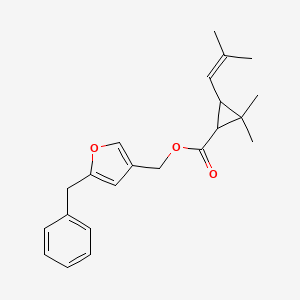
Resmethrin
Resmethrin is a member of furans and a cyclopropanecarboxylate ester. It has a role as an agrochemical and a pyrethroid ester insecticide. It is functionally related to a chrysanthemic acid. — ChEBI
- IUPAC name
- (5-benzylfuran-3-yl)methyl 2,2-dimethyl-3-(2-methylprop-1-enyl)cyclopropane-1-carboxylate
- Molecular formula
- C22H26O3
- Molecular weight
- 338.4 g/mol
- Exact mass
- 338.18819469 Da
- XLogP3
- 6.1
- Topological polar surface area
- 39.4 Ų
- Hydrogen-bond donors
- 0
- Hydrogen-bond acceptors
- 3
- Covalent units
- 1
- Defined stereocentres
- 0
Also known as
16 more reported names
External database identifiers
- ChEBI:CHEBI:8811
- ChEMBL:CHEMBL1879822
- EPA DTXSID:DTXSID7022253
- PubMed:36842454
- PubMed:32278787
- PubMed:31593228
- PubMed:28927721
- PubMed:26647222
- PubMed:23169446
- PubMed:22812138
- PubMed:22520572
- PubMed:22455560
- PubMed:22429776
- PubMed:22418650
- PubMed:22242119
Evidence from additional scientific databases
EMBL-EBI ChEBI
resmethrin
- Formula
- C22H26O3
- Average mass
- 338.447 g/mol
- Monoisotopic mass
- 338.18819 Da
- Formal charge
- 0
- furans — is a (CHEBI:24129)
- cyclopropanecarboxylate ester — is a (CHEBI:50351)
- pyrethroid ester insecticide — has role (CHEBI:39116)
- agrochemical — has role (CHEBI:33286)
- chrysanthemic acid — has functional parent (CHEBI:3680)
- pyrethroid ester insecticide — has role (CHEBI:39116)
- agrochemical — has role (CHEBI:33286)
- furans — is a (CHEBI:24129)
- cyclopropanecarboxylate ester — is a (CHEBI:50351)
Additional curated names
Cross-references from this source
- CAS: 10453-86-8 — ChemIDplus
- CAS: 10453-86-8 — KEGG COMPOUND
- REGISTRY_NUMBER: 1351757 — Beilstein
- MANUAL_X_REF: 585 — PPDB
- MANUAL_X_REF: C10991 — KEGG COMPOUND
- MANUAL_X_REF: D08475 — KEGG DRUG
- MANUAL_X_REF: LSM-1846 — LINCS
Mapped by: Exact CAS cross-reference in the ChEBI compound record. Source updated: 2016-10-28. Retrieved: 2026-08-31. Open source record
NIH PubChem PUG-View
Attributed physical-property, hazard, environmental and use annotations.
- Boiling Point: Decomposes at >180 °C Source: Hazardous Substances Data Bank (HSDB)
- Color/Form: Waxy off-white to tan solid Source: Hazardous Substances Data Bank (HSDB)
- Color/Form: Colorless crystals Source: Hazardous Substances Data Bank (HSDB)
- Density: 0.958-0.968 at 20 °C Source: Hazardous Substances Data Bank (HSDB)
- Density: Relative density (water = 1): 0.96 Source: ILO-WHO International Chemical Safety Cards (ICSCs)
- LogP: log Kow = 5.43 Source: Hazardous Substances Data Bank (HSDB)
- LogP: 3.46 Source: ILO-WHO International Chemical Safety Cards (ICSCs)
- Melting Point: 56.5 °C (pure (1-RS)-trans isomer) Source: Hazardous Substances Data Bank (HSDB)
- Melting Point: Mp: 43-48 °C (isomeric mixture with 20-30% cis and 80-70% trans) Source: Hazardous Substances Data Bank (HSDB)
- Melting Point: 43-48 °C Source: ILO-WHO International Chemical Safety Cards (ICSCs)
- Odor: Chrysanthemate odor Source: Hazardous Substances Data Bank (HSDB)
- Physical Description: Resmethrin appears as colorless crystals or waxy solid. Insoluble in water. Used as an insecticide. Source: CAMEO Chemicals
- Physical Description: Colorless solid; [ICSC] Colorless or off-white to tan solid; [HSDB] Source: Haz-Map, Information on Hazardous Chemicals and Occupational Diseases
- Physical Description: COLOURLESS WAXY SOLID IN VARIOUS FORMS WITH CHARACTERISTIC ODOUR. Source: ILO-WHO International Chemical Safety Cards (ICSCs)
- Physical Description: Waxy white to tan solid; colorless crystals. Source: Occupational Safety and Health Administration (OSHA)
- Refractive Index: Refractive index at 20 °C= 1.5287 Source: Hazardous Substances Data Bank (HSDB)
- Solubility: Very sol in xylene and aromatic petroleum hydrocarbons; solubility in kerosene 10% Source: Hazardous Substances Data Bank (HSDB)
- Solubility: Insol in water at 25 °C; methylene chloride at 25 °C: greater than 50% wt/wt; in acetone at 25 °C: greater than 50% wt/wt; in ethanol and isopropanol 8 and 7%, /respectively/ Source: Hazardous Substances Data Bank (HSDB)
- Solubility: In water, 0.0379 mg/L at 25 °C Source: Hazardous Substances Data Bank (HSDB)
- Solubility: Solubility in water: none Source: ILO-WHO International Chemical Safety Cards (ICSCs)
- Vapor Pressure: 0.00000001 [mmHg] Source: Haz-Map, Information on Hazardous Chemicals and Occupational Diseases
- Vapor Pressure: 1.13X10⁻⁸ mm Hg at 30 °C Source: Hazardous Substances Data Bank (HSDB)
- Vapor Pressure: Vapor pressure, Pa at 20 °C: Source: ILO-WHO International Chemical Safety Cards (ICSCs)
- Carcinogen Classification: No indication of carcinogenicity to humans (not listed by IARC). Source: Toxin and Toxin Target Database (T3DB)
- Exposure Routes: The substance can be absorbed into the body by inhalation of its aerosol and by ingestion. Source: ILO-WHO International Chemical Safety Cards (ICSCs)
- Exposure Routes: Inhalation (L857) ; oral (L857) ; dermal (L857) ; eye contact (L857). Source: Toxin and Toxin Target Database (T3DB)
- First Aid: Excerpt from ERG Guide 171 [Substances (Low to Moderate Hazard)]:; Refer to the "General First Aid" section. (ERG, 2024) Source: CAMEO Chemicals
- Signal: Warning Source: Regulation (EC) No 1272/2008 of the European Parliament and of the Council
- GHS Hazard Statements: H302: Harmful if swallowed [Warning Acute toxicity, oral]; H400: Very toxic to aquatic life [Warning Hazardous to the aquatic environment, acute hazard]; H410: Very toxic to aquatic life with long lasting effects [Warning Hazardous to the aquatic environment, long-term hazard] Source: Regulation (EC) No 1272/2008 of the European Parliament and of the Council
- Precautionary Statement Codes: P264, P270, P273, P301+P317, P330, P391, and P501 (click each P-code to see the statement) Source: Regulation (EC) No 1272/2008 of the European Parliament and of the Council
- Signal: Warning Source: European Chemicals Agency (ECHA)
- GHS Hazard Statements: H302 (100%): Harmful if swallowed [Warning Acute toxicity, oral]; H400 (100%): Very toxic to aquatic life [Warning Hazardous to the aquatic environment, acute hazard]; H410 (100%): Very toxic to aquatic life with long lasting effects [Warning Hazardous to the aquatic environment, long-term hazard] Source: European Chemicals Agency (ECHA)
- Precautionary Statement Codes: P264, P270, P273, P301+P317, P330, P391, and P501 (click each P-code to see the statement) Source: European Chemicals Agency (ECHA)
- ECHA C&L Notifications Summary: Aggregated GHS information provided per 47 reports by companies from 4 notifications to the ECHA C&L Inventory. Each notification may be associated with multiple companies.; Information may vary between notifications depending on impurities, additives, and other factors. The percentage value in parenthesis indicates the notified classification ratio from companies that provide hazard codes. Only hazard codes with percentage values above 10% are shown. For more detailed information, please visit ECHA C&L website. Source: European Chemicals Agency (ECHA)
- Signal: Warning Source: NITE-CMC
- GHS Hazard Statements: H302: Harmful if swallowed [Warning Acute toxicity, oral]; H361: Suspected of damaging fertility or the unborn child [Warning Reproductive toxicity]; H371: May cause damage to organs [Warning Specific target organ toxicity, single exposure]; H373: May causes damage to organs through prolonged or repeated exposure [Warning Specific target organ toxicity, repeated exposure] Source: NITE-CMC
- Precautionary Statement Codes: P203, P260, P264, P270, P280, P301+P317, P308+P316, P318, P319, P330, P405, and P501 (click each P-code to see the statement) Source: NITE-CMC
- Signal: Warning Source: Hazardous Chemical Information System (HCIS), Safe Work Australia
- GHS Hazard Statements: H302: Harmful if swallowed [Warning Acute toxicity, oral]; H410: Very toxic to aquatic life with long lasting effects [Warning Hazardous to the aquatic environment, long-term hazard] Source: Hazardous Chemical Information System (HCIS), Safe Work Australia
- Health Effects: Pyrethroid effects typically include rapid onset of aggressive behavior and increased sensitivity to external stimuli, followed by fine tremor, prostration with coarse whole body tremor, elevated body temperature, coma, and death. Paresthesia, severe corneal damage, hypotension and tachycardia, associated with anaphylaxis, can also occur following pyrethriod poisoning. (L857) Source: Toxin and Toxin Target Database (T3DB)
- Health Effects: As for every type I pyrethroid, bioresmethrin effects typically include rapid onset of aggressive behavior and increased sensitivity to external stimuli, followed by fine tremor, prostration with coarse whole body tremor, elevated body temperature, coma, and death. (L857) Source: Toxin and Toxin Target Database (T3DB)
- Target Organs: Reproductive Source: EPA Integrated Risk Information System (IRIS)
- Toxicity Summary: Both type I and type II pyrethroids exert their effect by prolonging the open phase of the sodium channel gates when a nerve cell is excited. They appear to bind to the membrane lipid phase in the immediate vicinity of the sodium channel, thus modifying the channel kinetics. This blocks the closing of the sodium gates in the nerves, and thus prolongs the return of the membrane potential to its resting state. The repetitive (sensory, motor) neuronal discharge and a prolonged negative afterpotential produces effects quite similar to those produced by DDT, leading to hyperactivity of the nervous system which can result in paralysis and/or death. Other mechanisms of action of pyrethroids include antagonism of gamma-aminobutyric acid (GABA)-mediated inhibition, modulation of nicotinic cholinergic transmission, enhancement of noradrenaline release, and actions on calcium ions. They also inhibit calium channels and Ca2+, Mg2+-ATPase. (T10, T18, L857) Source: Toxin and Toxin Target Database (T3DB)
- Toxicity Summary: Pyrethroids exert their effect by prolonging the open phase of the sodium channel gates when a nerve cell is excited. They appear to bind to the membrane lipid phase in the immediate vicinity of the sodium channel, thus modifying the channel kinetics. This blocks the closing of the sodium gates in the nerves, and thus prolongs the return of the membrane potential to its resting state. The repetitive (sensory, motor) neuronal discharge and a prolonged negative afterpotential produces effects quite similar to those produced by DDT, leading to hyperactivity of the nervous system which can result in paralysis and/or death. Other mechanisms of action of pyrethroids include antagonism of gamma-aminobutyric acid (GABA)-mediated inhibition, modulation of nicotinic cholinergic transmission, enhancement of noradrenaline release, and actions on calcium ions. (T18, L857) Source: Toxin and Toxin Target Database (T3DB)
- Environmental Bioconcentration: An estimated BCF of 98 was calculated for resmethrin(SRC), using a log Kow of 5.43(1) and a regression derived equation(2). According to a classification scheme(3), this BCF suggests the potential for bioconcentration in aquatic organisms is moderate(SRC). Source: Hazardous Substances Data Bank (HSDB)
- Environmental Fate: TERRESTRIAL FATE: Based on a classification scheme(1), an estimated Koc value of 3.1X10+5(SRC), determined from a measured log Kow of 5.43(2) and a regression derived equation(3), indicates that resmethrin is expected to be immobile in soil(SRC). Volatilization of resmethrin from moist soil surfaces is not expected to be an important fate process(SRC) given an estimated Henry's Law constant of 1.3X10⁻⁷ atm-cu m/mole(SRC), calculated from its vapor pressure, 1.1X10⁻⁸ mm Hg(4), and water solubility, 0.0379 mg/L(2). Resmethrin is not expected to volatilize from dry soil surfaces(SRC) based upon its vapor pressure(2). Hydrolysis in moist soil surfaces is expected to be an important fate process for resmethrin under alkaline conditions(SRC). The second order aqueous hydrolysis rate constant for resmethrin has been estimated to be 0.17 L/mole sec at 25 °C(SRC) using a structure estimation method(7), which corresponds to aqueous hydrolysis half-lives of 1.3 yrs, and 47 days at pH 7 and 8, respectively(SRC). Photolysis may also be an important fate process for this compound on soil surfaces(SRC). The photolysis half-life of resmethrin films on glass plates ranged from about 20 to 90 minute Source: Hazardous Substances Data Bank (HSDB)
- Environmental Fate: TERRESTRIAL FATE: Resmethin is expected to have a 30-day half-life in soil based on values of other pyrethroid compounds(1). Source: Hazardous Substances Data Bank (HSDB)
- Environmental Fate: AQUATIC FATE: Based on a classification scheme(1), an estimated Koc value of 3.1X10+5(SRC), determined from a log Kow of 5.43(2) and a regression-derived equation(3), indicates that resmethrin is expected to adsorb to suspended solids and sediment(SRC). Volatilization from water surfaces is not expected(4) based upon an estimated Henry's Law constant of 1.3X10⁻⁷ atm-cu m/mole(SRC), derived from its vapor pressure, 1.13X10⁻⁸ mm Hg(5), and water solubility of 0.0379 mg/L(2). According to a classification scheme(6), an estimated BCF of 98 days(SRC), from its log Kow(2) and a regression-derived equation(7), suggests the potential for bioconcentration in aquatic organisms is moderate(SRC). Hydrolysis is expected to be an important environmental fate process for resmethrin, particularly in alkaline waters(SRC). The second-order aqueous hydrolysis half-lives are 1.3 yrs and 47 days at pH 7 and 8, respectively(SRC), using a structure estimation method(8). Photolysis on surface waters is also expected to be an important fate process(SRC). The predicted near-surface half-life for the photosensitized oxidation of resmethrin in natural water has been reported as 0.2 hrs(9). Although biodegrada Source: Hazardous Substances Data Bank (HSDB)
- Environmental Fate: ATMOSPHERIC FATE: According to a model of gas/particle partitioning of semivolatile organic compounds in the atmosphere(1), resmethrin, which has a vapor pressure of 1.13X10⁻⁸ mm Hg at 30 °C(2) is expected to exist solely in the particulate phase in the ambient atmosphere. Particulate-phase resmethrin may be removed from the air by wet or dry deposition. Resmethrin undergoes rapid photolysis in the environment with half-lives on the order of several minutes to a few hours(3-5). Source: Hazardous Substances Data Bank (HSDB)
- Sources/Uses: Used as insecticide for control of household and public health pests (including aerial application for mosquitoes) in residential, commercial, and industrial areas, animal dwellings, food handling/ storage facilities, and greenhouses; Also used for domestic and farm animals (in sprays and shampoos) and fabric protection; [HSDB] Source: Haz-Map, Information on Hazardous Chemicals and Occupational Diseases
- Restricted Notes: Use restricted to certified applicators; Not registered in the US for agricultural applications; [HSDB] Source: Haz-Map, Information on Hazardous Chemicals and Occupational Diseases
- Industrial Processes with risk of exposure: Farming (Pesticides) [Category: Industry]; Textiles (Printing, Dyeing, or Finishing) [Category: Industry] Source: Haz-Map, Information on Hazardous Chemicals and Occupational Diseases
- Uses: End-use products intended for wide area mosquito abatement programs /are/ Restricted Use Pesticides due to acute fish toxicity. For retail sale to and use only by certified applicators or persons under their direct supervision and only for those uses covered by the certified applicator's certification. Source: Hazardous Substances Data Bank (HSDB)
- Uses: For resmethrin (USEPA/OPP Pesticide Code: 097801) ACTIVE products with label matches. /SRP: Registered for use in the U.S. but approved pesticide uses may change periodically and so federal, state and local authorities must be consulted for currently approved uses./ Source: Hazardous Substances Data Bank (HSDB)
- Uses: Resmethrin is a synthetic Type I pyrethroid insecticide registered for control of insects in residential, commercial and industrial settings, and in animal living areas. Resmethrin is also registered for use in food handling establishments and as a restricted use pesticide when used in ULV spray to control adult mosquitoes in the interest of public health. Source: Hazardous Substances Data Bank (HSDB)
- Uses: Food uses include crack and crevice spray and enclosed space fog in food handling establishments such as food processing/handling plants, restaurants, commercial food item transportation, and food storage facilities. There are no agricultural uses registered for resmethrin. Source: Hazardous Substances Data Bank (HSDB)
- Uses: For more Uses (Complete) data for RESMETHRIN (16 total), please visit the HSDB record page. Source: Hazardous Substances Data Bank (HSDB)
- Uses: Pyrethroids are used as insecticides. (L857) Source: Toxin and Toxin Target Database (T3DB)
Mapped by: Existing checksum-valid CAS to unique PubChem CID match. Retrieved: 2026-08-31. Open source record
Scientific classifications and hazard annotations provide context and do not replace the market-specific regulatory decision shown above.
Additional source coverage and match status
| Source | Result | Checked |
|---|---|---|
| EMBL-EBI ChEBI | Exact match | 2026-08-31 |
| NIH PubChem PUG-View | Exact match | 2026-08-31 |
A recorded no-match is useful evidence that the source was checked; it is not a claim that the substance does not exist elsewhere.
Retrieved from NIH PubChem on 2026-08-31 by checksum-valid CAS matching. Chemical properties do not replace the regulatory decision on this page.