
Official EU label nameGlossary entry 13329
HYDROXYPROPYL BIS(N-HYDROXYETHYL-P-PHENYLENEDIAMINE) HCl
This record confirms an official common ingredient name for EU cosmetic product labelling. It does not by itself confirm that the substance is permitted, unrestricted or safe.
Global evidence snapshot
The resolved identity has matching regulatory evidence in 7 of 13 indexed market datasets: 9 country records and 1 EU Annex records. Every result and evidence gap is listed below.
Markets checked
13
Markets with evidence
7
Evidence gaps
6
Resolved identifiers
3
Resolved substance identity
CAS:128729-28-2128729-30-6
EC:416-320-2
Ingredient index records:
HYDROXYPROPYL BIS(N-HYDROXYETHYL-P-PHENYLENEDIAMINE) HCL
Cosmetic functions: HAIR DYEING
1,4-Benzenediamine, N(4)-(2-hydroxyethyl)-N(1),N'(1)-[2-hydroxypropanediyl]-
Inventory restriction note: III/239
9 matched or reported names
HYDROXYPROPYL BIS(N-HYDROXYETHYL-P-PHENYLENEDIAMINE) HCLHydroxypropyl bis(N-hydroxyethyl-p-phenylenediamine) and its tetrahydro-chlorideHydroxypropyl bis(N-hydroxyethyl-p-phenylenediamine) HClHydroxypropyl bis(N-hydroxyethyl-p-phenylenediamine) and its tetrahydrochloride (HCl)Hydroxypropyl bis(N-hydroxyethyl-p- phenylenediamine) and its tetrahydrochloride Hydroxypropyl bis(N-hydroxyethyl-p- phenylenediamine) HCl CAS No 128729-30-6 / 128729-28-2히드록시프로필 비스(N-히드록시에칠-p-페닐렌디아민) 및 그 염류1)염산 히드록시프로필비스(N-히드록시에칠-p-페닐렌디아민)히드록시프로필비스(N-히드록시에칠-p-페닐렌디아민) 및 그 염류Hydroxypropyl bis(N- hydroxyethyl-p-phenylened- iamine) and its tetrahydrochloride Hydroxypropyl bis(N- hydroxyethyl-p-phenylened- iamine) (CAS No. 128729-30-6) Hydroxypropyl bis(N- hydroxyethyl-p-phenylened- iamine) HCl (CAS No. 128729-28-2)
Regulatory evidence in all 13 markets
Open each matched record for its scope, concentration, conditions, warnings and official source version.
Swipe or scroll horizontally to see dataset coverage and next actions.
| Market | Result | Records | Dataset | Meaning / next action |
|---|---|---|---|---|
| European Union EU | Restricted | 1Open record 1 | Complete annex dataset Regulation (EC) 1223/2009 consolidated to 1 May 2026 | Review every linked record and exact conditions. |
| Great Britain GB | Restricted | 1Open record 1 | Complete consolidated annex dataset GB retained Regulation 1223/2009 schedules, effective 15 August 2026 | Review every linked record and exact conditions. |
| Canada CA | No local match | 0 | Complete Hotlist snapshot Health Canada Cosmetic Ingredient Hotlist, 13 August 2025 | The Hotlist is an administrative compliance tool, not an exhaustive safety approval list. |
| New Zealand NZ | Restricted | 2Open record 1Open record 2 | Complete schedules dataset Cosmetic Products Group Standard schedules effective 1 January 2026 | Review every linked record and exact conditions. |
| ASEAN ASEAN | Restricted | 1Open record 1 | Complete regional annex dataset ASEAN Cosmetic Directive annexes 2026-1, 22 June 2026 | Review every linked record and exact conditions. |
| China CN | No local match | 0 | Complete prohibited catalogues plus official-source workflow NMPA 2021 banned catalogues plus dynamic IECIC List I/List II system current since 2025 | IECIC listing is not blanket approval; absence may require the new cosmetic ingredient route, and restrictions are checked separately. |
| Japan JP | No local match | 0 | Complete Standards appendices dataset MHLW Standards for Cosmetics official English source and Japanese amendments checked for the imported snapshot | The Japanese text and subsequent notices are canonical; no local match is not a product-compliance conclusion. |
| South Korea KR | Prohibited | 3Open record 1Open record 2 | Complete current appendix dataset MFDS Notice 2026-19, effective 18 March 2026 | Review every linked record and exact conditions. |
| United States US | No local match | 0 | Complete enumerated federal ingredient rules eCFR Title 21 issue date 27 August 2026 | FDA has no general approved-cosmetic-ingredient catalogue; absence from these sections is not approval or proof of safety. |
| Australia AU | No local match | 0 | Complete cosmetic-relevant Poisons Standard subset plus official workflow Therapeutic Goods (Poisons Standard—June 2026) Instrument 2026 | An AICIS Inventory match is not cosmetic approval; no Inventory match can indicate a new, exempted, reported or confidential introduction. |
| Brazil BR | No local match | 0 | Complete prohibited dataset plus current restricted-list workflow ANVISA RDC 1.029/2026 and RDC 1.030/2026, published 15 June 2026 | RDC 1.030/2026 amends rather than replaces the prohibited baseline, and the second restricted-list revision was still under consultation in July 2026. |
| India IN | Restricted | 1Open record 1 | Complete current Part 2 dataset plus official workflow for Parts 1, 3 and 4 Cosmetics Rules 2020 plus current BIS IS 4707 parts (1:2020, 2:2025, 3:2025, 4:2022) | Review every linked record and exact conditions. |
| Saudi Arabia SA | Restricted | 1Open record 1 | Complete official list index SFDA live prohibited/restricted lists, snapshot 30 August 2026 | Review every linked record and exact conditions. |
No market rows match this filter.
Matching market records and conditions
Great Britain
GB retained Regulation 1223/2009 schedules, effective 15 August 2026New Zealand
Cosmetic Products Group Standard schedules effective 1 January 2026Hydroxypropyl bis(N-hydroxyethyl-p-phenylenediamine) and its tetrahydrochloride (HCl)Restricted
Product scope: Hair dye substance in oxidative hair dye products · Maximum concentration: After mixing under oxidative conditions the maximum concentration applied to hair must not exceed 0.4% (as tetrahydrochloride) · Warnings: The mixing ratio. ⚠Hair colourants can cause seve…
Schedule 5, reference 239, source row 289 · effective-2026-01-01
Hydroxypropyl bis(N-hydroxyethyl-p-phenylenediamine) and its tetrahydrochloride (HCl)Restricted
Product scope: Hair dye substance in oxidative hair dye products · Maximum concentration: After mixing under oxidative conditions the maximum concentration applied to hair must not exceed 0.4% (as tetrahydrochloride) · Warnings: The mixing ratio. ⚠Hair colourants can cause seve…
Schedule 5, reference 239, source row 290 · effective-2026-01-01
ASEAN
ASEAN Cosmetic Directive annexes 2026-1, 22 June 2026South Korea
MFDS Notice 2026-19, effective 18 March 2026히드록시프로필 비스(N-히드록시에칠-p-페닐렌디아민) 및 그 염류1)Prohibited
히드록시프로필비스(N-히드록시에칠-p-페닐렌디아민)
화장품 안전기준 등에 관한 규정, 별표 1, record 1-1240 · 2026-19
염산 히드록시프로필비스(N-히드록시에칠-p-페닐렌디아민)Restricted
산화염모제에 0.4% · 기타 제품에는 사용금지
화장품 안전기준 등에 관한 규정, 별표 2, record 2-184 · 2026-19
히드록시프로필비스(N-히드록시에칠-p-페닐렌디아민) 및 그 염류Restricted
산화염모제에서 테트라하이드 로클로라이드 염으로서 0.4% 이하 · 기타제품에는 사용금지 · 히드록시프로필비스(N-히드록시에칠-p-페닐렌디아민)
화장품 안전기준 등에 관한 규정, 별표 2, record 2-248 · 2026-19
India
Cosmetics Rules 2020 plus current BIS IS 4707 parts (1:2020, 2:2025, 3:2025, 4:2022)Saudi Arabia
SFDA live prohibited/restricted lists, snapshot 30 August 2026Exact Annex II–VI evidence
Annex IIIentry 239
Open full regulatory recordHYDROXYPROPYL BIS(N-HYDROXYETHYL-P-PHENYLENEDIAMINE) HCL
Product scope: Hair dye substance in oxidative hair dye products
Restrictions: After mixing under oxidative conditions the maximumconcentration applied to hair must not exceed 0.4% (as tetrahydro-chloride)
Warnings: Hair colourants can cause severe allergic reactions Read and follow instructions
Chemical identity and properties
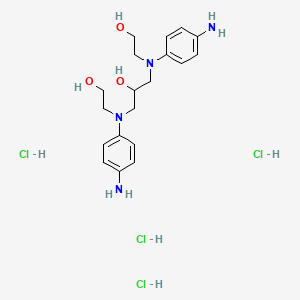
CAS 128729-28-2PubChem CID 21932462
Hydroxypropyl bis(N-hydroxyethyl-p-phenylenediamine) hydrochloride
- IUPAC name
- 1,3-bis[4-amino-N-(2-hydroxyethyl)anilino]propan-2-ol;tetrahydrochloride
- Molecular formula
- C19H32Cl4N4O3
- Molecular weight
- 506.3 g/mol
- Exact mass
- 506.119902 Da
- Topological polar surface area
- 119.0 Ų
- Hydrogen-bond donors
- 9
- Hydrogen-bond acceptors
- 7
- Covalent units
- 5
- Defined stereocentres
- 0
Also known as
Imexine OAXUNII-0K832J58E7Hydroxypropyl bis(N-hydroxyethyl-p-phenylenediamine) HCl0K832J58E72-Propanol, 1,3-bis((4-aminophenyl)(2-hydroxyethyl)amino)-, tetrahydrochloride1,3-Bis-((4-amino-phenyl)-(2-hydroxy-ethyl)-amino)-propan-2-ol, tetrahydrochloride2-Propanol, 1,3-bis((4-aminophenyl)(2-hydroxyethyl)amino)-, hydrochloride (1:4)RefChem:147262
9 more reported names
HYDROXYPROPYL BIS(N-HYDROXYETHYL-P-PHENYLENEDIAMINE) HCL [INCI]416-320-2Hydroxypropyl bis (N-Hydroxyethyl-p-phenylenediamine Hydrochloride) (>90%)2,2'-((2-Hydroxypropane-1,3-diyl)bis((4-aminophenyl)azanediyl))diethanol tetrahydrochloride1,3-bis[(4-Aminophenyl)(2-hydroxyethyl)amino]-2-propanol TetrahydrochlorideGATCALZBQPZIFW-UHFFFAOYSA-NHydroxypropyl bis (N-Hydroxyethyl-p-phenylenediamine Hydrochloride)1,3-Bis[(4-aminophenyl)(2-hydroxyethyl)amino]propan-2-ol--hydrogen chloride (1/4)2-Propanol,1,3-bis[(4-aminophenyl)(2-hydroxyethyl)amino]-, tetrahydrochloride
External database identifiers
- EPA DTXSID:DTXSID30155976
Evidence from additional scientific databases
NIH PubChem PUG-View
Exact identifier match21932462
Attributed physical-property, hazard, environmental and use annotations.
- Signal: Danger Source: European Chemicals Agency (ECHA)
- GHS Hazard Statements: H315 (100%): Causes skin irritation [Warning Skin corrosion/irritation]; H317 (100%): May cause an allergic skin reaction [Warning Sensitization, Skin]; H318 (100%): Causes serious eye damage [Danger Serious eye damage/eye irritation]; H400 (100%): Very toxic to aquatic life [Warning Hazardous to the aquatic environment, acute hazard]; H410 (100%): Very toxic to aquatic life with long lasting effects [Warning Hazardous to the aquatic environment, long-term hazard] Source: European Chemicals Agency (ECHA)
- Precautionary Statement Codes: P261, P264, P264+P265, P272, P273, P280, P302+P352, P305+P354+P338, P317, P321, P332+P317, P333+P317, P362+P364, P391, and P501 (click each P-code to see the statement) Source: European Chemicals Agency (ECHA)
- ECHA C&L Notifications Summary: Aggregated GHS information provided per 2 reports by companies from 2 notifications to the ECHA C&L Inventory. Each notification may be associated with multiple companies.; Information may vary between notifications depending on impurities, additives, and other factors. The percentage value in parenthesis indicates the notified classification ratio from companies that provide hazard codes. Only hazard codes with percentage values above 10% are shown. For more detailed information, please visit ECHA C&L website. Source: European Chemicals Agency (ECHA)
- ECHA C&L Notifications Summary: The GHS information provided by 1 company from 1 notification to the ECHA C&L Inventory. Source: European Chemicals Agency (ECHA)
- Cosmetic Ingredient Review Finding(s): Safe in the present practices of use and concentration. Ingredient, concentration, and use information are available in documents discoverable at https://cir-reports.cir-safety.org Source: Cosmetic Ingredient Review (CIR)
- Cosmetic Ingredient Review Link: CIR ingredient: Hydroxypropyl Bis(N-Hydroxyethyl-p-Phenylenediamine) HCl Source: Cosmetic Ingredient Review (CIR)
Mapped by: Existing checksum-valid CAS to unique PubChem CID match. Retrieved: 2026-08-31. Open source record
Scientific classifications and hazard annotations provide context and do not replace the market-specific regulatory decision shown above.
Additional source coverage and match status
| Source | Result | Checked |
|---|---|---|
| NIH PubChem PUG-View | Exact match | 2026-08-31 |
A recorded no-match is useful evidence that the source was checked; it is not a claim that the substance does not exist elsewhere.
Retrieved from NIH PubChem on 2026-09-02 by checksum-valid CAS matching. Chemical properties do not replace the regulatory decision on this page.
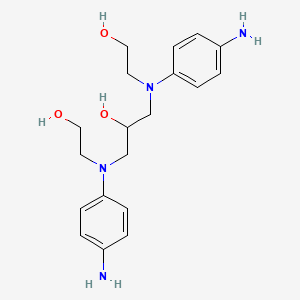
CAS 128729-30-6PubChem CID 9885240
1,3-Bis((4-aminophenyl)-(2-hydroxyethyl)-amino)-propan-2-ol
- IUPAC name
- 1,3-bis[4-amino-N-(2-hydroxyethyl)anilino]propan-2-ol
- Molecular formula
- C19H28N4O3
- Molecular weight
- 360.5 g/mol
- Exact mass
- 360.21614077 Da
- XLogP3
- 0.5
- Topological polar surface area
- 119.0 Ų
- Hydrogen-bond donors
- 5
- Hydrogen-bond acceptors
- 7
- Covalent units
- 1
- Defined stereocentres
- 0
Also known as
UNII-632K3X0904632K3X09042-Propanol, 1,3-bis((4-aminophenyl)(2-hydroxyethyl)amino)-1,3-Bis(N-(4-aminophenyl)-N-(2-hydroxyethyl)amino)-2-propanol1,3-bis[(4-aminophenyl)(2-hydroxyethyl)amino]propan-2-ol2-aPropanol, 1,a3-abis[(4-aaminophenyl)a(2-ahydroxyethyl)aamino]a-
External database identifiers
- EPA DTXSID:DTXSID90879823
Evidence from additional scientific databases
NIH PubChem PUG-View
Exact identifier match9885240
Attributed physical-property, hazard, environmental and use annotations.
Mapped by: Existing checksum-valid CAS to unique PubChem CID match. Retrieved: 2026-08-31. Open source record
Scientific classifications and hazard annotations provide context and do not replace the market-specific regulatory decision shown above.
Additional source coverage and match status
| Source | Result | Checked |
|---|---|---|
| NIH PubChem PUG-View | Exact match | 2026-08-31 |
A recorded no-match is useful evidence that the source was checked; it is not a claim that the substance does not exist elsewhere.
Retrieved from NIH PubChem on 2026-09-02 by checksum-valid CAS matching. Chemical properties do not replace the regulatory decision on this page.
Additional authoritative substance research
Each link searches that source for this identity. A link is a research route, not a claim that the source holds an exact record. What each source is, and its legal weight
Take this record further
Official source and scope
Imported from Commission Implementing Decision (EU) 2025/1175 (dataset version EU 2025/1175). The glossary supplies common ingredient names for the ingredient list required by Article 19(1)(g); it is not an approval or safety list.
Open official Decision