
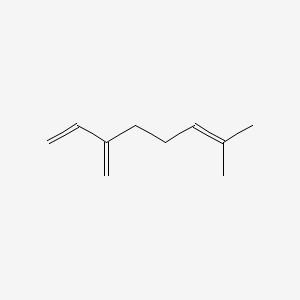
Myrcene
Beta-myrcene is a monoterpene that is octa-1,6-diene bearing methylene and methyl substituents at positions 3 and 7 respectively. It has a role as a volatile oil component, a flavouring agent, an anabolic agent, a fragrance, an anti-inflammatory agent and a plant metabolite. — ChEBI
- IUPAC name
- 7-methyl-3-methylideneocta-1,6-diene
- Molecular formula
- C10H16
- Molecular weight
- 136.23 g/mol
- Exact mass
- 136.125200510 Da
- XLogP3
- 4.3
- Topological polar surface area
- 0.0 Ų
- Hydrogen-bond donors
- 0
- Hydrogen-bond acceptors
- 0
- Covalent units
- 1
- Defined stereocentres
- 0
Also known as
16 more reported names
External database identifiers
- ChEBI:CHEBI:17221
- ChEMBL:CHEMBL455491
- EPA DTXSID:DTXSID6025692
- PubMed:38000518
- PubMed:23018851
- PubMed:22985393
- PubMed:22980106
- PubMed:22978240
- PubMed:22945026
- PubMed:22835693
- PubMed:22799102
- PubMed:22701361
- PubMed:22659460
- PubMed:22654405
- PubMed:22539043
Evidence from additional scientific databases
NIH PubChem PUG-View
Attributed physical-property, hazard, environmental and use annotations.
- Boiling Point: 332.6 °F at 760 mmHg (USCG, 1999) Source: CAMEO Chemicals
- Boiling Point: 167 °C Source: Hazardous Substances Data Bank (HSDB)
- Boiling Point: 166.00 to 167.00 °C. @ 760.00 mm Hg Source: Human Metabolome Database (HMDB)
- Boiling Point: 166-167 °C Source: Joint FAO/WHO Expert Committee on Food Additives (JECFA)
- Color/Form: Yellow, oily liquid Source: Hazardous Substances Data Bank (HSDB)
- Density: 0.794 at 20 °C/4 °C Source: Hazardous Substances Data Bank (HSDB)
- Density: Density: 0.7959 at 25 °C/25 °C; max absorption (isooctane): 224.5 nm /alpha-Myrcene/ Source: Hazardous Substances Data Bank (HSDB)
- Density: 0.789-0.793 Source: Joint FAO/WHO Expert Committee on Food Additives (JECFA)
- Flash Point: 103 °F (USCG, 1999) Source: CAMEO Chemicals
- LogP: log Kow = 4.33 Source: Hazardous Substances Data Bank (HSDB)
- LogP: 4.17 Source: Human Metabolome Database (HMDB)
- Melting Point: < -10 °C Source: Hazardous Substances Data Bank (HSDB)
- Melting Point: < -10 °C Source: Human Metabolome Database (HMDB)
- Odor: Pleasant Source: Hazardous Substances Data Bank (HSDB)
- Odor: Terpene odor Source: Hazardous Substances Data Bank (HSDB)
- Physical Description: Myrcene, [liquid] appears as a yellow oily liquid with a pleasant odor. Flash point below 200 °F. Insoluble in water and less dense than water. Source: CAMEO Chemicals
- Physical Description: Liquid Source: EPA Chemical Data Reporting (CDR)
- Physical Description: Yellow liquid with a pleasant odor; [Hawley] Source: Haz-Map, Information on Hazardous Chemicals and Occupational Diseases
- Physical Description: Liquid Source: Human Metabolome Database (HMDB)
- Physical Description: Colourless or very pale straw-coloured mobile liquid; sweet balsamic aroma Source: Joint FAO/WHO Expert Committee on Food Additives (JECFA)
- Refractive Index: Triply unsaturated aliphatic hydrocarbon; Index of refraction: 1.471 at 20 °C (81% Myrcene) Source: Hazardous Substances Data Bank (HSDB)
- Refractive Index: Index of refraction: 1.4709 at 20 °C; max absorption (ethanol): 226 nm (epsilon = 16,100) Source: Hazardous Substances Data Bank (HSDB)
- Refractive Index: 1.466-1.471 Source: Joint FAO/WHO Expert Committee on Food Additives (JECFA)
- Solubility: Soluble in alcohol, chloroform, ether, glacial acetic acid Source: Hazardous Substances Data Bank (HSDB)
- Solubility: Soluble in ethanol and benzene Source: Hazardous Substances Data Bank (HSDB)
- Solubility: Soluble in oxygenated and chlorinated solvents. Source: Hazardous Substances Data Bank (HSDB)
- Solubility: In water, 5.60 mg/L at 25 °C Source: Hazardous Substances Data Bank (HSDB)
- Solubility: In water, 4.09 mg/L at 25 °C Source: Hazardous Substances Data Bank (HSDB)
- Solubility: 0.0056 mg/mL at 25 °C Source: Human Metabolome Database (HMDB)
- Solubility: Insoluble in water; soluble in oils Source: Joint FAO/WHO Expert Committee on Food Additives (JECFA)
- Solubility: Soluble (in ethanol) Source: Joint FAO/WHO Expert Committee on Food Additives (JECFA)
- Vapor Pressure: 4.61 mmHg (USCG, 1999) Source: CAMEO Chemicals
- Vapor Pressure: 2.01 [mmHg] Source: Haz-Map, Information on Hazardous Chemicals and Occupational Diseases
- Vapor Pressure: 2.09 mm Hg at 25 °C Source: Hazardous Substances Data Bank (HSDB)
- IARC Carcinogenic Agent: β-Myrcene Source: International Agency for Research on Cancer (IARC)
- IARC Carcinogenic Classes: Group 2B: Possibly carcinogenic to humans Source: International Agency for Research on Cancer (IARC)
- IARC Monographs: Volume 119: (2019) Some Chemicals That Cause Tumours of the Urinary Tract in Rodents Source: International Agency for Research on Cancer (IARC)
- Publication Year: 2019 Source: International Agency for Research on Cancer (IARC)
- Evaluation Year: 2017 Source: International Agency for Research on Cancer (IARC)
- Substance: β-Myrcene Source: NTP Technical Reports
- NTP Technical Report: TR-557: Toxicology and Carcinogenesis Studies of beta-Myrcene (CASRN 123-35-3) in F344/N Rats and B6C3F1 Mice (Gavage Studies) (2010 ) Source: NTP Technical Reports
- Peer Review Date: 02/25/09 Source: NTP Technical Reports
- Conclusion for Male Rat: Clear Evidence Source: NTP Technical Reports
- Conclusion for Female Rat: Equivocal Evidence Source: NTP Technical Reports
- Conclusion for Male Mice: Clear Evidence Source: NTP Technical Reports
- Conclusion for Female Mice: Equivocal Evidence Source: NTP Technical Reports
- Exposure Routes: Dermal ; inhalation Source: Toxin and Toxin Target Database (T3DB)
- First Aid: INHALATION: Call for medical aid. Remove the victim to fresh air. If not breathing give artificial respiration. If breathing is difficult give oxygen.; SKIN: Wash with soap and copious amounts of water.; EYES: Immediately flush with copious amounts of water. Insure adequate flushing of the eyes by holding the eyelids open with the fingers. (USCG, 1999) Source: CAMEO Chemicals
- Signal: Danger Source: European Chemicals Agency (ECHA)
- GHS Hazard Statements: H226 (99.8%): Flammable liquid and vapor [Warning Flammable liquids]; H304 (99%): May be fatal if swallowed and enters airways [Danger Aspiration hazard]; H315 (85.6%): Causes skin irritation [Warning Skin corrosion/irritation]; H319 (85.5%): Causes serious eye irritation [Warning Serious eye damage/eye irritation]; H400 (14.6%): Very toxic to aquatic life [Warning Hazardous to the aquatic environment, acute hazard]; H412 (18.7%): Harmful to aquatic life with long lasting effects [Hazardous to the aquatic environment, long-term hazard] Source: European Chemicals Agency (ECHA)
- Precautionary Statement Codes: P210, P233, P240, P241, P242, P243, P264, P264+P265, P273, P280, P301+P316, P302+P352, P303+P361+P353, P305+P351+P338, P321, P331, P332+P317, P337+P317, P362+P364, P370+P378, P391, P403+P235, P405, and P501 (click each P-code to see the statement) Source: European Chemicals Agency (ECHA)
- ECHA C&L Notifications Summary: Aggregated GHS information provided per 2180 reports by companies from 35 notifications to the ECHA C&L Inventory. Each notification may be associated with multiple companies.; Information may vary between notifications depending on impurities, additives, and other factors. The percentage value in parenthesis indicates the notified classification ratio from companies that provide hazard codes. Only hazard codes with percentage values above 10% are shown. For more detailed information, please visit ECHA C&L website. Source: European Chemicals Agency (ECHA)
- Signal: Danger Source: NITE-CMC
- GHS Hazard Statements: H226: Flammable liquid and vapor [Warning Flammable liquids]; H315: Causes skin irritation [Warning Skin corrosion/irritation]; H319: Causes serious eye irritation [Warning Serious eye damage/eye irritation]; H351: Suspected of causing cancer [Warning Carcinogenicity]; H360: May damage fertility or the unborn child [Danger Reproductive toxicity]; H400: Very toxic to aquatic life [Warning Hazardous to the aquatic environment, acute hazard]; H410: Very toxic to aquatic life with long lasting effects [Warning Hazardous to the aquatic environment, long-term hazard] Source: NITE-CMC
- Precautionary Statement Codes: P203, P210, P233, P240, P241, P242, P243, P264, P264+P265, P273, P280, P302+P352, P303+P361+P353, P305+P351+P338, P318, P321, P332+P317, P337+P317, P362+P364, P370+P378, P391, P403+P235, P405, and P501 (click each P-code to see the statement) Source: NITE-CMC
- Signal: Warning Source: NITE-CMC
- GHS Hazard Statements: H226: Flammable liquid and vapor [Warning Flammable liquids]; H315: Causes skin irritation [Warning Skin corrosion/irritation]; H351: Suspected of causing cancer [Warning Carcinogenicity]; H361: Suspected of damaging fertility or the unborn child [Warning Reproductive toxicity] Source: NITE-CMC
- Precautionary Statement Codes: P203, P210, P233, P240, P241, P242, P243, P264, P280, P302+P352, P303+P361+P353, P318, P321, P332+P317, P362+P364, P370+P378, P403+P235, P405, and P501 (click each P-code to see the statement) Source: NITE-CMC
- Health Effects: Health effects may include dermatitis (A334). Source: Toxin and Toxin Target Database (T3DB)
- Toxicity Summary: Myrcene exhibits tyrosinase inhibitory activities, which plays an important role in neuromelanin formation (A2448). Source: Toxin and Toxin Target Database (T3DB)
- Environmental Bioconcentration: An estimated BCF of 334 was calculated in fish for myrcene(SRC), using a log Kow of 4.33(1) and a regression-derived equation(2). According to a classification scheme(3), this BCF suggests the potential for bioconcentration in aquatic organisms is high(SRC), provided the compound is not metabolized by the organism(SRC). Source: Hazardous Substances Data Bank (HSDB)
- Environmental Fate: THE INFLUENCE OF LIGHT & TEMP ON MONOTERPENE EMISSIONS FROM SLASH PINE WERE ASSESSED. QUANT PRESENT IN VAPOR PHASE WERE SUFFICIENT TO MEASURE RELIABLY. Source: Hazardous Substances Data Bank (HSDB)
- Environmental Fate: TERRESTRIAL FATE: Based on a classification scheme(1), an estimated Koc value of 1074(SRC), determined from a structure estimation method(2), indicates that myrcene is expected to have low mobility in soil(SRC). Volatilization of myrcene from moist soil surfaces is expected to be an important fate process(SRC) given an estimated Henry's Law constant of 0.0916 atm-cu m/mole(SRC), derived from its vapor pressure, 2.09 mm Hg(3), and water solubility, 4.09 mg/L(4). However, adsorption to soil may attenuate volatilization(SRC). Myrcene is expected to volatilize from dry soil surfaces(SRC) based upon the vapor pressure of 2.09 mm Hg at 25 °C(3). Myrcene, present at 100 mg/L, reached 82-92% of its theoretical BOD in 2 weeks using an activated sludge inoculum at 30 mg/L and the Japanese MITI test(5) which classifies the compound as readily biodegradable. Monoterpene compounds similar in structure to myrcene (limonene, pinene, terpinene, terpinolene) were readily degraded in aerobic batch experiments using forest soil(6). Source: Hazardous Substances Data Bank (HSDB)
- Environmental Fate: AQUATIC FATE: Based on a classification scheme(1), an estimated Koc value of 1074(SRC), determined from a structure estimation method(2), indicates that myrcene is expected to adsorb to suspended solids and sediment(SRC). Volatilization from water surfaces is expected(3) based upon an estimated Henry's Law constant of 0.0916 atm-cu m/mole(SRC), derived from its vapor pressure, 2.09 mm Hg(4), and water solubility, 4.09 mg/L(5). Using this Henry's Law constant and an estimation method(3), volatilization half-lives for a model river and model lake are 3.4 hours and 4.6 days, respectively(SRC). According to a classification scheme(6), an estimated BCF of 334(SRC), from its log Kow of 4.33(7) and a regression-derived equation(2), suggests the potential for bioconcentration in aquatic organisms is high(SRC), provided the compound is not metabolized by the organism(SRC). Myrcene is not expected to undergo hydrolysis in the environment due to the lack of functional groups that hydrolyze under environmental conditions(3). Myrcene, present at 100 mg/L, reached 82-92% of its theoretical BOD in 2 weeks using an activated sludge inoculum at 30 mg/L and the Japanese MITI test(8) which classifies Source: Hazardous Substances Data Bank (HSDB)
- Environmental Fate: ATMOSPHERIC FATE: According to a model of gas/particle partitioning of semivolatile organic compounds in the atmosphere(1), myrcene, which has a vapor pressure of 2.09 mm Hg at 25 °C(2), is expected to exist solely as a vapor in the ambient atmosphere. Vapor-phase myrcene is degraded in the atmosphere by reaction with photochemically-produced hydroxyl radicals, ozone and nitrate radicals(SRC); the half-life for the reaction with hydroxyl radicals is estimated to be 1.8 hrs(SRC), calculated from its rate constant of 2.15X10⁻¹⁰ cu cm/molecule-sec at 25 °C(3); the half-life for the reaction with ozone is estimated to be 34 minutes(SRC), calculated from its rate constant of 4.90X10⁻¹⁶ cu cm/molecule-sec(4); the half-life for the reaction with nitrate radicals in nighttime air is estimated to be 4 minutes(SRC), calculated from its rate constant of 1.10X10⁻¹¹ cu cm/molecule-sec(4). Hydroxyl radical and ozone oxidation of myrcene in the ambient atmosphere yields acetone, formaldehyde and formic acid as degradation products(5). Myrcene does not contain chromophores that absorb at wavelengths >290 nm(6), and therefore is not expected to be susceptible to direct photolysis by sunlight(SRC). Source: Hazardous Substances Data Bank (HSDB)
- Consumer Uses: Fragrance; Not Known or Reasonably Ascertainable; Odor agents Source: EPA Chemical Data Reporting (CDR)
- Industry Uses: Other; Intermediates; Not Known or Reasonably Ascertainable; Fragrance Source: EPA Chemical Data Reporting (CDR)
- Sources/Uses: Beta-myrcene: Found in oil of bay, verbena, hops, and other natural sources; Alpha-myrcene: Not found in nature; [Merck Index] Used as a fragrance, flavoring agent, insect repellent, and detergent additive; [HSDB] Source: Haz-Map, Information on Hazardous Chemicals and Occupational Diseases
- Uses: ... Myrcene is the starting material for a range of industrially important products, e.g., geraniol, nerol, linalool, and isophytol. ... Besides its main use as an intermediate for the production of terpene alcohols, myrcene is used in the production of terpene polymers, terpene-phenol resins, and terpene-maleate resins. It can also be used as a solvent or diluting agent for dyes and varnishes. Source: Hazardous Substances Data Bank (HSDB)
- Uses: Preparation of perfume chemicals and flavoring. Source: Hazardous Substances Data Bank (HSDB)
- Uses: INSECT REPELLENT Source: Hazardous Substances Data Bank (HSDB)
- Uses: Detergents Source: Hazardous Substances Data Bank (HSDB)
- Uses: For more Uses (Complete) data for MYRCENE (6 total), please visit the HSDB record page. Source: Hazardous Substances Data Bank (HSDB)
- Uses: Perfume chemicals and flavoring. Myrcene is the major constituent of oil of bay and hop which are used in the manufacture of alcoholic beverages. Myrcene is also present in lemon grass (Cymbopogon citratus), a plant widely used in Brazilian folk medicine. Recently, it was shown that myrcene is a very potent analgesic substance and might be an alternative to the already available analgesic drugs (T39, A2447). Source: Toxin and Toxin Target Database (T3DB)
Mapped by: Existing checksum-valid CAS to unique PubChem CID match. Retrieved: 2026-08-31. Open source record
Scientific classifications and hazard annotations provide context and do not replace the market-specific regulatory decision shown above.
Additional source coverage and match status
| Source | Result | Checked |
|---|---|---|
| NIH PubChem PUG-View | Exact match | 2026-08-31 |
A recorded no-match is useful evidence that the source was checked; it is not a claim that the substance does not exist elsewhere.
Retrieved from NIH PubChem on 2026-08-31 by checksum-valid CAS matching. Chemical properties do not replace the regulatory decision on this page.