
OCTOCRYLENE
2-Cyano-3,3-diphenyl acrylic acid 2-ethylhexyl ester / Octocrilene
OCTOCRYLENE appears in Annex VI as a positive-list UV filter entry for EU cosmetics. Maximum concentration in this record: a) 9% b) 10% Footnote (*3): Benzophenone as an impurity and/or degradation product of Octocrylene shall be kept at trace level..
Reading this entry
Octocrylene is permitted at 9% in sprays and 10% elsewhere, with a condition that is not about octocrylene at all: benzophenone arising as an impurity or degradation product must be kept to trace level.
- Propellant sprays: 9%. Other products: 10%.
- Benzophenone present as an impurity or a degradation product must be kept at trace level.
- That condition concerns a substance the formula never deliberately contains, so it is a raw-material and stability question.
- Benzophenone itself is prohibited in cosmetics, which is why the trace condition exists.
The concentration limits are unremarkable. The condition attached to them is not, because it governs something a formulator does not add. Octocrylene can carry benzophenone as a manufacturing impurity, and it can generate benzophenone as it degrades — and benzophenone is prohibited in cosmetics. The entry therefore requires that benzophenone, whether it arrives as an impurity or forms later, is kept at trace level.
That turns a compliance question into two practical ones. The first is about the raw material: supplier specification and certificate of analysis, because impurity content is set before the ingredient reaches the formula. The second is about stability, since degradation happens over a product's shelf life and in the conditions it is stored in — which means the answer at manufacture is not necessarily the answer at the end of a period after opening.
Article 17 of the regulation is the general provision behind this: the unintended presence of a prohibited substance is tolerated only where it is technically unavoidable under good manufacturing practice and the product remains safe. This entry makes that expectation explicit for one filter.
Checked against
Chemical identity and properties
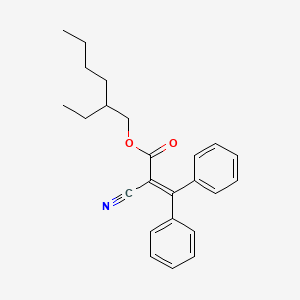
- IUPAC name
- 2-ethylhexyl 2-cyano-3,3-diphenylprop-2-enoate
- Molecular formula
- C24H27NO2
- Molecular weight
- 361.5 g/mol
- Exact mass
- 361.204179104 Da
- XLogP3
- 7.1
- Topological polar surface area
- 50.1 Ų
- Hydrogen-bond donors
- 0
- Hydrogen-bond acceptors
- 3
- Covalent units
- 1
- Defined stereocentres
- 0
Also known as
16 more reported names
External database identifiers
- ChEBI:CHEBI:135526
- ChEMBL:CHEMBL1201147
- EPA DTXSID:DTXSID9025299
- PubMed:34864131
- PubMed:32889307
- PubMed:23035447
- PubMed:22980125
- PubMed:22960810
- PubMed:22957488
- PubMed:22828885
- PubMed:22669305
- PubMed:22629203
- PubMed:22530300
- PubMed:22482479
- PubMed:22428874
Retrieved from NIH PubChem on 2026-09-02 by checksum-valid CAS matching. Chemical properties do not replace the regulatory decision on this page.
Record details
Maximum concentration
a) 9% b) 10% Footnote (*3): Benzophenone as an impurity and/or degradation product of Octocrylene shall be kept at trace level.
Product type
INCI glossary name
OCTOCRYLENE
Chemical name
2-Cyano-3,3-diphenyl acrylic acid 2-ethylhexyl ester / Octocrilene
Chemical / IUPAC name
2-Cyano-3,3-diphenyl acrylic acid 2-ethylhexyl ester / Octocrylene
Regulatory information
SCCS opinions
Identified ingredients
Key data
Inventory links for OCTOCRYLENE
Related records for OCTOCRYLENE
Alpha-Damascone/cis-Rose ketone 1/trans-Rose ketone 1; Rose ketone 4 (Damascone); Rose ketone 3 (de…
TITANIUM DIOXIDE
POTASSIUM CHLORATE / SODIUM CHLORATE
What Annex VI means for OCTOCRYLENE
OCTOCRYLENE is an approved UV filter listed in Annex VI of EU Cosmetics Regulation 1223/2009. Only UV filters included in this positive list may be used to provide UV protection in EU cosmetic products.
The maximum permitted concentration specified in this entry applies to the ready-to-use product. Some UV filters are restricted to specific application types or require label warnings.
This record is linked to 2 CosIng inventory ingredients for name and identifier cross-reference. The page also surfaces 12 related annex records with overlapping identifiers, annex logic or naming patterns.
Compliance checklist
- Concentration in ready-to-use product must not exceed: a) 9% b) 10% Footnote (*3): Benzophenone as an impurity and/or degradation product of Octocrylene shall be kept at trace level.
- Check whether the UV filter is approved for both leave-on and rinse-off applications.
Frequently asked questions
Source note for Annex VI record OCTOCRYLENE
This page summarizes one Annex VI record for OCTOCRYLENE from public European Commission cosmetic materials and adds linked inventory or identifier matches when available.
Use this record page to review Annex VI conditions for OCTOCRYLENE, but confirm any final regulatory decision against the current official annex wording and source files.
Tools & next steps
Check your formula
Paste a full INCI list to detect OCTOCRYLENE and other flagged EU annex records in one pass.
INCI CheckerCompare entries
Compare OCTOCRYLENE side by side with another annex record to review differences in restrictions, concentrations and annex placement.
CompareBrowse the annex
See all records in Annex VI and compare regulatory conditions across substances in this annex.
Open Annex VI