
IODOPROPYNYL BUTYLCARBAMATE
3-Iodo-2-propynylbutylcarbamate
IODOPROPYNYL BUTYLCARBAMATE appears in Annex V as a positive-list preservative entry for EU cosmetics. Maximum concentration in this record: a) 0.02% b) 0.01% c) 0.0075%.
Reading this entry
IPBC has three concentration tiers and a set of exclusions that do more work than the tiers: no oral or lip products, and — with narrow exceptions — nothing for children under three.
- Rinse-off 0.02%; leave-on 0.01%; deodorants and antiperspirants 0.0075%.
- Not permitted in oral or lip products at any concentration.
- Not for children under three, except bath products, shower gels and shampoos.
- Not permitted in body lotion or body cream, whatever the concentration.
The concentrations are low and the exclusions are where most products meet this entry. Body lotion and body cream are ruled out entirely — not limited, not conditioned, ruled out — which removes IPBC from a large share of leave-on formats before any concentration question arises. Oral and lip products are likewise excluded outright.
The children's rule has a shape worth reading carefully. Products for children under three may not use IPBC, with an exception in the rinse-off tier for bath products, shower gels and shampoos. In the leave-on tier and in deodorants there is no exception at all. And a product that is not aimed at young children but might plausibly be used on them carries a label warning rather than an exemption.
IPBC is a carbamate with a well-documented sensitisation profile, which is what the tiers and the exclusions are answering. As with everything in Annex V, the list of permitted uses is exhaustive: a format that is not covered is not a format where it may be used as a preservative.
Checked against
Chemical identity and properties
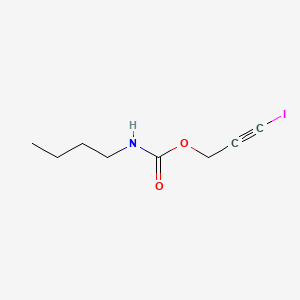
3-Iodo-2-propynyl butylcarbamate
3-iodoprop-2-yn-1-yl butylcarbamate is a carbamate ester that is carbamic acid in which the nitrogen has been substituted by a butyl group and in which the hydrogen of the carboxy group is replaced by a 1-iodoprop-2-yn-3-yl group. A fungicide, it is used as a preservative and sapstain control chemical in wood products and as a preservative in adhesives, paints, latex paper coating, plastic, water-based inks, metal working fluids, textiles, and numerous consumer products. It has a role as a xenobiotic, an environmental contaminant and an antifungal agrochemical. It is a carbamate ester, an organoiodine compound, an acetylenic compound and a carbamate fungicide. — ChEBI
- IUPAC name
- 3-iodoprop-2-ynyl N-butylcarbamate
- Molecular formula
- C8H12INO2
- Molecular weight
- 281.09 g/mol
- Exact mass
- 280.99128 Da
- XLogP3
- 2.1
- Topological polar surface area
- 38.3 Ų
- Hydrogen-bond donors
- 1
- Hydrogen-bond acceptors
- 2
- Covalent units
- 1
- Defined stereocentres
- 0
Also known as
16 more reported names
External database identifiers
- ChEBI:CHEBI:83279
- ChEMBL:CHEMBL1893913
- EPA DTXSID:DTXSID0028038
- PubMed:35435491
- PubMed:33049310
- PubMed:23869727
- PubMed:21839199
- PubMed:21788198
- PubMed:21251949
- PubMed:18416770
- PubMed:17244082
- PubMed:15261450
- PubMed:14513245
- PubMed:12755730
- PubMed:12022126
Retrieved from NIH PubChem on 2026-09-02 by checksum-valid CAS matching. Chemical properties do not replace the regulatory decision on this page.
Record details
Maximum concentration
a) 0.02% b) 0.01% c) 0.0075%
Other restrictions
Not to be used in oral and lip products
a) Not to be used in products for children under 3 years of age, except in bath products / shower gels and shampoos
b) Not to be used in body lotion and body cream (13)
b) and c) Not to be used in products for children under 3 years of age
Warnings
a) Not to be used for children under three years of age (11)
b) and c) Not to be used for children under three years of age (12)
INCI glossary name
IODOPROPYNYL BUTYLCARBAMATE
Chemical name
3-Iodo-2-propynylbutylcarbamate
Regulatory information
SCCS opinions
Identified ingredients
Key data
Inventory links for IODOPROPYNYL BUTYLCARBAMATE
Related records for IODOPROPYNYL BUTYLCARBAMATE
Acetyl hexamethyl indan; 1,1,2,3,3,6-Hexamethylindan-5-yl methyl ketone
Tagetes minuta flower extract; Tagetes minuta flower oil
Tagetes patula flower extract; Tagetes patula flower oil
BENZOIC ACID; SODIUM BENZOATE
1-Hydroxy-4-methyl-6-(2,4,4-trimethylpentyl)-2 pyridon, piroctone olamine
What Annex V means for IODOPROPYNYL BUTYLCARBAMATE
IODOPROPYNYL BUTYLCARBAMATE is an approved preservative listed in Annex V of EU Cosmetics Regulation 1223/2009. Only substances on this positive list may be used as cosmetic preservatives in the EU.
Each preservative entry specifies maximum permitted concentrations and applicable product scope. Concentrations must not exceed the listed maximum. Some preservatives require warning statements on the product label.
This record is linked to 1 CosIng inventory ingredient for name and identifier cross-reference. The page also surfaces 12 related annex records with overlapping identifiers, annex logic or naming patterns.
Compliance checklist
- Use concentration must not exceed: a) 0.02% b) 0.01% c) 0.0075%
- Verify the preservative is effective at the permitted concentration for your matrix.
- Apply required label warning statement.
Frequently asked questions
Source note for Annex V record IODOPROPYNYL BUTYLCARBAMATE
This page summarizes one Annex V record for IODOPROPYNYL BUTYLCARBAMATE from public European Commission cosmetic materials and adds linked inventory or identifier matches when available.
Use this record page to review Annex V conditions for IODOPROPYNYL BUTYLCARBAMATE, but confirm any final regulatory decision against the current official annex wording and source files.
Tools & next steps
Check your formula
Paste a full INCI list to detect IODOPROPYNYL BUTYLCARBAMATE and other flagged EU annex records in one pass.
INCI CheckerCompare entries
Compare IODOPROPYNYL BUTYLCARBAMATE side by side with another annex record to review differences in restrictions, concentrations and annex placement.
CompareBrowse the annex
See all records in Annex V and compare regulatory conditions across substances in this annex.
Open Annex V