
Carmines
CI 75470
Carmines appears in Annex IV as a positive-list colorant entry for EU cosmetics.
Chemical identity and properties
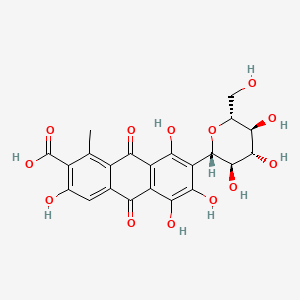
Carminic Acid
Carminic acid is a tetrahydroxyanthraquinone that is that is 1,3,4,6-tetrahydroxy-9,10-anthraquinone substituted by a methyl group at position 8, a carboxy group at position 7 and a 1,5-anhydro-D-glucitol moiety at position 2 via a C-glycosidic linkage. It is a natural dye isolated from several insects such as Dactylopius coccus. It has a role as an animal metabolite and a histological dye. It is a C-glycosyl compound, a monocarboxylic acid and a tetrahydroxyanthraquinone. It is a conjugate acid of a carminate(2-). — ChEBI
- IUPAC name
- 3,5,6,8-tetrahydroxy-1-methyl-9,10-dioxo-7-[(2S,3R,4R,5S,6R)-3,4,5-trihydroxy-6-(hydroxymethyl)oxan-2-yl]anthracene-2-carboxylic acid
- Molecular formula
- C22H20O13
- Molecular weight
- 492.4 g/mol
- Exact mass
- 492.09039069 Da
- XLogP3
- 0.5
- Topological polar surface area
- 243.0 Ų
- Hydrogen-bond donors
- 9
- Hydrogen-bond acceptors
- 13
- Covalent units
- 1
- Defined stereocentres
- 5
Also known as
16 more reported names
External database identifiers
- ChEBI:CHEBI:78310
- ChEMBL:CHEMBL263094
- EPA DTXSID:DTXSID9022817
- PubMed:7249
Evidence from additional scientific databases
NIH PubChem PUG-View
Attributed physical-property, hazard, environmental and use annotations.
- Color/Form: Red monoclinic prisms from aqueous methanol Source: Hazardous Substances Data Bank (HSDB)
- Color/Form: Dark, purplish-brown mass or bright-red powder Source: Hazardous Substances Data Bank (HSDB)
- Color/Form: Deep red color in water; yellow to violet in acid solutions Source: Hazardous Substances Data Bank (HSDB)
- Dissociation Constants: pKa1 = 2.81; pKa2 = 5.43; pKa3 = 8.10 Source: Hazardous Substances Data Bank (HSDB)
- Melting Point: Decomposes at 277 °F (NTP, 1992) Source: CAMEO Chemicals
- Melting Point: 136 °C (decomposes) Source: Hazardous Substances Data Bank (HSDB)
- Melting Point: No distinct melting point; darkens at 120 °C Source: Hazardous Substances Data Bank (HSDB)
- Physical Description: Carminic acid appears as dark purplish-brown mass or bright red or dark red powder. Darkens at 248 °F. Deep red color in water. Yellow to violet in acidic aqueous solutions. (NTP, 1992) Source: CAMEO Chemicals
- Physical Description: Red to dark red, friable, solid or powder. Cochineal extract is generally a dark red liquid but can also be dried as a powder. Source: EU Food Improvement Agents
- Physical Description: Dark purplish-brown or bright red solid; [Hawley] Deep violet fine crystals; [MSDSonline] Source: Haz-Map, Information on Hazardous Chemicals and Occupational Diseases
- Solubility: less than 1 mg/mL at 70 °F (NTP, 1992) Source: CAMEO Chemicals
- Solubility: Soluble in alcohol, concentrated sulfuric acid; slightly soluble in ether; practically insoluble in petroleum ether, benzene, chloroform Source: Hazardous Substances Data Bank (HSDB)
- Solubility: In water, 1.30 g/L (1.30X10+3 mg/L) at 25 °C Source: Hazardous Substances Data Bank (HSDB)
- pH: pH = 4.8 (yellow); pH = 6.2 (violet) Source: Hazardous Substances Data Bank (HSDB)
- Carcinogen Classification: No indication of carcinogenicity to humans (not listed by IARC). Source: Toxin and Toxin Target Database (T3DB)
- First Aid: EYES: First check the victim for contact lenses and remove if present. Flush victim's eyes with water or normal saline solution for 20 to 30 minutes while simultaneously calling a hospital or poison control center. Do not put any ointments, oils, or medication in the victim's eyes without specific instructions from a physician. IMMEDIATELY transport the victim after flushing eyes to a hospital even if no symptoms (such as redness or irritation) develop.; SKIN: IMMEDIATELY flood affected skin with water while removing and isolating all contaminated clothing. Gently wash all affected skin areas thoroughly with soap and water. If symptoms such as redness or irritation develop, IMMEDIATELY call a physician and be prepared to transport the victim to a hospital for treatment.; INHALATION: IMMEDIATELY leave the contaminated area; take deep breaths of fresh air. If symptoms (such as wheezing, coughing, shortness of breath, or burning in the mouth, throat, or chest) develop, call a physician and be prepared to transport the victim to a hospital. Provide proper respiratory protection to rescuers entering an unknown atmosphere. Whenever possible, Self-Contained Breathing Apparatus (SCBA) shou Source: CAMEO Chemicals
- Note: This chemical does not meet GHS hazard criteria for 98.9% (89 of 90) of all reports. Source: European Chemicals Agency (ECHA)
- GHS Hazard Statements: Not Classified; Reported as not meeting GHS hazard criteria by 89 of 90 companies (only 1.1% companies provided GHS information). For more detailed information, please visit ECHA C&L website. Source: European Chemicals Agency (ECHA)
- ECHA C&L Notifications Summary: Aggregated GHS information provided per 90 reports by companies from 2 notifications to the ECHA C&L Inventory.; Reported as not meeting GHS hazard criteria per 89 of 90 reports by companies.; There is 1 notification provided by 1 of 90 reports by companies with hazard statement code(s).; Information may vary between notifications depending on impurities, additives, and other factors. The percentage value in parenthesis indicates the notified classification ratio from companies that provide hazard codes. Only hazard codes with percentage values above 10% are shown. For more detailed information, please visit ECHA C&L website. Source: European Chemicals Agency (ECHA)
- Environmental Bioconcentration: An estimated BCF of 3.2 was calculated in fish for carminic acid(SRC), using an estimated log Kow of 0.97(1) and a regression-derived equation(2). According to a classification scheme(3), this BCF suggests the potential for bioconcentration in aquatic organisms is low(SRC). Source: Hazardous Substances Data Bank (HSDB)
- Environmental Fate: TERRESTRIAL FATE: Based on a classification scheme(1), an estimated Koc value of 440(SRC), determined from a structure estimation method(2), indicates that carminic acid is expected to have moderate mobility in soil(SRC). The pKa values of carminic acid are 2.81, 5.43 and 8.10(3), indicate that this compound will almost entirely exist in anion form in the environment and anions generally do not adsorb more strongly to soils containing organic carbon and clay than their neutral counterparts(4). Volatilization from moist soil is not expected because the acid exists as an anion and anions do not volatilize(SRC). Carminic acid is not expected to volatilize from dry soil surfaces(SRC) based upon an estimated vapor pressure of 5.07X10⁻²⁷ mm Hg at 25 °C(SRC), determined from a fragment constant method(5). Biodegradation data in soil were not available(SRC, 2010). Source: Hazardous Substances Data Bank (HSDB)
- Environmental Fate: AQUATIC FATE: Based on a classification scheme(1), an estimated Koc value of 440(SRC), determined from a structure estimation method(2), indicates that carminic acid is expected to adsorb to suspended solids and sediment(SRC). The pKa values of 2.81, 5.43 and 8.10(3) indicate carminic acid will exist almost entirely in the anion form at pH values of 5 to 9 and therefore volatilization from water surfaces is not expected to be an important fate process(SRC). According to a classification scheme(4), an estimated BCF of 3.2(SRC), from an estimated log Kow of 0.97(5) and a regression-derived equation(2), suggests the potential for bioconcentration in aquatic organisms is low(SRC). Biodegradation data in water were not available(SRC, 2010). Source: Hazardous Substances Data Bank (HSDB)
- Environmental Fate: ATMOSPHERIC FATE: According to a model of gas/particle partitioning of semivolatile organic compounds in the atmosphere(1), carminic acid, which has an estimated vapor pressure of 5.07X10⁻²⁷ mm Hg at 25 °C(SRC), determined from a fragment constant method(2), is expected to exist solely in the particulate phase in the ambient atmosphere. Particulate-phase carminic acid may be removed from the air by wet or dry deposition(SRC). Carminic acid contains chromophores that absorb at wavelengths >290 nm(3), and therefore may be susceptible to direct photolysis by sunlight(SRC); its UV absorption maxima is approximately 500 nm in water(4) and primary aliphatic alcohols(5). Source: Hazardous Substances Data Bank (HSDB)
- Sources/Uses: Extracted from the insects Coccus cacti (cochineal); [Hawley] Used as a free acid in color photography, a pigment for artists' paints, a bacteriological stain, a reagent for aluminum, a complexing agent for cations, a dye, and rarely now as an acid-base indicator or oxidimetric indicator; [HSDB] Source: Haz-Map, Information on Hazardous Chemicals and Occupational Diseases
- Industrial Processes with risk of exposure: Photographic Processing [Category: Other] Source: Haz-Map, Information on Hazardous Chemicals and Occupational Diseases
- Activities with risk of exposure: Painting [Category: Hobbies] Source: Haz-Map, Information on Hazardous Chemicals and Occupational Diseases
- Uses: Free acid in color photography; pigment for artists' paints; as bacteriological stain; reagent for aluminum; rarely now as acid-base indicator or oxidimetric indicator; complexing agent for cations Source: Hazardous Substances Data Bank (HSDB)
- Uses: Colorant used in cosmetics Source: Hazardous Substances Data Bank (HSDB)
- Uses: Coloring proprietary medicines; pigment for fine oil colors; indicators in analytical chemistry Source: Hazardous Substances Data Bank (HSDB)
- Uses: Used as dye; in inks, coloring food products and galenicals; in microscopy for making various stains /Aluminum calcium lake/ Source: Hazardous Substances Data Bank (HSDB)
- Uses: Used as a food dye in products such as juices, ice cream, yogurt, and candy; as a dye in cosmetic products such as eye shadow and lipstick. /Carmine/ Source: Hazardous Substances Data Bank (HSDB)
Mapped by: Existing checksum-valid CAS to unique PubChem CID match. Retrieved: 2026-08-31. Open source record
Scientific classifications and hazard annotations provide context and do not replace the market-specific regulatory decision shown above.
Additional source coverage and match status
| Source | Result | Checked |
|---|---|---|
| NIH PubChem PUG-View | Exact match | 2026-08-31 |
A recorded no-match is useful evidence that the source was checked; it is not a claim that the substance does not exist elsewhere.
Retrieved from NIH PubChem on 2026-09-02 by checksum-valid CAS matching. Chemical properties do not replace the regulatory decision on this page.
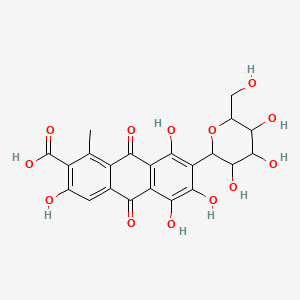
7-Hexopyranosyl-9,10-dihydro-3,5,6,8-tetrahydroxy-1-methyl-9,10-dioxo-2-anthracenecarboxylic acid
- IUPAC name
- 3,5,6,8-tetrahydroxy-1-methyl-9,10-dioxo-7-[3,4,5-trihydroxy-6-(hydroxymethyl)oxan-2-yl]anthracene-2-carboxylic acid
- Molecular formula
- C22H20O13
- Molecular weight
- 492.4 g/mol
- Exact mass
- 492.09039069 Da
- XLogP3
- 0.5
- Topological polar surface area
- 243.0 Ų
- Hydrogen-bond donors
- 9
- Hydrogen-bond acceptors
- 13
- Covalent units
- 1
- Defined stereocentres
- 0
Also known as
9 more reported names
External database identifiers
- EPA DTXSID:DTXSID20859613
Retrieved from NIH PubChem on 2026-09-02 by checksum-valid CAS matching. Chemical properties do not replace the regulatory decision on this page.
Record details
Warnings
Purity criteria as set out in Commission Directive 95/45/EC (E 120)
Colour index or glossary
CI 75470
Chemical name
Carmines
Chemical / IUPAC name
Carmines
Color
Red
Regulatory information
Key data
Inventory links for Carmines
Related records for Carmines
Direct matches are limited for this record, so nearby entries from Annex IV are shown as well.
CI 75810
CI 77002
CI 75130
CI 77007
CI 75120
What Annex IV means for Carmines
Carmines is an approved colorant listed in Annex IV of EU Cosmetics Regulation 1223/2009. Only colorants on this positive list may be used to colour cosmetic products on the EU market.
Some colorants in Annex IV are restricted by product type — for example, prohibited from use around the eyes or in products applied to mucous membranes. Check the product type and conditions fields above before use.
This record is linked to 2 CosIng inventory ingredients for name and identifier cross-reference. The page also surfaces 12 related annex records with overlapping identifiers, annex logic or naming patterns.
Compliance checklist
- Confirm colorant is used only in permitted product types listed above.
- Record the Colour Index number and CAS identifier in the ingredient declaration.
Frequently asked questions
Source note for Annex IV record Carmines
This page summarizes one Annex IV record for Carmines from public European Commission cosmetic materials and adds linked inventory or identifier matches when available.
Use this record page to review Annex IV conditions for Carmines, but confirm any final regulatory decision against the current official annex wording and source files.
Tools & next steps
Check your formula
Paste a full INCI list to detect Carmines and other flagged EU annex records in one pass.
INCI CheckerCompare entries
Compare Carmines side by side with another annex record to review differences in restrictions, concentrations and annex placement.
CompareBrowse the annex
See all records in Annex IV and compare regulatory conditions across substances in this annex.
Open Annex IV