
Malononitrile
Malononitrile is listed in Annex II as a prohibited substance for cosmetic products placed on the EU market.
Chemical identity and properties
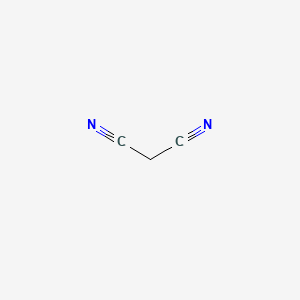
Malononitrile
Malononitrile is a dinitrile that is methane substituted by two cyano groups. It is a dinitrile and an aliphatic nitrile. — ChEBI
- IUPAC name
- propanedinitrile
- Molecular formula
- C3H2N2
- Molecular weight
- 66.06 g/mol
- Exact mass
- 66.021798072 Da
- XLogP3
- -0.5
- Topological polar surface area
- 47.6 Ų
- Hydrogen-bond donors
- 0
- Hydrogen-bond acceptors
- 2
- Covalent units
- 1
- Defined stereocentres
- 0
Also known as
16 more reported names
External database identifiers
- ChEBI:CHEBI:33186
- ChEMBL:CHEMBL3187514
- EPA DTXSID:DTXSID6021907
- PubMed:23125765
- PubMed:23125655
- PubMed:23030064
- PubMed:22968474
- PubMed:22939001
- PubMed:22934677
- PubMed:22932824
- PubMed:22922279
- PubMed:22920458
- PubMed:22876607
- PubMed:22870807
- PubMed:22825620
Evidence from additional scientific databases
NIH PubChem PUG-View
Attributed physical-property, hazard, environmental and use annotations.
- Boiling Point: 424 to 426 °F at 760 mmHg (EPA, 1998) Source: CAMEO Chemicals
- Boiling Point: 218-219 °C @ 760 mm Hg Source: Hazardous Substances Data Bank (HSDB)
- Boiling Point: 218-220 °C Source: ILO-WHO International Chemical Safety Cards (ICSCs)
- Boiling Point: 220 °C @760 [mm Hg] Source: PAC Chemical Database, U.S. Department of Energy
- Boiling Point: 426 °F Source: The National Institute for Occupational Safety and Health (NIOSH)
- Color/Form: Colorless solid Source: Hazardous Substances Data Bank (HSDB)
- Color/Form: White powder or colorless crystals Source: Hazardous Substances Data Bank (HSDB)
- Density: 1.191 at 68 °F (EPA, 1998) - Denser than water; will sink Source: CAMEO Chemicals
- Density: 1.1910 @ 20 °C/4 °C Source: Hazardous Substances Data Bank (HSDB)
- Density: 1.19 g/cm³ Source: ILO-WHO International Chemical Safety Cards (ICSCs)
- Density: 1.049 @ 34°C Source: PAC Chemical Database, U.S. Department of Energy
- Density: 1.19 Source: The National Institute for Occupational Safety and Health (NIOSH)
- Dissociation Constants: pKa = 11.40 Source: Hazardous Substances Data Bank (HSDB)
- Flash Point: 266 °F (EPA, 1998) Source: CAMEO Chemicals
- Flash Point: 266 °F Source: Haz-Map, Information on Hazardous Chemicals and Occupational Diseases
- Flash Point: 266 °F (OPEN CUP) Source: Hazardous Substances Data Bank (HSDB)
- Flash Point: 112 °C o.c. Source: ILO-WHO International Chemical Safety Cards (ICSCs)
- Flash Point: (oc) 266 °F Source: The National Institute for Occupational Safety and Health (NIOSH)
- LogP: log Kow = -0.60 Source: Hazardous Substances Data Bank (HSDB)
- LogP: -0.6 Source: ILO-WHO International Chemical Safety Cards (ICSCs)
- Melting Point: 90 °F (EPA, 1998) Source: CAMEO Chemicals
- Melting Point: 32 °C Source: Hazardous Substances Data Bank (HSDB)
- Melting Point: 30-34 °C Source: ILO-WHO International Chemical Safety Cards (ICSCs)
- Melting Point: 30.5 °C Source: PAC Chemical Database, U.S. Department of Energy
- Melting Point: 90 °F Source: The National Institute for Occupational Safety and Health (NIOSH)
- Physical Description: Malononitrile appears as a white-colored crystalline solid. Denser than water and soluble in water. Toxic by ingestion and may severely irritate skin and eyes. May polymerize violently if exposed to temperatures above 266 °F. Used to make other chemicals. Source: CAMEO Chemicals
- Physical Description: Other Solid Source: EPA Chemical Data Reporting (CDR)
- Physical Description: White powder or colorless crystals; Note: Melts above 90 degrees F. Forms cyanide in the body; [NIOSH] Source: Haz-Map, Information on Hazardous Chemicals and Occupational Diseases
- Physical Description: COLOURLESS CRYSTALS OR WHITE POWDER. Source: ILO-WHO International Chemical Safety Cards (ICSCs)
- Physical Description: White powder or colorless crystals. [Note: Melts above 90 °F. Forms cyanide in the body.] Source: The National Institute for Occupational Safety and Health (NIOSH)
- Refractive Index: Index of refraction: 1.4146 @ 34 °C/D Source: Hazardous Substances Data Bank (HSDB)
- Solubility: greater than or equal to 100 mg/mL at 72.5 °F (NTP, 1992) Source: CAMEO Chemicals
- Solubility: SOL IN ACETIC ACID, CHLOROFORM Source: Hazardous Substances Data Bank (HSDB)
- Solubility: Soluble in acetone and benzene Source: Hazardous Substances Data Bank (HSDB)
- Solubility: In water, 1.33X10+5 mg/l @ 25 °C Source: Hazardous Substances Data Bank (HSDB)
- Solubility: In ethanol, 0.40 g/ml @ 25 °C; in ether, 0.20 g/ml @ 25 °C Source: Hazardous Substances Data Bank (HSDB)
- Solubility: Solubility in water, g/100ml at 20 °C: 13.3 (moderate) Source: ILO-WHO International Chemical Safety Cards (ICSCs)
- Solubility: 13% Source: The National Institute for Occupational Safety and Health (NIOSH)
- Vapor Pressure: 0.2 [mmHg] Source: Haz-Map, Information on Hazardous Chemicals and Occupational Diseases
- Vapor Pressure: 0.200 mm Hg @ 25 °C Source: Hazardous Substances Data Bank (HSDB)
- Vapor Pressure: Vapor pressure, Pa at 25 °C: 27 Source: ILO-WHO International Chemical Safety Cards (ICSCs)
- Vapor Pressure: 11 [mm Hg] @99 °C Source: PAC Chemical Database, U.S. Department of Energy
- Carcinogen Classification: No indication of carcinogenicity to humans (not listed by IARC). Source: Toxin and Toxin Target Database (T3DB)
- Exposure Routes: The substance can be absorbed into the body by inhalation, through the skin and by ingestion. Source: ILO-WHO International Chemical Safety Cards (ICSCs)
- Exposure Routes: inhalation, skin absorption, ingestion, skin and/or eye contact Source: The National Institute for Occupational Safety and Health (NIOSH)
- Exposure Routes: Oral (L96) ; inhalation (L96) ; dermal (L96) Source: Toxin and Toxin Target Database (T3DB)
- First Aid: Warning: Malononitrile may be fatal if inhaled, swallowed, or absorbed through skin or mucous membranes. Caution is advised.; Signs and Symptoms of Malononitrile Exposure: Signs and symptoms of acute exposure to malononitrile may include hypertension (high blood pressure) and tachycardia (rapid heart rate), followed by hypotension (low blood pressure) and bradycardia (slow heart rate). Cherry-red or bloody mucous membranes may be noted. Cardiac arrhythmias and other cardiac abnormalities are common. Cyanosis (blue tint to the skin and mucous membranes) may be observed. Other symptoms include anxiety, confusion, tightness in the chest, and involuntary urination and defecation. Headache, vertigo (dizziness), agitation, and giddiness may be followed by combative behavior, convulsions, paralysis, protruding eyeballs, dilated and unreactive pupils, unconsciousness and coma. Tachypnea (rapid, shallow respirations) or hyperpnea (rapid, deep respirations) may be followed by respiratory depression or arrest. Lung hemorrhage and pulmonary edema may also occur. Malononitrile is irritating to the skin, eyes, and mucous membranes. Lacrimation (tearing) and a burning sensation of the mouth and t Source: CAMEO Chemicals
- ERG2024, Guide 153 (Malononitrile): General First Aid:; · Call 911 or emergency medical service.; · Ensure that medical personnel are aware of the material(s) involved, take precautions to protect themselves and avoid contamination.; · Move victim to fresh air if it can be done safely.; · Administer oxygen if breathing is difficult.; · If victim is not breathing:; -- DO NOT perform mouth-to-mouth resuscitation; the victim may have ingested or inhaled the substance.; -- If equipped and pulse detected, wash face and mouth, then give artificial respiration using a proper respiratory medical device (bag-valve mask, pocket mask equipped with a one-way valve or other device).; -- If no pulse detected or no respiratory medical device available, provide continuous compressions. Conduct a pulse check every two minutes or monitor for any signs of spontaneous respirations.; · Remove and isolate contaminated clothing and shoes.; · For minor skin contact, avoid spreading material on unaffected skin.; · In case of contact with substance, remove immediately by flushing skin or eyes with running water for at least 20 minutes.; · For severe burns, immediate medical attention is required.; · Effects of exposure (inhalation, ingestion, Source: Emergency Response Guidebook (ERG)
- First Aid: (General first aid procedures); Eye: Irrigate immediately - If this chemical contacts the eyes, immediately wash (irrigate) the eyes with large amounts of water, occasionally lifting the lower and upper lids. Get medical attention immediately.; Skin: Water wash immediately - If this chemical contacts the skin, immediately wash the contaminated skin with water. If this chemical penetrates the clothing, immediately remove the clothing and wash the skin with water. If symptoms occur after washing, get medical attention immediately.; Breathing: Respiratory support; Swallow: Medical attention immediately - If this chemical has been swallowed, get medical attention immediately. Source: The National Institute for Occupational Safety and Health (NIOSH)
- Signal: Danger Source: Regulation (EC) No 1272/2008 of the European Parliament and of the Council
- GHS Hazard Statements: H301: Toxic if swallowed [Danger Acute toxicity, oral]; H311: Toxic in contact with skin [Danger Acute toxicity, dermal]; H331: Toxic if inhaled [Danger Acute toxicity, inhalation]; H400: Very toxic to aquatic life [Warning Hazardous to the aquatic environment, acute hazard]; H410: Very toxic to aquatic life with long lasting effects [Warning Hazardous to the aquatic environment, long-term hazard] Source: Regulation (EC) No 1272/2008 of the European Parliament and of the Council
- Precautionary Statement Codes: P261, P262, P264, P270, P271, P273, P280, P301+P316, P302+P352, P304+P340, P316, P321, P330, P361+P364, P391, P403+P233, P405, and P501 (click each P-code to see the statement) Source: Regulation (EC) No 1272/2008 of the European Parliament and of the Council
- Signal: Danger Source: European Chemicals Agency (ECHA)
- GHS Hazard Statements: H300 (68.5%): Fatal if swallowed [Danger Acute toxicity, oral]; H301 (31.5%): Toxic if swallowed [Danger Acute toxicity, oral]; H311+H331 (52%): Toxic in contact with skin or if inhaled. [Danger Acute toxicity, dermal; acute toxicity, inhalation]; H311 (100%): Toxic in contact with skin [Danger Acute toxicity, dermal]; H317 (68.5%): May cause an allergic skin reaction [Warning Sensitization, Skin]; H319 (68.9%): Causes serious eye irritation [Warning Serious eye damage/eye irritation]; H331 (100%): Toxic if inhaled [Danger Acute toxicity, inhalation]; H400 (100%): Very toxic to aquatic life [Warning Hazardous to the aquatic environment, acute hazard]; H410 (100%): Very toxic to aquatic life with long lasting effects [Warning Hazardous to the aquatic environment, long-term hazard] Source: European Chemicals Agency (ECHA)
- Precautionary Statement Codes: P261, P262, P264, P264+P265, P270, P271, P272, P273, P280, P301+P316, P302+P352, P304+P340, P305+P351+P338, P316, P321, P330, P333+P317, P337+P317, P361+P364, P362+P364, P391, P403+P233, P405, and P501 (click each P-code to see the statement) Source: European Chemicals Agency (ECHA)
- ECHA C&L Notifications Summary: Aggregated GHS information provided per 254 reports by companies from 10 notifications to the ECHA C&L Inventory. Each notification may be associated with multiple companies.; Information may vary between notifications depending on impurities, additives, and other factors. The percentage value in parenthesis indicates the notified classification ratio from companies that provide hazard codes. Only hazard codes with percentage values above 10% are shown. For more detailed information, please visit ECHA C&L website. Source: European Chemicals Agency (ECHA)
- Signal: Danger Source: NITE-CMC
- GHS Hazard Statements: H301: Toxic if swallowed [Danger Acute toxicity, oral]; H311: Toxic in contact with skin [Danger Acute toxicity, dermal]; H319: Causes serious eye irritation [Warning Serious eye damage/eye irritation]; H330: Fatal if inhaled [Danger Acute toxicity, inhalation]; H370: Causes damage to organs [Danger Specific target organ toxicity, single exposure] Source: NITE-CMC
- Precautionary Statement Codes: P260, P262, P264, P264+P265, P270, P271, P280, P284, P301+P316, P302+P352, P304+P340, P305+P351+P338, P308+P316, P316, P320, P321, P330, P337+P317, P361+P364, P403+P233, P405, and P501 (click each P-code to see the statement) Source: NITE-CMC
- Signal: Danger Source: Hazardous Chemical Information System (HCIS), Safe Work Australia
- GHS Hazard Statements: H301: Toxic if swallowed [Danger Acute toxicity, oral]; H311: Toxic in contact with skin [Danger Acute toxicity, dermal]; H331: Toxic if inhaled [Danger Acute toxicity, inhalation]; H410: Very toxic to aquatic life with long lasting effects [Warning Hazardous to the aquatic environment, long-term hazard] Source: Hazardous Chemical Information System (HCIS), Safe Work Australia
- Health Effects: Exposure to high levels of cyanide for a short time harms the brain and heart and can even cause coma, seizures, apnea, cardiac arrest and death. Chronic inhalation of cyanide causes breathing difficulties, chest pain, vomiting, blood changes, headaches, and enlargement of the thyroid gland. Skin contact with cyanide salts can irritate and produce sores. (L96, L97) Source: Toxin and Toxin Target Database (T3DB)
- Target Organs: Eyes, skin, respiratory system, central nervous system, cardiovascular system Source: The National Institute for Occupational Safety and Health (NIOSH)
- Toxicity Summary: Organic nitriles decompose into cyanide ions both in vivo and in vitro. Consequently the primary mechanism of toxicity for organic nitriles is their production of toxic cyanide ions or hydrogen cyanide. Cyanide is an inhibitor of cytochrome c oxidase in the fourth complex of the electron transport chain (found in the membrane of the mitochondria of eukaryotic cells). It complexes with the ferric iron atom in this enzyme. The binding of cyanide to this cytochrome prevents transport of electrons from cytochrome c oxidase to oxygen. As a result, the electron transport chain is disrupted and the cell can no longer aerobically produce ATP for energy. Tissues that mainly depend on aerobic respiration, such as the central nervous system and the heart, are particularly affected. Cyanide is also known produce some of its toxic effects by binding to catalase, glutathione peroxidase, methemoglobin, hydroxocobalamin, phosphatase, tyrosinase, ascorbic acid oxidase, xanthine oxidase, succinic dehydrogenase, and Cu/Zn superoxide dismutase. Cyanide binds to the ferric ion of methemoglobin to form inactive cyanmethemoglobin. (L97) Source: Toxin and Toxin Target Database (T3DB)
- Environmental Bioconcentration: An estimated BCF of 3 was calculated for malononitrile(SRC), using a log Kow of -0.60(1) and a regression-derived equation(2). According to a classification scheme(3), this BCF suggests the potential for bioconcentration in aquatic organisms is low(SRC). Source: Hazardous Substances Data Bank (HSDB)
- Environmental Fate: TERRESTRIAL FATE: Based on a classification scheme(1), an estimated Koc value of 11(SRC), determined from a log Kow of -0.60(2) and a regression-derived equation(3), indicates that malononitrile is expected to have very high mobility in soil(SRC). Volatilization of malononitrile from moist soil surfaces is not expected to be an important fate process(SRC) given an estimated Henry's Law constant of 1.27X10⁻⁸ atm-cu m/mole(SRC), using a fragment constant estimation method(4). Malononitrile is not expected to volatilize from dry soil surfaces(SRC) based upon a vapor pressure of 0.20 mm Hg(5). Nitriles are biodegraded by enzyme-catalyzed hydrolysis to ultimately form carboxylic acids and ammonia(6,7). Thus, malononitrile may biodegrade in soil(SRC). Source: Hazardous Substances Data Bank (HSDB)
- Environmental Fate: AQUATIC FATE: Based on a classification scheme(1), an estimated Koc value of 11(SRC), determined from a log Kow of -0.60(2) and a regression-derived equation(3), indicates that malononitrile is not expected to adsorb to suspended solids and sediment(SRC). Volatilization from water surfaces is not expected(3) based upon an estimated Henry's Law constant of 1.27X10⁻⁸ atm-cu m/mole(SRC), developed using a fragment constant estimation method(4). According to a classification scheme(5), an estimated BCF of 3(SRC), from its log Kow(2) and a regression-derived equation(6), suggests the potential for bioconcentration in aquatic organisms is low(SRC). The neutral and base hydrolysis rate constants for malononitrile in water at 25 °C were experimentally determined to be 0.00135/hr and 806/M-hr, respectively, which corresponds to a half-life of 20.2 days at a pH of 7(7); at pHs of 5, 6, 8 and 9, the hydrolysis half-lives would be 21.4, 21.3. 13.4 and 3.1 days, respectively(SRC). Nitriles are biodegraded by enzyme-catalyzed hydrolysis to ultimately form carboxylic acids and ammonia(8,9). Thus, malononitrile may biodegrade in water(SRC). Source: Hazardous Substances Data Bank (HSDB)
- Environmental Fate: ATMOSPHERIC FATE: According to a model of gas/particle partitioning of semivolatile organic compounds in the atmosphere(1), malononitrile, which has a vapor pressure of 0.200 mm Hg at 25 °C(2), is expected to exist solely as a vapor in the ambient atmosphere(SRC). Vapor-phase malononitrile is degraded in the atmosphere by reaction with photochemically-produced hydroxyl radicals(SRC); the half-life for this reaction in air is estimated to be 476 days(SRC), calculated from its rate constant of 3.37X10⁻¹⁴ cu cm/molecule-sec at 25 °C(SRC) determined using a structure estimation method(3). Source: Hazardous Substances Data Bank (HSDB)
- Industry Uses: Intermediate Source: EPA Chemical Data Reporting (CDR)
- Sources/Uses: Used in organic synthesis of thiamine, an anti-cancer drug, acrylic fibers, and dyes; used as a leaching agent for gold; [HSDB] Source: Haz-Map, Information on Hazardous Chemicals and Occupational Diseases
- Uses: Organic synthesis; leaching agent for gold Source: Hazardous Substances Data Bank (HSDB)
- Uses: Used as lubricating oil additive; thiamine synthesis; anti-cancer agent synthesis; acrylic fiber and dyestuff synthesis. Source: Hazardous Substances Data Bank (HSDB)
- Uses: In life science industry, especially for synthesis of N-containing heterocycles; in production of herbicides, the diuretic triamterene, antineoplastic methotrexate, adenine, dyes, 7,7,8,8-tetracyanoquinodimethane, 2-chlorobenzyliden malononitrile (CS-gas) used for self-defense. Source: Hazardous Substances Data Bank (HSDB)
Mapped by: Existing checksum-valid CAS to unique PubChem CID match. Retrieved: 2026-08-31. Open source record
Scientific classifications and hazard annotations provide context and do not replace the market-specific regulatory decision shown above.
Additional source coverage and match status
| Source | Result | Checked |
|---|---|---|
| NIH PubChem PUG-View | Exact match | 2026-08-31 |
A recorded no-match is useful evidence that the source was checked; it is not a claim that the substance does not exist elsewhere.
Retrieved from NIH PubChem on 2026-08-31 by checksum-valid CAS matching. Chemical properties do not replace the regulatory decision on this page.
Record details
Chemical name
Malononitrile
Regulatory information
Key data
Related records for Malononitrile
Direct matches are limited for this record, so nearby entries from Annex II are shown as well.
Metformin (INN) and its salts
Dinitrophenol isomers
Amitriptyline (INN) and its salts
Metamfepramone (INN) and its salts
Dimevamide (INN) and its salts
Methapyrilene (INN) and its salts
Diphenylpyraline (INN) and its salts
1,1-Bis(dimethylaminomethyl)propyl benzoate (amydricaine, alypine) and its salts
What Annex II means for Malononitrile
Malononitrile is listed as a prohibited substance under Annex II of EU Cosmetics Regulation 1223/2009 and must not be intentionally added. Article 17 separately addresses unintended small quantities that are technically unavoidable under good manufacturing practice and compatible with the Article 3 safety requirement.
Formulators must screen their ingredients and raw materials to ensure none contain this substance. Suppliers should provide documentation confirming absence when requested.
The page also surfaces 12 related annex records with overlapping identifiers, annex logic or naming patterns.
Compliance checklist
- Verify this substance is absent from all raw materials and finished formulations.
- Request absence confirmation or CoA from raw material suppliers.
- Document the screening result in the Product Information File (PIF).
Frequently asked questions
Source note for Annex II record Malononitrile
This page summarizes one Annex II record for Malononitrile from public European Commission cosmetic materials and adds linked inventory or identifier matches when available.
Use this record page to review Annex II conditions for Malononitrile, but confirm any final regulatory decision against the current official annex wording and source files.
Tools & next steps
Check your formula
Paste a full INCI list to detect Malononitrile and other flagged EU annex records in one pass.
INCI CheckerCompare entries
Compare Malononitrile side by side with another annex record to review differences in restrictions, concentrations and annex placement.
CompareBrowse the annex
See all records in Annex II and compare regulatory conditions across substances in this annex.
Open Annex II