
右美沙芬及其盐类 — Dextromethorphan (INN) (CAS No. 125-71-3) and its salts
Dextromethorphan (INN) (CAS No. 125-71-3) and its salts
The NMPA binding 2021 catalogue prohibits this raw material in cosmetic formulas in China.
Regulatory decision and full conditions
- Status
- Prohibited
- Legal role
- Binding rule
- Regulatory summary
- The NMPA binding 2021 catalogue prohibits this raw material in cosmetic formulas in China.
- Conditions and restrictions
Prohibited in cosmetic product formulas. Verify the cited Chinese source identity and any later NMPA amendment before use.
Substance identity
- Official source name
- 右美沙芬及其盐类 — Dextromethorphan (INN) (CAS No. 125-71-3) and its salts
- CAS
- 125-71-3
- EC
- Not supplied in this source row
- Identity mapping
- standalone:official_nmpa_record
Cross-market snapshot for this identity
Exact linked records currently present in this site. An absent market means no imported exact match, not permission to use the substance.
European Union
1 linked record
Open supporting recordGreat Britain
1 linked record
Open supporting recordCanada
1 linked record
Open supporting recordNew Zealand
1 linked record
Open supporting recordASEAN
1 linked record
Open supporting recordChina
Current record1 linked record · 1 with specific conditions
Open supporting recordSouth Korea
1 linked record · 1 with specific conditions
Open supporting recordBrazil
1 linked record · 1 with specific conditions
Open supporting recordIndia
1 linked record · 1 with specific conditions
Open supporting recordSaudi Arabia
1 linked record
Open supporting record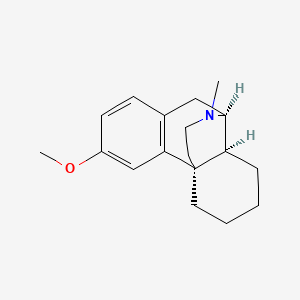
Verified chemistry for CAS 125-71-3
Dextromethorphan
Dextromethorphan is a 6-methoxy-11-methyl-1,3,4,9,10,10a-hexahydro-2H-10,4a-(epiminoethano)phenanthrene in which the sterocenters at positions 4a, 10 and 10a have S-configuration. It is a prodrug of dextrorphan and used as an antitussive drug for suppressing cough. It has a role as a oneirogen, a xenobiotic, a prodrug, a neurotoxin, an antitussive, a NMDA receptor antagonist and an environmental contaminant. It is functionally related to a dextrorphan. It is an enantiomer of a levomethorphan. — ChEBI
- IUPAC name
- (1S,9S,10S)-4-methoxy-17-methyl-17-azatetracyclo[7.5.3.01,10.02,7]heptadeca-2(7),3,5-triene
- Molecular formula
- C18H25NO
- Molecular weight
- 271.4 g/mol
- Exact mass
- 271.193614421 Da
- Monoisotopic mass
- 271.193614421 Da
- XLogP3
- 3.4
- Topological polar surface area
- 12.5 Ų
- Molecular complexity
- 370.0
- Formal charge
- 0
- Hydrogen-bond donors
- 0
- Hydrogen-bond acceptors
- 2
- Rotatable bonds
- 1
- Heavy atoms
- 20
- Covalent units
- 1
Names and synonyms reported to PubChem
16 more reported names
External database identifiers
- ChEBI:CHEBI:4470
- ChEBI:CHEBI:92579
- ChEMBL:CHEMBL52440
- EPA DTXSID:DTXSID3022908
- PubMed:22608604
- PubMed:22073096
- PubMed:22066053
- PubMed:22044595
- PubMed:21973086
- PubMed:21867562
- PubMed:21614312
- PubMed:21445282
- PubMed:21436715
- PubMed:21266064
- PubMed:21244712
- PubMed:21175434
Advanced structure statistics
- Defined atom stereocentres
- 3
- Undefined atom stereocentres
- 0
- Defined bond stereocentres
- 0
- Undefined bond stereocentres
- 0
- 3D pharmacophore features
- 6
- 3D rings
- 4
- 3D hydrophobes
- 0
- 3D acceptor features
- 1
- 3D donor features
- 0
- 3D anionic centres
- 0
- 3D cationic centres
- 1
- 3D conformers
- 2
- Effective 3D rotors
- 2.6
Machine-readable structure identifiers
- SMILES
CN1CC[C@@]23CCCC[C@@H]2[C@@H]1CC4=C3C=C(C=C4)OC- InChI
InChI=1S/C18H25NO/c1-19-10-9-18-8-4-3-5-15(18)17(19)11-13-6-7-14(20-2)12-16(13)18/h6-7,12,15,17H,3-5,8-11H2,1-2H3/t15-,17+,18+/m1/s1- InChIKey
MKXZASYAUGDDCJ-NJAFHUGGSA-N
Evidence from additional scientific databases
NIH PubChem PUG-View
Attributed physical-property, hazard, environmental and use annotations.
- Color/Form: White to slightly yellow crystalline powder Source: Hazardous Substances Data Bank (HSDB)
- Melting Point: 122-124 Source: DrugBank
- Melting Point: 109-111 °C Source: Hazardous Substances Data Bank (HSDB)
- Odor: Odorless Source: Hazardous Substances Data Bank (HSDB)
- Solubility: 1.5 g/100 mL Source: DrugBank
- Solubility: Practically insoluble in water Source: Hazardous Substances Data Bank (HSDB)
- Solubility: Freely soluble in chloroform Source: Hazardous Substances Data Bank (HSDB)
- Carcinogen Classification: No indication of carcinogenicity to humans (not listed by IARC). Source: Toxin and Toxin Target Database (T3DB)
- Exposure Routes: Oral, rapidly absorbed from the gastrointestinal tract. Source: Toxin and Toxin Target Database (T3DB)
- Note: This chemical does not meet GHS hazard criteria for 46.8% (36 of 77) of reports. Source: European Chemicals Agency (ECHA)
- Signal: Danger Source: European Chemicals Agency (ECHA)
- GHS Hazard Statements: H301 (51.9%): Toxic if swallowed [Danger Acute toxicity, oral] Source: European Chemicals Agency (ECHA)
- Precautionary Statement Codes: P264, P270, P301+P316, P321, P330, P405, and P501 (click each P-code to see the statement) Source: European Chemicals Agency (ECHA)
- ECHA C&L Notifications Summary: Aggregated GHS information provided per 77 reports by companies from 4 notifications to the ECHA C&L Inventory.; Reported as not meeting GHS hazard criteria per 36 of 77 reports by companies.; There are 3 notifications provided by 41 of 77 reports by companies with hazard statement code(s).; Information may vary between notifications depending on impurities, additives, and other factors. The percentage value in parenthesis indicates the notified classification ratio from companies that provide hazard codes. Only hazard codes with percentage values above 10% are shown. For more detailed information, please visit ECHA C&L website. Source: European Chemicals Agency (ECHA)
- Health Effects: Hypertension, shallow respiration. Dextromethorphan can cause other gastrointestinal disturbances. [Wikipedia] Source: Toxin and Toxin Target Database (T3DB)
- Toxicity Summary: IDENTIFICATION AND USE: Dextromethorphan is a white odorless solid crystal or powder. It is an opium alkaloid derivative, which is found in cough and cold preparations. HUMAN STUDIES: Dextromethorphan is a drug of abuse. The main risks associated with dextromethorphan are ataxia, central nervous system (CNS) stimulation, dizziness, lethargy and psychotic behavior. Less frequently with large doses seizures and respiratory depression can occur. Nausea, vomiting, constipation and tachycardia may also occur. CNS effects include ataxia, drowsiness, vertigo and rarely coma. CNS stimulation may be observed. Restlessness, increased muscle tone with body rigidity have been reported. With extremely large ingestions respiratory depression can occur. Gastrointestinal effects include nausea, vomiting, constipation and dry mouth. Urinary retention may be seen. Dextromethorphan abuse has been described and produces euphoria, CNS stimulation, visual and/or auditory hallucinations. Dextromethorphan hydrobromide is the drug form, thus the possibility of bromide poisoning should be considered in the long term abuser. Dextromethorphan enhances serotonin activity by inhibiting the reuptake of serotonin Source: Hazardous Substances Data Bank (HSDB)
- Toxicity Summary: Signs and Symptoms of Overdose; One significant concern regarding dextromethorphan toxicity is its OTC misuse, which has steadily increased since the early 2000s. This misuse is referred to by slang terms such as "going pharming," "robotripping," and "dexing." In 2006, three specific OTC product formulations accounted for 66% of reported dextromethorphan misuse cases in the United States, with Coricidin HBP Cough & Cold Tablets and Robitussin products being prominent. A life-threatening toxicity associated with dextromethorphan abuse is serotonin syndrome, resulting from its serotonin reuptake inhibition properties. When combined with SSRIs or MAOIs, the risk of serotonin syndrome increases significantly. Symptoms include agitation, confusion, dilated pupils, headache, tachycardia, hypotension, high fever, seizures, irregular heartbeat, and may progress to unconsciousness.; Despite the rise in misuse, public health efforts and legislative actions restricting the sale of dextromethorphan-containing products to minors have helped stabilize or reduce abuse rates in recent years. However, continued vigilance is essential to prevent misuse and associated toxicities, given dextromethorph Source: StatPearls
- Toxicity Summary: Dextromethorphan is an opioid-like drug that binds to and acts as antagonist to the NMDA glutamatergic receptor, it is an agonist to the opioid sigma 1 and sigma 2 receptors, it is also an alpha3/beta4 nicotinic receptor antagonist and targets the serotonin reuptake pump. Dextromethorphan is rapidly absorbed from the gastrointestinal tract, where it enters the bloodstream and crosses the blood-brain barrier. The first-pass through the hepatic portal vein results in some of the drug being metabolized into an active metabolite of dextromethorphan, dextrorphan, the 3-hydroxy derivative of dextromethorphan. Source: Toxin and Toxin Target Database (T3DB)
- Environmental Bioconcentration: The estimated pKa of dextromethorphan is 9.8(1), indicating that dextromethorphan will exist almost entirely in the cation form at pH values of 5 to 9 and, therefore, bioconcentration in fish is not expected to be an important fate process(SRC). Source: Hazardous Substances Data Bank (HSDB)
- Environmental Fate: TERRESTRIAL FATE: Based on a classification scheme(1), an estimated Koc value of 23,000(SRC), determined from a structure estimation method(2), indicates that dextromethorphan is expected to be immobile in soil(SRC). The estimated pKa of dextromethorphan is 9.8(3), indicating that this compound will exist almost entirely in the cation form in the environment and cations generally adsorb more strongly to soils containing organic carbon and clay than their neutral counterparts(4). Volatilization of the cation from moist soil is not expected because cations do not volatilize(SRC). Dextromethorphan is not expected to volatilize from dry soil surfaces(SRC) based upon an estimated vapor pressure of 1.0X10⁻⁵ mm Hg at 25 °C(SRC), determined from a fragment constant method(2). Biodegradation data in soil were not available(SRC, 2017). Source: Hazardous Substances Data Bank (HSDB)
- Environmental Fate: AQUATIC FATE: Based on a classification scheme(1), an estimated Koc value of 23,000(SRC), determined from a structure estimation method(2), indicates that dextromethorphan is expected to adsorb to suspended solids and sediment(SRC). An estimated pKa of 9.8(3) indicates dextromethorphan will exist almost entirely in the cation form at pH values of 5 to 9 and, therefore, volatilization from water surfaces and bioconcentration in aquatic organisms are not expected to be an important fate processes(SRC). Dextromethorphan is not expected to undergo hydrolysis in the environment due to the lack of functional groups that hydrolyze under environmental conditions(4). Biodegradation data in water were not available(SRC, 2017). Source: Hazardous Substances Data Bank (HSDB)
- Environmental Fate: ATMOSPHERIC FATE: According to a model of gas/particle partitioning of semivolatile organic compounds in the atmosphere(1), dextromethorphan, which has an estimated vapor pressure of 1.0X10⁻⁵ mm Hg at 25 °C(SRC), determined from a fragment constant method(2), will exist in both the vapor and particulate phases in the ambient atmosphere. Vapor-phase dextromethorphan is degraded in the atmosphere by reaction with photochemically-produced hydroxyl radicals(SRC); the half-life for this reaction in air is estimated to be 3.3 hours(SRC), calculated from its rate constant of 1.2X10⁻¹⁰ cu cm/molecule-sec at 25 °C(SRC) that was derived using a structure estimation method(2). Particulate-phase dextromethorphan may be removed from the air by wet or dry deposition(SRC). Dextromethorphan contains chromophores that absorb at wavelengths >290 nm(3) and, therefore, is expected to be susceptible to direct photolysis by sunlight(SRC). Source: Hazardous Substances Data Bank (HSDB)
- Uses: Antitussive Agents; Excitatory Amino Acid Antagonists Source: Hazardous Substances Data Bank (HSDB)
- Uses: Probe to determine cytochrome 450 phenotype Source: Hazardous Substances Data Bank (HSDB)
- Uses: MEDICATION Source: Hazardous Substances Data Bank (HSDB)
- Uses: Dextromethorphan (DXM) is an over-the-counter (OTC) cough suppressant commonly found in cold medications. DXM is often abused in high doses by adolescents to generate euphoria and visual and auditory hallucinations. Illicit use of DXM is referred to on the street as "Robo-tripping" or "skittling." These terms are derived from the most commonly abused products, Robitussin and Coricidin. Source: Hazardous Substances Data Bank (HSDB)
- Uses: Use (kg; approx.) in Germany (2009): >1000; Use (kg) in USA (2002): 38000; Consumption (g per capita; approx.) in Germany (2009): 0.0122; Consumption (g per capita) in the USA (2002): 0.135; Excretion rate: 0.25; Calculated removal (%): 45.3 Source: NORMAN Suspect List Exchange
- Uses: The primary use of dextromethorphan is as a cough suppressant, for the temporary relief of cough caused by minor throat and bronchial irritation (as commonly accompanies the common cold), as well as those resulting from inhaled irritants. In addition, a combination of dextromethorphan and quinidine has been shown to alleviate symptoms of easy laughing and crying (pseudobulbar affect) in patients with amyotrophic lateral sclerosis and multiple sclerosis. Source: Toxin and Toxin Target Database (T3DB)
Mapped by: Existing checksum-valid CAS to unique PubChem CID match. Retrieved: 2026-08-31. Open source record
Scientific classifications and hazard annotations provide context and do not replace the market-specific regulatory decision shown above.
Additional source coverage and match status
| Source | Result | Checked |
|---|---|---|
| NIH PubChem PUG-View | Exact match | 2026-08-31 |
A recorded no-match is useful evidence that the source was checked; it is not a claim that the substance does not exist elsewhere.
Retrieved from NIH PubChem on 2026-08-31 by checksum-valid CAS matching. Chemical properties do not replace the regulatory decision on this page.
Official source and provenance
- Registered source
- China NMPA banned raw-material catalogues (2021)
- Source reference
- NMPA 2021 Catalogue of Raw Materials Banned for Cosmetics, entry 457
- Source record ID
chemical-457- Source version
- NMPA Announcement No. 74 of 2021, effective 2021-05-26
- Source language
- Chinese with source English/Latin identity
- Translation status
- Official English translation · English translation
- Effective date
- 2021-05-26
- Source updated
- 2021-05-26
- Snapshot checked
- 2026-08-31 14:13 UTC
- Validation method
- pdfplumber tables; exact 1,284 + 109 row counts and contiguous source numbering
- SHA-256
8848aa3e0c7ac5e74f56fc27927336c4fc2e5bc80137da087c2ca9ba2d2c075e
Registered dataset notes
- Dataset coverage
- All 1,284 banned raw materials and 109 banned plant/animal raw materials effective from 26 May 2021
- Authority note
- Binding NMPA catalogues replacing Tables 1 and 2 of the 2015 Technical Specification
How this record fits the market dataset
Status distribution
Condition text is present on 1393 of 1393 current records. An empty condition field is interpreted according to the record type above; it is never converted into an unrestricted-use claim.
China market context
Complete prohibited catalogues plus official-source workflow
Coverage version: NMPA 2021 banned catalogues plus dynamic IECIC List I/List II system current since 2025
All 1,284 banned raw materials and 109 banned plant/animal raw materials, plus the official workflow for the dynamic existing-ingredient inventory, other technical restrictions and new ingredients.
Verification checklist
- Search the current NMPA IECIC List I and List II by Chinese name and identity.
- Check prohibited/restricted and positive lists in the current Safety and Technical Standards.
- Review technical purpose, use history and any monitoring period.
- Confirm Chinese labelling, safety assessment and filing/registration duties.
Official market sources
- China NMPA IECIC dynamic inventoryOfficial NMPA inventory, not a blanket permission or safety decision
- China draft mandatory cosmetic safety standardConsultation draft — not current law and not a substitute for the effective NMPA catalogues
- China NMPA banned raw-material catalogues (2021)Binding NMPA catalogues replacing Tables 1 and 2 of the 2015 Technical Specification
Verification workflow and record completeness
Before using this result in a compliance decision
- Confirm that “右美沙芬及其盐类 — Dextromethorphan (INN) (CAS No. 125-71-3) and its salts” and every CAS/EC identifier refer to the material in your supplier specification.
- Search the current NMPA IECIC List I and List II by Chinese name and identity.
- Check prohibited/restricted and positive lists in the current Safety and Technical Standards.
- Review technical purpose, use history and any monitoring period.
- Confirm Chinese labelling, safety assessment and filing/registration duties.
- Document the source version and recheck the regulator before manufacture, notification or market placement.
Fields available in this record
- Official substance nameAvailable
- CASAvailable
- ECNot supplied
- Separate condition textAvailable
- Effective dateAvailable
- Snapshot hash and methodAvailable
Questions this page answers
Stable citation
右美沙芬及其盐类 — Dextromethorphan (INN) (CAS No. 125-71-3) and its salts. NMPA 2021 Catalogue of Raw Materials Banned for Cosmetics, entry 457. China. Source version NMPA Announcement No. 74 of 2021, effective 2021-05-26. CosIng Checker regulatory record: https://cosingchecker.com/regulations/cn/records/12146/
Cite the regulator as the legal authority. This page is a structured evidence index and verification aid, not a substitute for the official text or professional legal assessment.
Interpretation and limits for China
This official record identifies the substance as prohibited for cosmetic use in the stated market scope.
Do not rely on a formulation containing this identity until the cited source, effective date and exact substance match have been verified.
How to interpret the legal role
The cited row forms part of a binding rule or legally incorporated list for this market.
Evidence on this page
- Recorded outcome: Prohibited
- Legal role: Binding rule
- Source version: NMPA Announcement No. 74 of 2021, effective 2021-05-26
- Effective date: 2021-05-26
What it does not prove
IECIC listing is not blanket approval; absence may require the new cosmetic ingredient route, and restrictions are checked separately.
Further authoritative substance research
None of these sources overrides the market decision above.
Cosmetic Ingredient Review safety assessments
Expert Panel conclusions, assessed ingredient groups, use conditions, dates and report documents
Independent expert review considered by FDA; not a government approval or binding market rule
Research this identity at the sourceFDA Global Substance Registration System
UNII identifiers, preferred names, substance types, codes and public substance relationships
Identity registry only; UNII availability does not imply FDA review or approval
Research this identity at the sourceILO/WHO International Chemical Safety Cards
Hazards, symptoms, first aid, storage, incompatibilities and physical properties for covered chemicals
International occupational chemical-safety reference; not cosmetic-use approval
Research this identity at the sourceJapan NITE-CHRIP
Chemical identity, Japanese and foreign legal lists, GHS hazards and exposure-related information
Chemical-management evidence; cosmetic status remains governed by the applicable MHLW standard and market rules
Research this identity at the sourceNIOSH Pocket Guide to Chemical Hazards
REL, PEL, IDLH, properties, exposure routes, symptoms, target organs, first aid and measurement methods for covered workplace chemicals
US occupational-health guidance and limits; not a cosmetic ingredient decision
Research this identity at the sourceOECD eChemPortal
Gateway to authority-owned physical-property, fate, ecotoxicity, toxicity, exposure and GHS records
Discovery gateway; each linked authority remains responsible for its data
Research this identity at the sourceUS EPA CompTox CTX APIs
API key required for importDTXSID identity, experimental and predicted properties, toxicity, bioactivity, exposure and environmental data
Scientific and computational evidence; predictions must remain labelled and do not determine cosmetic legality
Research this identity at the source