
2,7-NAPHTHALENEDIOL
The current Australian Poisons Standard places this cosmetic or personal-care use in Schedule 6.
Regulatory decision and full conditions
- Status
- Restricted
- Legal role
- Binding rule
- Regulatory summary
- The current Australian Poisons Standard places this cosmetic or personal-care use in Schedule 6.
- Conditions and restrictions
2,7-NAPHTHALENEDIOL except: (a) in non-oxidative hair dye preparations containing 1% or less of 2,7-naphthalenediol when the immediate container and primary pack are labelled with the following statements: (i) KEEP OUT OF REACH OF CHILDREN; and (ii) WARNING – This product contains ingredients which may cause skin sensitisation to certain individuals. A preliminary test according to the accompanying directions should be made before use. This product must not be used for dyeing eyelashes or eyebrows; to do so may be injurious to the eye; written in letters not less than 1.5 mm in height; or (b) in oxidative hair dye preparations containing 1% or less of 2,7-naphthalenediol after mixing under oxidative conditions when the immediate container and primary pack are labelled with the following statements: (i) KEEP OUT OF REACH OF CHILDREN; and (ii) WARNING – This product contains ingredients which may cause skin sensitisation to certain individuals. A preliminary test according to the accompanying directions should be made before use. This product must not be used for dyeing eyelashes or eyebrows; to do so may be injurious to the eye; written in letters not less than 1.5 mm in height.
Substance identity
- Official source name
- 2,7-NAPHTHALENEDIOL
- CAS
- 582-17-2
- EC
- 209-478-7
- Identity mapping
- exact_name
- Linked ingredient
- 2,7-NAPHTHALENEDIOL
Linked CosIng identity data
Names and aliases
CosIng description: Naphthalene-2,7-diol (CI 76645)
EU inventory restriction note: III/4
Recorded cosmetic function: HAIR DYEING
Function pages:HAIR DYEING
View the complete ingredient profileCross-market snapshot for this identity
Exact linked records currently present in this site. An absent market means no imported exact match, not permission to use the substance.
European Union
2 linked records · 2 with specific conditions
Open supporting recordGreat Britain
1 linked record · 1 with specific conditions
Open supporting recordNew Zealand
1 linked record · 1 with specific conditions
Open supporting recordASEAN
1 linked record · 1 with specific conditions
Open supporting recordSouth Korea
2 linked records · 2 with specific conditions
Open supporting recordAustralia
Current record1 linked record · 1 with specific conditions
Open supporting recordIndia
1 linked record · 1 with specific conditions
Open supporting recordSaudi Arabia
1 linked record
Open supporting record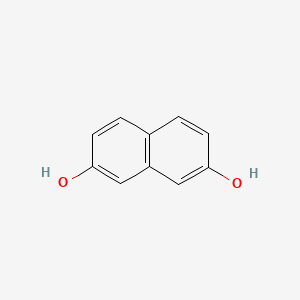
Verified chemistry for CAS 582-17-2
2,7-Naphthalenediol
2,7-naphthalenediol has been reported in Magnolia liliiflora with data available. — LOTUS - the natural products occurrence database
- IUPAC name
- naphthalene-2,7-diol
- Molecular formula
- C10H8O2
- Molecular weight
- 160.17 g/mol
- Exact mass
- 160.052429494 Da
- Monoisotopic mass
- 160.052429494 Da
- XLogP3
- 2.3
- Topological polar surface area
- 40.5 Ų
- Molecular complexity
- 142.0
- Formal charge
- 0
- Hydrogen-bond donors
- 2
- Hydrogen-bond acceptors
- 2
- Rotatable bonds
- 0
- Heavy atoms
- 12
- Covalent units
- 1
Names and synonyms reported to PubChem
16 more reported names
External database identifiers
Advanced structure statistics
- Defined atom stereocentres
- 0
- Undefined atom stereocentres
- 0
- Defined bond stereocentres
- 0
- Undefined bond stereocentres
- 0
- 3D pharmacophore features
- 4
- 3D rings
- 2
- 3D hydrophobes
- 0
- 3D acceptor features
- 0
- 3D donor features
- 2
- 3D anionic centres
- 0
- 3D cationic centres
- 0
- 3D conformers
- 1
- Effective 3D rotors
- 0.0
Machine-readable structure identifiers
- SMILES
C1=CC(=CC2=C1C=CC(=C2)O)O- InChI
InChI=1S/C10H8O2/c11-9-3-1-7-2-4-10(12)6-8(7)5-9/h1-6,11-12H- InChIKey
DFQICHCWIIJABH-UHFFFAOYSA-N
Retrieved from NIH PubChem on 2026-09-02 by checksum-valid CAS matching. Chemical properties do not replace the regulatory decision on this page.
Official source and provenance
- Registered source
- Australia Poisons Standard (SUSMP)
- Source reference
- Therapeutic Goods (Poisons Standard—June 2026) Instrument 2026, Schedule 6
- Source record ID
schedule-6:27-naphthalenediol:51- Source version
- Therapeutic Goods (Poisons Standard—June 2026) Instrument 2026
- Source language
- English
- Translation status
- Original is English
- Effective date
- 2026-06-01
- Source updated
- 2026-05-28
- Snapshot checked
- 2026-08-31 15:26 UTC
- Validation method
- pdftotext -layout; 674 pages; exact cosmetic-relevant per-schedule counts {2: 4, 4: 12, 5: 15, 6: 62, 10: 32}
- SHA-256
38478bdefd4ebaf571ac39001e2ce35026a7edafbaec995e75746ce69a650e11
Registered dataset notes
- Dataset coverage
- All current Poisons Standard entries whose source wording explicitly covers cosmetics or personal-care uses
- Authority note
- Binding Commonwealth scheduling instrument; state and territory implementation and AICIS duties still apply
How this record fits the market dataset
Status distribution
Condition text is present on 125 of 125 current records. An empty condition field is interpreted according to the record type above; it is never converted into an unrestricted-use claim.
Australia market context
Complete cosmetic-relevant Poisons Standard subset plus official workflow
Coverage version: Therapeutic Goods (Poisons Standard—June 2026) Instrument 2026
All 125 current Schedule 2, 4, 5, 6 and 10 entries whose legal wording explicitly covers cosmetics or personal-care uses, plus AICIS verification links.
Verification checklist
- Decide whether the product is a cosmetic or therapeutic good.
- Check the current Poisons Standard for every ingredient.
- Search AICIS Inventory terms and assessment certificates by exact identity.
- Determine introduction category, registration, reporting, records and labelling duties.
Official market sources
- Australia AICIS InventoryNot an allowed/banned cosmetics list; use for per-CAS enrichment and source links
- Australia Poisons Standard (SUSMP)Binding Commonwealth scheduling instrument; state and territory implementation and AICIS duties still apply
- Australia AICIS banned or restricted chemicals guidanceWorkflow guidance, not an exhaustive ingredient list
Verification workflow and record completeness
Before using this result in a compliance decision
- Confirm that “2,7-NAPHTHALENEDIOL” and every CAS/EC identifier refer to the material in your supplier specification.
- Decide whether the product is a cosmetic or therapeutic good.
- Check the current Poisons Standard for every ingredient.
- Search AICIS Inventory terms and assessment certificates by exact identity.
- Determine introduction category, registration, reporting, records and labelling duties.
- Document the source version and recheck the regulator before manufacture, notification or market placement.
Fields available in this record
- Official substance nameAvailable
- CASAvailable
- ECAvailable
- Separate condition textAvailable
- Effective dateAvailable
- Snapshot hash and methodAvailable
Questions this page answers
Stable citation
2,7-NAPHTHALENEDIOL. Therapeutic Goods (Poisons Standard—June 2026) Instrument 2026, Schedule 6. Australia. Source version Therapeutic Goods (Poisons Standard—June 2026) Instrument 2026. CosIng Checker regulatory record: https://cosingchecker.com/regulations/au/records/13157/
Cite the regulator as the legal authority. This page is a structured evidence index and verification aid, not a substitute for the official text or professional legal assessment.
Interpretation and limits for Australia
This substance is not unrestricted: cosmetic use is subject to the conditions in the cited official record.
Check product type, body area, concentration, purity and warning requirements before deciding whether a formulation is compliant.
How to interpret the legal role
The cited row forms part of a binding rule or legally incorporated list for this market.
Evidence on this page
- Recorded outcome: Restricted
- Legal role: Binding rule
- Source version: Therapeutic Goods (Poisons Standard—June 2026) Instrument 2026
- Effective date: 2026-06-01
What it does not prove
An AICIS Inventory match is not cosmetic approval; no Inventory match can indicate a new, exempted, reported or confidential introduction.
Further authoritative substance research
None of these sources overrides the market decision above.
Cosmetic Ingredient Review safety assessments
Expert Panel conclusions, assessed ingredient groups, use conditions, dates and report documents
Independent expert review considered by FDA; not a government approval or binding market rule
Research this identity at the sourceFDA Global Substance Registration System
UNII identifiers, preferred names, substance types, codes and public substance relationships
Identity registry only; UNII availability does not imply FDA review or approval
Research this identity at the sourceILO/WHO International Chemical Safety Cards
Hazards, symptoms, first aid, storage, incompatibilities and physical properties for covered chemicals
International occupational chemical-safety reference; not cosmetic-use approval
Research this identity at the sourceJapan NITE-CHRIP
Chemical identity, Japanese and foreign legal lists, GHS hazards and exposure-related information
Chemical-management evidence; cosmetic status remains governed by the applicable MHLW standard and market rules
Research this identity at the sourceNIOSH Pocket Guide to Chemical Hazards
REL, PEL, IDLH, properties, exposure routes, symptoms, target organs, first aid and measurement methods for covered workplace chemicals
US occupational-health guidance and limits; not a cosmetic ingredient decision
Research this identity at the sourceOECD eChemPortal
Gateway to authority-owned physical-property, fate, ecotoxicity, toxicity, exposure and GHS records
Discovery gateway; each linked authority remains responsible for its data
Research this identity at the sourceUS EPA CompTox CTX APIs
API key required for importDTXSID identity, experimental and predicted properties, toxicity, bioactivity, exposure and environmental data
Scientific and computational evidence; predictions must remain labelled and do not determine cosmetic legality
Research this identity at the source