
Strontium nitrate
ASEAN Annex II lists this record among substances prohibited in cosmetic products. Member-state transition rules and deviations still require local verification.
Regulatory decision and full conditions
- Status
- Prohibited
- Legal role
- Binding rule
- Regulatory summary
- ASEAN Annex II lists this record among substances prohibited in cosmetic products. Member-state transition rules and deviations still require local verification.
- Conditions and restrictions
- A prohibition entry may contain no separate condition text because the regulatory outcome is the prohibition itself. Open the cited source and apply the market-wide requirements below.
Substance identity
- Official source name
- Strontium nitrate
- CAS
- 10042-76-9
- EC
- 233-131-9
- Identity mapping
- cas_number
- Linked ingredient
- STRONTIUM NITRATE
Linked CosIng identity data
Names and aliases
EU inventory restriction note: II/403
Recorded cosmetic function: ORAL CARE, SKIN CONDITIONING
Function pages:ORAL CARE, SKIN CONDITIONING
View the complete ingredient profileCross-market snapshot for this identity
Exact linked records currently present in this site. An absent market means no imported exact match, not permission to use the substance.
European Union
1 linked record
Open supporting recordGreat Britain
1 linked record
Open supporting recordNew Zealand
1 linked record
Open supporting recordASEAN
Current record1 linked record
Open supporting recordChina
1 linked record · 1 with specific conditions
Open supporting recordBrazil
1 linked record · 1 with specific conditions
Open supporting recordIndia
1 linked record · 1 with specific conditions
Open supporting recordSaudi Arabia
1 linked record
Open supporting record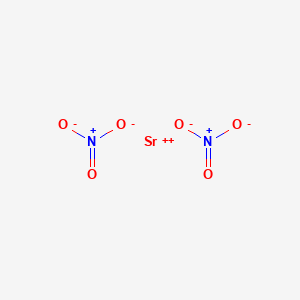
Verified chemistry for CAS 10042-76-9
Strontium nitrate
Strontium nitrate appears as a white crystalline solid. Noncombustible but accelerates burning of combustible materials. May explode if large quantities are involved in a fire or the combustible material is finely divided. May explode under prolonged exposure to heat or fire. Toxic oxides of nitrogen are produced in fires. Used in pyrotechnics, in medicine, and to make other chemicals. — CAMEO Chemicals
- IUPAC name
- strontium dinitrate
- Molecular formula
- N2O6Sr
- Molecular weight
- 211.63 g/mol
- Exact mass
- 211.88124798 Da
- Monoisotopic mass
- 211.88124798 Da
- Topological polar surface area
- 126.0 Ų
- Molecular complexity
- 18.0
- Formal charge
- 0
- Hydrogen-bond donors
- 0
- Hydrogen-bond acceptors
- 6
- Rotatable bonds
- 0
- Heavy atoms
- 9
- Covalent units
- 3
Names and synonyms reported to PubChem
16 more reported names
External database identifiers
- ChEMBL:CHEMBL2219742
- EPA DTXSID:DTXSID9064924
Advanced structure statistics
- Defined atom stereocentres
- 0
- Undefined atom stereocentres
- 0
- Defined bond stereocentres
- 0
- Undefined bond stereocentres
- 0
- 3D conformers
- 0
Machine-readable structure identifiers
- SMILES
[N+](=O)([O-])[O-].[N+](=O)([O-])[O-].[Sr+2]- InChI
InChI=1S/2NO3.Sr/c2*2-1(3)4;/q2*-1;+2- InChIKey
DHEQXMRUPNDRPG-UHFFFAOYSA-N
Evidence from additional scientific databases
NIH PubChem PUG-View
Attributed physical-property, hazard, environmental and use annotations.
- Boiling Point: 1193 °F at 760 mmHg (USCG, 1999) Source: CAMEO Chemicals
- Boiling Point: 645 °C Source: Hazardous Substances Data Bank (HSDB)
- Boiling Point: 645 °C @760 [mm Hg] Source: PAC Chemical Database, U.S. Department of Energy
- Color/Form: WHITE GRANULES OR POWDER Source: Hazardous Substances Data Bank (HSDB)
- Color/Form: Colorless cubic crystals Source: Hazardous Substances Data Bank (HSDB)
- Density: 2.98 (USCG, 1999) - Denser than water; will sink Source: CAMEO Chemicals
- Density: 2.99 g/cu-cm Source: Hazardous Substances Data Bank (HSDB)
- Density: 2.99 @25 °C Source: PAC Chemical Database, U.S. Department of Energy
- Melting Point: 1058 °F (USCG, 1999) Source: CAMEO Chemicals
- Melting Point: 570 °C Source: Hazardous Substances Data Bank (HSDB)
- Melting Point: 570 °C Source: PAC Chemical Database, U.S. Department of Energy
- Physical Description: Strontium nitrate appears as a white crystalline solid. Noncombustible but accelerates burning of combustible materials. May explode if large quantities are involved in a fire or the combustible material is finely divided. May explode under prolonged exposure to heat or fire. Toxic oxides of nitrogen are produced in fires. Used in pyrotechnics, in medicine, and to make other chemicals. Source: CAMEO Chemicals
- Physical Description: Dry Powder; CBI; Large Crystals Source: EPA Chemical Data Reporting (CDR)
- Physical Description: White solid; [Merck Index] White odorless crystalline solid; [MSDSonline] Source: Haz-Map, Information on Hazardous Chemicals and Occupational Diseases
- Solubility: 70.9 g/100 ml water at 18 °C, 100 g/100 ml water at 100 °C Source: Hazardous Substances Data Bank (HSDB)
- Solubility: 401 G/L OF WATER @ 0 °C; 1 KG/L WATER @ 90 °C Source: Hazardous Substances Data Bank (HSDB)
- Solubility: Slightly sol in alcohol or acetone. Source: Hazardous Substances Data Bank (HSDB)
- Solubility: 0.012 g/100 ml absolute alcohol Source: Hazardous Substances Data Bank (HSDB)
- pH: AQ SOLN IS NEUTRAL Source: Hazardous Substances Data Bank (HSDB)
- Carcinogen Classification: Ingested nitrate or nitrite under conditions that result in endogenous nitrosation is probably carcinogenic to humans (Group 2A). (L135) Source: Toxin and Toxin Target Database (T3DB)
- Exposure Routes: Oral (L1137) ; inhalation (L1137) Source: Toxin and Toxin Target Database (T3DB)
- First Aid: Call for medical aid.; EYES: Rinse with water.; SKIN: Wash with water for 15 minutes.; INGESTION: Drink water, milk, or activated charcoal; then induce vomiting. (USCG, 1999) Source: CAMEO Chemicals
- ERG2024, Guide 140 (Strontium nitrate): General First Aid:; · Call 911 or emergency medical service.; · Ensure that medical personnel are aware of the material(s) involved, take precautions to protect themselves and avoid contamination.; · Move victim to fresh air if it can be done safely.; · Administer oxygen if breathing is difficult.; · If victim is not breathing:; -- DO NOT perform mouth-to-mouth resuscitation; the victim may have ingested or inhaled the substance.; -- If equipped and pulse detected, wash face and mouth, then give artificial respiration using a proper respiratory medical device (bag-valve mask, pocket mask equipped with a one-way valve or other device).; -- If no pulse detected or no respiratory medical device available, provide continuous compressions. Conduct a pulse check every two minutes or monitor for any signs of spontaneous respirations.; · Remove and isolate contaminated clothing and shoes.; · For minor skin contact, avoid spreading material on unaffected skin.; · In case of contact with substance, remove immediately by flushing skin or eyes with running water for at least 20 minutes.; · For severe burns, immediate medical attention is required.; · Effects of exposure (inhalation, ingestion, Source: Emergency Response Guidebook (ERG)
- Note: This chemical does not meet GHS hazard criteria for 0.6% (2 of 363) of reports. Source: European Chemicals Agency (ECHA)
- Signal: Danger Source: European Chemicals Agency (ECHA)
- GHS Hazard Statements: H271 (66.1%): May cause fire or explosion; strong Oxidizer [Danger Oxidizing liquids; Oxidizing solids]; H272 (33.1%): May intensify fire; oxidizer [Danger Oxidizing liquids; Oxidizing solids]; H302 (13.5%): Harmful if swallowed [Warning Acute toxicity, oral]; H315 (14.9%): Causes skin irritation [Warning Skin corrosion/irritation]; H318 (77.4%): Causes serious eye damage [Danger Serious eye damage/eye irritation]; H319 (14.9%): Causes serious eye irritation [Warning Serious eye damage/eye irritation]; H335 (13.8%): May cause respiratory irritation [Warning Specific target organ toxicity, single exposure; Respiratory tract irritation] Source: European Chemicals Agency (ECHA)
- Precautionary Statement Codes: P210, P220, P261, P264, P264+P265, P270, P271, P280, P283, P301+P317, P302+P352, P304+P340, P305+P351+P338, P305+P354+P338, P306+P360, P317, P319, P321, P330, P332+P317, P337+P317, P362+P364, P370+P378, P371+P380+P375, P403+P233, P405, P420, and P501 (click each P-code to see the statement) Source: European Chemicals Agency (ECHA)
- ECHA C&L Notifications Summary: Aggregated GHS information provided per 363 reports by companies from 22 notifications to the ECHA C&L Inventory. Each notification may be associated with multiple companies.; Reported as not meeting GHS hazard criteria per 2 of 363 reports by companies.; There are 21 notifications provided by 361 of 363 reports by companies with hazard statement code(s).; Information may vary between notifications depending on impurities, additives, and other factors. The percentage value in parenthesis indicates the notified classification ratio from companies that provide hazard codes. Only hazard codes with percentage values above 10% are shown. For more detailed information, please visit ECHA C&L website. Source: European Chemicals Agency (ECHA)
- Signal: Danger Source: NITE-CMC
- GHS Hazard Statements: H272: May intensify fire; oxidizer [Danger Oxidizing liquids; Oxidizing solids]; H315: Causes skin irritation [Warning Skin corrosion/irritation]; H320: Causes eye irritation [Warning Serious eye damage/eye irritation] Source: NITE-CMC
- Precautionary Statement Codes: P210, P220, P264, P264+P265, P280, P302+P352, P305+P351+P338, P321, P332+P317, P337+P317, P362+P364, P370+P378, and P501 (click each P-code to see the statement) Source: NITE-CMC
- Health Effects: Nitrate and nitrite poisoning causes methemoglobinemia. Nitrites may cause pregnancy complications and developmental effects. They may also be carcinogenic. (L1137) Source: Toxin and Toxin Target Database (T3DB)
- Toxicity Summary: Nitrate's toxicity is a result of it's conversion to nitrite once in the body. Nitrite causes the autocatalytic oxidation of oxyhemoglobin to hydrogen peroxide and methemoglobin. This elevation of methemoglobin levels is a condition known as methemoglobinemia, and is characterized by tissue hypoxia, as methemoglobin cannot bind oxygen. (A2450, L1613) Source: Toxin and Toxin Target Database (T3DB)
- Consumer Uses: Not Known or Reasonably Ascertainable; Soil amendments (fertilizers) Source: EPA Chemical Data Reporting (CDR)
- Industry Uses: Intermediate; Oxidizing agent; Not Known or Reasonably Ascertainable; Other Source: EPA Chemical Data Reporting (CDR)
- Sources/Uses: Used in pyrotechnics (red fire), signal lights, marine signals, railroad flares, matches, and military tracer bullets; Also used in electron tubes and as a pigment; [HSDB] Source: Haz-Map, Information on Hazardous Chemicals and Occupational Diseases
- Uses: In signal lights, marine signals, railroad flares, matches; in pyrotechnics (red fire) Source: Hazardous Substances Data Bank (HSDB)
- Uses: INTERMEDIATE; ELECTRON TUBES Source: Hazardous Substances Data Bank (HSDB)
- Uses: PIGMENT Source: Hazardous Substances Data Bank (HSDB)
- Uses: Mfr of pyrotechnics as it imparts brilliant color to flame Source: Hazardous Substances Data Bank (HSDB)
- Uses: For more Uses (Complete) data for STRONTIUM NITRATE (6 total), please visit the HSDB record page. Source: Hazardous Substances Data Bank (HSDB)
- Uses: Strontium nitrate is used as an oxidizer and colorant in fireworks. Source: Toxin and Toxin Target Database (T3DB)
Mapped by: Existing checksum-valid CAS to unique PubChem CID match. Retrieved: 2026-08-31. Open source record
Scientific classifications and hazard annotations provide context and do not replace the market-specific regulatory decision shown above.
Additional source coverage and match status
| Source | Result | Checked |
|---|---|---|
| EMBL-EBI ChEBI | No exact record | 2026-08-31 |
| NIH PubChem PUG-View | Exact match | 2026-08-31 |
A recorded no-match is useful evidence that the source was checked; it is not a claim that the substance does not exist elsewhere.
Retrieved from NIH PubChem on 2026-09-02 by checksum-valid CAS matching. Chemical properties do not replace the regulatory decision on this page.
Official source and provenance
- Registered source
- ASEAN Cosmetic Directive annexes
- Source reference
- ASEAN Annex II, reference 403
- Source record ID
II-403- Source version
- 2026-1
- Source language
- English
- Translation status
- Original is English
- Source updated
- 2026-06-22
- Snapshot checked
- 2026-08-30 04:44 UTC
- Validation method
- pdfplumber ruled-table extraction with per-annex reviewed counts
- SHA-256
ffad59f6c01a92c82042c54203ee14969425c2a82bd04c2f4012ff82513e69f1
Registered dataset notes
- Dataset coverage
- Banned, restricted and positive-list substances under the harmonised ASEAN framework
- Authority note
- Regional directive; member-state transitions and deviations still require local verification
How this record fits the market dataset
Status distribution
Condition text is present on 462 of 2224 current records. An empty condition field is interpreted according to the record type above; it is never converted into an unrestricted-use claim.
ASEAN market context
Complete regional annex dataset
Coverage version: ASEAN Cosmetic Directive annexes 2026-1, 22 June 2026
Annexes II, III, IV, VI and VII covering prohibited, restricted and positive-list substances.
Verification checklist
- Search all ACD annexes by name and identifiers.
- Apply product type, maximum level and warning conditions.
- Confirm the target member state's adoption and transition date.
- Complete the local notification and responsible-company requirements.
Official market sources
- ASEAN Cosmetic Directive annexesRegional directive; member-state transitions and deviations still require local verification
Verification workflow and record completeness
Before using this result in a compliance decision
- Confirm that “Strontium nitrate” and every CAS/EC identifier refer to the material in your supplier specification.
- Search all ACD annexes by name and identifiers.
- Apply product type, maximum level and warning conditions.
- Confirm the target member state's adoption and transition date.
- Complete the local notification and responsible-company requirements.
- Document the source version and recheck the regulator before manufacture, notification or market placement.
Fields available in this record
- Official substance nameAvailable
- CASAvailable
- ECAvailable
- Separate condition textNot present in source row
- Effective dateNot supplied
- Snapshot hash and methodAvailable
Questions this page answers
Stable citation
Strontium nitrate. ASEAN Annex II, reference 403. ASEAN. Source version 2026-1. CosIng Checker regulatory record: https://cosingchecker.com/regulations/asean/records/2545/
Cite the regulator as the legal authority. This page is a structured evidence index and verification aid, not a substitute for the official text or professional legal assessment.
Interpretation and limits for ASEAN
This official record identifies the substance as prohibited for cosmetic use in the stated market scope.
Do not rely on a formulation containing this identity until the cited source, effective date and exact substance match have been verified.
How to interpret the legal role
The cited row forms part of a binding rule or legally incorporated list for this market.
Evidence on this page
- Recorded outcome: Prohibited
- Legal role: Binding rule
- Source version: 2026-1
What it does not prove
Regional annex coverage does not replace member-state implementation dates, notifications or national deviations.
Further authoritative substance research
None of these sources overrides the market decision above.
Cosmetic Ingredient Review safety assessments
Expert Panel conclusions, assessed ingredient groups, use conditions, dates and report documents
Independent expert review considered by FDA; not a government approval or binding market rule
Research this identity at the sourceFDA Global Substance Registration System
UNII identifiers, preferred names, substance types, codes and public substance relationships
Identity registry only; UNII availability does not imply FDA review or approval
Research this identity at the sourceILO/WHO International Chemical Safety Cards
Hazards, symptoms, first aid, storage, incompatibilities and physical properties for covered chemicals
International occupational chemical-safety reference; not cosmetic-use approval
Research this identity at the sourceJapan NITE-CHRIP
Chemical identity, Japanese and foreign legal lists, GHS hazards and exposure-related information
Chemical-management evidence; cosmetic status remains governed by the applicable MHLW standard and market rules
Research this identity at the sourceNIOSH Pocket Guide to Chemical Hazards
REL, PEL, IDLH, properties, exposure routes, symptoms, target organs, first aid and measurement methods for covered workplace chemicals
US occupational-health guidance and limits; not a cosmetic ingredient decision
Research this identity at the sourceOECD eChemPortal
Gateway to authority-owned physical-property, fate, ecotoxicity, toxicity, exposure and GHS records
Discovery gateway; each linked authority remains responsible for its data
Research this identity at the sourceUS EPA CompTox CTX APIs
API key required for importDTXSID identity, experimental and predicted properties, toxicity, bioactivity, exposure and environmental data
Scientific and computational evidence; predictions must remain labelled and do not determine cosmetic legality
Research this identity at the source