
BETAINE
Methanaminium, 1-carboxy-N,N,N-trimethyl-, hydroxide, inner salt
BETAINE is listed in the EU CosIng inventory, but no direct annex records are linked on this page yet.
Regulatory evidence by market
No rule for this ingredient has been imported for any of the 13 markets tracked here.
That describes this inventory, not the law. No imported rule is not evidence that an ingredient is permitted: a rule may exist under another name or identifier, or in a dataset not yet imported here.
Chemical identity and properties
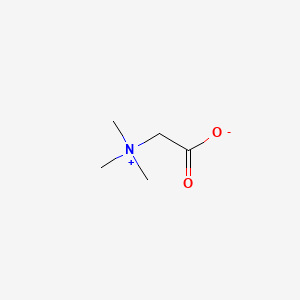
Betaine
Glycine betaine is the amino acid betaine derived from glycine. It has a role as a fundamental metabolite. It is an amino-acid betaine and a glycine derivative. It is a conjugate base of a N,N,N-trimethylglycinium. — ChEBI
- IUPAC name
- 2-(trimethylazaniumyl)acetate
- Molecular formula
- C5H11NO2
- Molecular weight
- 117.15 g/mol
- Exact mass
- 117.078978594 Da
- XLogP3
- 0.5
- Topological polar surface area
- 40.1 Ų
- Hydrogen-bond donors
- 0
- Hydrogen-bond acceptors
- 2
- Covalent units
- 1
- Defined stereocentres
- 0
Also known as
16 more reported names
External database identifiers
- ChEBI:CHEBI:17750
- ChEMBL:CHEMBL1182
- EPA DTXSID:DTXSID8022666
- PubMed:36080318
- PubMed:33124720
- PubMed:29968805
- PubMed:24323041
- PubMed:21501141
- PubMed:19261122
- PubMed:12777166
Evidence from additional scientific databases
EMBL-EBI ChEBI
glycine betaine
The amino acid betaine derived from glycine.
- Formula
- C5H11NO2
- Average mass
- 117.148 g/mol
- Monoisotopic mass
- 117.07898 Da
- Formal charge
- 0
- amino-acid betaine — is a (CHEBI:22860)
- glycine derivative — is a (CHEBI:24373)
- fundamental metabolite — has role (CHEBI:78675)
- fundamental metabolite — has role (CHEBI:78675)
- amino-acid betaine — is a (CHEBI:22860)
- glycine derivative — is a (CHEBI:24373)
- N,N,N-trimethylglycinium — is conjugate base of (CHEBI:41139)
Additional curated names
Cross-references from this source
- CAS: 107-43-7 — KEGG COMPOUND
- CAS: 107-43-7 — ChemIDplus
- CAS: 107-43-7 — NIST Chemistry WebBook
- REGISTRY_NUMBER: 26434 — Gmelin
- REGISTRY_NUMBER: 3537113 — Reaxys
- MANUAL_X_REF: 347 — DrugCentral
- MANUAL_X_REF: BET — PDBeChem
- MANUAL_X_REF: BETAINE — MetaCyc
- MANUAL_X_REF: C00007291 — KNApSAcK
- MANUAL_X_REF: C00719 — KEGG COMPOUND
- MANUAL_X_REF: C00719 — KEGG COMPOUND
- MANUAL_X_REF: D07523 — KEGG DRUG
- MANUAL_X_REF: HMDB0000043 — HMDB
- MANUAL_X_REF: Trimethylglycine — Wikipedia
- MANUAL_X_REF: YMDB01516 — YMDB
Mapped by: Exact CAS cross-reference in the ChEBI compound record. Source updated: 2024-04-18. Retrieved: 2026-08-31. Open source record
NIH PubChem PUG-View
Attributed physical-property, hazard, environmental and use annotations.
- Color/Form: Deliquescent scales or prisms Source: Hazardous Substances Data Bank (HSDB)
- pKa: 1.83 Source: DrugBank
- Melting Point: 301-305°C Source: DrugBank
- Melting Point: Decomposes around 293 °C Source: Hazardous Substances Data Bank (HSDB)
- Physical Description: Liquid; Dry Powder Source: EPA Chemical Data Reporting (CDR)
- Physical Description: Deliquescent solid; [Merck Index] Powder; [Alfa Aesar MSDS] Source: Haz-Map, Information on Hazardous Chemicals and Occupational Diseases
- Physical Description: Free-flowing, white crystals; Savoury Source: Joint FAO/WHO Expert Committee on Food Additives (JECFA)
- Solubility: Soluble Source: DrugBank
- Solubility: Solubility (g/100 g solvent): methanol, 55; ethanol, 8.7. Sparingly soluble in ether. Source: Hazardous Substances Data Bank (HSDB)
- Solubility: Slightly soluble in chloroform Source: Hazardous Substances Data Bank (HSDB)
- Solubility: In water, 6.11X10+5 mg/L at 19 °C Source: Hazardous Substances Data Bank (HSDB)
- Solubility: Very soluble Source: Joint FAO/WHO Expert Committee on Food Additives (JECFA)
- Solubility: Soluble (in ethanol) Source: Joint FAO/WHO Expert Committee on Food Additives (JECFA)
- Vapor Pressure: 0.00000053 [mmHg] Source: Haz-Map, Information on Hazardous Chemicals and Occupational Diseases
- Note: This chemical does not meet GHS hazard criteria for 90.4% (274 of 303) of all reports. Source: European Chemicals Agency (ECHA)
- GHS Hazard Statements: Not Classified; Reported as not meeting GHS hazard criteria by 274 of 303 companies (only 9.6% companies provided GHS information). For more detailed information, please visit ECHA C&L website. Source: European Chemicals Agency (ECHA)
- ECHA C&L Notifications Summary: Aggregated GHS information provided per 303 reports by companies from 5 notifications to the ECHA C&L Inventory.; Reported as not meeting GHS hazard criteria per 274 of 303 reports by companies.; There are 3 notifications provided by 29 of 303 reports by companies with hazard statement code(s).; Information may vary between notifications depending on impurities, additives, and other factors. The percentage value in parenthesis indicates the notified classification ratio from companies that provide hazard codes. Only hazard codes with percentage values above 10% are shown. For more detailed information, please visit ECHA C&L website. Source: European Chemicals Agency (ECHA)
- Cosmetic Ingredient Review Conclusion: The CIR Expert Panel concluded that the eleven alkyl betaines listed below are safe in the present practices of use and concentration in cosmetics, when formulated to be non-irritating...Betaine... Source: Cosmetic Ingredient Review (CIR)
- Cosmetic Ingredient Review Finding(s): Safe for use in cosmetics, with qualifications Source: Cosmetic Ingredient Review (CIR)
- Environmental Bioconcentration: An estimated BCF of 0.3 was calculated in fish for betaine(SRC), using a water solubility of 611,000 mg/L at 19.3 °C(1) and a regression-derived equation(2). According to a classification scheme(3), this BCF suggests the potential for bioconcentration in aquatic organisms is low(SRC), provided the compound is not metabolized by the organism(SRC). Source: Hazardous Substances Data Bank (HSDB)
- Environmental Fate: TERRESTRIAL FATE: Based on a classification scheme(1), an estimated Koc value of 3(SRC), determined from a water solubility of 611,000 mg/L at 19.3 °C(2) and a regression-derived equation(3), indicates that betaine is expected to have very high mobility in soil(SRC). The estimated pKa of betaine, an inner salt, is 2.38(4). Volatilization of betaine from moist soil surfaces is not expected to be an important fate process(SRC) because ionic compounds do not volatilize. Betaine is not expected to volatilize from dry soil surfaces(SRC) based upon an estimated vapor pressure of 1.4X10⁻⁸ mm Hg(SRC), determined from a fragment constant method(5). No information on the aerobic biodegradation of betaine was located; however, the mineralization of alkyl betaine surfactants is considerable (>60% BODT reached in 28-day screening tests(6,7)) indicating that it is likely that betaine is also readily mineralized(SRC). Betaine is expected to biodegrade under anaerobic conditions as well based on data indicating that it is removed during anaerobic sewage treatment(8). Source: Hazardous Substances Data Bank (HSDB)
- Environmental Fate: AQUATIC FATE: Based on a classification scheme(1), an estimated Koc value of 3(SRC), determined from a water solubility of 611,000 mg/L at 19.3 °C(2) and a regression-derived equation(3), indicates that betaine is not expected to adsorb to suspended solids and sediment(SRC). An estimated pKa of 2.38(4) indicates betaine, will exist entirely as an inner salt at pH values of 5 to 9 and therefore volatilization from water surfaces will not occur as ionic compounds do not volatilize. According to a classification scheme(5), an estimated BCF of 0.3(SRC), from its water solubility(2) and a regression-derived equation(6), suggests the potential for bioconcentration in aquatic organisms is low(SRC). No information on the aerobic biodegradation of betaine was located; however, the mineralization of alkyl betaine surfactants is considerable (>60% BODT reached in 28-day screening tests(7,8)) indicating that it is likely that betaine is also readily mineralized(SRC). Betaine is expected to biodegrade under anaerobic conditions as well based on data indicating that it is removed during anaerobic sewage treatment(9). Source: Hazardous Substances Data Bank (HSDB)
- Environmental Fate: ATMOSPHERIC FATE: According to a model of gas/particle partitioning of semivolatile organic compounds in the atmosphere(1), betaine, which has an estimated vapor pressure of 1.4X10⁻⁸ mm Hg at 25 °C(SRC), determined from a fragment constant method(2), is expected to exist solely in the particulate phase in the ambient atmosphere. Particulate-phase betaine may be removed from the air by wet or dry deposition(SRC). Betaine does not contain chromophores that absorb at wavelengths >290 nm and therefore is not expected to be susceptible to direct photolysis by sunlight(3). Source: Hazardous Substances Data Bank (HSDB)
- Consumer Uses: Other Source: EPA Chemical Data Reporting (CDR)
- Industry Uses: Other; Solvent; Anti-freeze agent Source: EPA Chemical Data Reporting (CDR)
- Cosmetic Ingredient Review Link: CIR ingredient: Betaine Source: Cosmetic Ingredient Review (CIR)
- Sources/Uses: Occurs naturally in plants and animals; Used in the treatment of homocystinuria; [Merck Index] Used in soldering and resin curing fluxes, in organic synthesis, and in fisheries (promotes fish survival and aids transfer of salmon and trout from freshwater to seawater); [HSDB] Source: Haz-Map, Information on Hazardous Chemicals and Occupational Diseases
- Industrial Processes with risk of exposure: Soldering [Category: Heat or Machine] Source: Haz-Map, Information on Hazardous Chemicals and Occupational Diseases
- Uses: In soldering, resin curing fluxes, organic synthesis; in treatment of homocystinuria Source: Hazardous Substances Data Bank (HSDB)
- Uses: Lipotropic drug Source: Hazardous Substances Data Bank (HSDB)
- Uses: Gastric acidifier /Betaine hydrochloride/ Source: Hazardous Substances Data Bank (HSDB)
- Uses: Betaine ... /is/ known as /a/ dietary feeding attractant for many fish species ... Betaine given singly or mixed with other attractants has been found to have a positive effect on fish growth and survival rate. Betaine is also a very important substance for methyl donation and osmoregulation during the transfer of salmon and trout from freshwater to seawater ... Source: Hazardous Substances Data Bank (HSDB)
- Uses: Use (kg; approx.) in Germany (2009): >500; Consumption (g per capita; approx.) in Germany (2009): 0.00611; Calculated removal (%): 92.1 Source: NORMAN Suspect List Exchange
Mapped by: Existing checksum-valid CAS to unique PubChem CID match. Retrieved: 2026-08-31. Open source record
Scientific classifications and hazard annotations provide context and do not replace the market-specific regulatory decision shown above.
Additional source coverage and match status
| Source | Result | Checked |
|---|---|---|
| EMBL-EBI ChEBI | Exact match | 2026-08-31 |
| NIH PubChem PUG-View | Exact match | 2026-08-31 |
A recorded no-match is useful evidence that the source was checked; it is not a claim that the substance does not exist elsewhere.
Retrieved from NIH PubChem on 2026-08-31 by checksum-valid CAS matching. Chemical properties do not replace the regulatory decision on this page.
Inventory details for BETAINE
INCI name
BETAINE
INN name
betaine
Description
Methanaminium, 1-carboxy-N,N,N-trimethyl-, hydroxide, inner salt
Record provenance
- Inventory reference
- 74520
- Imported identity
- BETAINE
- Source update
- 15/10/2010
Annex records for BETAINE
Key data
- ANTISTATIC
- Preventing and/or reducing static electricity by neutralising electrical charge on surfaces.
- HAIR CONDITIONING
- Enhancing the appearance and feel of hair. Leaving the hair easy to comb, supple, soft and shiny and/or imparting volume, lightness, gloss, texture, etc.
- HUMECTANT
- Retaining and/or preserving the moisture in a product during use.
- SKIN CONDITIONING
- Maintaining the skin in good condition.
- VISCOSITY CONTROLLING
- Increasing or decreasing the viscosity (thickness) of cosmetics.
Official EU ingredient-name evidence
The ingredient name exactly matches the official 2025 EU glossary of common ingredient names.
Related inventory evidence
Ingredients with overlapping formulation functions
Additional official and scientific sources
11 external databases to check this identity in
Each link searches that source for this identity. What each source is, and its legal weight
How BETAINE appears in the CosIng inventory
The CosIng inventory lists BETAINE as a cosmetic ingredient and this page links it to 0 annex records. The inventory entry captures names and identifiers, while the annex records show where the substance is prohibited, restricted or positively listed in EU cosmetics law.
BETAINE is also tagged with 5 cosmetic functions in the official data. Function labels describe intended use, but they do not replace regulatory review of linked annex records before formulation or labelling work.
Frequently asked questions
Source note for BETAINE
This page reproduces the CosIng inventory entry for BETAINE from public European Commission cosmetic ingredient materials and shows linked identifiers even when no direct annex match is currently attached.
Use this inventory page to research BETAINE and compare linked records, but verify restrictions and legal status against the current official source text and law before making regulatory decisions.
Tools & next steps
Check your formula
Scan a full INCI list to detect BETAINE and any linked EU annex restrictions or allergen flags.
INCI CheckerSearch similar ingredients
Find other inventory ingredients and annex entries related to BETAINE, its identifiers or nearby name variants.
Search