
THIOCTIC ACID
1,2-Dithiolane-3-pentanoic acid, (+/-)-
THIOCTIC ACID is listed in the EU CosIng inventory, but no direct annex records are linked on this page yet.
Regulatory evidence by market
This matrix separates verified ingredient rules from sources that are mapped but not yet imported. No imported rule does not mean the ingredient is permitted.
Swipe or scroll horizontally to see every column.
| Market | Evidence status | Records | Source language |
|---|---|---|---|
| European Union | Source mapped Inventory entry; no linked annex rule | 0 | English and EU languages |
| Great Britain | Source mapped Official source mapped; ingredient rule not imported | 0 | English |
| Canada | Source mapped Official source mapped; ingredient rule not imported | 0 | English and French |
| New Zealand | Source mapped Official source mapped; ingredient rule not imported | 0 | English |
| ASEAN | Source mapped Official source mapped; ingredient rule not imported | 0 | English and national languages |
| China | Source mapped Official source mapped; ingredient rule not imported | 0 | Chinese with selected English material |
| Japan | Evidence linked Restricted Open this evidence | 1 | Japanese; official English translation available |
| South Korea | Source mapped Official source mapped; ingredient rule not imported | 0 | Korean with some English names |
| United States | Source mapped Official source mapped; ingredient rule not imported | 0 | English |
| Australia | Source mapped Official source mapped; ingredient rule not imported | 0 | English |
| Brazil | Source mapped Official source mapped; ingredient rule not imported | 0 | Portuguese with INCI crosswalks |
| India | Source mapped Official source mapped; ingredient rule not imported | 0 | English and Hindi |
| Saudi Arabia | Source mapped Official source mapped; ingredient rule not imported | 0 | Arabic and English |
Chemical identity and properties
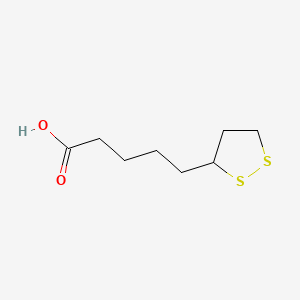
alpha Lipoic acid
Lipoic acid is a heterocyclic thia fatty acid comprising pentanoic acid with a 1,2-dithiolan-3-yl group at the 5-position. It has a role as a geroprotector and a fundamental metabolite. It is a member of dithiolanes, a heterocyclic fatty acid and a thia fatty acid. It is functionally related to an octanoic acid. It is a conjugate acid of a lipoate. — ChEBI
- IUPAC name
- 5-(dithiolan-3-yl)pentanoic acid
- Molecular formula
- C8H14O2S2
- Molecular weight
- 206.3 g/mol
- Exact mass
- 206.04352203 Da
- XLogP3
- 1.7
- Topological polar surface area
- 87.9 Ų
- Hydrogen-bond donors
- 1
- Hydrogen-bond acceptors
- 4
- Covalent units
- 1
- Defined stereocentres
- 0
Also known as
16 more reported names
External database identifiers
- ChEBI:CHEBI:16494
- ChEMBL:CHEMBL33864
- EPA DTXSID:DTXSID7025508
- PubMed:22654724
- PubMed:22448096
- PubMed:22384101
- PubMed:22374556
- PubMed:22363901
- PubMed:22272085
- PubMed:22242957
- PubMed:22163871
- PubMed:22163517
- PubMed:22146387
- PubMed:22125679
- PubMed:22125537
Evidence from additional scientific databases
NIH PubChem PUG-View
Attributed physical-property, hazard, environmental and use annotations.
- Color/Form: Forms yellowish flakes Source: Hazardous Substances Data Bank (HSDB)
- Dissociation Constants: pKa = 5.10 Source: Hazardous Substances Data Bank (HSDB)
- Melting Point: 47.5-48 °C Source: Hazardous Substances Data Bank (HSDB)
- Solubility: Yellow powder; solubility in ethanol: 50 mg/mL /Synthetic, oxidized form/ Source: Hazardous Substances Data Bank (HSDB)
- Solubility: Soluble in methanol, ethanol, diethyl ether and chloroform Source: Hazardous Substances Data Bank (HSDB)
- Carcinogen Classification: No indication of carcinogenicity to humans (not listed by IARC). Source: Toxin and Toxin Target Database (T3DB)
- Note: This chemical does not meet GHS hazard criteria for 6.5% (28 of 430) of reports. Source: European Chemicals Agency (ECHA)
- Signal: Warning Source: European Chemicals Agency (ECHA)
- GHS Hazard Statements: H302 (93.5%): Harmful if swallowed [Warning Acute toxicity, oral]; H315 (48.6%): Causes skin irritation [Warning Skin corrosion/irritation]; H317 (46.5%): May cause an allergic skin reaction [Warning Sensitization, Skin]; H319 (47%): Causes serious eye irritation [Warning Serious eye damage/eye irritation]; H411 (46.5%): Toxic to aquatic life with long lasting effects [Hazardous to the aquatic environment, long-term hazard] Source: European Chemicals Agency (ECHA)
- Precautionary Statement Codes: P261, P264, P264+P265, P270, P272, P273, P280, P301+P317, P302+P352, P305+P351+P338, P321, P330, P332+P317, P333+P317, P337+P317, P362+P364, P391, and P501 (click each P-code to see the statement) Source: European Chemicals Agency (ECHA)
- ECHA C&L Notifications Summary: Aggregated GHS information provided per 430 reports by companies from 16 notifications to the ECHA C&L Inventory. Each notification may be associated with multiple companies.; Reported as not meeting GHS hazard criteria per 28 of 430 reports by companies.; There are 14 notifications provided by 402 of 430 reports by companies with hazard statement code(s).; Information may vary between notifications depending on impurities, additives, and other factors. The percentage value in parenthesis indicates the notified classification ratio from companies that provide hazard codes. Only hazard codes with percentage values above 10% are shown. For more detailed information, please visit ECHA C&L website. Source: European Chemicals Agency (ECHA)
- Note: This chemical does not meet GHS hazard criteria for 42.3% (52 of 123) of reports. Source: European Chemicals Agency (ECHA)
- GHS Hazard Statements: H302 (57.7%): Harmful if swallowed [Warning Acute toxicity, oral]; H315 (31.7%): Causes skin irritation [Warning Skin corrosion/irritation]; H319 (31.7%): Causes serious eye irritation [Warning Serious eye damage/eye irritation]; H335 (31.7%): May cause respiratory irritation [Warning Specific target organ toxicity, single exposure; Respiratory tract irritation]; H412 (19.5%): Harmful to aquatic life with long lasting effects [Hazardous to the aquatic environment, long-term hazard] Source: European Chemicals Agency (ECHA)
- Precautionary Statement Codes: P261, P264, P264+P265, P270, P271, P273, P280, P301+P317, P302+P352, P304+P340, P305+P351+P338, P319, P321, P330, P332+P317, P337+P317, P362+P364, P403+P233, P405, and P501 (click each P-code to see the statement) Source: European Chemicals Agency (ECHA)
- ECHA C&L Notifications Summary: Aggregated GHS information provided per 123 reports by companies from 8 notifications to the ECHA C&L Inventory. Each notification may be associated with multiple companies.; Reported as not meeting GHS hazard criteria per 52 of 123 reports by companies.; There are 7 notifications provided by 71 of 123 reports by companies with hazard statement code(s).; Information may vary between notifications depending on impurities, additives, and other factors. The percentage value in parenthesis indicates the notified classification ratio from companies that provide hazard codes. Only hazard codes with percentage values above 10% are shown. For more detailed information, please visit ECHA C&L website. Source: European Chemicals Agency (ECHA)
- Health Effects: Acute exposure to cholinesterase inhibitors can cause a cholinergic crisis characterized by severe nausea/vomiting, salivation, sweating, bradycardia, hypotension, collapse, and convulsions. Increasing muscle weakness is a possibility and may result in death if respiratory muscles are involved. Accumulation of ACh at motor nerves causes overstimulation of nicotinic expression at the neuromuscular junction. When this occurs symptoms such as muscle weakness, fatigue, muscle cramps, fasciculation, and paralysis can be seen. When there is an accumulation of ACh at autonomic ganglia this causes overstimulation of nicotinic expression in the sympathetic system. Symptoms associated with this are hypertension, and hypoglycemia. Overstimulation of nicotinic acetylcholine receptors in the central nervous system, due to accumulation of ACh, results in anxiety, headache, convulsions, ataxia, depression of respiration and circulation, tremor, general weakness, and potentially coma. When there is expression of muscarinic overstimulation due to excess acetylcholine at muscarinic acetylcholine receptors symptoms of visual disturbances, tightness in chest, wheezing due to bronchoconstriction, incre Source: Toxin and Toxin Target Database (T3DB)
- Toxicity Summary: ALA is generally considered a safe drug. A daily dose of 200 mg/day to 2400 mg/day of ALA is deemed safe without significant adverse effects. However, there is no reported safe dose in children.; A notable case in literature demonstrated status epilepticus (SE) that subsided within a few days. The seizures were treated per normal standards for SE.; In the last 2 decades, there have been few reported cases of ALA toxicity in humans. Most of these cases occur in children and are treatable. Though there is no established lethal dosage of ALA for humans, studies have shown that a high dose of 121 mg/kg body weight/day was associated with alterations in liver enzymes and liver function. Therefore, there are potentially harmful adverse effects from overdosing on ALA, and more studies are necessary to determine the toxicity. Source: StatPearls
- Toxicity Summary: (R)-lipoic acid is a cholinesterase or acetylcholinesterase (AChE) inhibitor. A cholinesterase inhibitor (or 'anticholinesterase') suppresses the action of acetylcholinesterase. Because of its essential function, chemicals that interfere with the action of acetylcholinesterase are potent neurotoxins, causing excessive salivation and eye-watering in low doses, followed by muscle spasms and ultimately death. Nerve gases and many substances used in insecticides have been shown to act by binding a serine in the active site of acetylcholine esterase, inhibiting the enzyme completely. Acetylcholine esterase breaks down the neurotransmitter acetylcholine, which is released at nerve and muscle junctions, in order to allow the muscle or organ to relax. The result of acetylcholine esterase inhibition is that acetylcholine builds up and continues to act so that any nerve impulses are continually transmitted and muscle contractions do not stop. Among the most common acetylcholinesterase inhibitors are phosphorus-based compounds, which are designed to bind to the active site of the enzyme. The structural requirements are a phosphorus atom bearing two lipophilic groups, a leaving group (such as Source: Toxin and Toxin Target Database (T3DB)
- Uses: Nutrition, biochemical research /Thioctic acid, dl-form/ Source: Hazardous Substances Data Bank (HSDB)
- Uses: THERAPEUTIC CATEGORY: Treatment of liver disease; antidote to poisonous mushrooms (Amanita species). Source: Hazardous Substances Data Bank (HSDB)
- Uses: Use (kg; approx.) in Germany (2009): >7500; Consumption (g per capita; approx.) in Germany (2009): 0.0916; Calculated removal (%): 96.4 Source: NORMAN Suspect List Exchange
- Uses: For nutritional supplementation, also for treating dietary shortage or imbalance. Source: Toxin and Toxin Target Database (T3DB)
Mapped by: Existing checksum-valid CAS to unique PubChem CID match. Retrieved: 2026-08-31. Open source record
Scientific classifications and hazard annotations provide context and do not replace the market-specific regulatory decision shown above.
Additional source coverage and match status
| Source | Result | Checked |
|---|---|---|
| NIH PubChem PUG-View | Exact match | 2026-08-31 |
A recorded no-match is useful evidence that the source was checked; it is not a claim that the substance does not exist elsewhere.
Retrieved from NIH PubChem on 2026-09-02 by checksum-valid CAS matching. Chemical properties do not replace the regulatory decision on this page.
Inventory details for THIOCTIC ACID
INCI name
THIOCTIC ACID
INN name
Thioctic acid [JAN]
Description
1,2-Dithiolane-3-pentanoic acid, (+/-)-
Record provenance
- Inventory reference
- 60299
- Imported identity
- THIOCTIC ACID
- Source update
- 15/10/2010
Annex records for THIOCTIC ACID
Key data
- ANTIOXIDANT
- Inhibiting reactions promoted by oxygen, thus avoiding oxidation and rancidity.
Official EU ingredient-name evidence
The ingredient name exactly matches the official 2025 EU glossary of common ingredient names.
Related inventory evidence
Ingredients with overlapping formulation functions
Additional official and scientific sources
11 external databases to check this identity in
Each link searches that source for this identity. What each source is, and its legal weight
How THIOCTIC ACID appears in the CosIng inventory
The CosIng inventory lists THIOCTIC ACID as a cosmetic ingredient and this page links it to 0 annex records. The inventory entry captures names and identifiers, while the annex records show where the substance is prohibited, restricted or positively listed in EU cosmetics law.
THIOCTIC ACID is also tagged with 1 cosmetic function in the official data. Function labels describe intended use, but they do not replace regulatory review of linked annex records before formulation or labelling work.
Frequently asked questions
Source note for THIOCTIC ACID
This page reproduces the CosIng inventory entry for THIOCTIC ACID from public European Commission cosmetic ingredient materials and shows linked identifiers even when no direct annex match is currently attached.
Use this inventory page to research THIOCTIC ACID and compare linked records, but verify restrictions and legal status against the current official source text and law before making regulatory decisions.
Tools & next steps
Check your formula
Scan a full INCI list to detect THIOCTIC ACID and any linked EU annex restrictions or allergen flags.
INCI CheckerSearch similar ingredients
Find other inventory ingredients and annex entries related to THIOCTIC ACID, its identifiers or nearby name variants.
Search