
DIBROMOCYANOACETAMIDE
Acetamide, 2,2-dibromo-2-cyano
DIBROMOCYANOACETAMIDE is listed in the EU CosIng inventory, but no direct annex records are linked on this page yet.
Regulatory evidence by market
No rule for this ingredient has been imported for any of the 13 markets tracked here.
That describes this inventory, not the law. No imported rule is not evidence that an ingredient is permitted: a rule may exist under another name or identifier, or in a dataset not yet imported here.
Chemical identity and properties
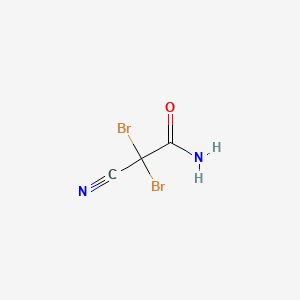
2,2-Dibromo-3-nitrilopropionamide
2,2-dibromo-3-nitrilopropionamide is a colorless to yellow liquid with a moldy pungent odor. — CAMEO Chemicals
- IUPAC name
- 2,2-dibromo-2-cyanoacetamide
- Molecular formula
- C3H2Br2N2O
- Molecular weight
- 241.87 g/mol
- Exact mass
- 241.85134 Da
- XLogP3
- 0.6
- Topological polar surface area
- 66.9 Ų
- Hydrogen-bond donors
- 1
- Hydrogen-bond acceptors
- 2
- Covalent units
- 1
- Defined stereocentres
- 0
Also known as
16 more reported names
External database identifiers
Evidence from additional scientific databases
NIH PubChem PUG-View
Attributed physical-property, hazard, environmental and use annotations.
- Boiling Point: Decomposes at 190 °C Source: Hazardous Substances Data Bank (HSDB)
- Color/Form: White to "off white" crystalline solid Source: Hazardous Substances Data Bank (HSDB)
- Dissociation Constants: 2.375 at 21 °C Source: Hazardous Substances Data Bank (HSDB)
- LogP: log Kow = 0.80 at pH 7; 0.795 at pH 5; 0.82 at pH 9.0 Source: Hazardous Substances Data Bank (HSDB)
- LogP: 0.820 Source: Human Metabolome Database (HMDB)
- Melting Point: 123 to 126 °C Source: Hazardous Substances Data Bank (HSDB)
- Melting Point: 126 °C Source: Human Metabolome Database (HMDB)
- Odor: Mild "medicinal antiseptic" Source: Hazardous Substances Data Bank (HSDB)
- Physical Description: 2,2-dibromo-3-nitrilopropionamide is a colorless to yellow liquid with a moldy pungent odor. Source: CAMEO Chemicals
- Physical Description: Dry Powder; Liquid Source: EPA Chemical Data Reporting (CDR)
- Physical Description: White solid; [HSDB] Colorless to yellow liquid with a moldy pungent odor; [CAMEO] White powder; [MSDSonline] Source: Haz-Map, Information on Hazardous Chemicals and Occupational Diseases
- Physical Description: Solid Source: Human Metabolome Database (HMDB)
- Solubility: In water, 1.5 g/100 mL (15,000 mg/L) Source: Hazardous Substances Data Bank (HSDB)
- Solubility: In acetone, 35 g/100 mL; in ethanol, 25 g/100mL Source: Hazardous Substances Data Bank (HSDB)
- Solubility: 0.82 mg/L @ 25 °C (exp) Source: Human Metabolome Database (HMDB)
- Vapor Pressure: 0.0009 [mmHg] Source: Haz-Map, Information on Hazardous Chemicals and Occupational Diseases
- Vapor Pressure: 9.0X10⁻⁴ mm Hg at 25 °C Source: Hazardous Substances Data Bank (HSDB)
- pH: pH at 25 °C: 6.61 in 0.01% aqueous solution Source: Hazardous Substances Data Bank (HSDB)
- First Aid: Excerpt from ERG Guide 154 [Substances - Toxic and/or Corrosive (Non-Combustible)]:; Refer to the "General First Aid" section. Specific First Aid: For corrosives, in case of contact, immediately flush skin or eyes with running water for at least 30 minutes. Additional flushing may be required. (ERG, 2024) Source: CAMEO Chemicals
- Signal: Danger Source: Regulation (EC) No 1272/2008 of the European Parliament and of the Council
- GHS Hazard Statements: H301: Toxic if swallowed [Danger Acute toxicity, oral]; H315: Causes skin irritation [Warning Skin corrosion/irritation]; H317: May cause an allergic skin reaction [Warning Sensitization, Skin]; H318: Causes serious eye damage [Danger Serious eye damage/eye irritation]; H330: Fatal if inhaled [Danger Acute toxicity, inhalation]; H372: Causes damage to organs through prolonged or repeated exposure [Danger Specific target organ toxicity, repeated exposure]; H400: Very toxic to aquatic life [Warning Hazardous to the aquatic environment, acute hazard]; H410: Very toxic to aquatic life with long lasting effects [Warning Hazardous to the aquatic environment, long-term hazard] Source: Regulation (EC) No 1272/2008 of the European Parliament and of the Council
- Precautionary Statement Codes: P260, P261, P264, P264+P265, P270, P271, P272, P273, P280, P284, P301+P316, P302+P352, P304+P340, P305+P354+P338, P316, P317, P319, P320, P321, P330, P332+P317, P333+P317, P362+P364, P391, P403+P233, P405, and P501 (click each P-code to see the statement) Source: Regulation (EC) No 1272/2008 of the European Parliament and of the Council
- Note: This chemical does not meet GHS hazard criteria for 1.1% (5 of 465) of reports. Source: European Chemicals Agency (ECHA)
- Signal: Danger Source: European Chemicals Agency (ECHA)
- GHS Hazard Statements: H301 (78.7%): Toxic if swallowed [Danger Acute toxicity, oral]; H315 (88.4%): Causes skin irritation [Warning Skin corrosion/irritation]; H317 (94.8%): May cause an allergic skin reaction [Warning Sensitization, Skin]; H318 (89%): Causes serious eye damage [Danger Serious eye damage/eye irritation]; H330 (65.2%): Fatal if inhaled [Danger Acute toxicity, inhalation]; H331 (19.4%): Toxic if inhaled [Danger Acute toxicity, inhalation]; H372 (47.3%): Causes damage to organs through prolonged or repeated exposure [Danger Specific target organ toxicity, repeated exposure]; H400 (91.4%): Very toxic to aquatic life [Warning Hazardous to the aquatic environment, acute hazard]; H410 (57.4%): Very toxic to aquatic life with long lasting effects [Warning Hazardous to the aquatic environment, long-term hazard] Source: European Chemicals Agency (ECHA)
- Precautionary Statement Codes: P260, P261, P264, P264+P265, P270, P271, P272, P273, P280, P284, P301+P316, P302+P352, P304+P340, P305+P354+P338, P316, P317, P319, P320, P321, P330, P332+P317, P333+P317, P362+P364, P391, P403+P233, P405, and P501 (click each P-code to see the statement) Source: European Chemicals Agency (ECHA)
- ECHA C&L Notifications Summary: Aggregated GHS information provided per 465 reports by companies from 31 notifications to the ECHA C&L Inventory. Each notification may be associated with multiple companies.; Reported as not meeting GHS hazard criteria per 5 of 465 reports by companies.; There are 30 notifications provided by 460 of 465 reports by companies with hazard statement code(s).; Information may vary between notifications depending on impurities, additives, and other factors. The percentage value in parenthesis indicates the notified classification ratio from companies that provide hazard codes. Only hazard codes with percentage values above 10% are shown. For more detailed information, please visit ECHA C&L website. Source: European Chemicals Agency (ECHA)
- Signal: Danger Source: NITE-CMC
- GHS Hazard Statements: H372: Causes damage to organs through prolonged or repeated exposure [Danger Specific target organ toxicity, repeated exposure]; H400: Very toxic to aquatic life [Warning Hazardous to the aquatic environment, acute hazard]; H410: Very toxic to aquatic life with long lasting effects [Warning Hazardous to the aquatic environment, long-term hazard] Source: NITE-CMC
- Precautionary Statement Codes: P260, P264, P270, P273, P319, P391, and P501 (click each P-code to see the statement) Source: NITE-CMC
- GHS Hazard Statements: H301: Toxic if swallowed [Danger Acute toxicity, oral]; H315: Causes skin irritation [Warning Skin corrosion/irritation]; H317: May cause an allergic skin reaction [Warning Sensitization, Skin]; H318: Causes serious eye damage [Danger Serious eye damage/eye irritation]; H330: Fatal if inhaled [Danger Acute toxicity, inhalation]; H335: May cause respiratory irritation [Warning Specific target organ toxicity, single exposure; Respiratory tract irritation]; H373: May causes damage to organs through prolonged or repeated exposure [Warning Specific target organ toxicity, repeated exposure]; H400: Very toxic to aquatic life [Warning Hazardous to the aquatic environment, acute hazard]; H410: Very toxic to aquatic life with long lasting effects [Warning Hazardous to the aquatic environment, long-term hazard] Source: NITE-CMC
- Toxicity Summary: IDENTIFICATION AND USE: 2,2-Dibromo-3-nitrilopropionamide (DBNPA) is white to "off white" crystalline solid. It is used as a pesticide(Trade Names: DBNPA, Slimicide 508, XD-7287L Antimicrobial, XD-1603.) Main uses include the following: algicide, bactericide and fungicide; preservative used mainly in pulp, paper and paperboard mill water systems and in industrial water cooling systems. It is also used as a preservative in animal glues, metalworking cutting fluids, oil recovery drilling muds, latex paints, resin/latex/polymer emulsions, latex/oil/varnish paints, and paper and paper products. HUMAN EXPOSURE AND TOXICITY: Several human incident reports concerning DBNPA are on file with the EPA. These include eye, throat, & respiratory irritation, runny nose, & headache. Generally the effects arose with spills or misuse. No treatment related effects on chromosome aberrations in proliferating cultured human lymphocyte were reported with or without metabolic activation. ANIMAL STUDIES: A primary eye irritation study in rabbits resulted in severe corneal damage. Dermal irritation was noted in rats of both sexes. Renal tubular alterations of the kidneys (minimal cytoplasmic swelling and va Source: Hazardous Substances Data Bank (HSDB)
- Environmental Bioconcentration: An estimated BCF of 3 was calculated in fish for 2,2-dibromo-3-nitrilopropionamide(SRC), using a log Kow of 0.80(1) and a regression-derived equation(2). According to a classification scheme(3), this BCF suggests the potential for bioconcentration in aquatic organisms is low(SRC). Using carp (Cyprinus carpio) which were exposed over an 8-week period, 2,2-dibromo-3-nitrilopropionamide was reported to have low bioconcentration (BCF value not available)(4). Source: Hazardous Substances Data Bank (HSDB)
- Environmental Fate: TERRESTRIAL FATE: Based on a classification scheme(1), an estimated Koc value of 58(SRC), determined from a log Kow of 0.80(2) and a regression-derived equation(3), indicates that 2,2-dibromo-3-nitrilopropionamide is expected to have high mobility in soil(SRC). Volatilization of 2,2-dibromo-3-nitrilopropionamide from moist soil surfaces is not expected to be an important fate process(SRC) given an estimated Henry's Law constant of 1.9X10⁻⁸ atm-cu m/mole(SRC), derived from its vapor pressure, 9.0X10⁻⁴ mm Hg(2), and water solubility, 1.5X10+4 mg/L(2). 2,2-Dibromo-3-nitrilopropionamide is not expected to volatilize from dry soil surfaces(SRC) based upon its vapor pressure(2). Biodegradation in soil may be an important environmental fate process; however, degradation in soil is expected to be due to both abiotic and biotic processes(2,4). 2,2-Dibromo-3-nitrilopropionamide is susceptible to aqueous hydrolysis in moist soils and susceptible to photodegradation when exposed to sunlight(2,4). Half-lives ranged from 4 to 25 hours in 7 different soils with pH values of 4.8 to 7.5(4). Source: Hazardous Substances Data Bank (HSDB)
- Environmental Fate: AQUATIC FATE: Based on a classification scheme(1), an estimated Koc value of 58(SRC), determined from a log Kow of 0.80(2) and a regression-derived equation(3), indicates that 2,2-dibromo-3-nitrilopropionamide is not expected to adsorb to suspended solids and sediment(SRC). Volatilization from water surfaces is not expected(4) based upon an estimated Henry's Law constant of 1.9X10⁻⁸ atm-cu m/mole(SRC), determined from its vapor pressure, 9.0X10⁻⁴ mm Hg(2) and water solubility, 1.5X10+4 mg/L(2). According to a classification scheme(5), an estimated BCF of 3(SRC), from its log Kow(2) and a regression-derived equation(3), suggests the potential for bioconcentration in aquatic organisms is low(SRC). Degradation in water is due to both abiotic and biotic processes(2,6). Hydrolysis half-lives of 67 days, 63 hours, and 73 minutes were measured for 2,2-dibromo-3-nitrilopropionamide at pH 5, 7, and 9, respectively(2). Dibromoacetic acid is the major degradate at pH 5 while dibromoacetonitrile is the major degradate at pH values of 7 and 9(2). The half-life of 2,2-dibromo-3-nitrilopropionamide is less than 4 hours in anaerobic and aerobic metabolism studies(2). Degradates include oxalic acid Source: Hazardous Substances Data Bank (HSDB)
- Environmental Fate: ATMOSPHERIC FATE: According to a model of gas/particle partitioning of semivolatile organic compounds in the atmosphere(1), 2,2-dibromo-3-nitrilopropionamide, which has a vapor pressure of 9X10⁻⁴ mm Hg at 25 °C(2), will exist solely as a vapor in the ambient atmosphere. Vapor-phase 2,2-dibromo-3-nitrilopropionamide is degraded in the atmosphere by reaction with photochemically-produced hydroxyl radicals(SRC); the half-life for this reaction in air is estimated to be 8 days(SRC), calculated from its rate constant of 2.0X10⁻¹² cu cm/molecule-sec at 25 °C(SRC) determined using a structure estimation method(3). Based on photolysis studies showing degradation in aqueous solution exposed to sunlight (99% loss in 28 days)(4), 2,2-dibromo-3-nitrilopropionamide is expected to be susceptible to direct photolysis in the atmosphere(SRC). Source: Hazardous Substances Data Bank (HSDB)
- Consumer Uses: Preservative Source: EPA Chemical Data Reporting (CDR)
- Industry Uses: Preservative; Processing aids not otherwise specified Source: EPA Chemical Data Reporting (CDR)
- Sources/Uses: Used as an algicide, bactericide, and fungicide; as a preservative in pulp, paper, and paperboard mill water systems and industrial water cooling systems; as a preservative in animal glues, metalworking cutting fluids, oil recovery drilling muds, emulsions, paints, and paper products; [HSDB] Source: Haz-Map, Information on Hazardous Chemicals and Occupational Diseases
- Industrial Processes with risk of exposure: Metal Machining [Category: Heat or Machine]; Petroleum Production and Refining [Category: Industry]; Pulp and Paper Processing [Category: Industry]; Painting (Pigments, Binders, and Biocides) [Category: Paint]; Farming (Pesticides) [Category: Industry] Source: Haz-Map, Information on Hazardous Chemicals and Occupational Diseases
- Uses: For 2,2-dibromo-3-nitrilopropionamide (USEPA/OPP Pesticide Code: 101801) ACTIVE products with label matches. /SRP: Registered for use in the U.S. but approved pesticide uses may change periodically and so federal, state and local authorities must be consulted for currently approved uses./ Source: Hazardous Substances Data Bank (HSDB)
- Uses: Algicide, bactericide and fungicide; preservative used mainly in pulp, paper and paperboard mill water systems and in industrial water cooling systems. It is also used as a preservative in animal glues, metalworking cutting fluids, oil recovery drilling muds, latex paints, resin/latex/polymer emulsions, latex/oil/varnish paints, and paper and paper products. Source: Hazardous Substances Data Bank (HSDB)
- Uses: Industrial antimicrobial agent with applications in cooling water slimicide, secondary oil recovery metalworking fluids. /From table/ Source: Hazardous Substances Data Bank (HSDB)
Mapped by: Existing checksum-valid CAS to unique PubChem CID match. Retrieved: 2026-08-31. Open source record
Scientific classifications and hazard annotations provide context and do not replace the market-specific regulatory decision shown above.
Additional source coverage and match status
| Source | Result | Checked |
|---|---|---|
| EMBL-EBI ChEBI | No exact record | 2026-08-31 |
| NIH PubChem PUG-View | Exact match | 2026-08-31 |
A recorded no-match is useful evidence that the source was checked; it is not a claim that the substance does not exist elsewhere.
Retrieved from NIH PubChem on 2026-08-31 by checksum-valid CAS matching. Chemical properties do not replace the regulatory decision on this page.
Inventory details for DIBROMOCYANOACETAMIDE
INCI name
DIBROMOCYANOACETAMIDE
Description
Acetamide, 2,2-dibromo-2-cyano
Record provenance
- Inventory reference
- 55819
- Imported identity
- DIBROMOCYANOACETAMIDE
- Source update
- 15/10/2010
Annex records for DIBROMOCYANOACETAMIDE
Key data
Official EU ingredient-name evidence
The ingredient name exactly matches the official 2025 EU glossary of common ingredient names.
Related inventory evidence
Ingredients with overlapping formulation functions
Additional official and scientific sources
11 external databases to check this identity in
Each link searches that source for this identity. What each source is, and its legal weight
How DIBROMOCYANOACETAMIDE appears in the CosIng inventory
The CosIng inventory lists DIBROMOCYANOACETAMIDE as a cosmetic ingredient and this page links it to 0 annex records. The inventory entry captures names and identifiers, while the annex records show where the substance is prohibited, restricted or positively listed in EU cosmetics law.
DIBROMOCYANOACETAMIDE is also tagged with 1 cosmetic function in the official data. Function labels describe intended use, but they do not replace regulatory review of linked annex records before formulation or labelling work.
Frequently asked questions
Source note for DIBROMOCYANOACETAMIDE
This page reproduces the CosIng inventory entry for DIBROMOCYANOACETAMIDE from public European Commission cosmetic ingredient materials and shows linked identifiers even when no direct annex match is currently attached.
Use this inventory page to research DIBROMOCYANOACETAMIDE and compare linked records, but verify restrictions and legal status against the current official source text and law before making regulatory decisions.
Tools & next steps
Check your formula
Scan a full INCI list to detect DIBROMOCYANOACETAMIDE and any linked EU annex restrictions or allergen flags.
INCI CheckerSearch similar ingredients
Find other inventory ingredients and annex entries related to DIBROMOCYANOACETAMIDE, its identifiers or nearby name variants.
Search