
2,4-XYLENOL
2,4-Xylenol
2,4-XYLENOL is listed in the EU CosIng inventory, but no direct annex records are linked on this page yet.
Regulatory evidence by market
No rule for this ingredient has been imported for any of the 13 markets tracked here.
That describes this inventory, not the law. No imported rule is not evidence that an ingredient is permitted: a rule may exist under another name or identifier, or in a dataset not yet imported here.
Chemical identity and properties
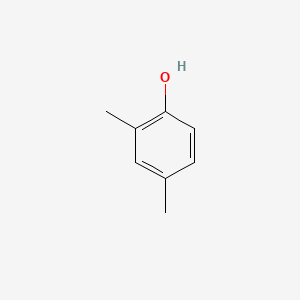
2,4-Dimethylphenol
2,4-xylenol is a member of the class of phenols that phenol substituted by methyl groups at positions 2 and 4. It has a role as a volatile oil component and a disinfectant. It is a member of phenols and an aromatic fungicide. It derives from a hydride of a m-xylene. — ChEBI
- IUPAC name
- 2,4-dimethylphenol
- Molecular formula
- C8H10O
- Molecular weight
- 122.16 g/mol
- Exact mass
- 122.073164938 Da
- XLogP3
- 2.3
- Topological polar surface area
- 20.2 Ų
- Hydrogen-bond donors
- 1
- Hydrogen-bond acceptors
- 1
- Covalent units
- 1
- Defined stereocentres
- 0
Also known as
16 more reported names
External database identifiers
- ChEBI:CHEBI:34241
- ChEMBL:CHEMBL29878
- EPA DTXSID:DTXSID2021864
- PubMed:29658714
- PubMed:27029555
- PubMed:22950624
- PubMed:22930485
- PubMed:22858495
- PubMed:22817926
- PubMed:22802703
- PubMed:22649300
- PubMed:22621394
- PubMed:22589719
- PubMed:22529989
- PubMed:22510713
Evidence from additional scientific databases
EMBL-EBI ChEBI
2,4-xylenol
A member of the class of phenols that phenol substituted by methyl groups at positions 2 and 4.
- Formula
- C8H10O
- Average mass
- 122.167 g/mol
- Monoisotopic mass
- 122.07316 Da
- Formal charge
- 0
- phenols — is a (CHEBI:33853)
- aromatic fungicide — is a (CHEBI:87034)
- disinfectant — has role (CHEBI:48219)
- volatile oil component — has role (CHEBI:27311)
- m-xylene — has parent hydride (CHEBI:28488)
- disinfectant — has role (CHEBI:48219)
- volatile oil component — has role (CHEBI:27311)
- phenols — is a (CHEBI:33853)
- aromatic fungicide — is a (CHEBI:87034)
- 18602751 Source: PubMed
- 18949436 Source: PubMed
- 18962311 Source: PubMed
- 19430139 Source: PubMed
- 20441950 Source: PubMed
- 21056717 Source: PubMed
- 21290525 Source: PubMed
- 22113936 Source: PubMed
- 23736872 Source: PubMed
- 24892532 Source: PubMed
- 25641836 Source: PubMed
- 26567311 Source: PubMed
- 26961915 Source: PubMed
- 29276958 Source: PubMed
- 30483493 Source: PubMed
- 30922799 Source: PubMed
- 31445024 Source: PubMed
- 32772833 Source: PubMed
- 32841770 Source: PubMed
- 33120340 Source: PubMed
- 33268651 Source: PubMed
- 34214809 Source: PubMed
- 4387388 Source: PubMed
- 6778378 Source: PubMed
Additional curated names
Cross-references from this source
- CAS: 105-67-9 — ChemIDplus
- CAS: 105-67-9 — NIST Chemistry WebBook
- MANUAL_X_REF: 13839123 — ChemSpider
- MANUAL_X_REF: 1619 — PPDB
- MANUAL_X_REF: C00052596 — KNApSAcK
- MANUAL_X_REF: C14582 — KEGG COMPOUND
- MANUAL_X_REF: CPD-18280 — MetaCyc
- MANUAL_X_REF: HMDB0245456 — HMDB
- MANUAL_X_REF: N0D — PDBeChem
- REGISTRY_NUMBER: 636244 — Reaxys
Mapped by: Exact CAS cross-reference in the ChEBI compound record. Source updated: 2022-05-06. Retrieved: 2026-08-31. Open source record
NIH PubChem PUG-View
Attributed physical-property, hazard, environmental and use annotations.
- Autoignition Temperature: 599 °C Source: ILO-WHO International Chemical Safety Cards (ICSCs)
- Boiling Point: 414 °F at 766 mmHg (NTP, 1992) Source: CAMEO Chemicals
- Boiling Point: 211.5 °C @ 766 mm Hg; 210.8 @ 760 mm Hg Source: Hazardous Substances Data Bank (HSDB)
- Boiling Point: 211.5 °C Source: ILO-WHO International Chemical Safety Cards (ICSCs)
- Boiling Point: 210.8 °C @760 [mm Hg] Source: PAC Chemical Database, U.S. Department of Energy
- Color/Form: Crystals Source: Hazardous Substances Data Bank (HSDB)
- Color/Form: NEEDLES FROM WATER Source: Hazardous Substances Data Bank (HSDB)
- Color/Form: Colorless needles Source: Hazardous Substances Data Bank (HSDB)
- Density: 1.0276 at 57 °F (NTP, 1992) - Denser than water; will sink Source: CAMEO Chemicals
- Density: 0.9650 @ 20 °C/4 °C Source: Hazardous Substances Data Bank (HSDB)
- Density: 0.97 g/cm³ Source: ILO-WHO International Chemical Safety Cards (ICSCs)
- Density: 0.9650 @ 20°C Source: PAC Chemical Database, U.S. Department of Energy
- Dissociation Constants: pKa= 10.60 at 25 °C Source: Hazardous Substances Data Bank (HSDB)
- Flash Point: greater than 235 °F (NTP, 1992) Source: CAMEO Chemicals
- Flash Point: Flash point > 112 °C Source: Haz-Map, Information on Hazardous Chemicals and Occupational Diseases
- Flash Point: >112 °C (closed cup) Source: Hazardous Substances Data Bank (HSDB)
- Flash Point: >112 °C c.c. Source: ILO-WHO International Chemical Safety Cards (ICSCs)
- LogP: log Kow= 2.30 Source: Hazardous Substances Data Bank (HSDB)
- LogP: 2.3 Source: ILO-WHO International Chemical Safety Cards (ICSCs)
- Melting Point: 72 to 73 °F (NTP, 1992) Source: CAMEO Chemicals
- Melting Point: 25.4-26 °C; 24.54 °C Source: Hazardous Substances Data Bank (HSDB)
- Melting Point: 25.4-26 °C Source: ILO-WHO International Chemical Safety Cards (ICSCs)
- Melting Point: 26 °C Source: PAC Chemical Database, U.S. Department of Energy
- Physical Description: 2,4-dimethylphenol appears as colorless crystals or clear, dark amber liquid. Source: CAMEO Chemicals
- Physical Description: Other Solid; Liquid Source: EPA Chemical Data Reporting (CDR)
- Physical Description: Colorless solid; [HSDB] May also exist as a dark amber liquid; [CAMEO] Colorless liquid or melt; mp = 22-23 deg C; [MSDSonline] Source: Haz-Map, Information on Hazardous Chemicals and Occupational Diseases
- Physical Description: YELLOW-TO-BROWN LIQUID OR COLOURLESS CRYSTALS. Source: ILO-WHO International Chemical Safety Cards (ICSCs)
- Refractive Index: Index of refraction: 1.5420 @ 14 °C/D Source: Hazardous Substances Data Bank (HSDB)
- Solubility: less than 1 mg/mL at 64 °F (NTP, 1992) Source: CAMEO Chemicals
- Solubility: Miscible in ethyl alcohol, ethyl ether; soluble in carbon tetrachloride Source: Hazardous Substances Data Bank (HSDB)
- Solubility: Very sol in benzene, chloroform Source: Hazardous Substances Data Bank (HSDB)
- Solubility: In water, 7.87X10+3 mg/l @ 25 °C. Source: Hazardous Substances Data Bank (HSDB)
- Solubility: Soluble in oxygenated and aromatic solvents Source: Hazardous Substances Data Bank (HSDB)
- Solubility: 7.2 x 10 (-2) mol/l, at pH 5.1 and 25 °C. Source: Hazardous Substances Data Bank (HSDB)
- Solubility: Solubility in water, g/100ml at 25 °C: 0.79 Source: ILO-WHO International Chemical Safety Cards (ICSCs)
- Vapor Pressure: 0.0621 mmHg at 68 °F ; 1 mmHg at 125.2 °F (NTP, 1992) Source: CAMEO Chemicals
- Vapor Pressure: 0.1 [mmHg] Source: Haz-Map, Information on Hazardous Chemicals and Occupational Diseases
- Vapor Pressure: 0.102 mm Hg @ 25 °C Source: Hazardous Substances Data Bank (HSDB)
- Vapor Pressure: Vapor pressure, Pa at 20 °C: 8 Source: ILO-WHO International Chemical Safety Cards (ICSCs)
- Vapor Pressure: 0.102 [mm Hg] @25 °C Source: PAC Chemical Database, U.S. Department of Energy
- Exposure Routes: The substance can be absorbed into the body by inhalation, by ingestion and through the skin. Source: ILO-WHO International Chemical Safety Cards (ICSCs)
- First Aid: EYES: First check the victim for contact lenses and remove if present. Flush victim's eyes with water or normal saline solution for 20 to 30 minutes while simultaneously calling a hospital or poison control center. Do not put any ointments, oils, or medication in the victim's eyes without specific instructions from a physician. IMMEDIATELY transport the victim after flushing eyes to a hospital even if no symptoms (such as redness or irritation) develop.; SKIN: IMMEDIATELY flood affected skin with water while removing and isolating all contaminated clothing. Gently wash all affected skin areas thoroughly with soap and water. IMMEDIATELY call a hospital or poison control center even if no symptoms (such as redness or irritation) develop. IMMEDIATELY transport the victim to a hospital for treatment after washing the affected areas.; INHALATION: IMMEDIATELY leave the contaminated area; take deep breaths of fresh air. If symptoms (such as wheezing, coughing, shortness of breath, or burning in the mouth, throat, or chest) develop, call a physician and be prepared to transport the victim to a hospital. Provide proper respiratory protection to rescuers entering an unknown atmosphere. Whene Source: CAMEO Chemicals
- Signal: Danger Source: Regulation (EC) No 1272/2008 of the European Parliament and of the Council
- GHS Hazard Statements: H301: Toxic if swallowed [Danger Acute toxicity, oral]; H311: Toxic in contact with skin [Danger Acute toxicity, dermal]; H314: Causes severe skin burns and eye damage [Danger Skin corrosion/irritation]; H411: Toxic to aquatic life with long lasting effects [Hazardous to the aquatic environment, long-term hazard] Source: Regulation (EC) No 1272/2008 of the European Parliament and of the Council
- Precautionary Statement Codes: P260, P262, P264, P270, P273, P280, P301+P316, P301+P330+P331, P302+P352, P302+P361+P354, P304+P340, P305+P354+P338, P316, P321, P330, P361+P364, P363, P391, P405, and P501 (click each P-code to see the statement) Source: Regulation (EC) No 1272/2008 of the European Parliament and of the Council
- Signal: Danger Source: European Chemicals Agency (ECHA)
- GHS Hazard Statements: H301 (99.1%): Toxic if swallowed [Danger Acute toxicity, oral]; H311 (99.1%): Toxic in contact with skin [Danger Acute toxicity, dermal]; H314 (100%): Causes severe skin burns and eye damage [Danger Skin corrosion/irritation]; H317 (37.4%): May cause an allergic skin reaction [Warning Sensitization, Skin]; H318 (41.4%): Causes serious eye damage [Danger Serious eye damage/eye irritation]; H411 (99.8%): Toxic to aquatic life with long lasting effects [Hazardous to the aquatic environment, long-term hazard] Source: European Chemicals Agency (ECHA)
- Precautionary Statement Codes: P260, P261, P262, P264, P264+P265, P270, P272, P273, P280, P301+P316, P301+P330+P331, P302+P352, P302+P361+P354, P304+P340, P305+P354+P338, P316, P317, P321, P330, P333+P317, P361+P364, P362+P364, P363, P391, P405, and P501 (click each P-code to see the statement) Source: European Chemicals Agency (ECHA)
- ECHA C&L Notifications Summary: Aggregated GHS information provided per 527 reports by companies from 15 notifications to the ECHA C&L Inventory. Each notification may be associated with multiple companies.; Information may vary between notifications depending on impurities, additives, and other factors. The percentage value in parenthesis indicates the notified classification ratio from companies that provide hazard codes. Only hazard codes with percentage values above 10% are shown. For more detailed information, please visit ECHA C&L website. Source: European Chemicals Agency (ECHA)
- Signal: Danger Source: NITE-CMC
- GHS Hazard Statements: H312: Harmful in contact with skin [Warning Acute toxicity, dermal]; H314: Causes severe skin burns and eye damage [Danger Skin corrosion/irritation]; H318: Causes serious eye damage [Danger Serious eye damage/eye irritation]; H371: May cause damage to organs [Warning Specific target organ toxicity, single exposure]; H373: May causes damage to organs through prolonged or repeated exposure [Warning Specific target organ toxicity, repeated exposure]; H401: Toxic to aquatic life [Hazardous to the aquatic environment, acute hazard]; H412: Harmful to aquatic life with long lasting effects [Hazardous to the aquatic environment, long-term hazard] Source: NITE-CMC
- Precautionary Statement Codes: P260, P264, P264+P265, P270, P273, P280, P301+P330+P331, P302+P352, P302+P361+P354, P304+P340, P305+P354+P338, P308+P316, P316, P317, P319, P321, P362+P364, P363, P405, and P501 (click each P-code to see the statement) Source: NITE-CMC
- GHS Hazard Statements: H303: May be harmful if swallowed [Warning Acute toxicity, oral]; H312: Harmful in contact with skin [Warning Acute toxicity, dermal]; H314: Causes severe skin burns and eye damage [Danger Skin corrosion/irritation]; H317: May cause an allergic skin reaction [Warning Sensitization, Skin]; H318: Causes serious eye damage [Danger Serious eye damage/eye irritation]; H371: May cause damage to organs [Warning Specific target organ toxicity, single exposure]; H373: May causes damage to organs through prolonged or repeated exposure [Warning Specific target organ toxicity, repeated exposure] Source: NITE-CMC
- Precautionary Statement Codes: P260, P261, P264, P264+P265, P270, P272, P280, P301+P317, P301+P330+P331, P302+P352, P302+P361+P354, P304+P340, P305+P354+P338, P308+P316, P316, P317, P319, P321, P333+P317, P362+P364, P363, P405, and P501 (click each P-code to see the statement) Source: NITE-CMC
- Target Organs: Hematologic; Nervous Source: EPA Integrated Risk Information System (IRIS)
- Environmental Bioconcentration: A BCF of 150 was determined for 2,4-dimethylphenol in bluegill sunfish and 28 days exposure(1). According to a classification scheme(2), this BCF suggests the potential for bioconcentration in aquatic organisms is high. Source: Hazardous Substances Data Bank (HSDB)
- Environmental Fate: TERRESTRIAL FATE: Based on a classification scheme(1), an estimated Koc value of 430(SRC), determined from a log Kow of 2.30(2) and a regression-derived equation(3), indicates that 2,4-dimethylphenol is expected to have moderate mobility in soil(SRC). Volatilization of 2,4-dimethylphenol from moist soil surfaces is expected to be an important fate process(SRC) given a Henry's Law constant of 1.7X10⁻⁵ atm-cu m/mole (4). 2,4-Dimethylphenol is not expected to volatilize from dry soil surfaces(3) based upon a vapor pressure of 0.102 mm Hg at 25 °C(5). 2,4-Dimethylphenol has been reported to completely biodegrade from soil in 4 days at a temperature of 19 °C(6) and the biodegradation half-life of 2,4-dimethylphenol from Texas soil and Mississippi soil was determined to be 1.5 and 3.5 days, respectively(7). Source: Hazardous Substances Data Bank (HSDB)
- Environmental Fate: AQUATIC FATE: Based on a classification scheme(1), a Koc value of 430(SRC), determined from a log Kow of 2.30(2) and a regression-derived equation(3), indicates that 2,4-dimethylphenol is expected to adsorb very little to suspended solids and sediment in water(SRC). 2,4-Dimethylphenol is expected to volatilize from water surfaces(3,SRC) based upon a Henry's Law constant of 1.7X10⁻⁵ atm-cu m/mole(4). Estimated volatilization half-lives for a model river and model lake are 3 days and 22 days, respectively(3,SRC). According to a classification scheme(5), a BCF of 150 in bluegill sunfish(6) suggests bioconcentration in aquatic organisms is moderate(SRC). In humic waters, degradation by the reaction with peroxy radicals should ensue with a half-life on the order of hours(7). 2,4-Dimethylphenol is not expected to undergo hydrolysis in the environment due to the lack of hydrolyzable functional groups(3). Screening studies indicate that 95% removal of 2,4-dimethylphenol was obtained after 5 days using an activated sludge inoculum(8). In addition, it has been reported that 2,4-dimethylphenol was readily degraded in St. Lawrence River water(9). Methanogenic consortia failed to anaerobically Source: Hazardous Substances Data Bank (HSDB)
- Environmental Fate: ATMOSPHERIC FATE: According to a model of gas/particle partitioning of semivolatile organic compounds in the atmosphere(1), 2,4-dimethylphenol, which has a vapor pressure of 0.102 mm Hg at 25 °C(2), is expected to exist solely as a vapor in the ambient atmosphere. Vapor-phase 2,4-dimethylphenol is degraded in the atmosphere by reaction with photochemically-produced hydroxyl radicals(SRC); the half-life for this reaction in air is estimated to be 5.3 hours(SRC) from its rate constant of 7.20X10⁻¹¹ cu cm/molecule-sec at 25 °C(3). 2,4-Dimethylphenol has an absorption band at 296 nm (maximum) and extends over 320 nm, thus making it a candidate for direct photochemical degradation(5,6). Night-time degradation in urban areas should occur rapidly through reaction with atmospheric nitrate radicals, as rate constants for this reaction with phenolic compounds are approximately 250 times faster than with hydroxyl radicals(7,SRC). Source: Hazardous Substances Data Bank (HSDB)
- Consumer Uses: Cleaning agent; Solvent Source: EPA Chemical Data Reporting (CDR)
- Industry Uses: Solvent; Surfactant (surface active agent); Monomers; Fuel; Cleaning agent; Corrosion inhibitor; Intermediate Source: EPA Chemical Data Reporting (CDR)
- Sources/Uses: Used to make phenolic antioxidants, pharmaceuticals, plastics, resins, solvents, insecticides, fungicides, rubber chemicals, polyphenylene oxide, wetting agents, and dyestuffs; Also used as a disinfectant, bacteriocide, germicide, sanitizer, virucide, insecticide, miticide, and fungicide; [HSDB] Source: Haz-Map, Information on Hazardous Chemicals and Occupational Diseases
- Industrial Processes with risk of exposure: Using Disinfectants or Biocides [Category: Clean]; Farming (Pesticides) [Category: Industry] Source: Haz-Map, Information on Hazardous Chemicals and Occupational Diseases
- Uses: MANUFACTURE OF PHARMACEUTICALS, PLASTICS, INSECTICIDES, FUNGICIDES, RUBBER CHEM, WETTING AGENTS, DYESTUFFS. Source: Hazardous Substances Data Bank (HSDB)
- Uses: HORTICULTURAL FORMULATION FOR ERADICATION OF CROWN GALL TUMORS. Source: Hazardous Substances Data Bank (HSDB)
- Uses: Used in phosphate esters, alkylated xylenols, antioxidants. /Xylenol 100/ Source: Hazardous Substances Data Bank (HSDB)
- Uses: Used in the production of high-viscosity phosphate esters, as a feedstock for hindered phenol antioxidant and specialty modified phenolic resin manufacture. /Xylenol 410/ Source: Hazardous Substances Data Bank (HSDB)
- Uses: For more Uses (Complete) data for 2,4-DIMETHYLPHENOL (13 total), please visit the HSDB record page. Source: Hazardous Substances Data Bank (HSDB)
Mapped by: Existing checksum-valid CAS to unique PubChem CID match. Retrieved: 2026-08-31. Open source record
Scientific classifications and hazard annotations provide context and do not replace the market-specific regulatory decision shown above.
Additional source coverage and match status
| Source | Result | Checked |
|---|---|---|
| EMBL-EBI ChEBI | Exact match | 2026-08-31 |
| NIH PubChem PUG-View | Exact match | 2026-08-31 |
A recorded no-match is useful evidence that the source was checked; it is not a claim that the substance does not exist elsewhere.
Retrieved from NIH PubChem on 2026-08-31 by checksum-valid CAS matching. Chemical properties do not replace the regulatory decision on this page.
Inventory details for 2,4-XYLENOL
INCI name
2,4-XYLENOL
Description
2,4-Xylenol
Record provenance
- Inventory reference
- 41303
- Imported identity
- 2,4-XYLENOL
- Source update
- 02/03/2011
Annex records for 2,4-XYLENOL
Key data
Related inventory evidence
Ingredients with overlapping formulation functions
Additional official and scientific sources
11 external databases to check this identity in
Each link searches that source for this identity. What each source is, and its legal weight
How 2,4-XYLENOL appears in the CosIng inventory
The CosIng inventory lists 2,4-XYLENOL as a cosmetic ingredient and this page links it to 0 annex records. The inventory entry captures names and identifiers, while the annex records show where the substance is prohibited, restricted or positively listed in EU cosmetics law.
2,4-XYLENOL is also tagged with 1 cosmetic function in the official data. Function labels describe intended use, but they do not replace regulatory review of linked annex records before formulation or labelling work.
Frequently asked questions
Source note for 2,4-XYLENOL
This page reproduces the CosIng inventory entry for 2,4-XYLENOL from public European Commission cosmetic ingredient materials and shows linked identifiers even when no direct annex match is currently attached.
Use this inventory page to research 2,4-XYLENOL and compare linked records, but verify restrictions and legal status against the current official source text and law before making regulatory decisions.
Tools & next steps
Check your formula
Scan a full INCI list to detect 2,4-XYLENOL and any linked EU annex restrictions or allergen flags.
INCI CheckerSearch similar ingredients
Find other inventory ingredients and annex entries related to 2,4-XYLENOL, its identifiers or nearby name variants.
Search